Local lexicon: The different Chinese terms for ‘orchid’


In China, the orchid is known as lanhua (兰花), while in Singapore the term hujihua (胡姬花) is used. For a long time, both terms, which have their own history, were used interchangeably in Singapore. In 1999, a debate arose in Singapore’s Mandarin-speaking circles over which term should be adopted or dropped.
The debate turned out to be inconclusive, with each side holding its ground and refusing to give way. Those who supported the use of lanhua argued that huji was a transliteration of the English term “orchid”, and that it was neither found in China’s dictionaries nor commonly used in China. As a small country with a small population, Singapore was being self-indulgent and would only be inconvenienced by adopting huji, they argued.
Among those who supported retaining huji, the opinion of academic Lim Buan Chay (1951–2024) was particularly notable. Huji, he remarked, “carries cultural load and is a mark of the times — it is important to retain the term”.
The legitimacy and reasoning behind the use of any term must be examined from the perspective of its origin, transmission and eventual acceptance by the people.
A profusion of names
In 1932, the Malayan Orchid Society organised its second orchid show, in which Chinese orchid growers participated for the first time. Of the five major Chinese newspapers in Singapore, only Sin Chew Jit Poh reported on the event, using lanhua for orchid. Sin Kuo Min Press mentioned the show in just one line in its “Xingzhou riji” (Singapore Diary) Columbiacolumn, referring to orchids by another name, xianglan.
Given that most of those who worked in Singapore’s Chinese-language press in the early days were literati from China, it was not surprising that they referred to orchids as lanhua, the term used in China. However, in the Xinjiapo zhinan (Directory of Singapore), edited by Phua Chay Long (1904–1987) published in 1935, an article on Singapore’s produce used another transliterated term, aojilan, for “orchid”.
The term “aojilan” is the Hokkien transliteration of orchid, whereby its cultivation was introduced to the Straits Chinese community by the Caucasians. In the early days when the Chinese community mainly spoke Hokkien, the choice of a Hokkien transliterated term reflected the reality of language usage back then.
After the orchid show, there were more newspaper articles on orchids. Back then, Chinese newspapers used a variety of names to refer to the flower. Some went with lanhua, which was in line with China’s usage, while others adopted various transliterations, such as wuji, aojie, wuqi and aozhi. Some also combined lan, hua or lanhua with other words to form new terms for orchids. When using lanhua for orchid, newspapers sometimes added descriptions such as “parasitic” and “Malayan speciality” to describe the plant.
The origin of huji
Most of those other Chinese terms for the orchid fell into disuse following the emergence of the term huji. How the term came about was quite serendipitous. According to Lim the academic, his teacher See Hiang To (1906–1990) said the founding principal of Singapore’s Nanyang Academy of Fine Arts (NAFA) Lim Hak Tai (1893–1963) had named his orchid painting “huji”. While See did not mention when the NAFA principal wrote the inscription, there is a painting by the latter titled huji in NAFA’s collection, which was painted in 1947 with the word huji in its inscription. A search of the Chinese newspapers of that time showed that the first instance when huji was used for orchid in Singapore was in a painting critique published in Nanyang Siang Pau on 25 March 1948.
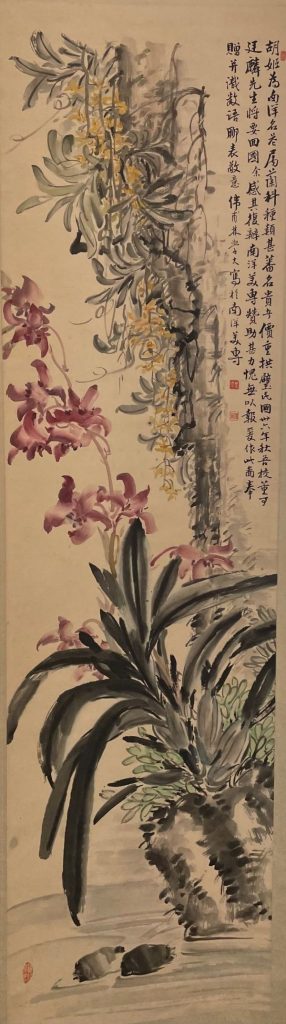

Time proved that Lim had made the right choice, as huji was later widely used as the local term for orchid. In the Chinese Language textbook for Primary Four published by the United Publishing House in 1953, huji was used in one of the lessons titled “Minghua zhanlan” (Flower Exhibition) — the first time that huji was adopted in Singapore’s textbooks. The use of huji as a teaching term was a big step forward in making it a standardised term in Singapore Mandarin.
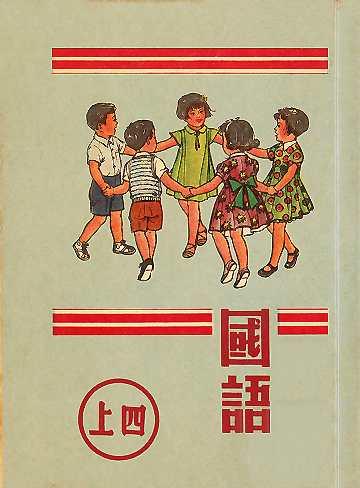
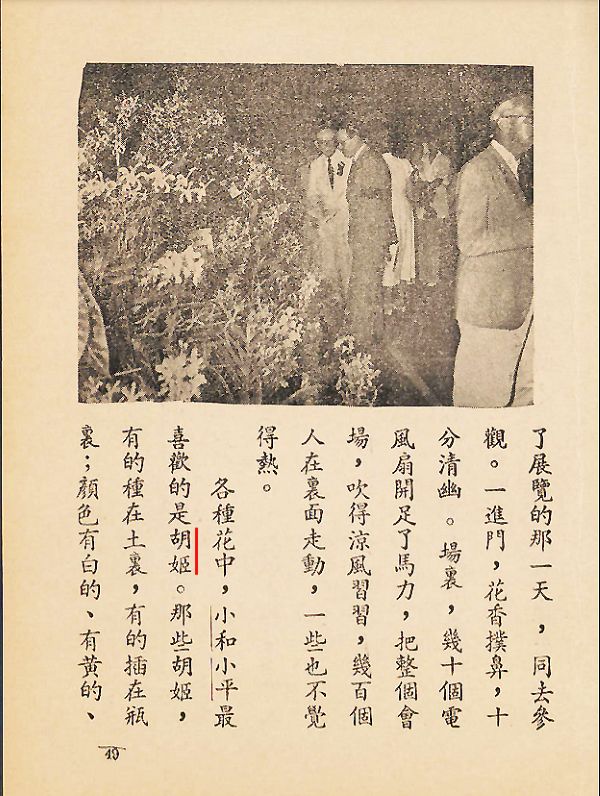
Over the years, Chinese newspapers, as well as textbooks, have supported the use of huji in Singapore, allowing it to gradually become a widely accepted standardised term.
The orchid has extraordinary value as it has been accorded multiple symbolic meanings and roles in Singapore’s politics, economy, culture and history. Today, the term huji is no longer unique to Singapore Mandarin, but also widely accepted by the Chinese communities in Southeast Asia.
This is an edited and translated version of 【本土语汇】“胡姬”与“兰花”. Click here to read original piece.
Hsu, Yun Tsiao. Wenxin diaochong [Reflections on language]. Singapore: Institute of Southeast Asian Studies, 1973. | |
Khoo, Kiak Uei. Malaixiya huayu yanjiu lunji [Collected writings on Malaysia’s Chinese language studies]. Kuala Lumpur: Centre for Malaysian Chinese Studies, 2018. | |
Wong, Wai Tik. Shicheng yuwen xiantan [Languages in Singapore]. Singapore: Federal Publications, 1995. | |
Lim, Buan Chay. Lunxue zazhu conggao [Collected writings of Lim Buan Chay]. Singapore: Xinhua Cultural Enterprises, 2017. | |
Lim, Buan Chay. Yuyan wenzi lunji [Collected writings on language]. Singapore: National University of Singapore, Department of Chinese Studies, 1996. | |
Lim, Earn Hoe. Wocheng woyu: xinjiapo diwenzhi [Our city, our language: Chronicling Singapore’s Chinese language heritage]. Singapore: Great River Book Co., 2018. |