Chinese-medium schools run by religious groups in pre-independence Singapore


Besides the Chinese-medium schools run by the community and the government in pre-independence Singapore, there were also Chinese-medium primary and secondary schools founded by religious groups. These included Roman Catholic, Protestant Christian and Buddhist groups, whose missionaries or religious figures actively set up schools while spreading their faiths, thereby contributing to the promotion of Chinese education in Singapore.1
The Roman Catholic Church
Before 1965, most priests sent to Singapore for missionary work came from Missions étrangères de Paris (The Society of Foreign Missions of Paris) in France. To carry out their mission, they learnt Chinese dialects such as Cantonese and Hokkien. When the People’s Republic of China was founded in 1949, religious activities were suppressed and Chinese priests were hence forced to leave China. At the invitation of the Archbishop of Singapore, they came to Singapore to serve. Beyond missionary work, the Roman Catholic Church also founded Catholic High School and its primary section, Maris Stella High School and its primary section, Holy Innocents’ Primary School, Holy Innocents’ High School, CHIJ St Nicholas Girls’ School (Primary and Secondary), and Hai Sing Girls’ High School.
- Catholic High School and its primary section
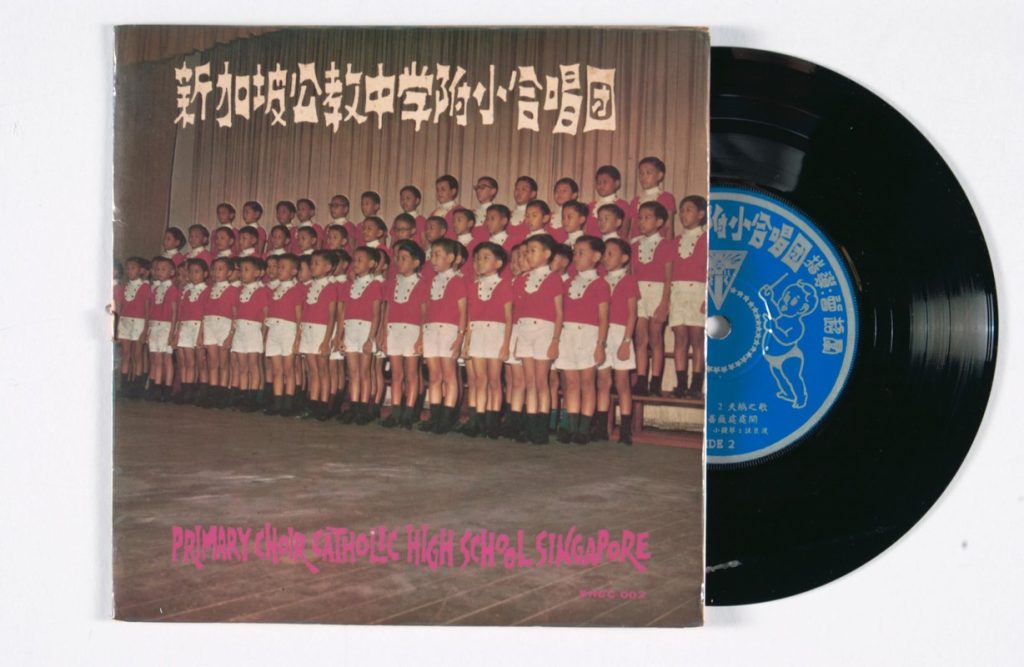
In 1935, French priest Reverend Father Edward Becheras (1881–1957) founded the Sino-English Catholic School in a small hut beside the Church of Saints Peter and Paul on Queen Street. As many schools at the time bore “Sino-English” in their names, Reverend Father Becheras wrote to the Education Department, requesting that the school’s name be changed to Catholic High School to give it a distinctive identity. It was the first bilingual school in Singapore founded on the principle of equal emphasis on Chinese and English. The school’s first principal was Yao Kwok Wah (1910–1975). In 1951, the building of Catholic High School’s primary section was completed. To raise funds for its construction, Yao and others personally travelled to Titi and Kuala Lumpur in Malaya to solicit donations.
- Maris Stella High School and its primary section
Reverend Brother Joseph Chanel Soon (1918–1989) founded Maris Stella High School and its primary section in 1958 because of overwhelming applications to Catholic High School, which was run by the Marist Brothers. The school started with four Primary 1 classes and four Secondary 1 classes, which functioned in the afternoon at the premises of St Stephen’s School in Siglap. A farsighted man, Brother Chanel set up a fundraising committee and actively sought support from Chinese community leaders such as Tan Keong Choon (1916–2015), Goh Tjoei Kok (1905–1994) and Runme Shaw (1901–1985) to secure a site for the school. After nine tireless years, Maris Stella High School and its primary section were established at Mount Vernon Road.
- Holy Innocents’ School (Holy Innocents’ Primary School / Holy Innocents’ High School)
Holy Innocents’ Boys’ School was founded in 1892 by Reverend Father H. Duvelle (birth and death years unknown) of the Church of the Nativity of the Blessed Virgin Mary in Hougang. It was originally a religious school named Tao Nan School (not to be confused with Tao Nan School under the Hokkien Huay Kuan), with Bible studies and classical Chinese as part of its curriculum. In 1920, Reverend Father Becheras renamed it Holy Innocents’ Chinese Boys’ School.
To promote education for girls, Reverend Father Beceras established Holy Innocents’ Chinese Girls’ School in 1932, which was managed by the Sisters of the Holy Infant Jesus. In 1958, Holy Innocents’ Chinese Boys’ School relocated to a new building funded by the Church, added a secondary section and was renamed Holy Innocents’ High School, while also running a primary section.
In 1985, at the recommendation of the Ministry of Education, Holy Innocents’ High (primary section) merged with Holy Innocents’ Chinese Girls’ School to form a co-educational school named Holy Innocents’ Primary School.
- Victoria Girls’ School (CHIJ St Nicholas Girls’ School)
Victoria Girls’ School, renamed St Nicholas Girls’ School, was founded in 1933 by four nuns from the Congregation of the Sisters of the Holy Infant Jesus (CHIJ) at the site where CHIJMES is today. The religious order was established in 1666 by French priest Blessed Father Nicolas Barré (1621–1686) with the mission of providing education for underprivileged girls.
In 1933, CHIJ founded a Chinese girls’ school named Victoria Girls’ School, which is the predecessor of CHIJ St Nicholas Girls’ School. The school was headed by foreign nuns until 1940, when Sister Francoise Lee (1909–1986), a Chinese woman, was appointed principal.
- Hai Sing Girls’ High School (Hai Sing Catholic School)
In 1959, Sister Magdalena Chenti (Theresa Tsang, 1911–1979) of the Franciscan Missionaries of Mary (FMM) Sisters borrowed three classrooms from Holy Innocents’ Chinese Girls’ School to start a new school for girls living in Punggol. In 1961, the Church built a campus at Upper Serangoon Road for the school, naming it Hai Sing Girls’ High School. At that time, many girls stopped schooling after completing primary education to help their parents with farming. Sister Chenti went door to door to persuade parents to let their daughters continue their studies. In 1990, the school relocated to Pasir Ris, changed its name to Hai Sing High School, and began admitting boys. In 1999, its name was changed to Hai Sing Catholic School.
Protestant Christian churches
Following Singapore’s founding in 1819, Protestant Christian missionaries came here to spread their Christian faith. From 1842, the London Missionary Society, Church of England, English Presbyterian Mission, American Board of Commissioners for Foreign Missions and American Presbyterian Mission all started to send missionaries to Singapore. Apart from building churches and evangelising, these Protestant Christian denominations also established schools. Before Singapore’s independence, Chinese-medium primary and secondary schools founded by Protestant Christian churches include Anglican High School and Road End Free School (now Pei Hwa Presbyterian Primary School).
- Anglican High School
In 1956, the Chinese-speaking congregations of five Anglican churches, namely, St Matthew’s Church, Church of the Good Shepherd, Holy Trinity Church, Church of the True Light and St Andrew’s Cathedral, founded Anglican High School. It was the only Chinese-medium school under the Anglican Church at that time. In its early years, classes were held in borrowed classrooms at St Andrew’s School, and its first principal was Reverend Huang Yang Ying (1897–unknown). In 1960, Anglican High School moved to its current premises at Upper Changi Road.
- Road End Free School (Pei Hwa Presbyterian Primary School)
In 1889, the Glory Presbyterian Church established a Teochew-medium school at Be Chia Lo Bue (meaning “at the end of the horse carriage road” in dialect) at Bukit Timah 7th Mile, and named it Road End Free School. Missionary Joseph Koh (1864–1903) from Shantou’s Barbour College in China was responsible for teaching the students the Bible, letter writing and abacus calculation. Due to declining enrolment, the school ceased operations in 1903. In 1918, the school was reopened by missionary Lin Weilin (1862–1936) and switched its medium of instruction to Mandarin. In 1922, Reverend Tang Poh Keng (1900–1942) became principal and renamed the school Pei Hwa. In 1995, the school’s board renamed it Pei Hwa Presbyterian Primary School.
Buddhist groups
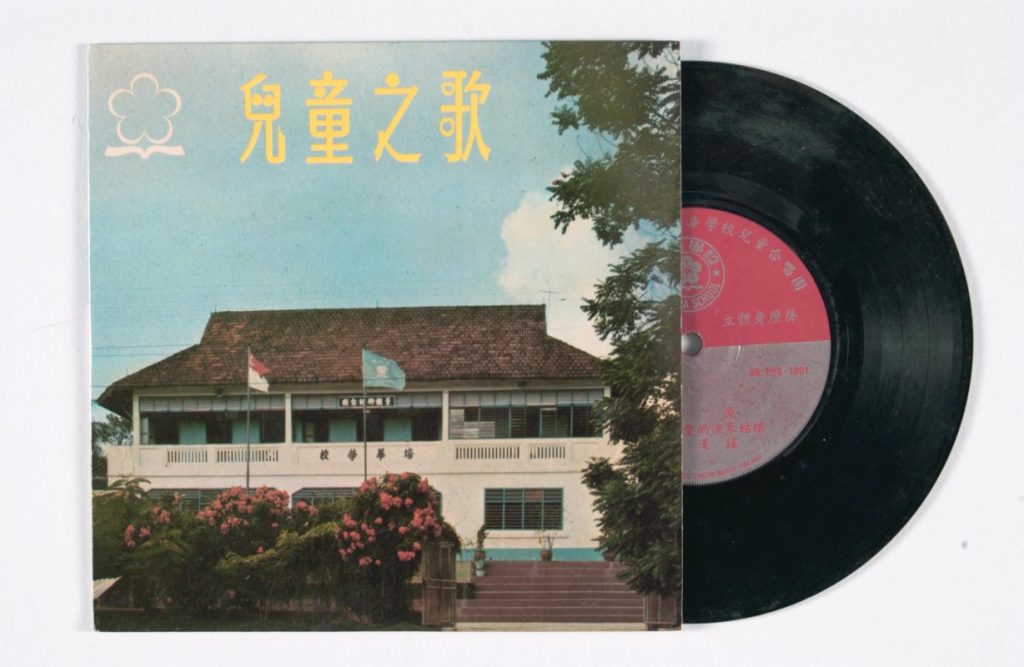
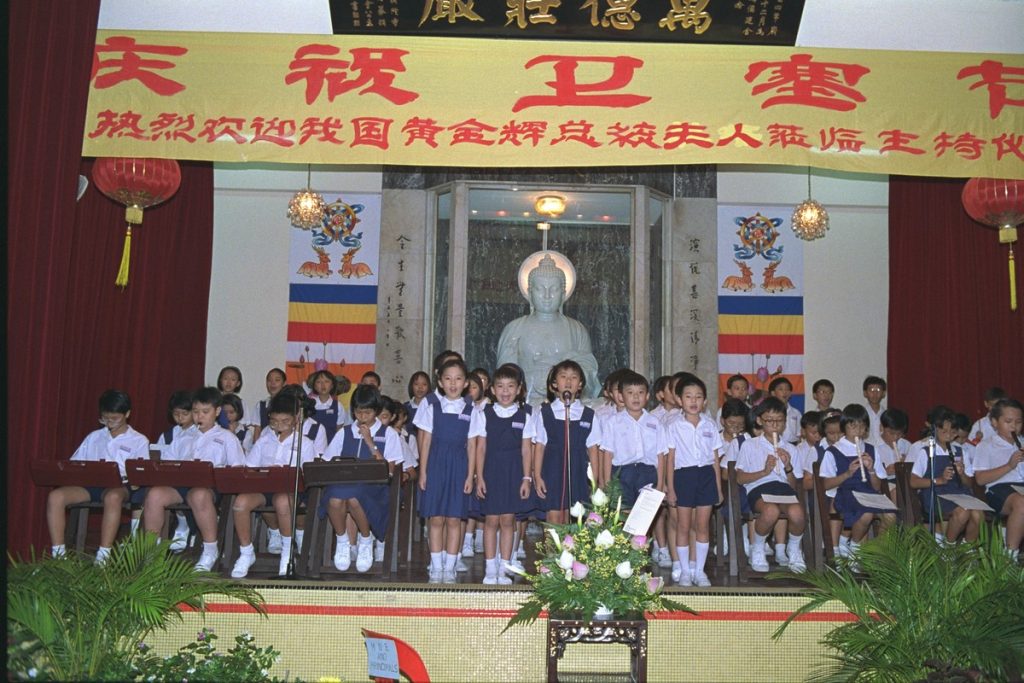
In 1898, Buddhist monks from Guangdong and Fujian in China began arriving in Singapore to propagate Buddhism. Buddhist leaders then established various organisations such as the Nanyang Buddhist Federation (1926) and Singapore Chinese Buddhist Association (1927). In 1949, the Singapore Buddhist Federation (SBF) was founded to unify the various Buddhist groups and serve as the representative body for the Buddhist community. Beyond spreading Buddhism, SBF also engaged in community service and spared no effort in promoting Chinese education. Maha Bodhi School and Mee Toh School are both affiliated to SBF.2
- Maha Bodhi School
In 1948, Reverend Chee Hong (1893–1954) of Leng Feng Bodhi Institute tasked lay Buddhist Pitt Chin Hui (1902–1982) to set up Maha Bodhi School in a shophouse at 743 Geylang Road. The first principal was Wong Loon Soo (birth and death years unknown), who served only six months before returning to Penang. Pitt then took over as principal. In 1950, the school management committee decided to place the school under SBF’s management and began raising funds for a new school site. In 1951, Maha Bodhi School moved to its then-new premises at Lorong 34 Geylang and has since further relocated to its current site at Ubi Avenue 1.
- Leong San School (Mee Toh School)
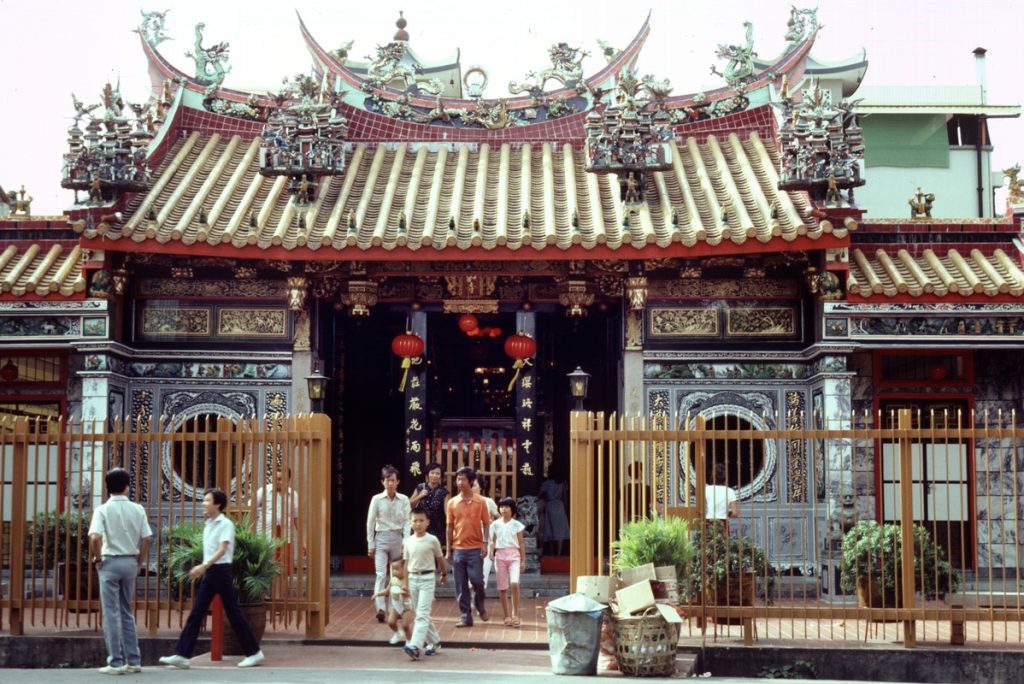
In 1952, Venerable Kong Hiap (1900–1994) founded Leong San School at Leong San See Temple at Race Course Road, setting up four classrooms above the temple’s Hall of Merit. The school relied entirely on donations from devotees for its operating expenses. As student numbers grew and the classrooms became insufficient, Venerable Kong Hiap donated a plot of land adjacent to the temple for the construction of a new school, which became Mee Toh School. In 2004, the school moved to Punggol. The lyrics of Mee Toh’s school song were penned by Chinese painter and writer Feng Zikai (1898–1975).
Through the efforts of their principals, many of these Chinese-medium primary and secondary schools founded by various religious groups have gone on to become Special Assistance Plan (SAP) schools today that place equal emphasis on Chinese and English.3
This is an edited and translated version of 新加坡建国前宗教团体创办的中小学华校. Click here to read original piece.
| 1 | English-medium primary and secondary schools established by religious groups are not included in this article. |
| 2 | Manjusri Secondary School, the only Buddhist secondary school in Singapore, was founded after independence in 1982 and is therefore not included in this article. |
| 3 | The Special Assistance Plan (SAP) was introduced in 1979 to nurture students with bilingual aptitude. The schools under this plan are known to provide students with high-quality teaching and an environment that emphasises bilingual learning. |
Dong, Li. “Xinjiapo huawen chuanjiao de xianfeng” [Trailblazer of Chinese missionary work in Singapore]. Haixing bao, 3 July 2011. | |
Ji, Yun. “Xinjiapo fojiao zonghui de chengli jingguo” [The establishment of Singapore Buddhist Federation]. Shin Min Daily News, 13 March 2025. | |
Koh, Hsiang Yu. “Jinian yi gu huawen jiaoshi, haixing tianzhujiao zhongxue xiaoyou she muyu jiangxuejin” [Hai Sing Catholic School Alumni set up scholarship in memory of a late Chinese teacher]. Lianhe Zaobao, 26 February 2019. | |
Mok, Mei Ngan. “Yi shi yi fu: yaoruiyun yishu sanshu yaoguohua” [Like teacher, like father: Yao Swee Yuin reminisces about his uncle Yao Kwok Wah]. Yuan Magazine 138, 2019. | |
Singapore Chinese Schools’ Conference, ed. Xinjiapo huaxiao lianhehui liushi zhounian jinian [The 60th anniversary commemorative booklet of the Singapore Chinese Schools’ Conference]. Singapore: Singapore Chinese Schools’ Conference, 2007. | |
Su, Ching. Jidujiao yu xinjiapo huaren 1819–1846 [Christianity and Singapore Chinese 1819–1846]. Taiwan: National Tsing Hua University Press, 2010. | |
Tan, Ke Yang. “Dingge bainian: puti xuexiao xiaoshe luocheng” [The official opening of the Maha Bodhi School campus]. Lianhe Zaobao, 24 January 2023. |