Amusement parks in early Singapore


Similar to today’s Disneyland and Universal Studios theme parks, Singapore’s amusement parks of yesteryear offered a variety of entertainment for all ages, creating many shared memories for Singaporeans.
Lim Teck Kim and Happy Valley
Singapore’s first amusement park, Happy Valley, was the brainchild of the wealthy businessman Lim Teck Kim (1882–1938). Born in Kinmen, Lim grew up in Singapore and married the eldest daughter of the wealthy Peranakan Chinese businessman Ong Sam Leong (1857–1918).1 Originally constructed for the Malaya-Borneo Exhibition, the amusement park was completed between 1921 and 1922. Spanning 68 acres, the Malaya-Borneo Exhibition featured a park, rock garden, football field, sports stadium, spectator grandstand, stage for large band performances, two cinemas and various exhibition areas, which offered traditional street operas, a circus, merry-go-rounds, water sports, horseracing, fencing, wrestling and boxing matches.2 After the exhibition concluded, the site was converted into the Happy Valley amusement park.
Located at one end of Tanjong Pagar Road (near the current Lim Teck Kim Road), Happy Valley was officially opened in 1924 by Tan Teck Neo (1877–1978), wife of local Chinese community leader Lee Choon Guan (1868–1924). Entry was a modest 10 cents, cheaper than a ticket for the film Orphan Rescues Grandfather, then screening at the Marlborough Theatre.3 In October that year, Rama VI (1880–1925), the King of Siam, made arrangements to visit the park in Singapore at midnight during his tour of Penang, Kuala Lumpur and Johor.4 Key attractions of the amusement park included boxing matches and a large octagonal pavilion which was set amongst mountain ridges and surrounded by the sea on three sides. The pavilion offered a panoramic view of Singapore, and drew significant crowds.5 Unfortunately, due to poor management, Happy Valley closed in 1928 after just four years of operation. As it preceded the three amusement parks in Singapore collectively known as the three Worlds, it is sometimes referred to as the Old World.
The Ong brothers and New World
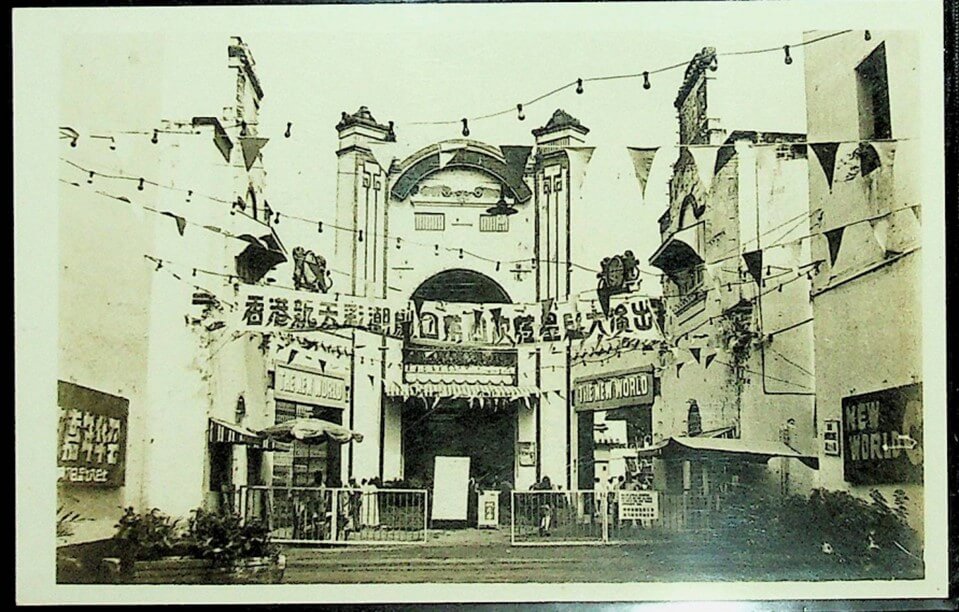
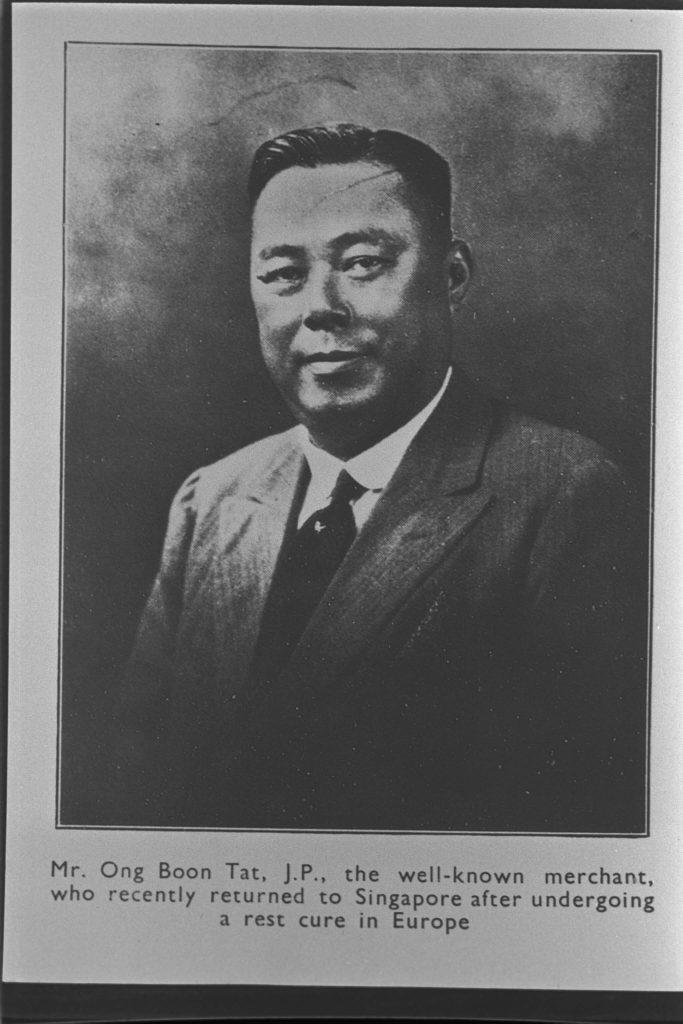
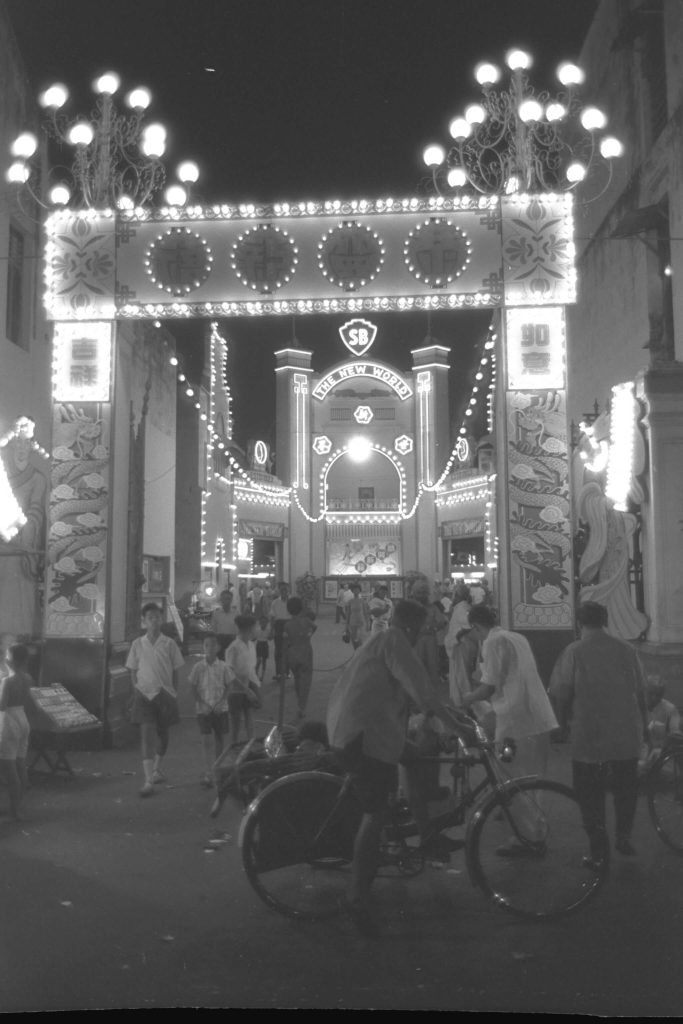
In 1923, New World amusement park was set up by Ong Boon Tat (1888–1941) and Ong Peng Hock (1889–1968), the sons of Ong Sam Leong. It quickly became renowned for introducing trendy entertainment options from abroad to local visitors. For instance, in 1933, New World imported the Dodg’em and Ghost Train rides from England, offering visitors thrilling new experiences. Following renovations, the park also boasted additional rental stalls and flexible activity spaces where people could meet to watch performances, grab a bite and shop. It also housed Malaya’s largest air-conditioned cabaret, which was used by Ong Boon Tat’s second son for his wedding tea reception.6 New World was the first place in Singapore to screen “talkies” (movies with soundtracks, as opposed to silent films). Following World War II, the park continued to generate excitement when cabaret dancer Rose Chan (1925–1987) performed her sensational strip tease act there.7 In 1987, Shaw Organisation, which had acquired the park earlier, sold the site to City Developments Limited. Today, City Square Mall stands where New World once did.
Entertainment galore at Great World
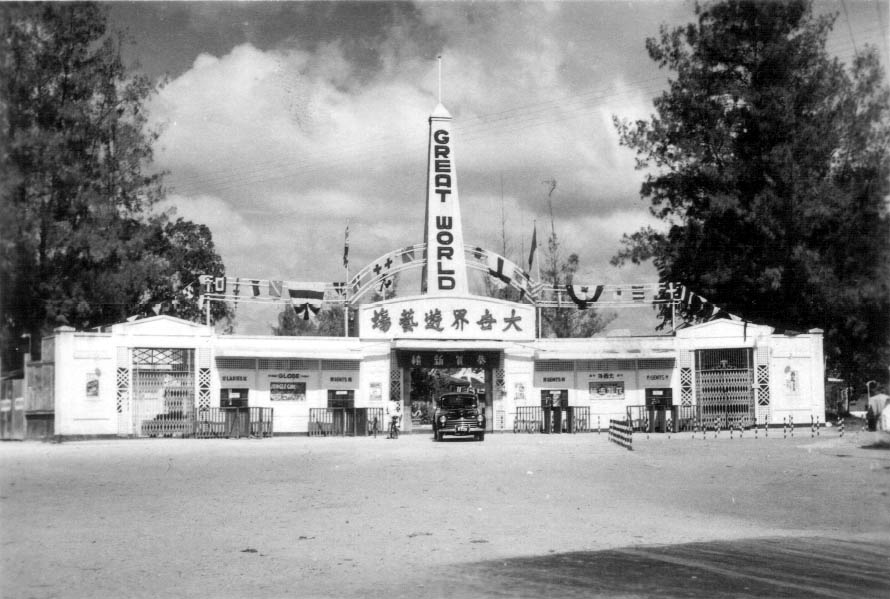
Located at Kim Seng Road, Great World amusement park was a venture undertaken by Tan Lark Sye (1897–1972), Lee Choon Yung, Lee Chin Tian (1874–1965), Dong Chunpo, Tay Eng Sin (1906–1963), Wang Qingfa and Lin Xili.8 It officially opened in 1931.9 There were five schools near Great World, including River Valley High School, which was used as an evening high school by the Adult Education Board. Students from these schools were naturally drawn to the amusement park. Despite being built on the site of a cemetery, Great World quickly matched New World’s popularity as an entertainment hotspot. Advertisements from the era showed that visitors to Great World could watch films at the Globe Theatre and Sky Theatre, as well as enjoy ice-skating shows, Cantonese opera, and performances by song and dance troupes. Established eateries like Spring Court (then known as Wing Choon Yuen) and Diamond Restaurant were also located inside the park. Great World was the setting for Kelvin Tong’s 2011 comedy, It’s a Great, Great World. During the Sino-Japanese war, the acclaimed Wuhan Chorus performed at all three Worlds in Singapore. Following World War II, Shaw Organisation, which took over proprietorship of the park in 1941, revamped the park. Ultimately, in 1979, it was sold to “Sugar King” Robert Kuok. Today, the site is home to a shopping mall, named Great World in homage to the former amusement park.
Happy World in Geylang
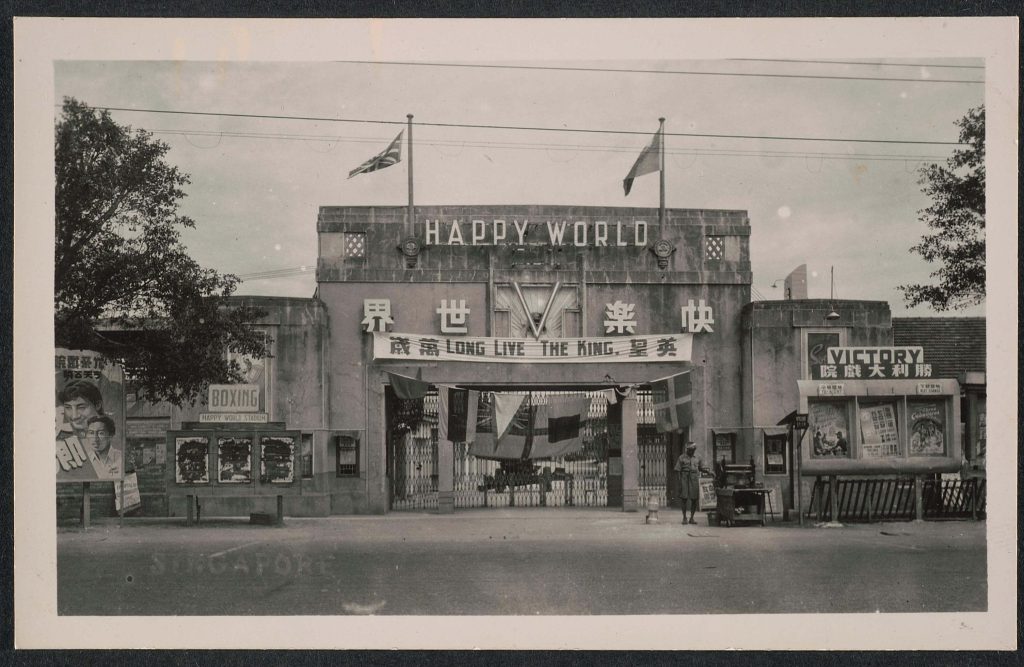
Happy World was the last of the three Worlds to be built, opening in 1937. It was funded by George Lee Geok Eng (1897–1965), the director and general manager of Nanyang Siang Pau.10 In 1964, the management of Happy World was taken over by Eng Wah Organisation, which renamed it Gay World in 1966. One of the park’s key features was its massive 10,000-seat indoor stadium, the largest facility of its kind in Singapore at the time. This stadium hosted numerous important international competitions, including the Southeast Asian Peninsular Games. The Happy World cabaret girls raised funds to build a school for children whose education had been interrupted by World War II. In 1946, they succeeded in establishing the Happy Free School, which was later renamed Happy School.11 Happy World was ravaged by fire several times and finally closed in 2000. It was the last of the three Worlds to be demolished.12
In an era without television and shopping centres, people flocked to these amusement parks to spend their leisure time. However, as televisions, videotapes and large shopping malls emerged, consumption habits also evolved. Over time, the beloved amusement parks faded into the past, remaining as cherished memories.
This is an edited and translated version of 新加坡早年的游艺场. Click here to read original piece.
| 1 | Biography of Lim Teck Kim, see Victor R. Savage and Brenda Yeoh, Singapore Street Names: A Study of Toponymics (Singapore: Marshall Cavendish Editions, 2013), 21, 151. Biography of Ong Sam Leong and Ong Boon Tat, see Koh Chin Yee ed., Jinmen xianxian lu. xinjiapo pian [Kinmen eminent persons in history. Singapore edition] (Singapore: Kim Mui Hoey Kuan, 2015), 12–17; Loo Say Chong and Lin Chien-yu, “Zai tan wang sanlong ji qi jiazu” [The story of Ong Sam Leong and his family], Lianhe Zaobao, 12 August 2019. |
| 2 | “Malaya-Borneo Exhibition,” The Straits Times, 5 January 1922. |
| 3 | The ticket prices for the film Orphan Rescues Grandfather were two dollars, one and a half dollars, one dollar, fifty cents, and the lowest price was twenty-five cents. See “Happy Valley advertisement,” Nanyang Siang Pau, 8 July 1924. |
| 4 | Lim Teck Kim, owner of the park, received the King of Thailand at that time, see “Royal Visit to Penang: Colony’s Welcome,” Pinang Gazette and Straits Chronicle, 1 October 1924. |
| 5 | Happy Valley was located near Tanjong Pagar pier and could be reached on foot. See “Guole lüke duiyu benpo huanleyuan zhi guangan, you huanleyuan jiyi” [Memories of visitors to Happy Valley], Nanyang Siang Pau, 28 March 1925. |
| 6 | See “Wang wenda cilang jiehun zuo she chahui kuandai qinyou” [Ong Boon Tat’s second son got married yesterday and hosted a tea party for his relatives and friends], Nanyang Siang Pau, 21 September 1940. |
| 7 | Rudolph, J. “Amusement in the Three ‘Worlds’,” in Looking at Culture (Singapore: Artres Design & Communications, 1996), edited by S. Krishnan et al., 28–29. |
| 8 | The birth and death years of the other individuals are unknown. |
| 9 | See Koh Chin Yee ed., Jinmen xianxian lu, xinjiapo pian [Kinmen eminent persons in history, Singapore edition] (Singapore: Kim Mui Hoey Kuan, 2015), 95. |
| 10 | Founded in 1923, Nanyang Siang Pau was initially run entirely by Tan Kah Kee. In 1932, Nanyang Siang Pau Limited was established. In 1937, George Lee Geok Eng took over, serving as director and general manager, while Lee Kong Chian served as chairman of the newspaper. |
| 11 | See Weng Jiajia and Xiang Huifei, “Yalong 2 dianwu huohuan, wunü ban kuaile xuexiao, yibahuo shaohui yizhi” [A fire broke out at two shophouses in Geylang, damaging the site of the old Happy School, which was funded by cabaret girls], Shin Min Daily News, 21 June 2019. |
| 12 | See “Xingjiapo de ‘shijie’” [The ‘worlds’ of Singapore], Sin Chew Jit Poh, 15 March 1972; “Fanhua shijie liuyuedi guanbi jin sheng si zuhu jixu yingye” [Gay World to be closed at the end of June, only four tenants remaining in business], Shin Min Daily News, 20 May 2000. |
Chandramohan, Gayathiri. “Theme parks in Singapore.” National Heritage Board’s Roots, undated. | |
Omar, Marsita and Makeswary Periasamy. “Great World Amusement Park.” Singapore Infopedia. | |
Teo, Woan Yee. History of Amusement Parks in Singapore: A Social History. Master’s Thesis, Department of Chinese Studies, National University of Singapore, 2000. | |
Wong, Yunn Chii and Tan Kar Lin. “Emergence of a Cosmopolitan Space for Culture and Consumption: The New World Amusement Park-Singapore (1923–70) in the Inter-war Years.” Inter-Asia Cultural Studies, 5/2 (2004): 279–304. |