Mottos of Singapore’s former Chinese-medium schools


In the early 1940s, there were about 370 Chinese-medium primary schools in Singapore, with students enrolled in them accounting for 82% of new entrants. Following Singapore’s independence, enrolment in Chinese-medium schools declined year by year. By 1978, only 10% of new Primary 1 students enrolled in these schools. Many Chinese-medium primary schools therefore closed due to insufficient student intake.
Special Assistance Plan (SAP) schools
In 1979, to preserve the traditions of Chinese-medium schools, Singapore’s founding Prime Minister Lee Kuan Yew (1923–2015) proposed setting up Special Assistance Plan (SAP) schools that emphasise the learning of both Chinese and English languages. This allowed Chinese-medium schools to be preserved in a new form.1
To date, 26 primary and secondary schools have been designated as SAP schools. All of them have long histories in Singapore. Most were founded by community organisations, such as temples, clan associations, churches, as well as Chinese community leaders. When establishing these Chinese-medium schools and deciding on their mottos, the founders often drew on their own educational philosophies and that of their communities, the words of renowned scholars, classical Chinese literature, and the Four Cardinal Principles and Eight Virtues in Chinese culture. Apart from SAP schools, some local schools that evolved from Chinese-medium schools, such as Hua Yi Secondary School and Xinmin Secondary School, still retain the old mottos they had when they were traditional Chinese-medium schools.
After the school mottos were determined, principals and teachers would expound their significance to students. These mottos served as guidelines for moral behaviour. Some formerly affiliated primary and secondary schools still share the same school motto today although they are now independent of each other.
School mottos based on the Four Cardinal Principles and Eight Virtues
The Eight Virtues originally referred to the traditional Chinese values of “filial piety, brotherly love, loyalty, trustworthiness, propriety, righteousness, integrity and sense of shame”. In the late Qing period, revolutionary leaders such as Sun Yat-sen (1866–1925) and Cai Yuanpei (1868–1940) proposed a new set of Eight Virtues, namely “loyalty, filial piety, benevolence, love, trustworthiness, righteousness, harmony and equality”.
The school motto of Nan Hua Primary School and High School consists of eight Chinese characters. The first four characters, “Zhong Xiao Ren Ai” (Loyalty, Filial Piety, Humanity and Love), are taken from the New Eight Virtues, while the last four characters, “Li Yi Lian Chi” (Courtesy, Righteousness, Integrity and Sense of Shame), come from the Four Cardinal Principles in Guanzi (a collection of political and philosophical essays from early China). The school motto aims to inculcate these moral values in students.
Pei Chun Public School also adopts “Li Yi Lian Chi” as its school motto. The core values of Poi Ching School, too, comprise eight characters. The first four, “Zhong Xiao Jie Yi” (Loyalty, Filial Piety, Integrity, Justice), emphasise the importance of loyalty and filial piety, while also calling upon students to uphold moral integrity and act with justice. The last four characters, “Qin Shen Cheng Pu” (Diligence, Prudence, Sincerity, Modesty), are almost identical to the school motto of Nanyang Girls’ High School, “Qin Shen Duan Pu” (Diligence, Prudence, Respectability, Simplicity), with the two mottos differing by just one character.
School mottos promoted in girls’ schools
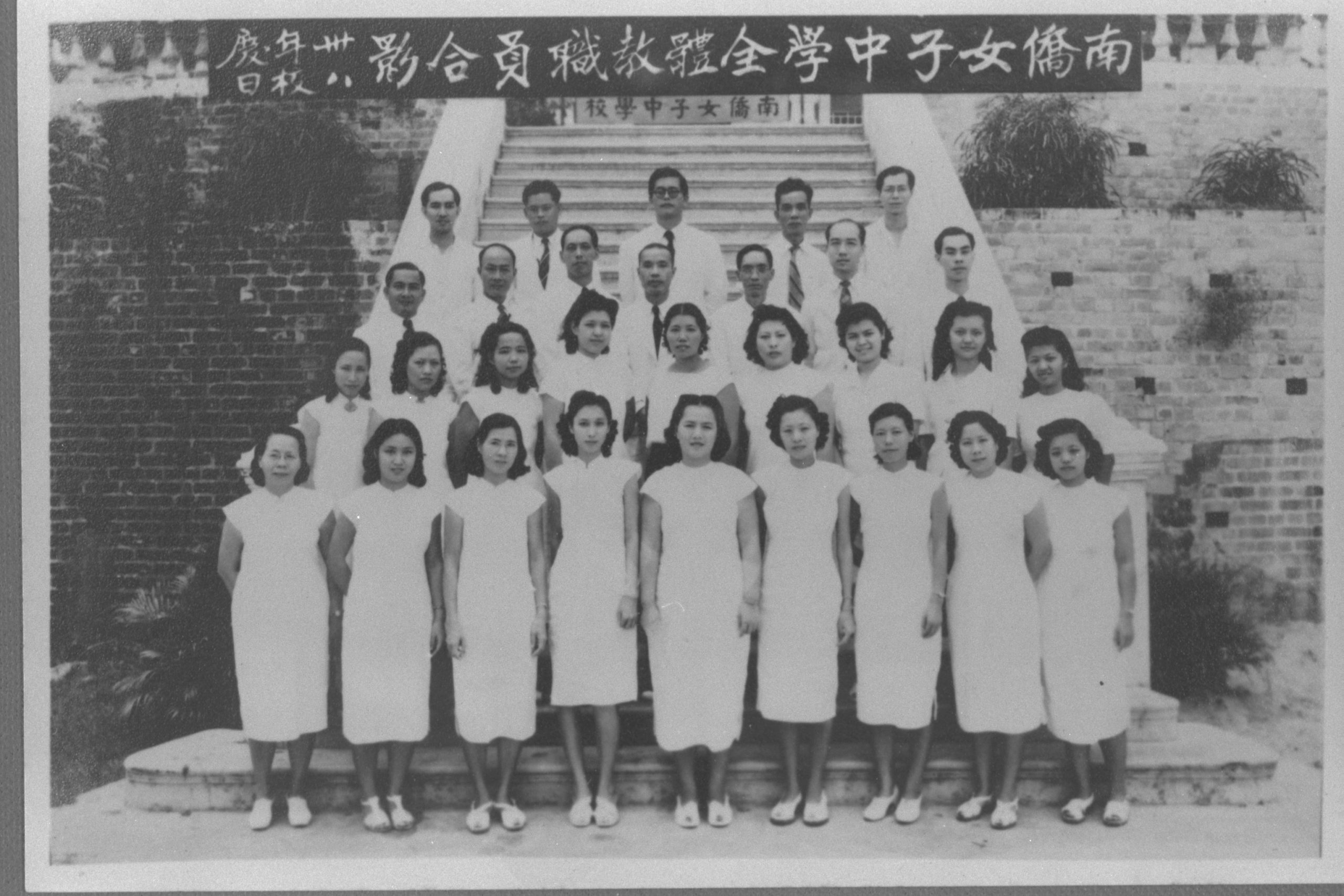
By adopting “Qin Shen Duan Pu” (Diligence, Prudence, Respectability, Simplicity) as its school motto, Nanyang Girls’ High School reflects its hope that its students be diligent in learning, prudent in speech, carry themselves with dignity, and demonstrate humility, so that they become modern women of culture. Nanyang Primary School shares the same motto.
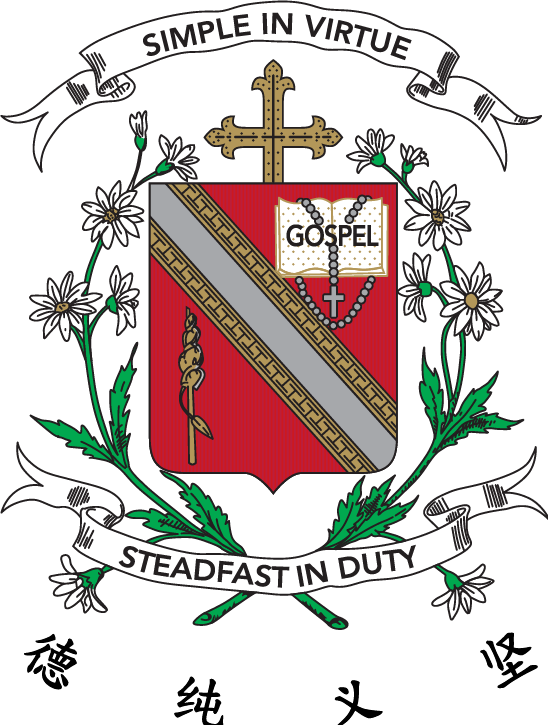
The school motto of CHIJ St Nicholas Girls’ School reads “De Chun Yi Jian” (Simple in Virtue, Steadfast in Duty), which calls on students to be girls of grace who exemplify feminine virtues of gracefulness, elegance and graciousness.
School mottos containing the words “loyalty” and “sincerity”
Among schools with a Chinese-medium school background, those whose mottos contain the character “Zhong” (loyalty) include Catholic High School and its primary section (“Qin Ai Zhong Cheng”: Care, Honesty), and Maris Stella High School and its primary section (“Qin Mian Zhong Yong”: Diligence, Determination, Loyalty & Dedication, Courage).2 These are all boys’ schools, and their mottos reflect the schools’ commitment to nurture a deep sense of patriotism in their students.
Pei Hwa Presbyterian Primary School and Dunman High School have also incorporated the word “loyalty” in their mottos. The motto of Pei Hwa is “Cheng yu Zhong” (Honesty and Loyalty), while that of Dunman High is “Cheng Xin Zhong Yong” (Honesty, Trustworthiness, Courage, Loyalty).
School mottos containing the words “sincerity and perseverance”
Prominent businessman and community leader Tan Kah Kee (1874–1961), who was devoted to the cause of education, came up with the motto “Cheng Yi” (Sincerity and Perseverance) for Jimei University in Xiamen, China based on his own life philosophy. As Tan also served as chairman of the Hokkien Huay Kuan for 20 years, the six schools under Hokkien Huay Kuan, such as Nan Chiau Teachers’ Training School (today Nan Chiau High School), Ai Tong School, Tao Nan School and Kong Hwa School, all founded by Tan, also adopted “Sincerity and Perseverance” as their school mottos.
Hong Wen School, founded by pioneers from the Henghua community, too, incorporated the term “Cheng Yi” in its motto (“Cheng Yi Qin Jian”: Honesty, Perseverance, Diligence, Thrift).
School mottos that draw on classical literature
The motto of Hwa Chong Institution is “Zi Qiang Bu Xi” (Tireless self — improvement with tenacity, innovation and passion), which is taken from a phrase in The Book of Changes, encourages students to make continuous efforts to improve themselves.
Hwa Chong Institution was at a low point in the 1950s and 1960s. Five principals came and went in the span of 10 years and students did not do well academically either. In 1978, under the leadership of new principal Tooh Fee San (1939–2023), the school implemented sweeping reforms and used the famous poem Man Jiang Hong (The Whole River Red) by General Yue Fei to rally teachers and students to work together to restore the school to its former glory – exemplifying the spirit of the school’s motto which emphasises tireless self-improvement.
The motto of Chung Cheng High School (Main) is eight characters long: “Hao Xue, Li Xing, Zhi Chi, Zi Qiang” (With Passion We Learn, With Perseverance We Strive, With Integrity We Live, With Commitment We Progress). The inclusion of “Zi Qiang” (self-improvement) in the school’s motto reflects its commitment to nurture students who are keen learners and persevere to realise their dreams.
Red Swastika School’s motto is “Gong Kuan Xin Min Hui” (Graciousness, Magnanimity, Trustworthiness, Diligence, Benevolence), adopted from The Analects. It was originally only “Gong Kuan Xin Min”, and in 2026, at the school’s 75th anniversary, it was announced that a fifth value “Hui” will be added to the school motto.
Other school mottos based on cultivation of virtues
The concept of “self-cultivation” has always been important in Chinese culture. It refers to the conscious act of developing a strong moral character.
Maha Bodhi School adopts “Dun Pin Li Xue” (Steadfast in Character, Thirst for Knowledge) as its motto. This phrase originated from Qing dynasty scholar Liang Zhangju (1775–1849), who used it to describe scholars devoted to moral self-cultivation and learning.
The school motto of Holy Innocents’ High and Primary Schools is “Qian Cheng He Ai” (Sincerity & Charity), which aspires to nurture students who are humble, sincere, and charitable.
Through the mottos, these schools hope to instil the values of charity, graciousness, and magnanimity in their students.
Unique school mottos
The school motto of Anglican High School, which was founded by the Anglican Church, is “Sheng Jie Gong Yi” (Aspiring towards Holiness and Righteousness). “Holiness” is a religious term which means “pure, sacred and inviolable”, while “righteousness” calls upon students to act honourably.
A school’s motto serves as a guiding principle for the speech and conduct of its students. Over time, the practice of the principle evolves into a distinctive school ethos, which further exerts a profound impact on the school’s culture and fosters a sense of identity among its students.
This is an edited and translated version of 新加坡传统华校校训. Click here to read original piece.
| 1 | The Special Assistance Plan (SAP) was introduced in 1979 to nurture students with bilingual aptitude. The schools under this plan are called SAP schools, known to provide students with high quality teaching and an environment that emphasises bilingual learning. |
| 2 | Maris Stella High School (Primary) will become coeducational in 2027. |
Neo, Peng Fu. “Kaizhi qimeng, xinjin huochuan” [Enlightenment and continuation]. In Huawen jiaoyu xuehui 70 zhounian jinian tekan [The 70th anniversary commemorative issue of The Society of Chinese Education Singapore], edited by Kang Ger-Wen and Tay Cheow Yong, 96– Singapore: The Society of Chinese Education Singapore, 2017. | |
Peh, Chong Teck. “Xiaoge de qianyi mohua zuoyong” [How school songs shape generations]. Lianhe Zaobao, 24 February 2018. | |
Poon, Sing Wah. “Dailing huazhong yuhuo chongsheng de lao xiaozhang du huisheng” [Veteran principal Tooh Fee San sparks a revival at Hwa Chong]. Lianhe Zaobao, 2 July 2023. | |
Tay, Cheow Yong. “Texuan xuexiao de xiaoxun chuancheng chuantong wenhua” [SAP schools passing down traditional cultures through their mottos]. Lianhe Zaobao, 8 March 2018. |