The legacy of Rediffusion in Singapore


For members of Gen Z and Gen Alpha who grew up with audio streaming services such as Spotify, the name Rediffusion will probably draw a blank. But for those old enough to remember Singapore’s nation-building years, the cable radio service played a distinctly vital role in shaping the media and cultural landscape of a young, multiethnic nation.
Origins of Rediffusion in Singapore
Rediffusion began as an innovative broadcasting service that revolutionised how people consumed audio entertainment and information, before radio dominated the global broadcast landscape. Started in the United Kingdom in the 1920s, Rediffusion was a privately owned company that was a subsidiary of London-based Broadcast Relay Services Ltd. It operated as wired radio, where audio was transmitted via cables to households and subscribers accessed content with a Rediffusion speaker box or loudspeaker. Since signals ran via cables, the consistency and reliability of Rediffusion’s audio quality gave it an edge over traditional over-the-air broadcasting, which was affected by atmospheric interference. This form of cable-transmitted radio was known as radio diffusion, hence the name “Rediffusion” or “re-diffusion”. It was also sometimes dubbed “Wired Wireless”. Seeing the international demand and potential, Rediffusion expanded to Barbados, Hong Kong, Malaysia, Singapore and other colonies, with Singapore becoming a key hub for the company’s expansion into Asia.1
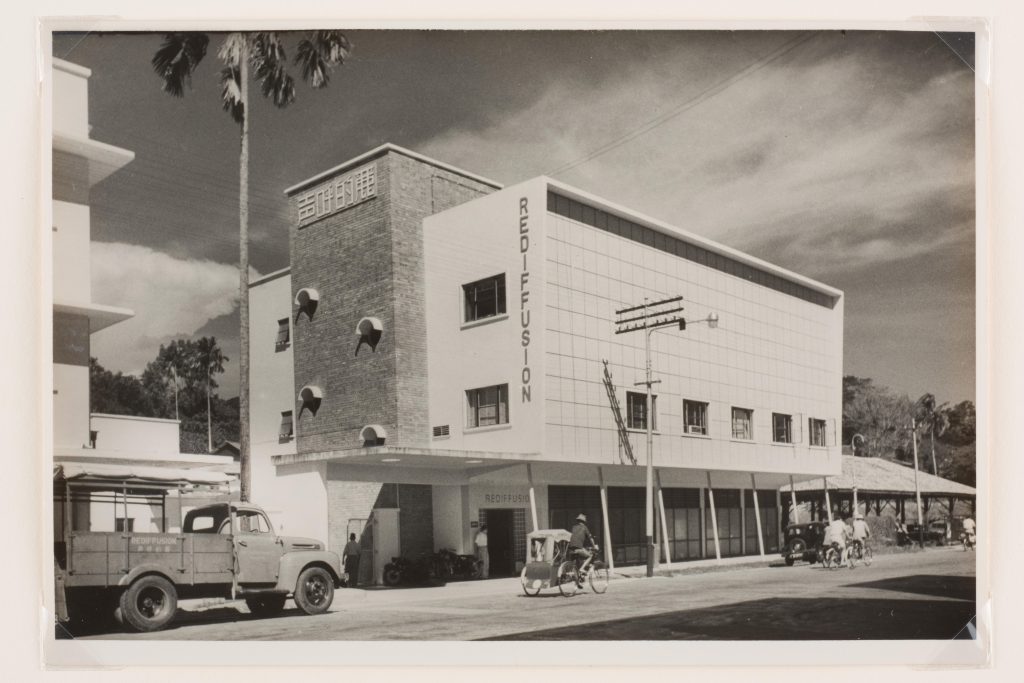
Rediffusion was introduced to Singapore in August 1949, with its first office set up in Clemenceau Avenue.2 It was to be the country’s first commercial and cable-transmitted radio station. It was also Singapore’s only subscription radio service. As Singapore emerged from the devastation of World War II and began to rebuild its infrastructure, Rediffusion filled a critical gap in media and entertainment. Apart from the cinema, Rediffusion provided the only other form of local entertainment. Radio Malaya, the government station, broadcast primarily news and educational programmes from England.3 At the time, radio ownership was relatively uncommon due to the high cost of receivers, and wired radio provided an affordable alternative for the masses.4 Due to its ease of use and relatively affordable subscription rate of $5 per month compared with the cost of a radio, Rediffusion quickly became a household name, offering a mix of entertainment, education, and news.5
Listen: Rediffusion Jingle, 1989.
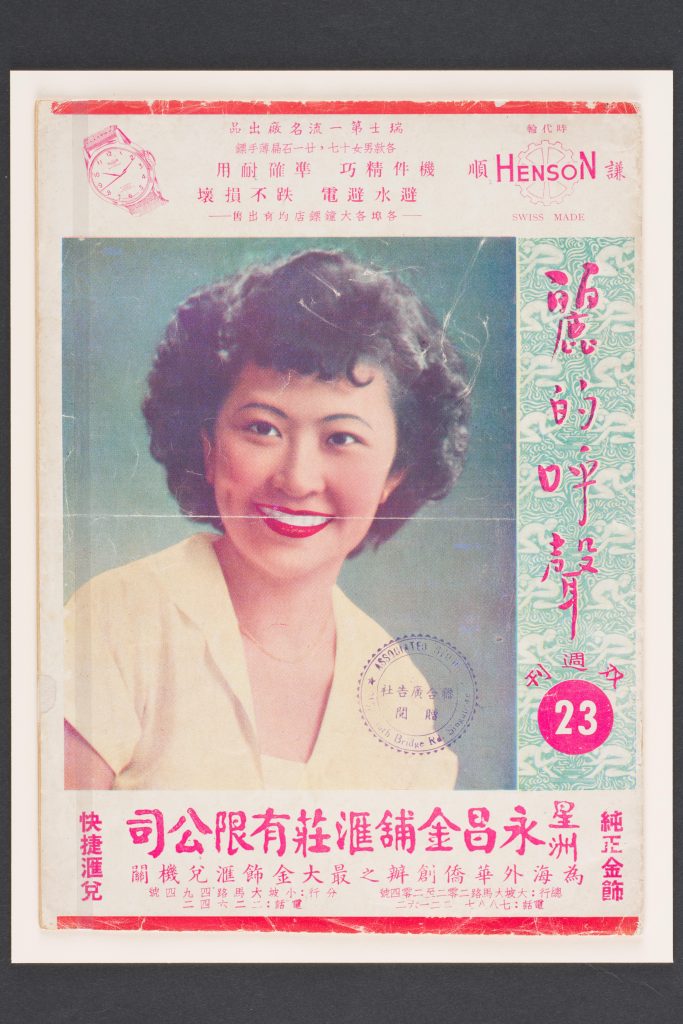
The Rediffusion box came with a two-station selector knob — the Gold network offered Chinese and dialect programmes in Hakka, Hokkien, Teochew, and Cantonese that ran 18 hours daily, while the Silver channel broadcast English and Chinese programmes 24 hours a day.6 This multilingual programming became one of Rediffusion’s defining characteristics and a key to its popularity, as well as its impact on Singapore culture and society.
The rise of Rediffusion’s popularity
Rediffusion garnered a large following because of its emphasis on entertainment.7 During its heyday between the 1950s and 1970s, Rediffusion’s wired radio service was indispensable in homes here. It provided a vital source of recreation and information in an era when television was still a luxury and newspapers did not cater to all linguistic groups.8
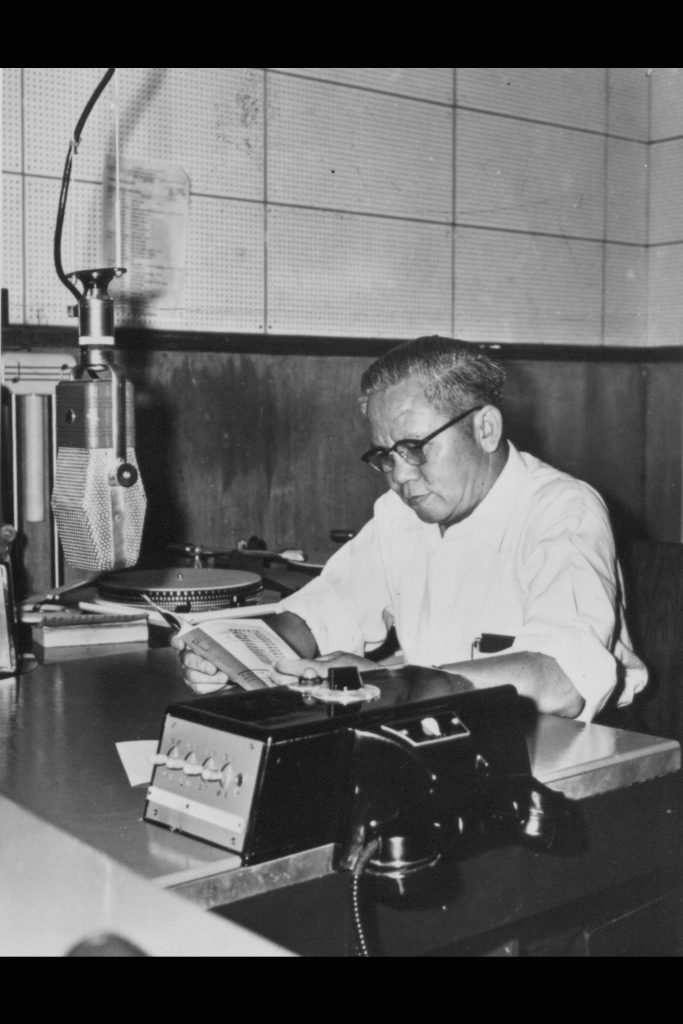
For young listeners, the Silver channel offered a glimpse of the music and cultural worlds of the West through programmes such as the American Top 40 countdown and the Dick Clark Record Show.9 Meanwhile, classic tales told in the various dialects on the Gold channel found fans among the post-war generation. Perhaps the most renowned Cantonese storyteller with Rediffusion was Lee Dai Soh (1913–1989) who captivated audiences with his animated narrations of Chinese classics such as Monkey God and Return of the Condor Heroes.10 There were other prominent storytellers who mesmerised listeners daily in their respective native tongue: Ng Chia Kheng (1912–2003) in Teochew; Ong Toh (1920–1999) in Hokkien; and Chong Soon Fat (birth and death years unknown) in Hakka. All were recognised as media stars in their time, and they helped establish Rediffusion as the leading Chinese broadcasting station then.
Cultural impact
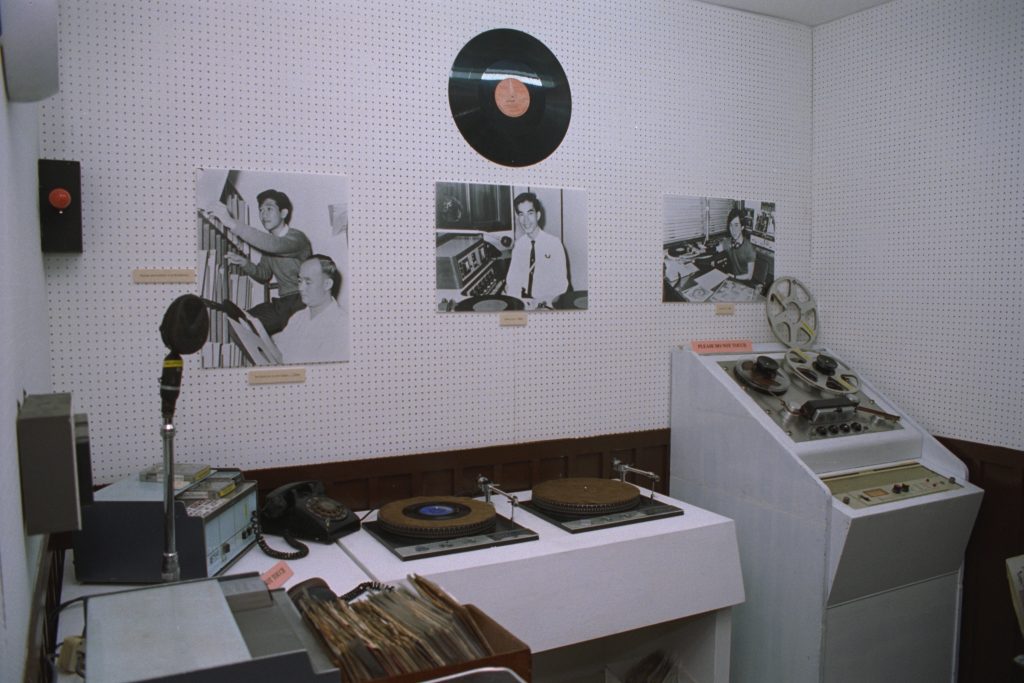
Because of its broad appeal and its linguistic and cultural diversity, Rediffusion became known as “the people’s radio” or “the people’s network”.11 For many families, listening to Rediffusion became a daily ritual that brought them together. Programmes were often scheduled around family activities, creating shared moments of enjoyment and conversation.12 As part of the company’s efforts to continually reinvent itself, Rediffusion included new programmes in the late 1960s and early 1970s such as interviews with stars, call-in games, and lucky draws. It also had segments where listeners would call in to chat with the DJs and even share their family problems.13 Many of these ideas would later be adopted by Radio Television Singapore when it launched four major FM (Frequency Modulation) radio stations in 1967 to cater to the four main linguistic groups here. 14
Rediffusion also helped nurture many talents for the burgeoning arts and music industry. One example is theatre doyen Kuo Pao Kun (1939–2002), who joined Rediffusion’s Mandarin Drama Group when he was only 15.15 Renowned Singapore composer and musician Dick Lee also found fame when he entered a talent contest organised by Rediffusion. He was asked to return as a guest performer — an invitation that marked the start of his career.16
With its wide range of recordings of Chinese opera, folk songs, and Chinese classics, Rediffusion played another important role — that of an archivist. Live recordings of outdoor concerts and wayang were made and then replayed over its system. Such an approach not only allowed those who could not attend the live show to hear their favourite tunes and performers, but also shaped Rediffusion as a cultural curator.17
Challenges, decline, and revival
The dominance of Rediffusion began to wane in the late 1970s and 1980s due to technological advancements and changing consumer preferences. The advent of transistor radios and, later, FM radio broadcasting provided cheaper and more portable alternatives to wired radio. These developments made Rediffusion’s cable-based service appear outdated.18
The Singapore government’s policy shift towards promoting Mandarin over Chinese dialects in the 1980s further dented Rediffusion’s appeal. Many of its iconic Chinese dialect programmes were phased out to align with the bilingual education policy, which aimed to establish Mandarin as the lingua franca of the Chinese community. This alienated some of Rediffusion’s traditional listeners, particularly the elderly who preferred content in their native dialects. Additionally, the Speak Mandarin Campaign and the removal of dialects from mainstream media meant that the younger generations born in the 1980s and after had little acquaintance with Chinese dialects. This also led to a subsequent decline in demand for the Chinese programmes Rediffusion was known for.
In the early 2000s, under new management, the station embraced digital audio broadcasting (DAB) to reach out to a younger, tech-savvy audience.19 Despite its efforts to modernise, however, declining subscription numbers and rising operational costs led to its eventual closure on 30 April 2012.20 The news was met with widespread sadness. But two months after it ceased broadcasting, Rediffusion was revived by Eeva Chang Mei Hsiang, who was a DJ with the service from 1985 to 1991. Chang purchased the Rediffusion name and all its audiovisual archives in the hopes of giving it a second life.21
Today, it maintains an online presence that includes a website, “Remembering Rediffusion”, a Facebook page, and a YouTube channel. It is also hosted on Ximalaya FM, an online audio-visual sharing platform. 22
An enduring legacy
Rediffusion’s impact on Singapore’s media landscape and cultural history cannot be overstated. For over six decades, it was a pioneer in radio broadcasting, setting the standard for high-quality, multilingual programming. It nurtured local talent, preserved linguistic diversity, and remains a cultural institution and a symbol of Singapore’s media evolution. The station paved the way for future innovations in broadcasting and left an indelible mark on the nation’s collective memory. Although no longer the dominant media force it once was, Rediffusion continues to resonate with Singaporeans as a cherished part of their heritage.23
| 1 | Chee Fee Min, “Rediffusion and its glorious 63 years,” Remember Singapore, 1 May 2012; David Clayton, “The consumption of radio broadcast technologies in Hong Kong, c. 1930–1960,” The Economic History Review 57 no. 4 (2004): 698. |
| 2 | “Rediffusion Ltd,” The Straits Times, 2 August 1949; “Rediffusion is launched,” Malaya Tribune, 2 August 1949. |
| 3 | Goh Yee Ling, “The entertainment house that Jack built,” The Business Times, 6 October 1986. |
| 4 | Chua Yeong Jia Joshua and Loh Pei Ying, “Rediffusion,” Singapore Infopedia, National Library Board, 24 December 2012. |
| 5 | Rafael Oei, Borderless Bandwidth: DNA of Digital Radio (Singapore: Times Academic Press, 2002), 111. |
| 6 | “Move to new home will help: Rediffusion,” The New Paper, 3 February 1989. |
| 7 | Goh, “The entertainment house that Jack built,” 8. |
| 8 | Rediffusion started off with 9,600 subscribers in its first year of launch, and this number grew to about 50,000 in the 1960s. Despite a brief decline with the loss of about 9% of its subscribers between 1963 and 1965, due to the introduction of Radio Television Singapore (RTS) and people’s increasing fascination with television, Rediffusion regained its popularity and continued to attract subscribers. By 1977, it had 90,428 subscribers with a staff strength of 800. Goh, “The entertainment house that Jack built,” 8; Drew O McDaniel, Broadcasting in the Malay World: Radio, Television, and Video in Brunei, Indonesia, Malaysia, and Singapore (New Jersey: Ablex Publishing Corporation, 1994), 183; Singapore International Chamber of Commerce, From Early Days (Singapore: The Chamber, 1979), 136. |
| 9 | “RIP Mr Ellery,” Today, 1 March 2015. |
| 10 | Chee, “Rediffusion and its glorious 63 years.” |
| 11 | Goh, “The entertainment house that Jack built,” 8. |
| 12 | Barbara Quek, “Rediffusion’s Golden Years,” BiblioAsia, 21 January 2020. |
| 13 | Chee, “Rediffusion and its glorious 63 years,” and Goh, “The entertainment house that Jack built,” 8. |
| 14 | “RIP Mr Ellery.” |
| 15 | Besides broadcasting and acting, Kuo also wrote radio dramas at Rediffusion. It was during his time there that he discovered xiangsheng or cross-talk, a genre which Kuo became proficient at writing and dramatising. Xiangsheng would find its way into Kuo’s multilingual plays, reflecting his knack for capturing the common man’s lingo and everyday speech. See “Kuo Pao Kun,”Singapore Infopedia, National Library Board; and Gan Chong Jing, “Marginal misdirections: imitation and mistranslation in the theatre of Kuo Pao Kun,” Singapore Unbound, 26 January 2024. |
| 16 | Christopher Toh, “Rediffusion returns as digital-only service,” Today, 31 May 2013. |
| 17 | Goh, “The entertainment house that Jack built,” 8. |
| 18 | Quek, “Rediffusion’s golden years.” |
| 19 | Gerald Clode, “Remembering Rediffusion: Singapore,” Memorable Radio: The Co-operative Global Radio Memories Project. |
| 20 | Royston Sim, “Rediffusion to close at month’s end after 63 years,” The Straits Times, 9 April 2012. |
| 21 | On 30 May 2013, Rediffusion re-commenced programming with as a digital-only service, with plans for four key programmes delivered via its website — an internet radio programme called “Radioffusion”, an educational television channel titled “Teleffusion”, a podcast channel called “Rediffusion on Air”, and a mobile app called “Rediffusion Classic” that featured Mandarin and Chinese dialect programmes. See Toh, “Rediffusion returns as digital-only service.” |
| 22 | Toh, “Rediffusion returns as digital-only service.” |
| 23 | When Minister for Digital Development and Information Josephine Teo visited the “Rediscover Rediffusion” pop-up exhibition at Chinatown Point in August 2024, she described her experience as being “enveloped by a warm wave of nostalgia”. See her Instagram post. |
Chua, Yeong Jia Joshua and Loh Pei Ying. “Rediffusion.” Singapore Infopedia, National Library Board, 24 December 2012. | |
McDaniel, Drew O. Broadcasting in the Malay World: Radio, Television, and Video in Brunei, Indonesia, Malaysia, and Singapore. New Jersey: Ablex Publishing Corporation, 1994. | |
Oei, Rafael. Borderless Bandwidth: DNA of Digital Radio. Singapore: Times Academic Press, 2002. | |
Quek, Barbara. “Rediffusion’s golden years.” BiblioAsia, 21 January 2020. | |
Yap, Neng Jye. “Xinjiapo ‘Li de husheng’ zhongwen guangbo chutan (1949–1965)” [An oral history of Chinese broadcasting in Singapore: The case of Rediffusion (1949–1965)]. Bachelor thesis, National University of Singapore, 2000. |