Hoi Thin Amateur Dramatic Association: From raising funds to promoting community ties


According to the Nanyang Yearbook published in 1939, the Hoi Thin Amateur Dramatic Association was established in 1918 to “foster community ties as well as support education and charity work at home and abroad”.1Then located at 37 Upper Nanking Street, the association had 119 members and was managed by Ng Sen Choy (1887–1960), Lum Mun Tin (1873–1943), and Ching Kee Sun (c. 1881–1972), with a monthly fund of $200.2
The beginnings of Hoi Thin
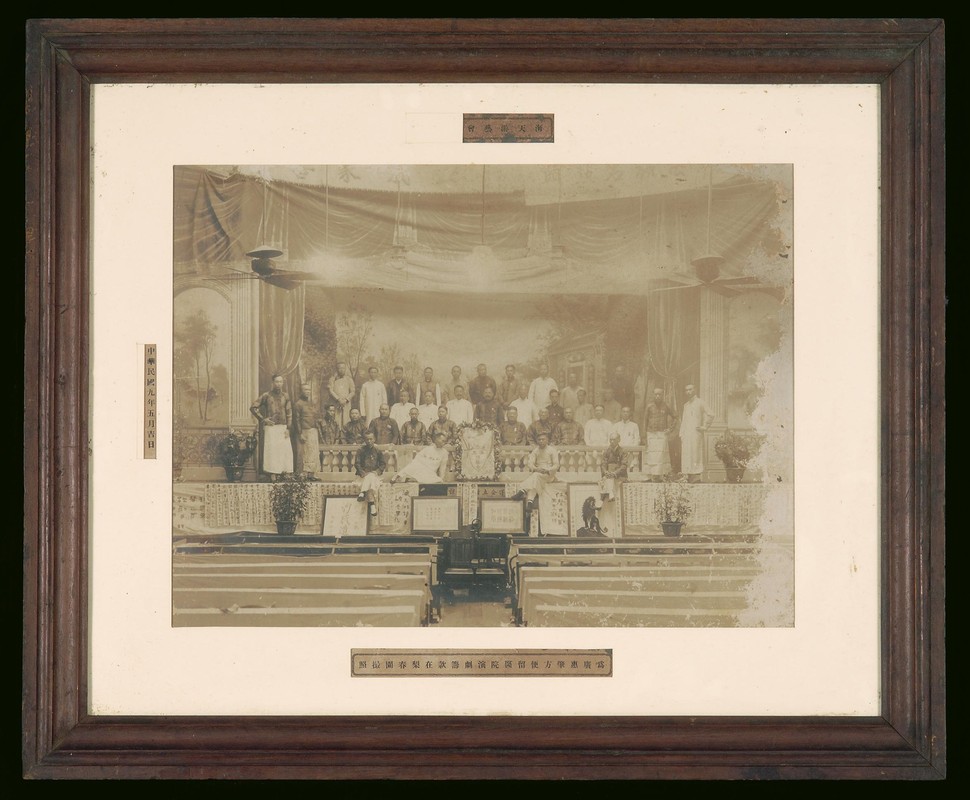
The predecessor of the Hoi Thin Amateur Dramatic Association was Qi Ying Shan She, established in 1913. That year, following years of war, many areas in Guangdong, China, were further hit by typhoons and floods, causing widespread suffering. Many overseas Chinese, especially the Cantonese whose ancestral homes were in Guangzhou and Zhaoqing, actively donated to disaster relief efforts. In October the same year, the Singapore Thong Chai Medical Institution launched a fundraising campaign.3 Led by Ng Sing Phang (1873–1952), Wu Jinsheng (birth and death years unknown), Yow Ngan Pan (1863–1930), and Wong Ah Fook (1837–1918), 35 people whose ancestors hailed from Guangzhou (31 people), Zhaoqing (three people), and Chaozhou (one person) initiated a disaster relief society to raise funds through staging opera performances in vernacular Chinese or baihua (plain Chinese). They had originally planned to dissolve the society after funds were raised and remittances completed.4 On 29 October, the society renamed itself Qi Ying Shan She, and used Yeung Ching School as its correspondence address.5Its membership also increased to 48 people.6From 7 to 9 November, the society performed baihua plays at Lai Chun Yuen in Chinatown for three nights in a row. Besides raising funds for disaster relief, the shows also aimed to cultivate virtues and discourage evil deeds. More than $8,000 was raised from the three days of performances.7 From a temporary society, Qi Ying Shan She eventually grew into a formal charity, working with people from all walks of life to organise plays to support continued fund-raising efforts.8
In August 1917, with the government conducting rigorous checks on unregistered groups and requiring them to provide evidence related to their activities, Qi Ying Shan She registered itself as a society under the name Hoi Thin Club in September that year.9 Its members were mainly Cantonese, as well as Chinese from other dialect groups. In 1924, floods in eight provinces in China again prompted overseas Chinese of various dialect groups to donate to flood relief funds. In September that year, led by Hoi Thin Club, the Cantonese community formed Hoi Thin Amateur Dramatic Troupe to stage fundraising opera performances.10 In March 1925, the troupe was renamed Hoi Thin Amateur Dramatic Association. In April that year, the association put on a three-day show in support of Singapore’s infant welfare.11 Before June 1927, whether it was called Qi Ying Shan She or Hoi Thin Club, the association largely functioned as a charitable organisation comprising mainly Cantonese members. They performed plays for schools, hospitals, creches, and other institutions in Singapore, as well as raised funds for disaster relief in Southeast Asia, China and Japan.
In March 1927, the Registry of Societies started putting clubs in order, and required the Hoi Thin Club to produce evidence of its existence. Members of the performing association of Hoi Thin Club removed the word “club” from its name and re-registered itself under the name Hoi Thin Amateur Dramatic Association. At the same time, it was also registered by the government as an Exempted Society.12 The Hoi Thin Club was officially closed in June 1927.13
A new chapter
The re-registered Hoi Thin Amateur Dramatic Association was mainly helmed by Cantonese businessmen in Singapore. Even as the association continued to stage fundraising performances for disaster and war relief across the world, it gradually became a meeting place for the Cantonese community. The members held gatherings, singing sessions, and later, meetings to discuss various matters. For instance, on 7 July 1936, representatives of Cantonese clan associations held a forum at Hoi Thin Amateur Dramatic Association to discuss the formation of Kwangtung Hui Kuan.14The association was also where a Cantonese fundraising committee discussed relief efforts during the War of Resistance against Japan.15
Its anti-Japanese fundraising efforts were probably the reason Hoi Thin Amateur Dramatic Association was not allowed to operate during the Japanese Occupation. After the end of World War II, the association became active again in 1948 when it moved from Upper Nanking Street to a new office in Neil Road. It continued to promote community ties and hold charitable activities post-war, but with a few differences: (1) it replaced baihua plays with Cantonese operas; (2) it played Cantonese operas on Radio Singapore and Rediffusion; (3) it organised local tours and interest classes like taichi; and (4) its charitable fundraising efforts and donations were mainly targeted at Singapore and Malaysian societies.16

In its over 100 years of history, the association has grown from a charitable society to a club that promotes ties among its clansmen, from staging group performances that transcended borders and dialect groups for disaster relief, to holding singing sessions and gatherings for its members.
This is an edited and translated version of 海天游艺会. Click here to read original piece.
| 1 | Nanyang Yearbook listed 228 overseas Chinese societies in Singapore, including Hoi Thin Amateur Dramatic Association. |
| 2 | Fu Wu Mun et al, eds., “Appendix: overseas Chinese associations: Singapore,” in Nanyang Yearbook (Singapore: Nanyang Siang Pau, 1939), appendix, 89. |
| 3 | “Yanju zhenzai” [Fundraising opera performance], Lat Pau, 27 October 1913. |
| 4 | “Faqi yanxi zhenzai zhi xuanyan” [Announcement of the fundraising opera performance], Lat Pau, 27 October 1913. |
| 5 | “Yanxi zhenzaihui qishi” [Notice of the fundraising opera performance], Lat Pau, 31 October 1913. |
| 6 | “Qiying shan she baihuaxi kaiyan” [Qi Ying Shan She starts performing vernacular opera], “Xinjiapo qiying shan she baihua peijing xi tongren yi lan biao xu” [Overview of the members of Qi Ying Shan She’s vernacular opera], Lat Pau, 7 November 1913. The names, professions and places of origin of the 35 initiators are listed in the programme for the 7 November performance. |
| 7 | “Yanxi zhenzai kuanxiang yijing huiqu zhi xuanyan” [Announcement of the remittance of funds from the opera performance for disaster relief], The Union Times, 3 March 1914. |
| 8 | The Union Times, 7 November 1913. |
| 9 | The Singapore Free Press and Mercantile Advertiser, 15 September 1917. |
| 10 | There were many reports on the fundraising performance. From Hoi Thin Club’s announcement on August 1924 on its fundraising performance for flood relief in Fujian and Guangdong, one can see that the president of the event was Tan Kah Kee (Hokkien), and its honorary presidents included Lim Nee Soon (Teochew) and other prominent figures in Singapore whose ancestral homes were in different parts of China. Nanyang Siang Pau, 28 August 1924. See “Haitian youyi jutuan yijue yanju chouzhen minyue shuizai” [Hoi Thin Amateur Dramatic Association to perform for flood relief in Fujian and Guangdong], Nanyang Siang Pau, 18 August 1924; Pu Zhiweng, “Wo suo wang yu haitian julebu zhu jun” [My hope for the members of Hoi Thin Club], Nanyang Siang Pau, 22 August 1924; “Wei yanju chouzhen minyue shuizai zhaoji tongqiao dahuiyi xuanyan” [Announcement of the meeting for the fundraising opera performance for flood relief in Fujian and Guangdong], Nanyang Siang Pau, 24 August 1924; “Huiyi yanju zhenzai xiangqing” [Details of the meeting for the fundraising opera performance], Nanyang Siang Pau, 23 August 1924. |
| 11 | “Dai xianzai yu weilai wu liangshu zhi pinku yinger mingxie” [Gratitude on behalf of countless poor infants of today and tomorrow], Nanyang Siang Pau, 4 March 1925; “Chouzhu xinjiapo yinger baoyuhui jingfei haitian youyihui xuanyan” [Hoi Thin Amateur Dramatic Association announces fundraising campaign in support of Singapore’s infant welfare], Nanyang Siang Pau, 16 March 1925. |
| 12 | The Singapore Free Press and Mercantile Advertiser, 12 March 1927; Malaya Tribune, 12 March 1927; Quay Sy Ren, “Tongji yiyuan yu xinjiapo xiandai xiju de dengchang: 1913 nian de qiying shan she” [Singapore Thong Chai Medical Institution and the emergence of modern drama in Singapore: Qi Ying Shan She in 1913], in Tongji yiyuan 150 zhounian wenji [Singapore Thong Chai Medical Institution 150th anniversary commemorative book], edited by Toh Lam Huat (Singapore: Focus Publishing, 2017), 222–227. |
| 13 | “Existence Ceased,” The Straits Times, 25 June 1927; “Haitian youyihui ke mian zhu ce zhi xixun” [Good news: Hoi Thin Amateur Dramatic Association exempted from registration], Nanyang Siang Pau, 7 June 1927. |
| 14 | Nanyang Siang Pau, 8 July 1936. |
| 15 | “Guangbang chouweihui zongwu gu ming wu taolun banli lianyihui” [Cantonese fundraising committee to discuss formation of association tomorrow afternoon], Nanyang Siang Pau, 23 July 1940. |
| 16 | Haitian youyihui sanshier zhounian jinian gongyan yueju tekan [Hoi Thin Amateur Dramatic Association 32nd anniversary Cantonese opera commemorative booklet] (Singapore: Kieshing Hupkee & Co, 1950); Tongshan yiyuan dunqing xinjiapo Haitian youyihui yiyan teji [Special edition: Tung Shin Hospital invites Hoi Thin Amateur Dramatic Association to perform for charity] (Kuala Lumpur, 1963). |
| 17 | Lee Kok Leong, “Zhuisu erzhan qian huaren julebu, kan huashe kaichuang huihuang laishilu” [Explore the thriving Chinese community through the Chinese associations established before World War II], Lianhe Zaobao, 21 November 2022. |
| 18 | Tang Ai Wei, “Bainian shetuan qianshi jinsheng” [The history and evolution of century-old associations], Lianhe Zaobao, 4 November 2019. |
| 19 | Tang Ai Wei, “Haitian youyihui qing bainian, mairu xin lichengbei” [Hoi Thin Amateur Dramatic Association marks 100 years and embarks on a new milestone], Lianhe Zaobao, 30 September 2019. |
Au, Yue Pak. “Huashe de julebu” [Chinese associations], in Xinjiapo huashe wushi nian [50 years of the Chinese community in Singapore], edited by Phua Kok Khoo, 113–122. Singapore: Global Publishing, 2016. | |
Chew, Kheng Chuan. “Huaren cishan, jin yu xi” [Philanthropy of the Chinese community, then and now]. In Xinjiapo huashe wushi nian [50 years of the Chinese community in Singapore], edited by Phua Kok Khoo, 97–112. Singapore: Global Publishing, 2016. | |
Chui Huay Lim Club, ed. Chui Huay Lim Club 150th Anniversary Souvenir Journal. Singapore: Chui Huay Lim Club, 1996. | |
Li, Aiyong. “Yule ruhe jiuguo: jindai youyihui ’gonggong kongjian’ de xingsu” [Entertainment and Patriotism: On the shaping of public space of modern entertainment festivals]. Hubei daxue xuebao (zhexue shehui kexue ban) [Journal of Hubei University (Philosophy and Social Sciences)] 46, no. 4 (2019): 97–106. | |
Liao, Hongyue. “Charity, Commerce, and Culture in Modern China: The Wing on Amateur Dramatic Club, 1923–1949.” Twentieth-Century China 43, no. 2 (2018): 101–119. | |
Lu, Shuang. “Zai guojia yu bangquan zhi jian: shehui zhengzhi kongjian xia yihexuan julebu de gongneng zhuanxing” [Between the state and the power of “Pang”: the Ee Hoe Hean Club within the social political space]. MA thesis, Department of Chinese Studies, National University of Singapore, 2013. | |
Preparatory committee for the 32nd anniversary celebration of the Hoi Thin Amateur Dramatic Association, ed. Haitian youyihui sanshier zhounian jinian gongyan yueju tekan [Hoi Thin Amateur Dramatic Association 32nd anniversary Cantonese opera commemorative booklet]. Singapore: Kieshing Hupkee & Co, 1950. | |
Quay, Sy Ren. “Tongji yiyuan yu xinjiapo xiandai xiju de dengchang: 1913 nian de qiying shan she” [Singapore Thong Chai Medical Institution and the emergence of modern drama in Singapore: Qi Ying Shan She in 1913]. In Tongji yiyuan 150 zhounian wenji [Singapore Thong Chai Medical Institution 150th anniversary commemorative book], edited by Toh Lam Huat, 222–227. Singapore: Focus Publishing, 2017. | |
Quah, Sy Ren. Xiju bainian: Xinjiapo huawen xiju 1913–2013 [Scenes: A hundred years of Singapore Chinese-language theatre 1913–2013]. Singapore: Drama Box, National Museum of Singapore, 2013. | |
Sinn, Elizabeth. Power and Charity: The Early History of the Tung Wah Hospital, Hong Kong. Hong Kong: Oxford University Press, 1989. | |
Smith, Carl. “The Hong Kong Amateur Dramatic Club and Its Predecessors.” Journal of the Hong Kong Branch of the Royal Asiatic Society 22, no. 1 (1982): 217–251. |