The Chinese Protectorate in Singapore (1877–1945)


A short distance from the Chinatown MRT station stands a grand neo-classical building dating back to 1930. The building, which now houses the Syariah Court, previously served as the Family Justice Courts and the Ministry of Labour. However, for the Chinese population of colonial Singapore, the building was a place of power associated with a group of British officers colloquially known as the Taijin, who held wide-ranging authority over Singapore’s Chinese community.1 Indeed, it was originally constructed for a department that historian Edwin Lee (1939–2023) has described as “the most important department” in the history of British rule in Singapore.2 That department was the Chinese Protectorate.3
Established in 1877, the Chinese Protectorate, later called the Secretariat of Chinese Affairs, oversaw virtually all matters relating to the Chinese population in Singapore. At various points in its long history, it combined the functions of immigration regulation, labour administration, social welfare, dispute arbitration, and even censorship and intelligence gathering under one roof. A distinctive characteristic of the Protectorate was the proficiency of its British officers in Chinese dialects.4 The first Protector of Chinese, William Pickering (1840–1907), was fluent in Hakka, Hokkien, Teochew, Cantonese, and court Mandarin. Later, officers were sent as cadets to China for two years of language training before serving in the department.
Pickering and the early Protectorate (1877–1900)
The Chinese Protectorate emerged during a period when the British colonial administration was adapting its governance of Singapore’s rapidly growing Chinese population.5 A series of riots involving secret societies had occurred in the mid-19th century. There were also concerns about abuses in the system of indentured labour that brought coolies to Singapore, as well as the trafficking of women and girls. More fundamentally, language barriers prevented the colonial authorities from interacting effectively with the Chinese population. Furthermore, in 1876, China under the Qing dynasty began negotiations with the British government for the establishment of a consulate in Singapore. This possible expansion of Chinese influence over Singapore’s Chinese population alarmed the Straits Settlements authorities, and the Protectorate was also envisioned as a response to this development.6
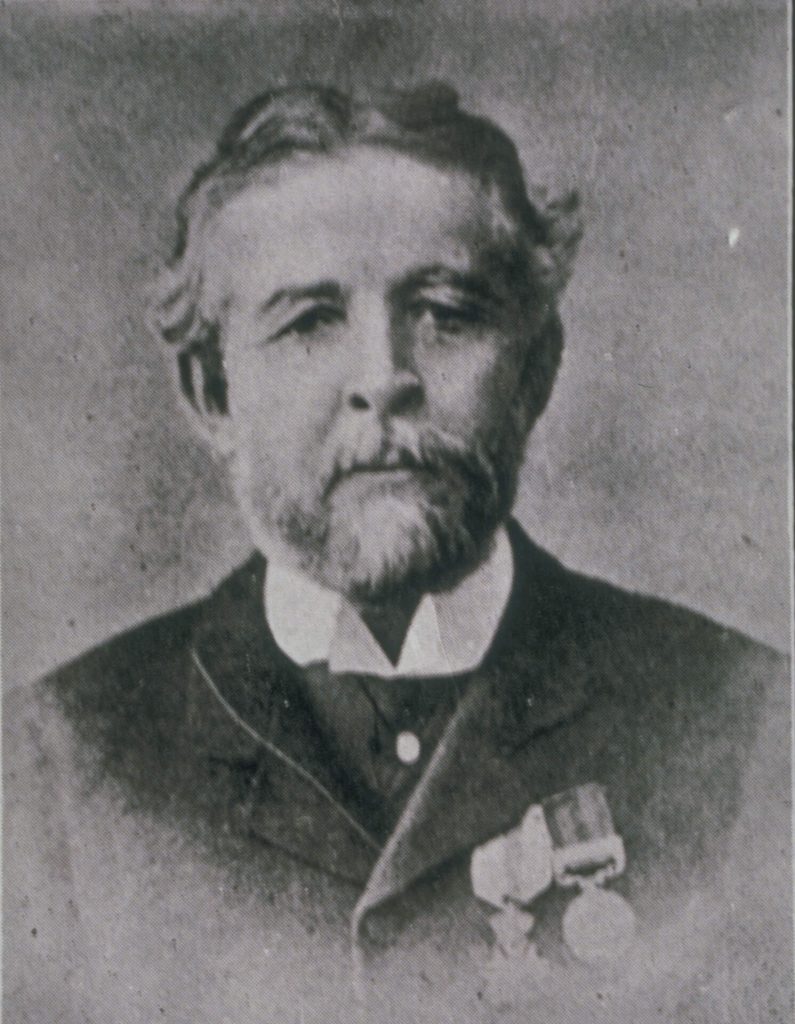
In its early years under Pickering, the Protectorate assumed numerous responsibilities. Foremost among these was the oversight of Chinese immigration. Many immigrants in this period were extremely poor and arrived under the credit system, in which recruiters obtained passage tickets on credit at Chinese ports of embarkation and then detained migrants on ships for days after arrival while seeking employers willing to repay the ticket costs and the recruiter’s profit. Some migrants were even kidnapped by secret societies and taken to mines and plantations in Sumatra. To address these abuses, officers boarded arriving ships to inform immigrants that they could seek assistance from the Chinese Protectorate and distributed handbills explaining their rights. Employers and migrants also had to sign their contracts before the Protector, who sought to ensure that the migrant understood the terms being agreed to.
The Protectorate also clamped down on the trafficking of women and girls into prostitution. While prostitution was legal, the Protectorate sought to rescue those who had been coerced or deceived into brothel work. Its staff, led by Pickering, screened all females arriving in the colony. If officers suspected that a girl was being brought in for sale, a monetary bond would be demanded. The Protectorate also ran a refuge for rescued women and girls. In 1886, a committee known as the “Po Leung Kuk” (Office to Protect Virtue), comprising influential Chinese elites and the Protector, was formed to oversee this refuge.
The problem of secret societies loomed large in British concerns over the governance of colonial Singapore during this period. Initially, an approach based on regulation through registration was adopted. Upon its establishment, responsibility for registering societies was transferred from the police to the Protectorate. Pickering concurrently served as Registrar of Societies and liaised with the headman in charge of each district. He also sought to cultivate relationships with these headmen to secure their cooperation and use them as intermediaries with the wider Chinese community. In practice, Pickering also competed with secret societies for influence, encouraging the Chinese to turn to the government for assistance instead. He positioned himself as an arbitrator who could help resolve disputes within the Chinese community, a role previously filled by secret society tribunals. His success was such that some contemporaries viewed him as encroaching upon the role of the magistrates.
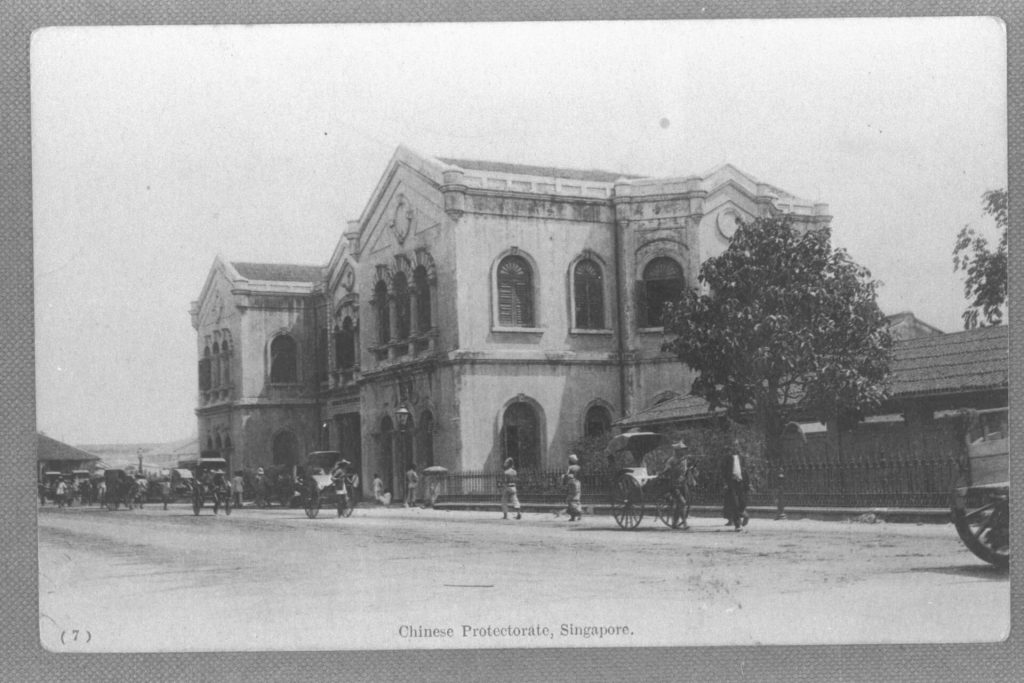
Both the Qing consulate and the Chinese Protectorate held broad mandates to oversee the Chinese community in Singapore, and clashes were therefore perhaps inevitable. During the tenure of the first two Chinese consuls, Tso Ping-lung (1850–1924) and Huang Tsun-hsien (1848–1905), the Straits government objected to numerous initiatives that were perceived as exerting improper influence over the local community. These included fundraising efforts among Singapore’s Chinese on behalf of the Qing government, as well as the visit of two Chinese commissioners tasked with reporting on local conditions. Pickering viewed the latter as an attempt by the imperial government to gather information about the local Chinese population to “draw a revenue” from them.
The later development of the Chinese Protectorate (1900–1945)
Pickering was injured in an 1887 attack by a Teochew carpenter sent by a secret society and subsequently retired. In the decades that followed, the Chinese Protectorate’s organisation and duties underwent gradual changes. Protectorate offices were opened across British Malaya, and a new position, Secretary of Chinese Affairs (SCA), Straits Settlements, was created in 1903 as head of the Protectorate in the Straits Settlements. With the clampdown on secret societies from 1890 onwards, their perceived threat to British governance diminished, and in 1907 the SCA reported that they were no longer a danger. In 1914, the system of indentured labour that the Protectorate had initially been established to address was officially abolished.7 Historian Robert Heussler has argued that by 1914, the Protectorate had “weathered its hardest years”.8
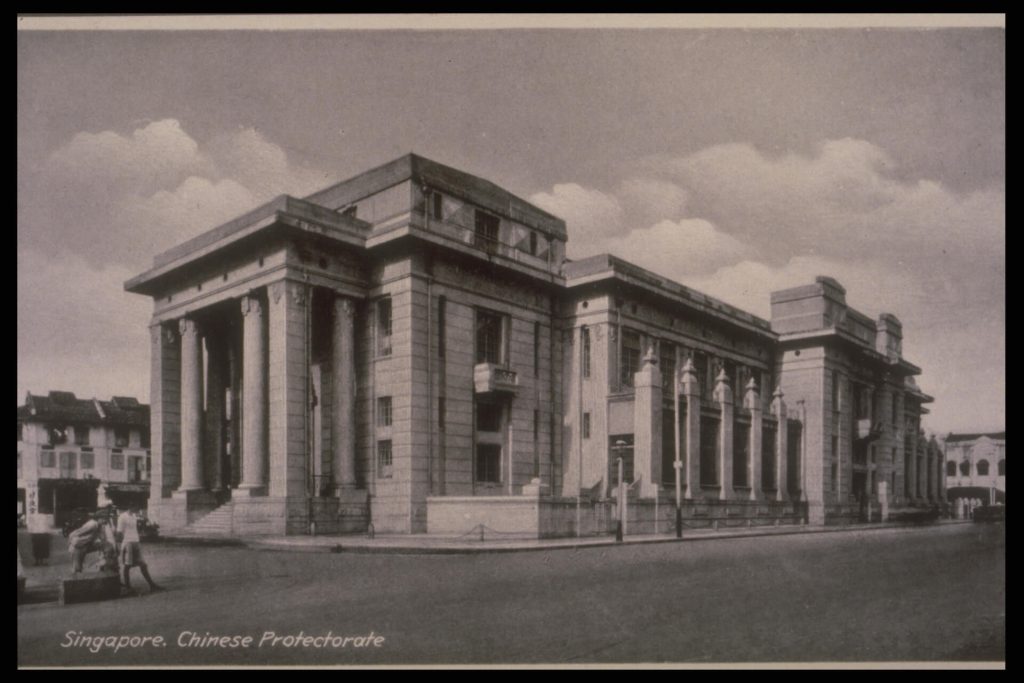
New Chinese Protectorate Building
In the 1920s, a new challenge confronting the Protectorate was the rise of Chinese nationalism and the activities of Chinese political parties in Singapore. The most significant of these was the Chinese Nationalist Party (Kuomintang). The Protectorate exerted considerable influence over the Straits government’s approach to Chinese nationalism. Historian Yong Ching Fatt has argued that the Secretaries for Chinese Affairs “controlled the fortunes” of the Kuomintang in Malaya during this period.9 In general, Protectorate officers sought to suppress organised Chinese nationalism, which they regarded as a potential threat to British rule. These efforts were supported by the police force, particularly the newly established Special Branch.
The Protectorate’s language expertise proved especially important in countering Chinese nationalism. Secretary for Chinese Affairs A. M. Goodman (1926–1930, 1932) directed Chinese translators within the department to read, translate, and summarise large volumes of material from the public press relating to developments in China and the local Chinese community. These materials were consolidated into reports for the colonial government, known as the Monthly Review of Chinese Affairs. Protectorate staff also engaged in the censorship of mail, books, and newspapers from China, which were brought to the Protectorate building and screened for potentially “inflammatory material”.10
The Protectorate also remained deeply embedded in the everyday life of Singapore’s Chinese society. It continued its longstanding practice of arbitration, dating back to Pickering’s tenure. Officers ruled on a wide range of disputes relating to Chinese society, including highly personal matters such as marital conflicts, despite having no formal authority to do so.11 Some scholars have described this as a “quasi-judicial role”.12 The Protectorate also continued to oversee matters relating to Chinese labour, and from 1930 its officers were granted formal authority to arbitrate wage disputes. Gradually, however, the Protectorate’s responsibilities were transferred to more specialised agencies. The 1927–33 Denham reforms shifted responsibility for suppressing unlawful societies to the police, while a new Immigration Department was created in 1933 to assume control over immigration management. These developments foreshadowed the institution’s eventual dissolution.
Local Chinese interpreters
While the British officers of the Protectorate were trained in Chinese dialects, they continued to rely heavily on local Chinese interpreters. Some of these Chinese employees became key figures in the operation of the department.13 Ho Siak Kuan (1865–1946) from the Cantonese community served for 42 years in the Protectorate, beginning as an interpreter and later rising to become Assistant Secretary for Chinese Affairs. Accomplished in all the major Chinese dialects and influential within local Chinese society, he was lauded by British officers as the “Father of the Chinese Protectorate”. Another interpreter, Sng Choon Yee (1897–1991) from the Foochow community, rose to become Chinese Assistant to the Secretary of Chinese Affairs. His responsibilities included overseeing the Protectorate’s translation and censorship work, as well as the compilation of the Monthly Review of Chinese Affairs. Sng’s position within the colonial administration also enabled him to collaborate with leaders of the Chinese community on various initiatives. He assisted Tan Kah Kee (1874–1961) in working with the colonial authorities on several occasions, including the reformation of the Singapore China Relief Fund Committee in 1937.14
Many Protectorate officers were killed or detained during World War II. In British postwar planning, the Protectorate was formally abolished, with officials declaring that its “historical function” had been fulfilled. Its remaining responsibilities and staff were divided among several new departments, including Social Welfare and Labour. A Secretary of Chinese Affairs remained, supported by a small staff and tasked with advising governors on Chinese matters, but with a far more limited remit.15 This final remnant of the Protectorate continued until its remaining duties were absorbed by the Chief Secretary’s Office by 1959, marking the definitive end of an institution that had shaped British governance over Singapore’s Chinese population for much of the colonial period.16
| 1 | The term “Great Man” — taijin (Hokkien) or taiyen (Cantonese) — was commonly used in imperial China to refer to officials. It was also used by many local Chinese to refer to William Pickering (1840–1907), his successors, and the Chinese Protectorate department in general throughout its existence. |
| 2 | Edwin Lee, The British as Rulers Governing Multi-racial Singapore, 1867–1914 (Singapore: Singapore University Press, 1991), 50. |
| 3 | For more on the Chinese and colloquial names of the Protectorate, see Huiming Cheng, “Huamin zhengwu sishu shilue” [A history of the Secretariat of Chinese Affairs], Nanyang Xuebao 4, no. 1 (1947): 54–59. |
| 4 | For more on the Protectorate’s use of language, see Rachel Leow, Taming Babel: Language in the Making of Malaysia (Cambridge: Cambridge University Press, 2016). |
| 5 | For more on the background of the Protectorate’s establishment and its early functions, see Lee, The British as Rulers; Ng Siew Yoong, “The Chinese Protectorate in Singapore, 1877–1900,” Journal of Southeast Asian History 2, no. 1 (1960): 76–99; Eunice Thio, “The Singapore Chinese Protectorate: Events and Conditions Leading to Its Establishment, 1823–1877,” Journal of the South Seas Society 16, no. 1/2 (1960): 40–80. |
| 6 | Lim How Seng, “Rivalry between Straits Settlements Government and Chinese Consulate in Singapore (1877–1894),” in A General History of the Chinese in Singapore, edited by Kwa Chong Guan and Kua Bak Lim (Singapore: Singapore Federation of Chinese Clan Associations and World Scientific, 2019), 185–200. |
| 7 | Chu Tee Seng, “The Singapore Chinese Protectorate 1900–1941,” Bachelor’s diss., University of Malaya, 1960. |
| 8 | Robert Heussler, British Rule in Malaya: The Malayan Civil Service and Its Predecessors, 1867–1942. (Oxford: Clio Press, 1981), 158. |
| 9 | Yong Ching Fatt and R. B. McKenna, The Kuomintang Movement in British Malaya, 1912–1949. (Singapore: Singapore University Press, 1990), 48. |
| 10 | Leow, Taming Babel, 51–55. |
| 11 | For more on the development of the Chinese Protectorate and its duties in the 20th century, see Chu, “The Singapore Chinese Protectorate, 1900–1941”; Heussler, British Rule in Malaya; and Hou Boyang , “The Functions of the Chinese Protectorate in Colonial Singapore and Its Interactions with Local Society, 1919–1941” (MPhil thesis, University of Cambridge, 2024). |
| 12 | Chu, “The Singapore Chinese Protectorate, 1900–1941,” 14. |
| 13 | For more on this, see Yong Ching Fatt, “Zhanqian huamin zhengwu sishu yu He Leru Sun Chongyu” [The pre-war Singapore Chinese Protectorate, Ho Siak Kuan, and Sng Choon Yee], essay printed in five parts in Sin Chew Jit Pao, 4, 10, 17, and 24 November, and 1 December 1976. |
| 14 | Yong Ching Fatt, “Leadership and Power in the Chinese Community of Singapore during the 1930s,” Journal of Southeast Asian Studies 8, no. 2 (1977): 195–209. |
| 15 | Robert Heussler, Completing a Stewardship: The Malayan Civil Service, 1942–1957 (Westport, Connecticut: Greenwood Press, 1983), 156–57. |
| 16 | On 1 January 1959, an article by a former Protectorate Officer on the end of the department and summarising its longer history was published in the Straits Times Annual. See W. L. Blythe, “The passing of the Protectorate,” The Straits Times Annual, 1 January 1959, 16–17. |
Cheng, Huiming. “Huamin zhengwu sishu shilue” [A history of the Secretariat of Chinese Affairs], Nanyang Xuebao 4, no. 1 (1947): 54–59. | |
Chu, Tee Seng. “The Singapore Chinese Protectorate, 1900–1941.” Bachelor’s diss., University of Malaya, 1960. | |
Lee, Edwin. The British as Rulers Governing Multi-racial Singapore, 1867–1914. Singapore: Singapore University Press, 1991. | |
Leow, Rachel. Taming Babel: Language in the Making of Malaysia. Cambridge: Cambridge University Press, 2016. | |
Lim, How Seng. “Rivalry between Straits Settlements Government and Chinese Consulate in Singapore (1877–1894),” in A General History of the Chinese in Singapore, edited by Kwa Chong Guan and Kua Bak Lim. Singapore: Singapore Federation of Chinese Clan Associations and World Scientific, 2019. 185–200. | |
Ng, Siew Yoong. “The Chinese Protectorate in Singapore, 1877–1900.” Journal of Southeast Asian History 2, no. 1 (1960): 76–99. | |
Yong, Ching Fatt and R. B. McKenna. The Kuomintang Movement in British Malaya, 1912–1949. Singapore: Singapore University Press, 1990. |