Hwa Chong Institution


On 8 June 1918, Tao Nan School’s chairman Tan Kah Kee (1874–1961), and his counterparts at 14 other schools, including Malacca’s Pay Fong and Singapore’s Tuan Mong, Yeung Ching, Khee Fatt and Ai Tong schools, published a notice in Lat Pau on the plan to establish The Chinese High School. On 15 June, Tan convened a meeting at the Chinese Chamber of Commerce and Industry, calling on the local Chinese community to work together to establish a middle school so that primary school graduates could have a chance to further their studies. At the meeting, the Chinese community leaders made the following decisions:
- The school would be sited in Singapore;
- The school would be named The Singapore Chinese High School; and
- Tan would be the school’s interim chairman and Lim Nee Soon (1879–1936), its interim vice-chairman.
On 21 March 1919, The Chinese High School (also known as Chinese High) — Singapore’s first Chinese-medium middle school — officially opened. Its first principal was Doo Kai You (1889–1969), a Hunan native whom the school hired from China. Located at Niven Road in the North Bridge Road area, the school was converted from two bungalows donated by Loke Yan Kit (1849–1933), a local Cantonese community leader. The school started out with only 73 students across four classes — three general classes and one business class. In 1922, the first batch of students graduated.
The school song of Chinese High, with lyrics by Chinese and music teacher Shao Qingyuan (1895–1950), marvels at the vastness of the campus and how the school has produced students who are role models for the Nanyang region. The song also encourages students to study hard, apply what they have learnt and serve society.1
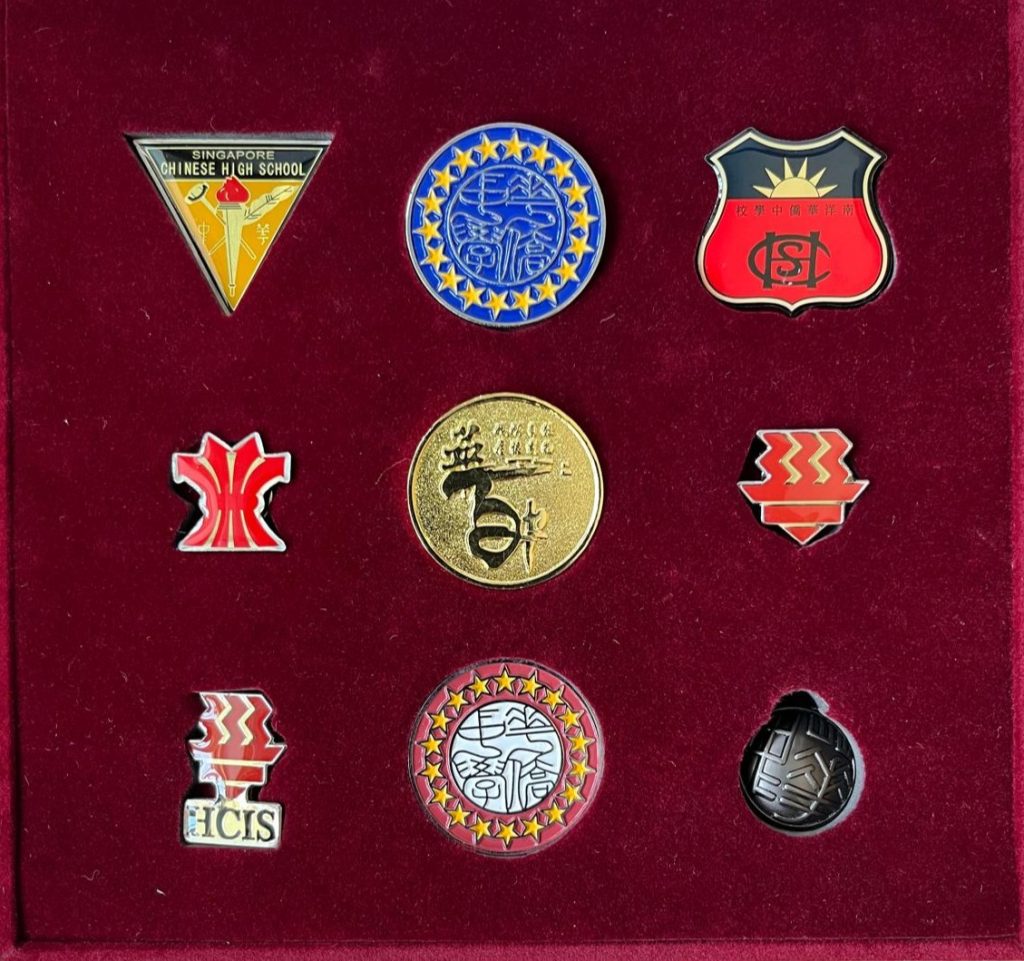
School motto
Aspiring, Diligent, Patriotic and Sociable (original)
Unrelenting Self-Empowerment (c. 1938–2005)
Tireless self-improvement with tenacity, innovation and passion (2005–present day)
Brief history
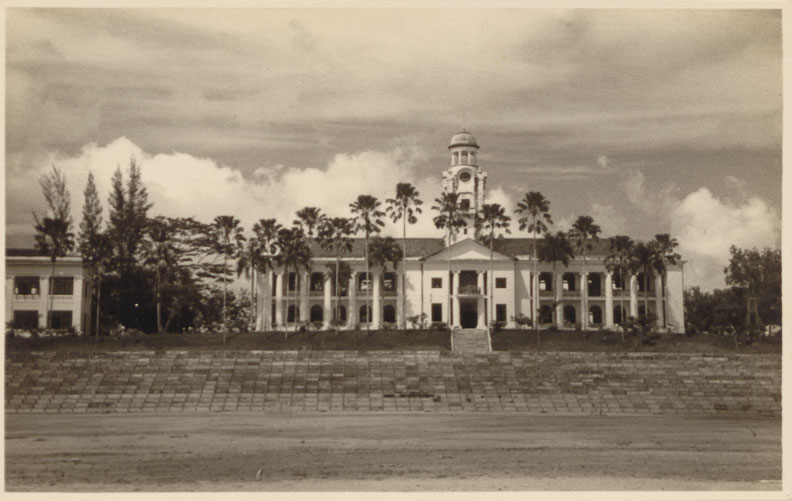
In 1923, while raising funds within the Chinese community to cover the school’s operating expenses, The Chinese High School’s chairman Tan Kah Kee also made plans to construct a new campus in Bukit Timah. Tan’s original intention was to have the junior-middle and senior-middle sections and university all in one place, and hence acquired a plot of land spanning 72 acres. In October 1925, Chinese High relocated to its new campus at Bukit Timah Road, which had a clock tower, auditorium, classroom blocks and student hostel, making it the largest middle school in Singapore.
During Ho Pao Jin’s tenure as principal (1925–1928), he actively promoted sports in school, and Chinese High became the first school to form a basketball school team in Singapore.
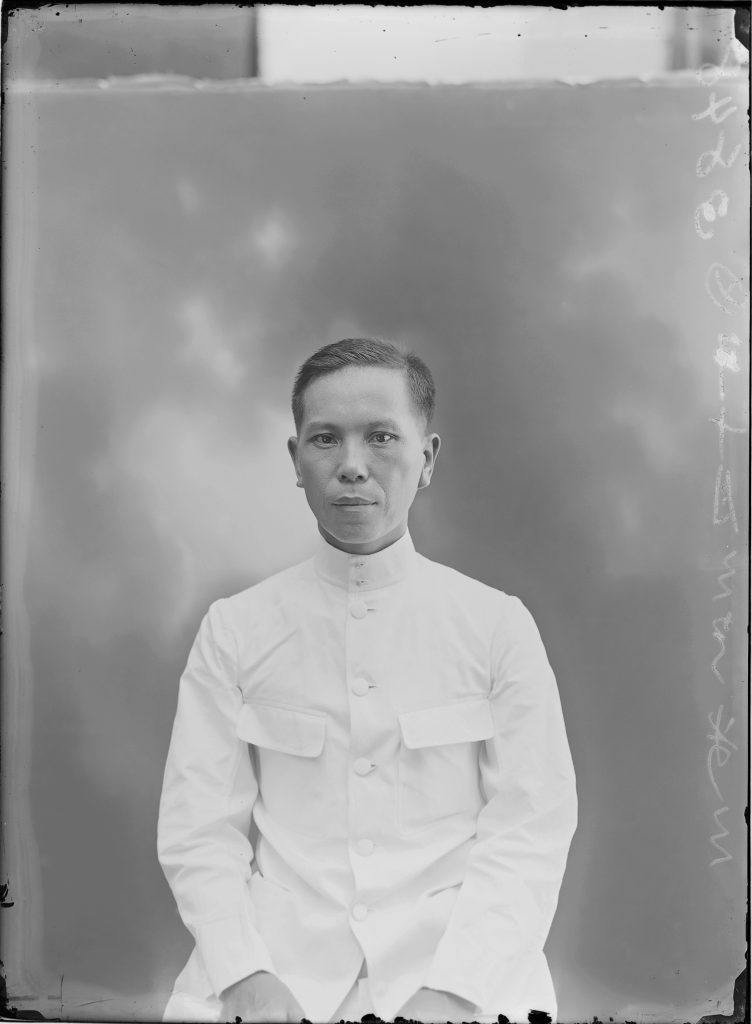
Between 1928 and 1930, during Tiger Balm founder Aw Boon Haw’s (1883–1954) tenure as its chairman, Chinese High built a staff hostel (Haw Par Building), two school gates, a driveway in the campus and a track in front of Haw Par Building. In 1933, Chinese High was temporarily closed for a year, before classes resumed in February 1934, when former Yeung Ching School principal Lam Lu Cheung (1888–1983) was appointed principal. In 1937, then-principal Sy Ong Sway (1889–1951) introduced many reforms, which boosted student enrolment and established a strong school ethos. In November that year, the board of directors registered The Chinese High School as a non-profit organisation in accordance with company regulations. On 17 May 1938, the school board approved a proposal to establish a physical education teachers’ training programme, but it did not materialise in the end. In 1940, Lee Kong Chian (1893–1967) made a sole donation for the construction of the Kuo Chuan Science Block in memory of his father, Lee Kuo Chuan (1854–1915). When the Japanese occupied Singapore in 1942, Chinese High was seized by the Japanese army and ceased operations.
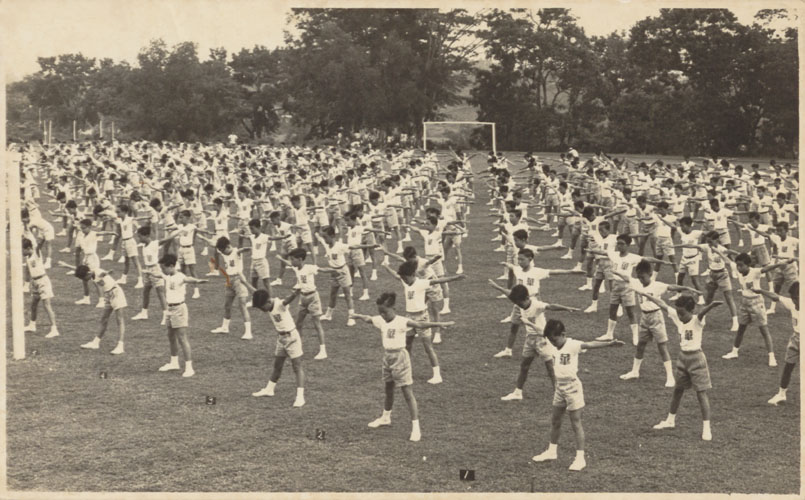
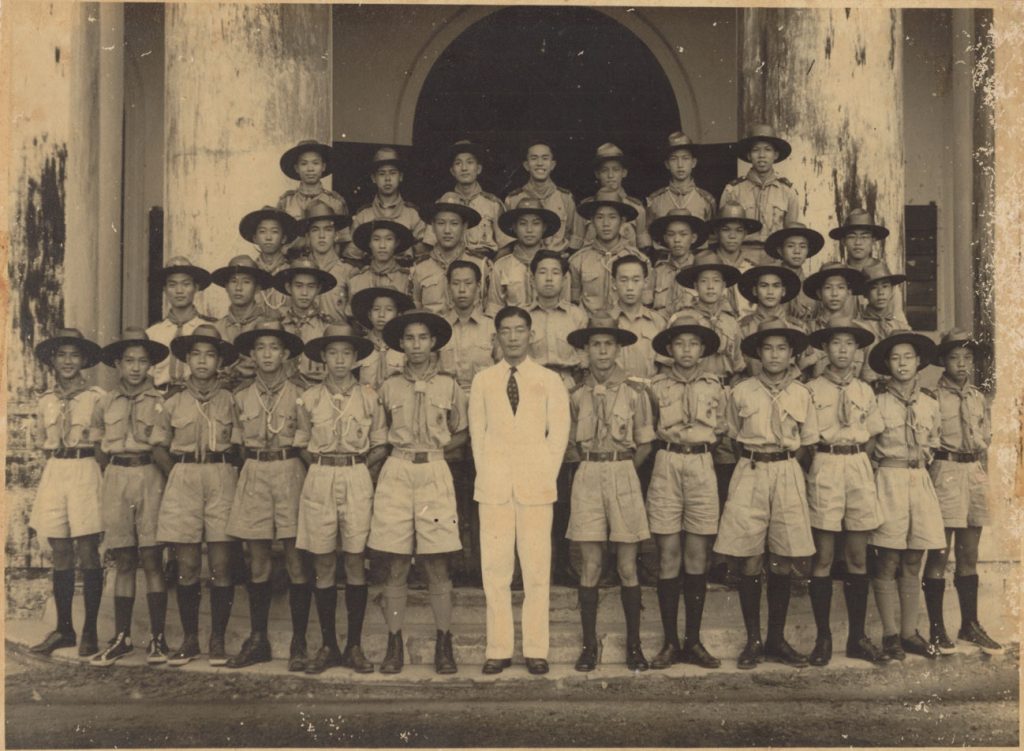
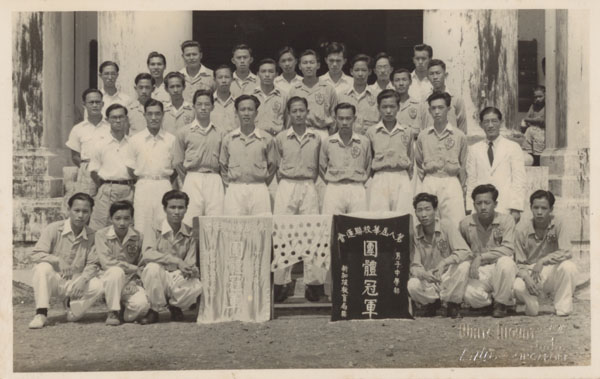
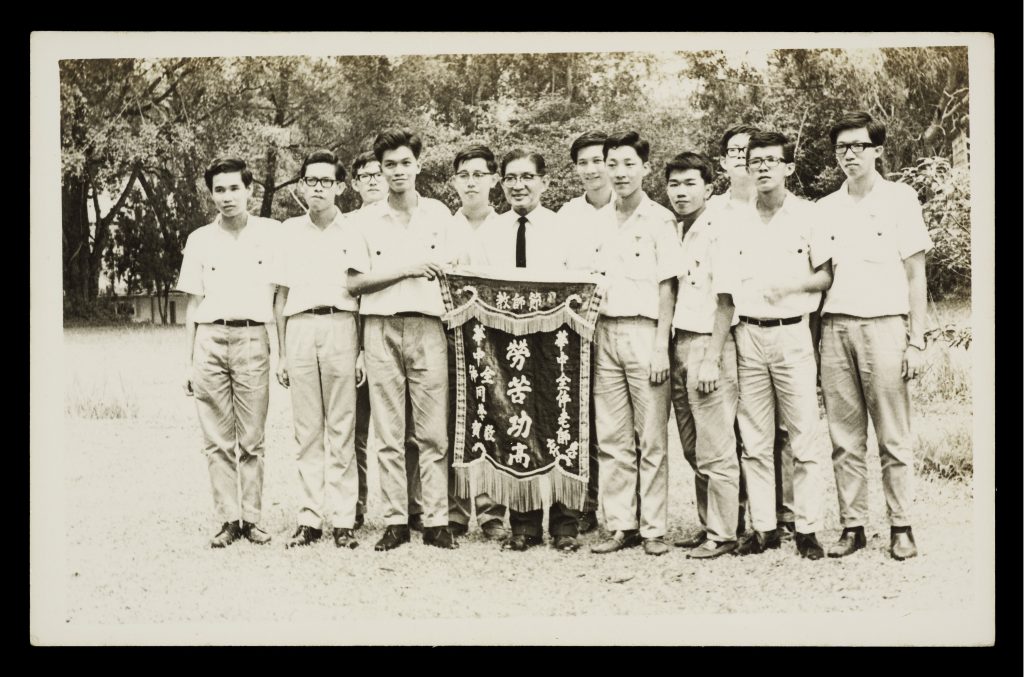
After the end of World War II in August 1945, classes resumed at Chinese High under the leadership of principal Sy Ong Sway and board chairman Lee Kong Chian. However, as the campus had been requisitioned by the British forces, classes were temporarily held first at the Chinese Kindergarten,2 and later at Nanyang Girls’ High School until 1946, when students were finally able to return to the old campus. As there was a shortage of Chinese textbooks in Singapore after the war, teachers from Chinese High collectively compiled a set of textbooks for local primary school students to use.
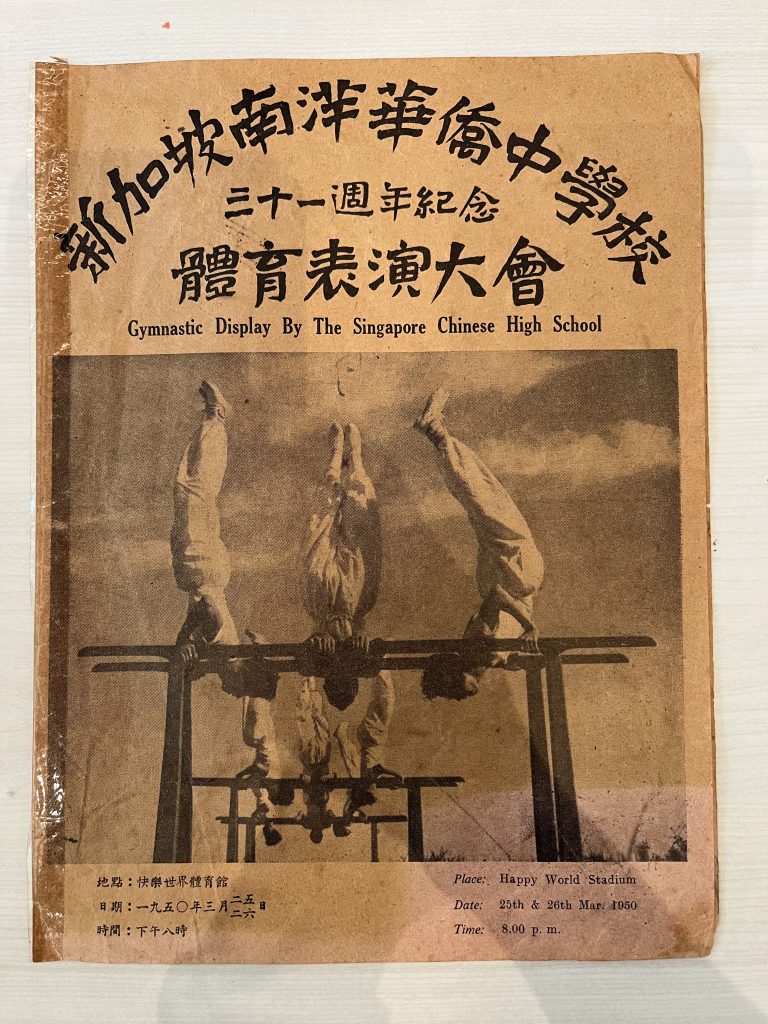
In 1947, Chinese High introduced a teachers’ training course to nurture primary school teachers, taking in both male and female students. However, the course was discontinued after two batches. In 1950, Chinese High staged a sports performance at the Gay World Stadium to raise funds for the construction of its large sports field, which was completed in 1954. With growing student enrolment, the school ran 40 classes in 1953, operating both morning and afternoon sessions. In 1954, strikes broke out when students from local Chinese-medium schools protested against the introduction of compulsory military conscription by the British colonial government, leading to authorities threatening to shut down Chinese High. Lee Kong Chian and principal Cheng An Lun (1910–1998) engaged in talks with the colonial government and saved the school from closure.
In 1962, Chinese High started a pre-university section. After Singapore gained independence, the school came under the purview of the Ministry of Education (MOE). In response to the government policy to develop technical education, technical subjects were added to the Secondary 1 curriculum, until they were replaced by computer courses in the 1980s. In 1974, Hwa Chong Junior College, which shared the same board of directors as Chinese High, was established. The same year, Chinese High ceased admitting new pre-university students and phased out its pre-university section at the end of the year, after its last cohort of Pre-University 2 students graduated. Between 1976 and 1977, construction of 18 new classrooms and a technical block was completed. With the new facilities, Chinese High no longer needed to operate two sessions and officially became a single-session school in 1977.
In 1981, the school began publishing The Tower Hill, which featured selected literary works from students. It started out as a bilingual publication, but was split into two publications each featuring either English or Chinese works from 1988. It is still in publication today.
In end-1978, Chinese High alumnus Tooh Fee San (1939–2023) became principal of the school. The following year, MOE launched the Special Assistance Plan (SAP) to nurture bilingual students. Under the programme, nine secondary schools with Chinese-stream background were designated as SAP schools, where both Chinese and English were taught as first languages.3 Chinese High was one of them. That year also marked the school’s 60th anniversary, which it celebrated on 21 March by holding its first-ever 10,000-people banquet. From 1985, all Secondary 1 to 4 students at Chinese High were placed in the “Special” stream, where they studied Chinese and English as first languages, underscoring the school’s emphasis on bilingual education.4 In 1988, the school’s board of directors and its alumni association accepted MOE’s proposal to make Chinese High an independent school.5 On its 70th anniversary, the school held its second 10,000-people banquet. Then-Second Deputy Prime Minister Ong Teng Cheong (1936–2002), who was an alumnus, graced the occasion. Between 1990 and end-1992, the campus underwent extensive renovation and added a building for the alumni association, a swimming pool, a new classroom block, a multi-purpose hall (Kah Kee Hall), a gymnasium and a Drama Centre, shaping the scale of Chinese High today.
In 1993, Chinese High launched the Gifted Education Programme, with a focus on nurturing high-achieving mathematics and science learners. The following year, it celebrated its 75th anniversary, with then-Senior Minister Lee Kuan Yew (1923–2015) officiating at the opening of the new campus and then-President Ong Teng Cheong gracing the banquet as guest of honour. The same year, the school restructured its extra-curricular activities as the Enhanced Pupil Performance Programme, which gives students the freedom to form any club or society of their choice. When Chinese High marked its 80th anniversary in 1999, the school’s clock tower was gazetted as a national monument.
After becoming an independent school in 1988, Chinese High practised decentralisation and autonomy. In 2000, the school replaced the traditional departmental structures adopted by most schools with the Consortium System, which operates on the concept of a “school within a school”. Under this model, teachers’ teams led by heads of departments would design and implement distinctive teaching programmes. In 2004, Chinese High joined the Integrated Programme and offered a six-year curriculum encompassing secondary and pre-university education.6 After a year of preparation, Chinese High and Hwa Chong Junior College merged on 1 January 2005 to become Hwa Chong Institution.
Building on its foundation where Chinese and English were taught as first languages, Hwa Chong Institution introduced the Bicultural Studies Programme in 2005.7 The aim was to elevate students from being effectively bilingual to being equipped with the necessary skills to traverse Chinese and Western cultures. In 2020, Hwa Chong Institution began offering the Chinese Language Elective Programme at the secondary level to nurture students proficient in the Chinese language.8
Since its founding, Chinese High offered art classes taught by artists from the region and graduates from various art colleges in China. Many of the art teachers were founding members of Singapore’s first calligraphy and painting society The Society of Chinese Artists, including Li Kueh Sei (1902–1971), Chen Chong Swee (1910–1985), Lim Hak Tai (1893–1963), Chen Wen Hsi (1906–1991), Liu Kang (1911–2004), Cheong Soo Pieng (1917–1983), Hsu Chun Lian (1911–2000) and Lu Heng (1902–1961).9
Chinese High has produced many notable alumni, including those who hold or have held political office, such as politicians Jek Yeun Thong, Ong Teng Cheong, Ng Chee Meng, Chee Hong Tat, Jek Yeun Thong, and Tan Kiat How; former top civil servants (Permanent Secretary) Cheng Tong Fatt (1929–2025) and Tan Chin Nam; former nominated parliamentarian Calvin Cheng and Koh Lian Pin. The school also counts among its alumni several recipients of the Cultural Medallion, including recipients Lim Tze Peng (1921–2025), Tan Swie Hian, Ho Ho Ying, Goh Beng Kwan, Choo Hoey, Lin Chen, Foo Tee Jun, and Lim Yew Kuan, Choo Hoey, Foo Tee Jun, Goh Beng Kwan, Ho Ho Ying, and Tan Swie Hian. Beyond public service and the arts, Chinese High alumni have also made outstanding contributions in the business, public service, cultural, and education, and technology sectors.
Principals and years in service
- Doo Kai You (1919–1922)
- Lu Shi Yi (1922–1926)
- Ho Pao Jin (1925–1928)
- Wu Yi Teng (1928–1929)
- Weng Zhi Da (1929)
- Huang Jun Chang (1930)
- Liu Gong Wu (1931–1932)
- Zhang Li Qian (1932–1933)
- Lam Lu Cheung (1934–1936)
- Sy Ong Sway (1937–1948)
- Cheng An Lun (1948–1968)
- Teh Kim Fatt (1968–1972)
- Wang Cho Ju (1972–1974)
- Kong Look Sen (1974–1976)
- Phua Beng Tee (1976–1978)
- Wu Tsung Kan (1978)10
- Tooh Fee San (1978–1999)
- Steven Koh Yong Chiah (1999–2002)
- Hon Chiew Weng (2002–2004)
- Ang Wee Hiong (2005–2009)
- Hon Chiew Weng (2010–2017)
- Pang Choon How (2018–2023)
- Lee Peck Ping (2024–present)
This is an edited and translated version of 华侨中学. Click here to read original piece.
| 1 | For an explanation of the Hwa Chong school song, see “Hwa Chong School Anthem”. |
| 2 | The Chinese Kindergarten, Singapore’s first kindergarten in 1921, was founded by Jubilee Church, which is part of the Presbyterian Church. |
| 3 | The Special Assistance Plan (SAP) was introduced in 1979 to nurture students with bilingual aptitude. The schools under this plan are called SAP schools, known to provide students with high-quality teaching and an environment that emphasises bilingual learning. |
| 4 | Under the streaming system introduced in 1981, MOE streamed secondary school students into three courses, “Normal”, “Express” and “Special” based on their Primary School Leaving Examination results. Students under the “Special” course would study both English and their respective mother tongue languages (Chinese, Malay or Tamil) at the first-language level. In 2024, MOE replaced the streaming system with Full Subject-Based Banding, which allows students of different backgrounds and strengths to learn and interact together. |
| 5 | Independent schools have the flexibility to set their own fees and decide on their academic and non-academic programmes. |
| 6 | Integrated Programme: A six-year course covering the secondary school and junior college curricula that leads to certification examinations such as the Singapore-Cambridge General Certificate of Education Advanced Level (GCE A-Level) examination. The programme allows students who scored in the top 10% of their cohort to proceed directly to junior college without taking the O-Level examination, giving them more time to develop their intellectual curiosity, creativity, critical thinking and leadership skills. |
| 7 | MOE established the Bicultural Studies Programme in 2005 to nurture bilingual and bicultural talents who can engage with both Chinese and Western cultures, while possessing local awareness and an international perspective. Students under the programme have the opportunity to participate in a variety of learning activities, such as seminars and lectures on Chinese general knowledge. |
| 8 | The Chinese Language Elective Programme (CLEP) is offered by selected secondary schools and junior colleges to nurture students who have an interest and aptitude in Chinese language and literature. |
| 9 | The Kuo Chuan Centennial Art Gallery (KCCAG) was officially opened in 2020 and houses the works of Singapore’s pioneer artists who were former Chinese High teachers, as well as works by established alumni artists. |
| 10 | Wu Tsung Kan was the principal of Hwa Chong Junior College, and was acting principal of The Chinese High School. |
“A brief history of our school.” Hwa Chong Virtual Tour website. | |
The Commemorative Magazine of the Official Opening of the Enhanced Campus of The Chinese High School. Singapore: Hwa Chong Institution, 1994. | |
“Hwa Chong Institution.” MOE Heritage Centre. | |
Loo, Kee Pow and Yeong Show Chang, eds. Hwa Chong Centennial Commemorative Book 1919–2019. Singapore: Hwa Chong Institution, 2019. | |
Souvenir Magazine on the 60th Anniversary of The Chinese High School. Singapore: The Chinese High School, 1979. | |
Souvenir Magazine on the Golden Jubilee Anniversary of The Chinese High School. Singapore: The Chinese High School, 1969. | |
Souvenir Magazine on the Unveiling Ceremony of the Bust of the Late Datuk Lee Kong Chian in Commemoration of the 65th Anniversary of The Chinese High School. Singapore: The Chinese High School, 1984. |