Maris Stella High School


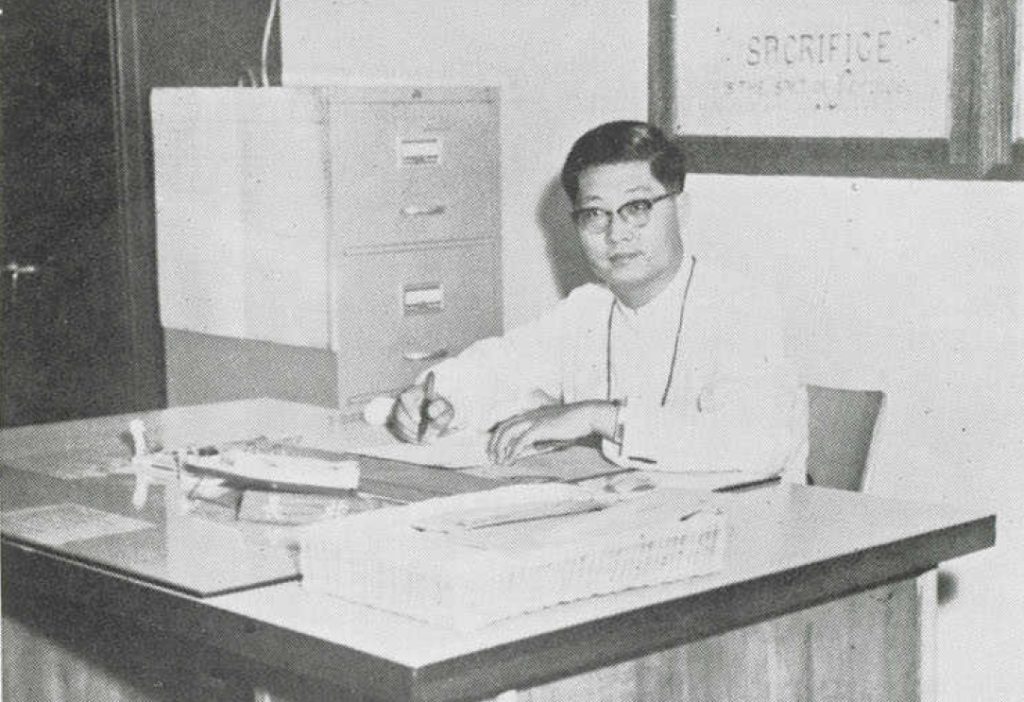
Maris Stella High School was founded by Reverend Brother (Rev Bro) Joche Chanel Soon (1918–1989) in 1958. Subsumed under the Marist Brothers Congregation, Maris Stella High School is the only school in Singapore established by this Catholic order. Marist Brothers Congregation was founded by French educator Blessed Marcellin Champagnat (1789–1840) in 1817, and is an international Catholic religious institute with an educational mission. All of its members are of the religious order.
Anchored on the Catholic faith and an understanding of Singapore’s society, Maris Stella High’s school song, which has always been sung in Mandarin, uses distinctive religious imagery such as “Star of the Sea” and “Our Lady”,1 moral exhortations, and terms of endearment for the country to echo the school’s motto of “Diligence, Determination, Loyalty and Dedication, Courage”. It articulates an education vision that is sacred yet secular.

School motto
Diligence, Determination, Loyalty & Dedication, Courage
Brief history
In post-war Singapore, there was a pressing need for education and Catholic High School (which had been handed over to the Marist Brothers to run) was overwhelmed with admission applications. To address the problem, parents of students at Catholic High School and the public urged the Catholic Church to establish a new school. Rev Bro Chanel, then head of academic affairs at Catholic High School, was tasked by His Excellency Mgr. Carlos van Melckebeke (1898–1980), Apostolic Visitor in South and East Asia, to establish Maris Stella High School to meet the urgent needs of society. In 1957, he discussed the matter with the Education Minister, and was formally appointed by the Marist Brothers that year to lead preparations for the new school. Maris Stella High School initially operated from borrowed classrooms at St Stephen’s School, which was managed by the De La Salle Brothers. Staying true to the values of the Marist Brothers, Maris Stella High School accepted boys regardless of their race or religion, with the mission of nurturing students of good character. The school started with a staff of 11 including the principal. They taught four Primary 1 classes and four Secondary 1 classes in the afternoon, with a total of 287 students.
Besides running classes at St Stephen’s School in Siglap, Maris Stella High School also operated concurrently at different premises between 1958 and 1966 as it gradually expanded. These included the science laboratories at St Patrick’s School in East Coast Road and classrooms at Silat Road Government Integrated Primary School, Jalan Kembangan Integrated Primary School, Opera Estate Convent and Tung Ling English School in Katong. As the school principal, Rev Bro Chanel had to manage school affairs while looking for a new campus site. In 1958, the school identified a 100-acre plot of government land at the junction of Fort Road and Mountbatten Road. The school was given two years to build the new campus, which would cost more than S$1 million. The school was unable to raise that amount after two years, and the land was returned to the government.
In 1961, the first batch of secondary-level students graduated, but Maris Stella did not have a pre-university section then. Rev Bro Chanel applied to the Education Ministry to set up a pre-university section the following year and his request was approved. In 1963, Maris Stella started to offer two-year pre-university classes, with the first batch of pre-university students graduating in 1964.
Between 1958 and 1964, Rev Bro Chanel travelled around the island and assessed 61 sites (including Scotts Road and Thomson Road) before settling on a five-acre plot of land in Mount Vernon Road in January 1964. More than 1,000 students from both primary and secondary sections of Maris Stella began lessons at this site from January 1967. Construction of the campus was carried out in three phases between 1967 and 1976. In 1967, a new school comprising classrooms and a science block was completed. The following year saw the completion of an adjoining block consisting of the Lee Kuo Chuan Hall, a canteen, a library, administration offices and a staff hostel. In 1976, a five-storey building for the primary section was officially opened. In 1982, the government allocated a 3.11ha plot adjacent to the secondary section for a separate primary section to meet growing demand for school admissions. The teachers, students and their parents were not averse to the fact that the mission school was situated next to the Mount Vernon cemetery. In 1987, the new primary school was completed and has been functioning as a single-session school since 1997.
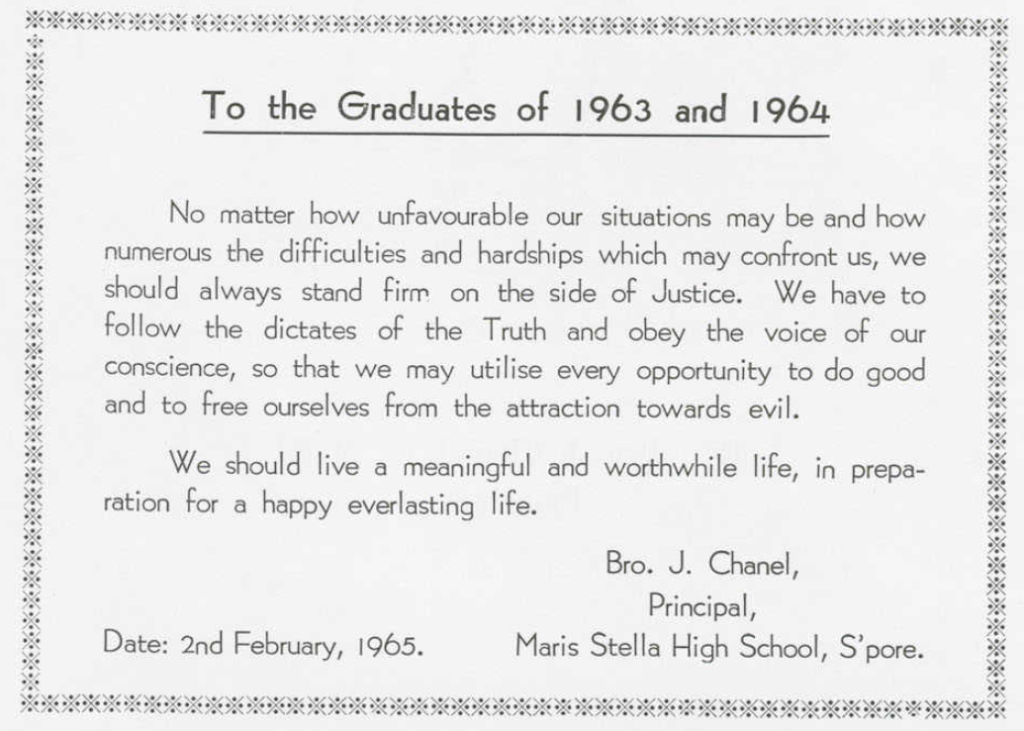
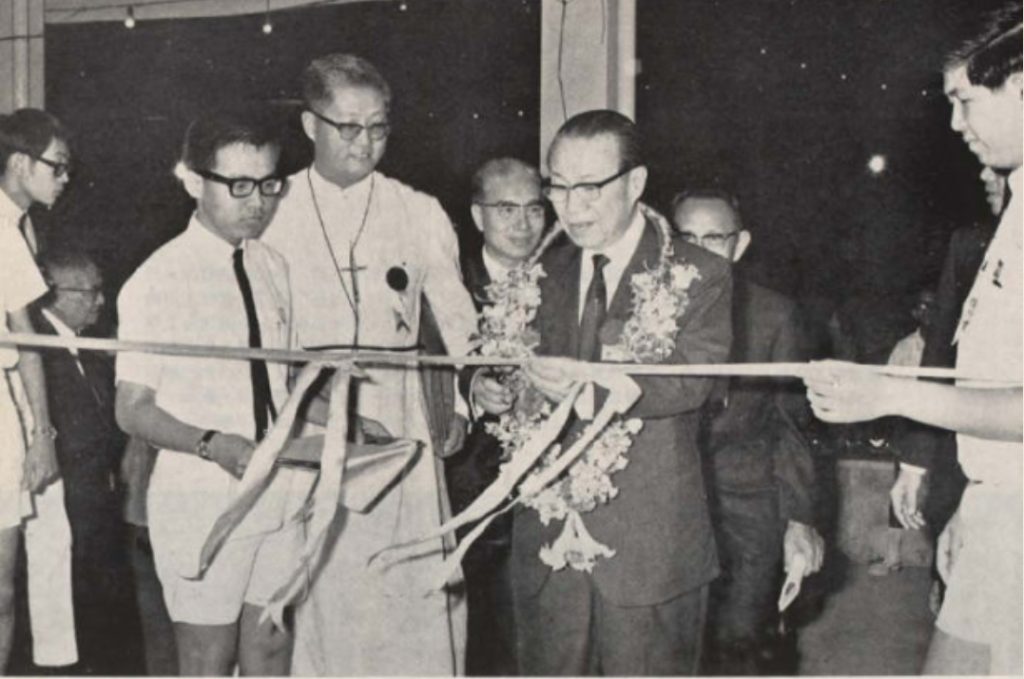
In 1971, the Maris Stella High School Alumni was set up. Four years later, Maris Stella ceased its pre-university classes. In 1979, the secondary section was selected as one of the nine pioneer Special Assistance Plan (SAP) schools, while the primary section was accorded SAP status in 1990.2 These attest to the school’s strong foundation in promoting Chinese culture. In 1982, old boys of Maris Stella High School set up the Brother Chanel Award at Rev Bro Chanel’s retirement dinner to honour his dedication to education. In 1996, the secondary section was granted autonomous status for its success in offering students a holistic education.3
After its secondary section became an SAP school in 1979, Maris Stella High embarked on a journey to transform its bilingual education. The school strengthened its teaching of the Chinese and English languages and fostered a bilingual learning environment, so that students can build on their mastery of the two languages and be better able to gain diverse knowledge and appreciate the beauty of different cultures. For instance, teachers use bilingual teaching materials in class and encourage discussions in English and Mandarin.
To further implement the mission of the SAP Schools in promoting Chinese language and literature, since 2008, Maris Stella has organised an annual National Chinese Short Film Competition, which is open to all secondary schools in Singapore. In 2020, Maris Stella began offering the Chinese Language Elective Programme4 at secondary level. In 2023, the school stipulated that all its Secondary 1 and 2 students must take Higher Chinese, to further promote the learning of Chinese at a higher level.
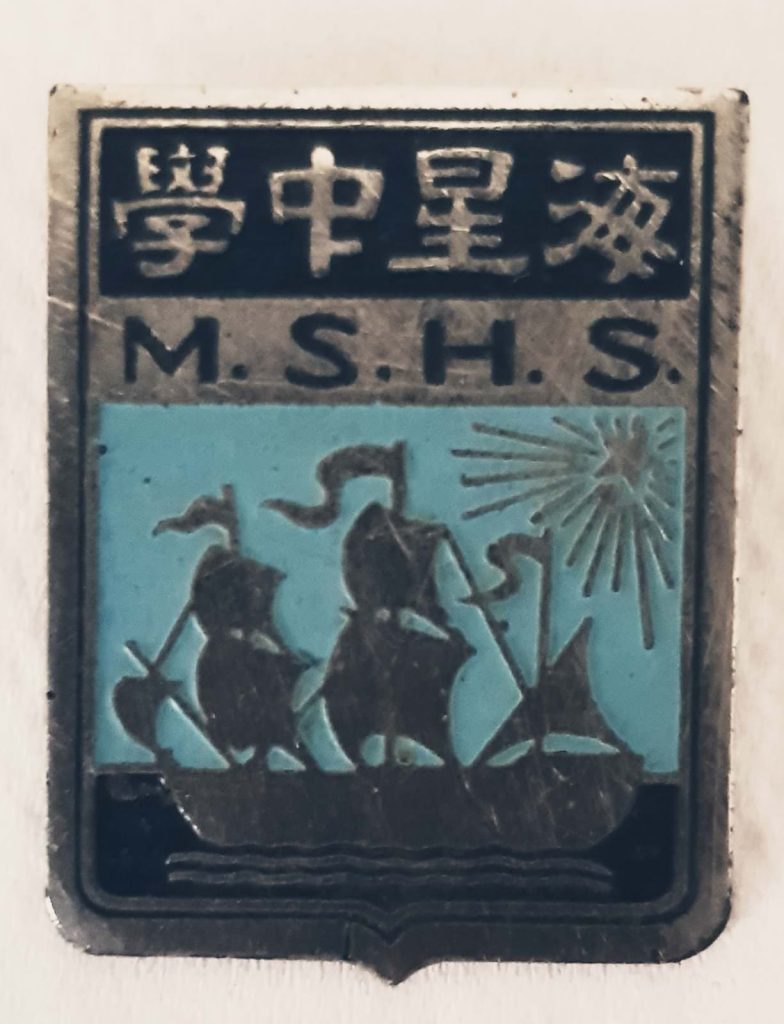
A school with a strong religious and cultural atmosphere, the school crest of Maris Stella High also bears deep religious and symbolic significance. The Marist “M” and 12 stars that symbolise the crown of Our Lady remind teachers and students to keep their faith, pass on the culture, embrace simplicity, foster a family spirit, have love of work and follow the way of Mary. Guided by the school’s vision of “Every Marist, a Gentleman of Faith, Vision and Service”, the school has transformed from a traditional Chinese school to one that offers modern, diverse education that moves with the times.
The school plans to rebuild its current campus from 2027 to 2029, and will relocate to a temporary campus from end-2026 before returning to Mount Vernon in 2030. Its primary section will go co-educational in 2027 and start taking in girls.
Alumni of Maris Stella High School have made contributions in various fields. They include current and former political office holders such as Ong Ye Kung, Koh Poh Koon, Lee Yi Shyan and Goh Chee Wee; Chinese community leaders Kwek Leng Joo (1953–2015), Teo Siong Seng and Roland Ng.
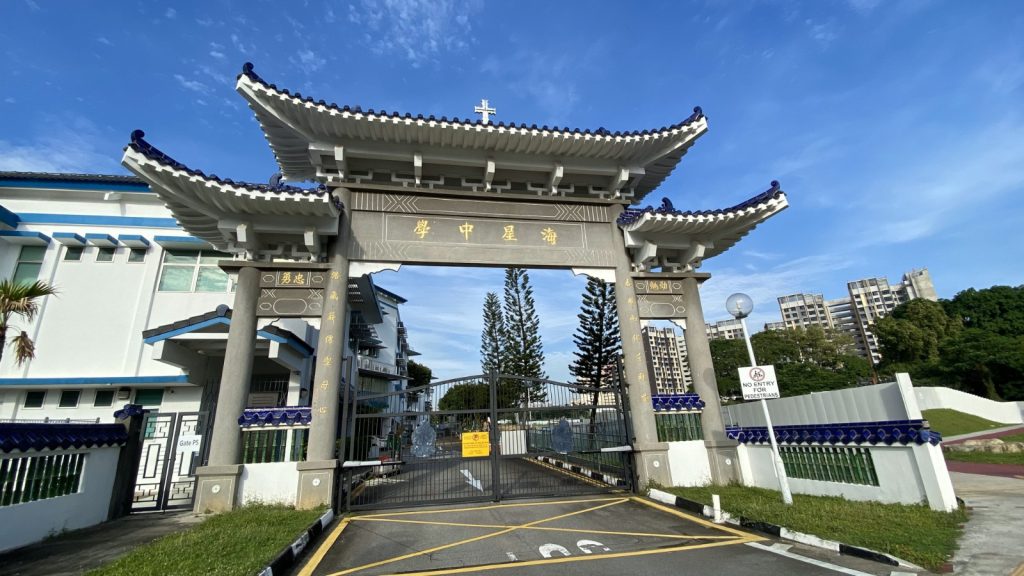
The Blessed Champagne school gate archway, which still remains today, is located in Maris Stella High School (Primary) and was built on the 200th anniversary of Blessed Champagne’s birth. Courtesy of Maris Stella High School.
Principals and years in service
- Rev Bro J. Chanel Soon (1958–1981)
- Rev Bro John Lek (1982–1983)
- Rev Bro Anthony Tan (1984–2009)
- Joseph Lim Choo Kiat (2009–2015)
- Woo Soo Min (2015–2022)
- Boy Eng Seng (2023–present)
This is an edited and translated version of 海星中学. Click here to read original piece.
| 1 | “Our Lady” is a title for the Virgin Mary, the mother of Jesus. |
| 2 | The Special Assistance Plan (SAP) was introduced in 1979 to nurture students with bilingual aptitude. Schools under this plan are known to provide students with high-quality teaching and an environment that emphasises bilingual learning. |
| 3 | Established in 1994, autonomous schools follow the Ministry of Education syllabus while providing a wider range of programmes than regular government schools to enhance students’ learning experience. |
| 4 | The Chinese Language Elective Programme (CLEP) is offered by selected secondary schools and junior colleges to nurture students who have an interest and aptitude in Chinese language and literature. |
Chong, Wing Hong, ed. Amazing Grace: In Memory of Brother Joseph Dufresse Chang 1927–2021. Singapore: Catholic High Alumni Singapore, 2023. | |
Koh, Hsiang Yu. “Dui shequ muxiao ji xiaoyou jieyou yichu, duoshu haixing xiaoyou lejian fuxiao yeshou nusheng” [Good for the community, the school and alumni: Most Maris Stella alumni happy with move of primary school to admit girls]. Lianhe Zaobao, 7 May 2024. | |
Haixing zhongxue biye tongxuehui qingzhu chuanghui shizhounian jinian tekan (1971–1981) [Maris Stella High School Alumni 10th anniversary commemorative magazine]. Singapore: Maris Stella High School, 1981. | |
“Haixing zhongxue xinxiaoshe shouqi gongcheng wanjun, ciqi yi yishi kaishi jinxing. Xiwang rexin renshi dingli zhichi” [First phase of Maris Stella High School’s new campus completed, second phase underway. School hopes for strong support from the public]. Nanyang Siang Pau, 1 August 1966. | |
“Maris Stella High School.” MOE Heritage Centre. | |
Maris Stella High School 25th Anniversary Souvenir Magazine. Singapore: Maris Stella High School, 1983. | |
Maria Stella High School Graduation Magazine. Singapore: Maris Stella High School, 1961. | |
Cuican xinghe: Haixing zhongxue 60 zhounian jinian tekan [Starry horizons: Maris Stella High School 60th anniversary commemorative book]. Singapore: Maris Stella High School, 2018. | |
Wu, Hua. Xinjiapo huawen zhongxue shilue [A brief history of Chinese secondary schools in Singapore].Singapore: Educational Publishing House, 1976. |