River Valley High School


In the 1950s, Singapore was in a state of unrest with widespread strikes and protests by workers and students, which affected community-run Chinese-medium schools. To provide uninterrupted education for students, the government, led by Singapore’s second Chief Minister Lim Yew Hock (1914–1984), established the first four government-run Chinese-medium secondary schools in 1956. They are Singapore Government Chinese Middle School1, Kallang West2, Gan Eng Seng3, and Hua Yi. All four schools bore the words “Government Chinese Middle School” in their names.
When it was first founded in 1956, River Valley High School was known as the Singapore Government Chinese Middle School and occupied the premises of Seng Poh Primary School. Its first principal was Suen Y-Chern (birth and death years unknown), who previously worked at the Ministry of Education (MOE). At that time, the school only had four classes with 119 students and three teachers.
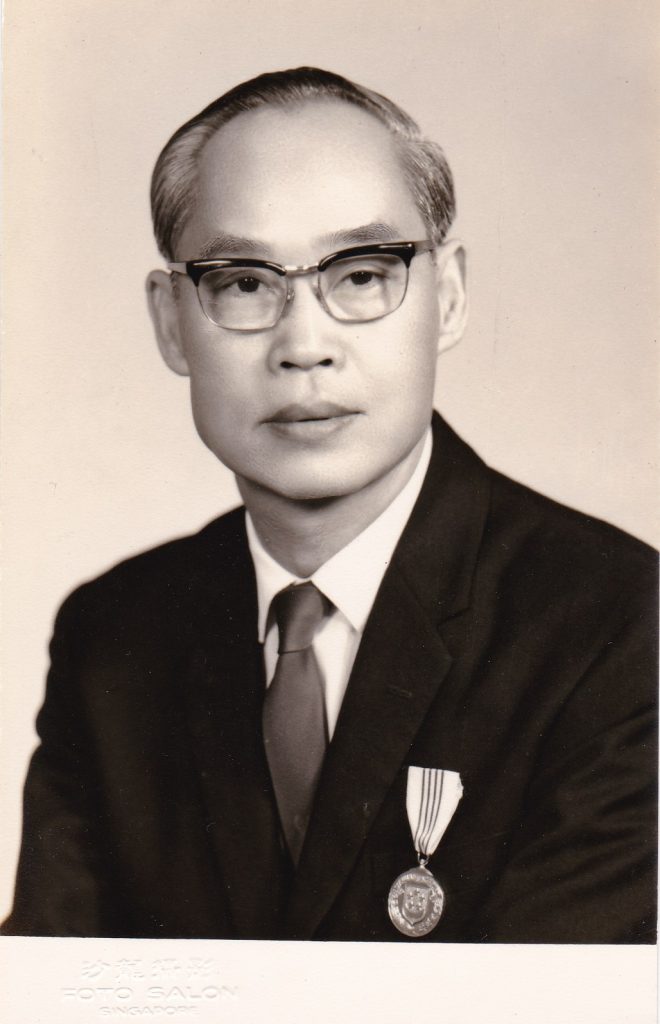
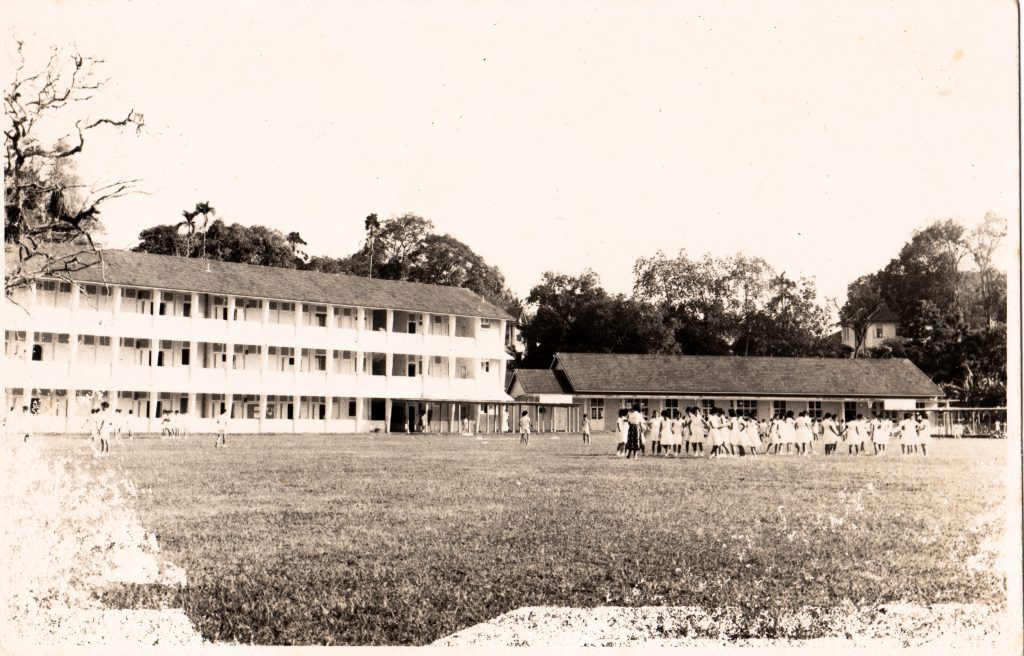
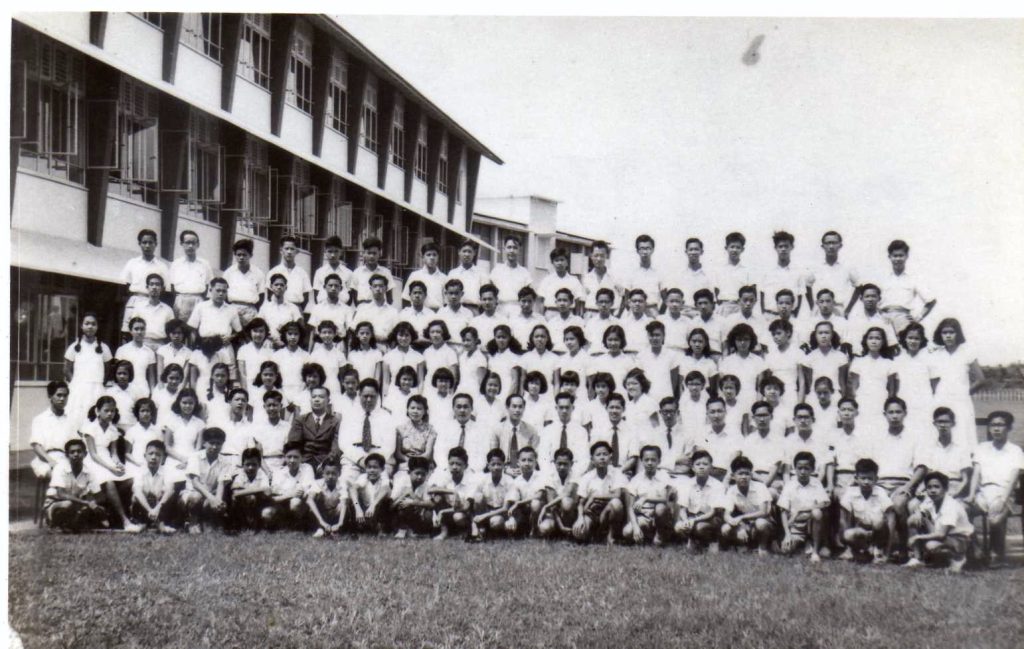
At the end of 1956, the school moved to the premises of Birdhann Primary School at Strathmore Avenue in Queenstown, and was renamed Queenstown Government Chinese Middle School. In 1958, it relocated to River Valley Road, which the school was named after. The school’s new official name was River Valley Government Chinese Middle School. When coming up with its Chinese name, the school wanted to incorporate transliterations of the words “river” and “valley”. Then-principal Lim Hui Eng (1921–1984) proposed “li hua”, a transliteration of the word “river”, taken from an old Chinese adage meaning to uphold virtue, establish merit, dispel ignorance, and overcome stubbornness. Beyond its Confucian connotations, the Chinese name also reflects the purpose of education.
In 1961, River Valley designed its own school uniform. Boys wore white shirts with metal buttons and white shorts, while girls wore white blouses and white skirts. Both uniforms featured the letters “R” in green and “V” in brown embroidered on the front. The same year, River Valley’s first batch of graduating Senior Middle 3 students achieved a 100% pass rate in the national examinations.
In 1967, River Valley adopted its school motto. Drawing inspiration from the Confucian concept of “three immortalities” (三不朽), a Chinese language teacher named Xiao Ting came up with the school motto, which echoes the school’s Chinese name. That same year, the school crest and flag — designed by students through a school-wide art competition — were also officially adopted, and have been in use since.
Xiao also incorporated the school motto into the lyrics of the school song, while the melody was composed by pioneering local musician Michael Tien Ming Ern (1918–1994). The lyrics use oceanic imagery such as “sea clouds and turquoise waves”, which are unique to equatorial regions, to depict the educational landscape. By likening the school to an “oasis”, the song not only makes references to local geography, but also subtly conveys the power of knowledge against ignorance, which is the core message of the school motto. In addition, the song uses “spring breezes” to symbolise the nurturing influence of moral education, and “peaches and plums” to represent the cultivation of talent, concretising the school’s pursuit of both moral and academic excellence as embodied in its motto. The verse “forget not” is repeated to elevate the school’s education mission into a collective vow passed on from generation to generation. The song ends with the lines “shining alongside the sun and moon” and “enduring as long as heaven and earth”, suggesting that only those with profound virtue and lasting achievements can make the school “shine brilliantly”.
School motto
Upholding Virtues, Contributing to Society
Brief history
In 1979, River Valley was designated a Special Assistance Plan (SAP) school in recognition of its strong foundation in Chinese language education, which heralded a new chapter in its development.4 Its alumni club was also established in the same year. In 1980, the school was officially renamed River Valley High School.
In 1986, it moved for the third time, this time to the former premises of Jurong Junior College at West Coast Road, and continued to expand its campus. In 1989, the school’s Archives was completed to preserve its rich heritage. In 1993, River Valley transitioned into a single-session school to enhance classroom management and became an autonomous school the following year.5
As it ushered in the 21st century, River Valley High School embarked on a new phase of development. In 2001, when the school was still located at West Coast Road, it was included in MOE’s Programme for Rebuilding and Improving Existing Schools (PRIME). The construction of a new teaching block equipped with modern teaching facilities, along with the addition of a new performing arts centre, enhanced the school’s infrastructure and laid a strong foundation for the school’s long-term growth.
In 2004, when reconstruction works of the West Coast campus commenced, over 2,000 teachers and students were temporarily relocated to the former campus of New Town Secondary School in Queensway. In September that year, then-Education Minister Tharman Shanmugaratnam officially approved River Valley High School’s proposal to offer the Integrated Programme.6 Following a re-evaluation by MOE, it was determined that even the reconstructed West Coast campus could no longer meet the needs of the six-year programme. As a result, the government allocated a 7.5ha site at Jalan Boon Lay as the school’s permanent campus.
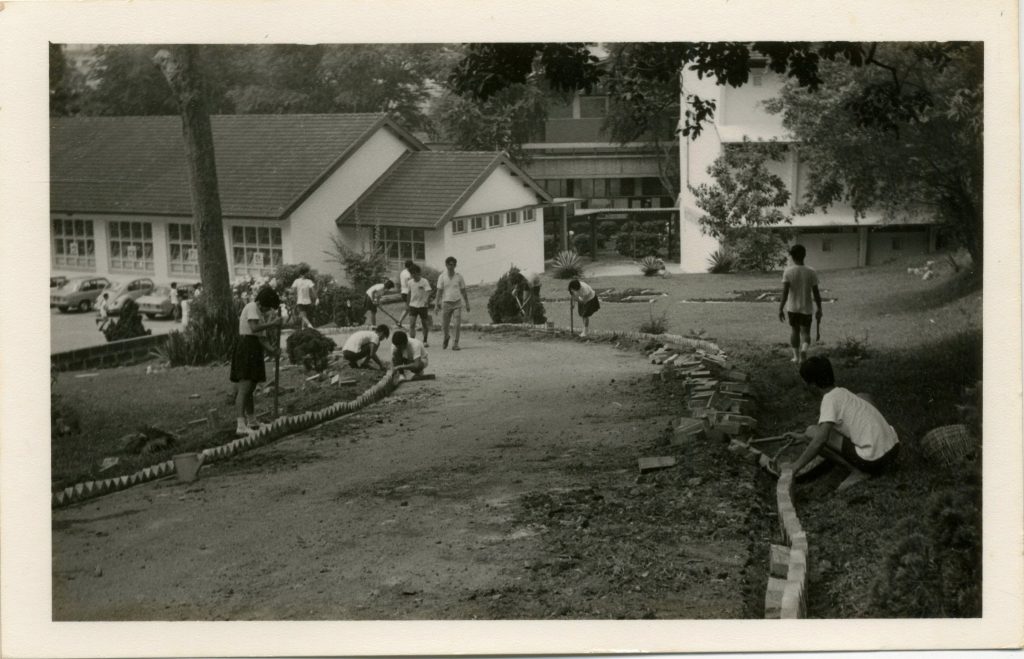
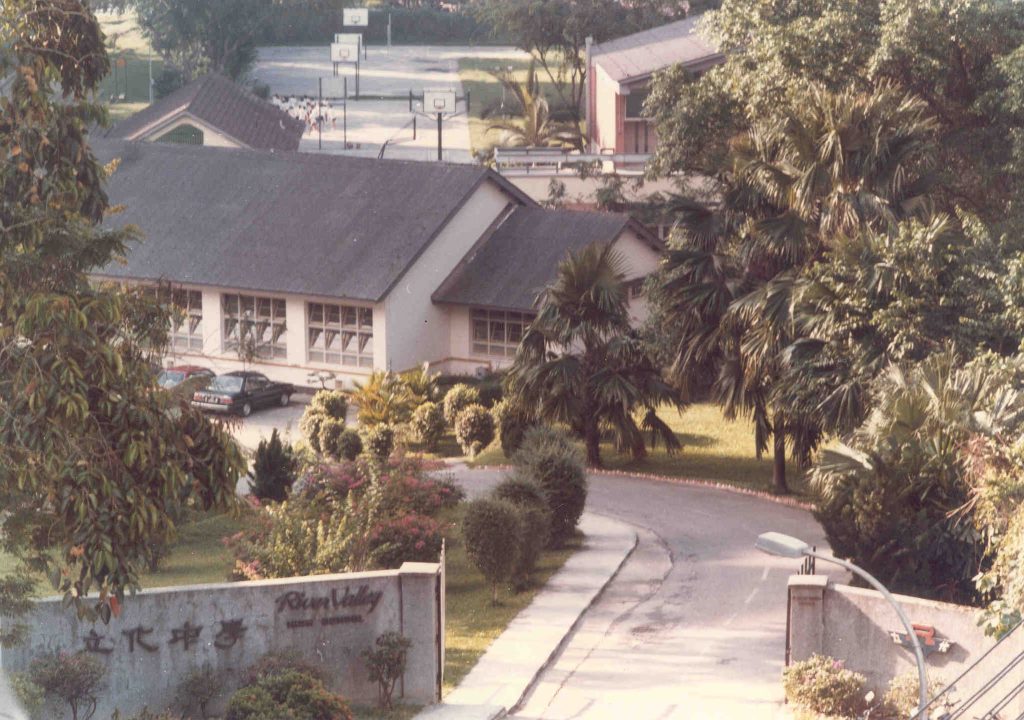
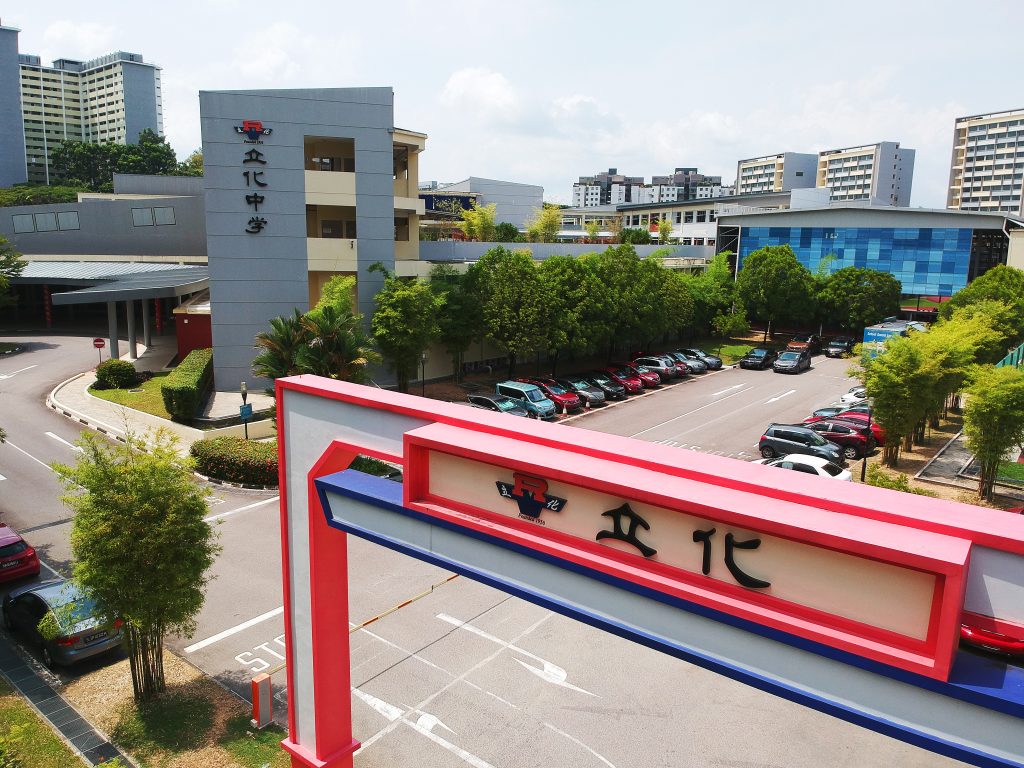
In 2006, the school implemented the Integrated Programme, which allows students to bypass the O-Level examinations and proceed directly to junior college. That year also marked River Valley High School’s 50th anniversary celebrations, and the school relocated again in June to the former site of St Andrew’s Junior College at Malan Road. This transitional move not only provided a suitable learning environment for students in the Integrated Programme, but also allowed sufficient time for the construction of the new campus at Jalan Boon Lay, with the full relocation scheduled for completion in 2009. In the same year, the school introduced the four-year Bicultural Studies Programme (BSP) for upper secondary students, further cementing its commitment to nurturing bilingual and bicultural competencies.7
In 2010, the school moved from Malan Road to its current premises at 6 Boon Lay Avenue, where the new campus officially opened for classes. After six relocations and four name changes, River Valley High School finally settled into its permanent home.
Today, River Valley High School is an autonomous school that offers both the SAP and Integrated Programme. Reflecting its rich cultural heritage, River Valley High School’s motto is prominently displayed on campus to inspire teachers and students alike to strive for high moral standards and guide others towards personal growth.
Alumni of River Valley High School have also made their mark in various fields. They include Cultural Medallion recipients Tham Yew Chin, Lim Yau, and former parliamentarians Ang Mong Seng and Peh Chin Hua.
Principals and years in service
- Suen Y-Chern (1956–1960)
- Lim Hui Eng (1960–1962)
- Wong Chong Chie (1962–1964)
- Wong Bing Chie (1964–1974)
- Leong Fan Chin (1974–1993)
- Tham Tuck Meng (1993–2002)
- Ek Soo Ben (2002–2009)
- Koh Yong Chiah (2009–2012)
- Teo Khin Hiang (2012–2021)
- Choy Wai Yin (2022–present)
This is an edited and translated version of 立化中学. Click here to read original piece.
| 1 | Now known as River Valley High School. |
| 2 | Now known as Dunman High School. |
| 3 | Now known as North Vista Secondary School. |
| 4 | The Special Assistance Plan (SAP) was introduced in 1979 to nurture students with bilingual aptitude. The schools under this plan are called SAP schools, known to provide students with high quality teaching and an environment that emphasises bilingual learning. |
| 5 | Established in 1994, autonomous schools follow the Ministry of Education syllabus, while providing a wider range of programmes than regular government schools, to enhance students’ learning experience. |
| 6 | Integrated Programme: A six-year course covering the secondary school and junior college curricula that leads to certification examinations such as the Singapore-Cambridge General Certificate of Education Advanced Level (GCE A-Level) examination. The programme allows students who scored in the top 10% of their cohort to proceed directly to junior college without taking the O-Level examination, giving them more time to develop their intellectual curiosity, creativity, critical thinking, and leadership skills. |
| 7 | Bicultural Studies Programme: The Ministry of Education established the Bicultural Studies Programme in 2005 to nurture bilingual and bicultural talents who can engage with both Chinese and Western cultures, while maintaining local awareness and a global perspective. Students in the programme have opportunities to participate in various learning activities, including immersion trips, as well as seminars and lectures on Chinese history, culture, and contemporary developments. |
He, Dechao, ed. Lihua teji [River Valley High School special issue]. Singapore: River Valley High School, 1990. | |
“River Valley High School.” MOE Heritage Centre. | |
Lihua zhongxue biye tekan [River Valley High School Graduation Magazine]. Singapore: River Valley High School, 1981. | |
Lihua zhongxue kuojian xiaoshe luocheng dianli ji youyihui tekan [River Valley Government Chinese Middle School Campus Expansion Inauguration Ceremony and Carnival Magazine]. Singapore: River Valley High School, 1968. | |
Tay, Cheow Yong. “Texuan xuexiao xiaoxun chuancheng chuantong wenhua” [The school motto of Special Assistance Plan school promotes traditional culture]. Lianhe Zaobao, 8 March 2018. | |
Wu, Hua. Xinjiapo huawen zhongxue shilüe [History of Chinese secondary schools in Singapore]. Singapore: EPB Publishers, 1976. | |
Woo, Keng Jin, ed. Lihua en, Lihua qing [River Valley High School: Gratitude and affection]. Singapore: Leong Fan Chin Education Foundation and River Valley High School Advisory Committee, 2018. |