From amusement parks to the heartlands: The evolution of getai in Singapore


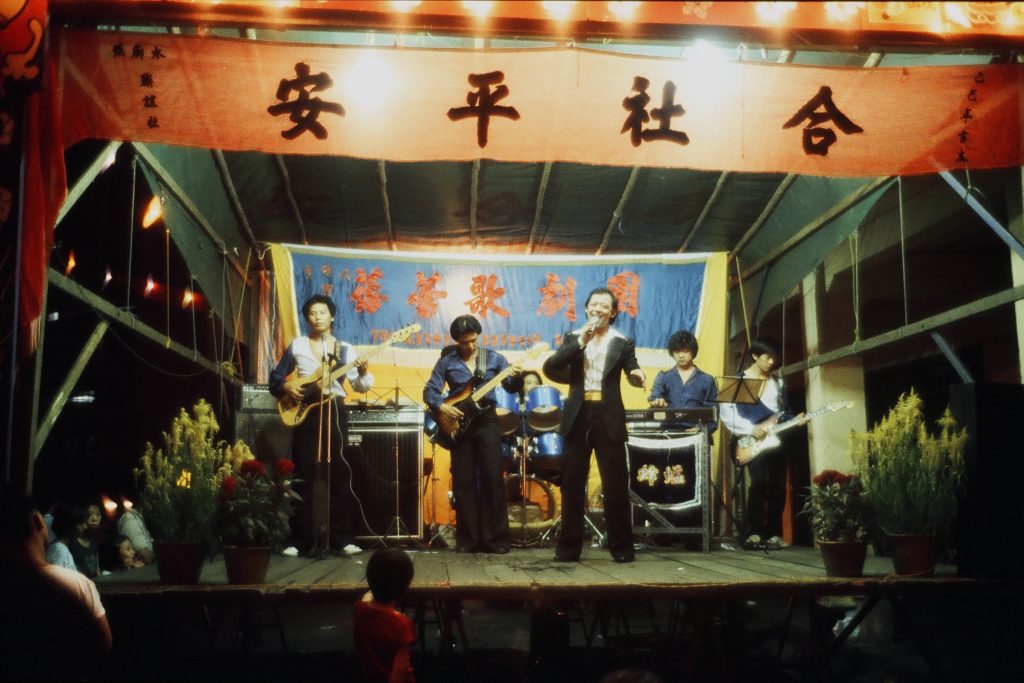
Getai (literally “song stage”) is an integral part of Singapore Chinese grassroots culture. Every year, during the seventh lunar month, elaborate stages can be spotted across the island in public spaces such as housing estates, basketball courts, and vacant car parks. As evening falls, nearby residents and getai enthusiasts take their seats and wait for the singers to perform a mix of Mandarin and dialect songs. The performances typically continue until 10pm, when the shows officially conclude.
Initially purely for entertainment, getai performances first began in Singapore’s amusement parks in the 1940s. They have now become ubiquitous in Singapore, and are also staged as offerings to deities during the Zhong Yuan Festival (Hungry Ghost Festival).
Getai has continuously evolved over more than 80 years, becoming one of Singapore’s most significant cultural events and reflecting the uniqueness of Singapore Chinese culture.
Getai’s amusement park beginnings
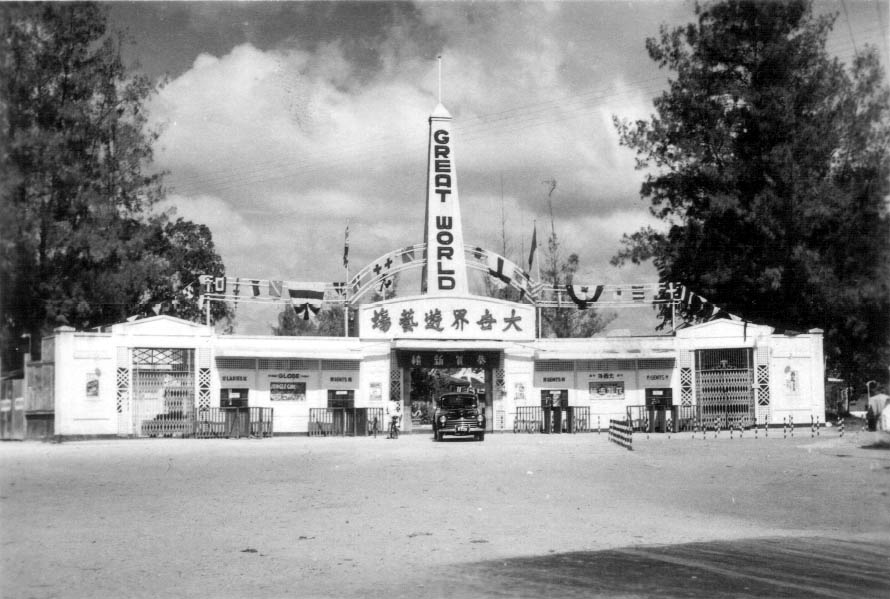
The origins of getai can be traced back to 1942 during the Japanese Occupation of Singapore. It first appeared in amusement park canteens as part of their entertainment offerings. According to the book Xinjiapo getai shihua (The history of getai in Singapore), Da Ye Hui, which performed at the New World Amusement Park, is regarded as Singapore’s first getai. Several other getai emerged at the New World Amusement Park in the 1940s, including Dong Fang, Le Yuan, Da Ye Hui, and Ti Yu Guan.1 In those early days, getai performances mainly featured songs, with each getai having its own resident singers and live bands. Competition between getai was common. As song and dance troupes joined the scene, getai gradually became more diverse, incorporating dance, acrobatics, drama, and other forms of performance. Getai became an important recreational activity that provided solace amid the hardships of the Japanese Occupation.
After World War II, the number of getai grew in tandem with Singapore’s economic growth and its flourishing entertainment industry. In the early 1950s, the outbreak of the Korean War caused rubber prices to soar, boosting Singapore’s economy. The improvement in living standards was also reflected in the thriving getai scene. Over the two decades after the war, as many as 50 getai emerged at the three major amusement parks in Singapore, and many getai performers went on to become celebrities. For instance, Rosalind Yang Pei Yun, the owner of Ciro’s Café at Great World Amusement Park, ventured into Hong Kong’s entertainment industry in the 1960s. Another getai star, Chng Soot Fong from Bai Le Men at the same Great World Amusement Park, was known as the “Queen of Amoy-dialect Cinema”, and starred in numerous Hong Kong films.2
Listen: Zao An Qu [Morning Serenade] by Chng Soot Fong, 1953.
Street getai in the seventh lunar month
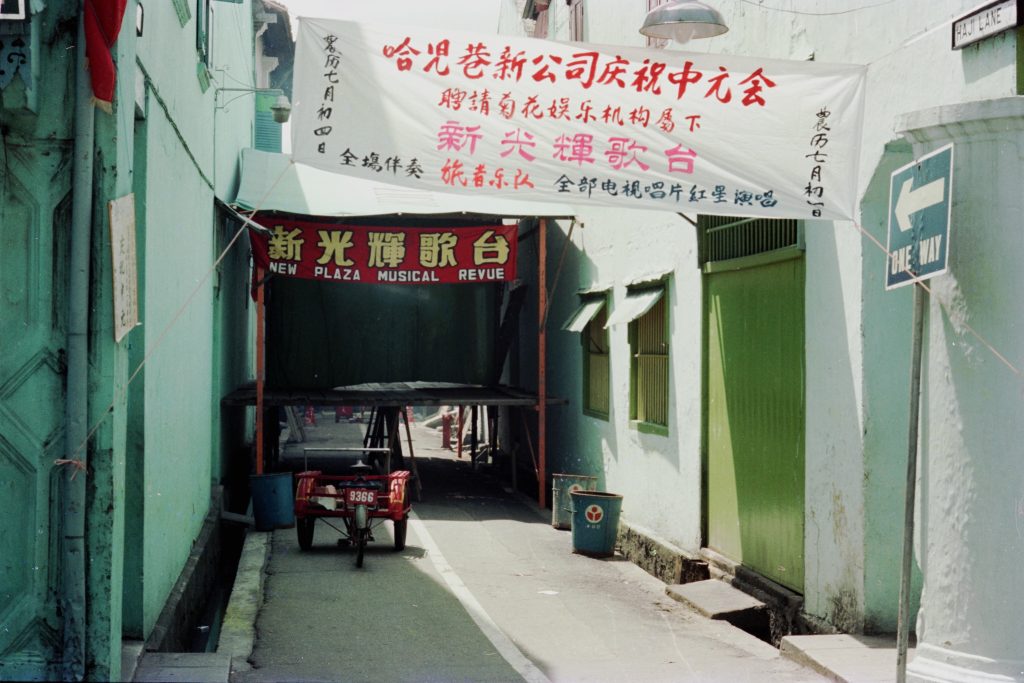
With the rise of television after the 1960s, Singaporeans’ main source of entertainment no longer centred around amusement parks as people switched to watching television from the comfort of their homes. To adapt to these changes, getai moved from amusement parks to temples and heartlands, becoming an important part of the Zhong Yuan Festival celebrations in the seventh lunar month.
According to Chinese folk tradition, the seventh month of the lunar calendar marks the opening of the Gates of Hell. It is known as the Ullambana Festival in Buddhism and the Zhong Yuan Festival in Taoism, and it is believed that wandering spirits return to the mortal world during this month in search of food. To appease these spirits and make offerings to deities (particularly the Diguan dadi, the Earth Official), people would conduct sacrificial rituals and perform traditional Chinese operas in the streets and temples, mainly in dialects.3 With the closure of amusement parks, getai singers began performing across Singapore at the invitation of Hungry Ghost Festival committees. Getai evolved into a festive activity that embodied both entertainment and religious elements. Over time, it gradually replaced traditional Chinese operas, becoming an important religious performance.
In the 1970s, as more public housing was developed, getai moved into housing estates and held regular performances throughout the year, becoming a symbol of the grassroots culture of Chinese Singaporeans. After the 1979 launch of the Speak Mandarin Campaign that encouraged people to speak less dialects, some academics believe that getai, which originally featured mainly Hokkien songs, has become an important cultural space for preserving the local Hokkien dialect.4
Getai in the age of new media
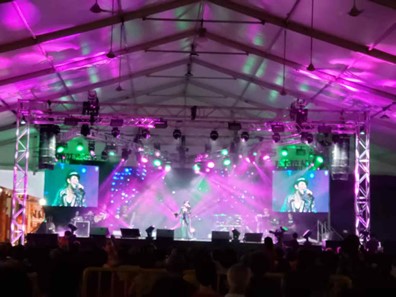
Getai experienced a period of inactivity in the 1990s due to urbanisation and the declining use of dialects. However, since the 21st century, new technologies have injected fresh life into getai performances. For instance, to raise performance standards, Lex(S) Entertainment Productions incorporated concert-standard stage designs and sound systems into its shows. Other production companies also livestream their getai performances on social media platforms like Facebook to attract a wider audience.
Films inspired by getai culture, such as 881 (2007) and 12 Lotus (2008), directed by Royston Tan, also received favourable reviews. In 2015 and 2018, Mediacorp organised two seasons of the singing competition GeTai Challenge, which allowed getai artistes to showcase their prowess. Meanwhile, films and television programmes have also given seasoned getai artistes more opportunities to perform.
With fewer Zhong Yuan Festival celebrations being held, the number of getai performances has also decreased over the years. During the COVID-19 pandemic, these performances were suspended. While local getai gradually resumed in 2022, the number of shows held in the seventh lunar month plummeted from over 300 before the pandemic to about a hundred afterwards. As a result, the question of how Singapore can sustain its unique getai culture has become a growing topic of discussion.
This is an edited and translated version of 从游艺场到邻里:新加坡歌台的历史演变. Click here to read original piece.
| 1 | Kwan Sin Ngee, “Rizhi shiqi de getai” [Getai during the Japanese Occupation], Lianhe Zaobao, 19 June 1994. |
| 2 | Wong Chin Soon, Xinjiapo getai shihua [The history of getai in Singapore] (Singapore: The Youth Book Co., 2006), 34–39. |
| 3 | Zeng Ling, “Chuangzao chuantong: dangdai xinjiapo zhongyuanjie yanjiu” [Creation of traditions: a study of the contemporary Hungry Ghost Festival in Singapore], in Xinjiapo huaren zongxiang wenhua yanjiu [A study of Singapore Chinese clan culture] (China, China Social Sciences Press, 2019), 249–79. |
| 4 | Huang Wen-ju, “Minnanyu geyao de chuanbo yu zaidihua fazhan: yi xinjiapo 1970 zhi 1980 niandai wei guancha duixiang” [The dissemination and local adaptation of Hokkien folk songs in Singapore during the 1970s and 1980s], The International Journal of Diasporic Chinese Studies 4, no. 1 (2012), 35–51. |
“Birth of the Singing Café: Sounds of the Yesteryear Volume 2 (1945–1955).” Digitised music record. National Archives of Singapore. | |
Chan, Hong-yin. “The Hungry Ghost Festival in Singapore: Getai (Songs on Stage) in the Lunar Seventh Month.” Religions 11, no. 7 (2020), 356. | |
Chan, Kwok-bun, and Yung Sai-shing. Chinese Entertainment, Ethnicity, and Pleasure. Visual Anthropology 18, no. 2–3 (2005): 103–142. | |
Chew, Wee Kai. “Nanfeiyan – bentu getai wenhua de lanshang” [The origins of local getai culture]. Lianhe Zaobao, 23 December 2019. | |
Goh, Siao Koon. “Getai biaoyan yujiaoyule, nianzhangzhe shuma shijie budiaodui” [Getai performances bridge the digital divide and enrich the lives of seniors]. Lianhe Zaobao, 5 November 2024. | |
Lee, Geok Hoon. “Wuxie getai de zuihou jiangren” [The last getai craftman]. Lianhe Zaobao, 2 July 2017. | |
Wong, Chin Soon. Xinjiapo getai shihua [The history of getai in Singapore]. Singapore: The Youth Book Co., 2006. |