Personal recollection: Live broadcasts of the National Day Parade


The Republic of Singapore was established on 9 August 1965, and celebrated its first National Day the following year. This inaugural celebration was highly symbolic, proclaiming Singapore as a sovereign, independent state. On that day, the government received congratulatory messages from 29 countries.1 The first NDP was held at the Padang (Malay for “field”) in front of City Hall, and was broadcast live on television, with coverage including its parades and performances such as lion and dragon dances. The event was celebrated nationwide. Over the past 50 years, the NDP has evolved from simple, large-scale events into dazzling, technology-driven musical spectacles. Today, live broadcasts of the NDP are a highlight of National Day celebrations every year, inspiring cohesion and unity among the people.
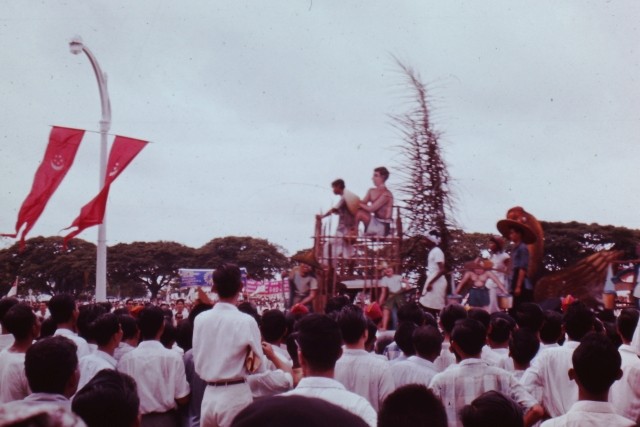
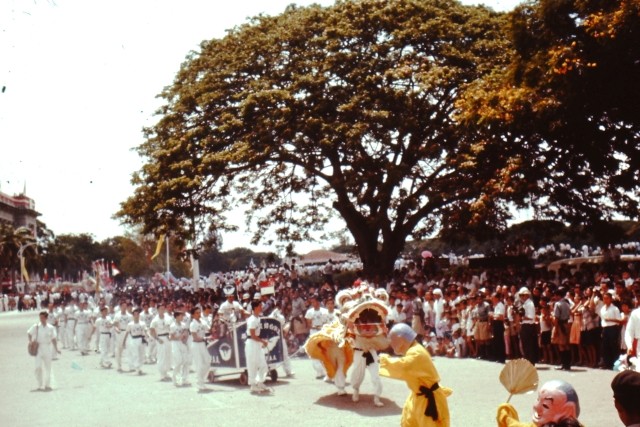
In 1975, Singapore began holding National Day celebrations at various locations around the island, in addition to the main event at the Padang. In 1983, the NDP was held at six different locations islandwide, with three events taking place in the morning and three in the evening. As a TV producer at Singapore Broadcasting Corporation (SBC), I was in charge of the morning and evening live telecasts of the celebrations at Jurong Stadium and Queenstown. Preparations began months earlier, with technicians from the engineering department and the production unit conducting site visits to find out more about the programme content, decide on the locations and number of cameras, as well as identify parking spaces for the outdoor broadcast vans, in order to avoid signal obstruction from tall buildings. As soon as the morning live broadcasts ended, the TV crew quickly packed up and drove the vans to the evening venues to prepare for the next live segment. Nearly 100 crew members worked quickly and deftly to ensure that the celebrations at various locations were broadcast to viewers all over Singapore.
At that time, concerned that the stadium might not be filled, the chairman of the Jurong Stadium NDP organising committee sent 20,000 invitations to nearby residents, and an open letter was sent inviting employers and employees of 600 companies in the Jurong Industrial Estate.2 A stark contrast to today, when people scramble to get hold of NDP tickets.
From 1976 onwards, the venue for the NDP alternated between the Padang and National Stadium, complemented by events on other parts of the islands. In 1985, Lim Siong Guan, then Permanent Secretary of the Ministry of Defence who was in charge of that year’s NDP, remarked to Cheng Tong Fatt, then Permanent Secretary of the Ministry of Culture and Deputy Chairman of SBC, that the NDP had become “repetitive and outdated”, and asked if SBC could offer some new ideas.3
Celebrations in the night
Cheng then assigned Director of TV Programmes Maureen Liew to form a team to work with the NDP organising committee. Liew proposed holding the show after dusk, as it would be more captivating under the floodlights. However, the lighting at the National Stadium was only suitable for night football matches and did not meet TV broadcast requirements. Furthermore, equipping the vast stadium with stage lighting would require thousands of lighting fixtures and millions of watts of electricity. The National Stadium, Public Utilities Board, and chairman of the organising committee all agreed that this would be a considerable challenge.
Cheng and Lim then convened a meeting with the relevant agencies, which yielded some breakthroughs. With full support from the Ministry of Defence, a dazzling and colourful performance was staged at the NDP held at National Stadium in 1986, which also featured laser displays and fireworks, giving Singaporeans a completely new NDP experience under a starry night. Since then, the NDP moved to the evening format, with its vibrant finale performances being the highlight of every year’s show. For the 1986 show, the production team deployed 13 cameras, including one on the stadium’s light tower and another on a Super Puma helicopter, to provide viewers with a panoramic view of the stadium for the first time.
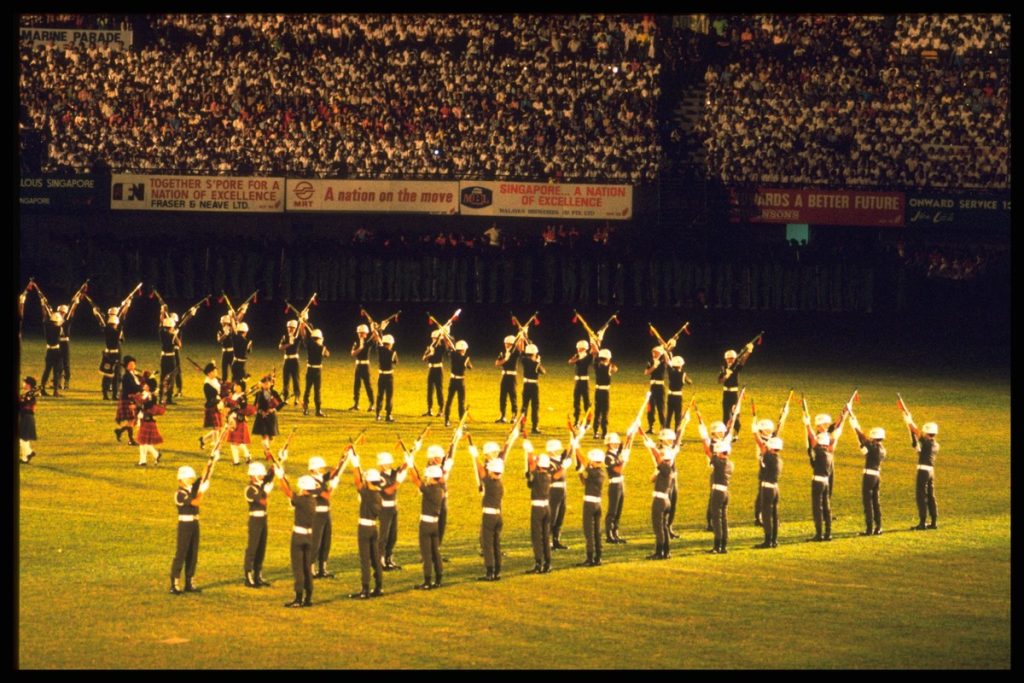
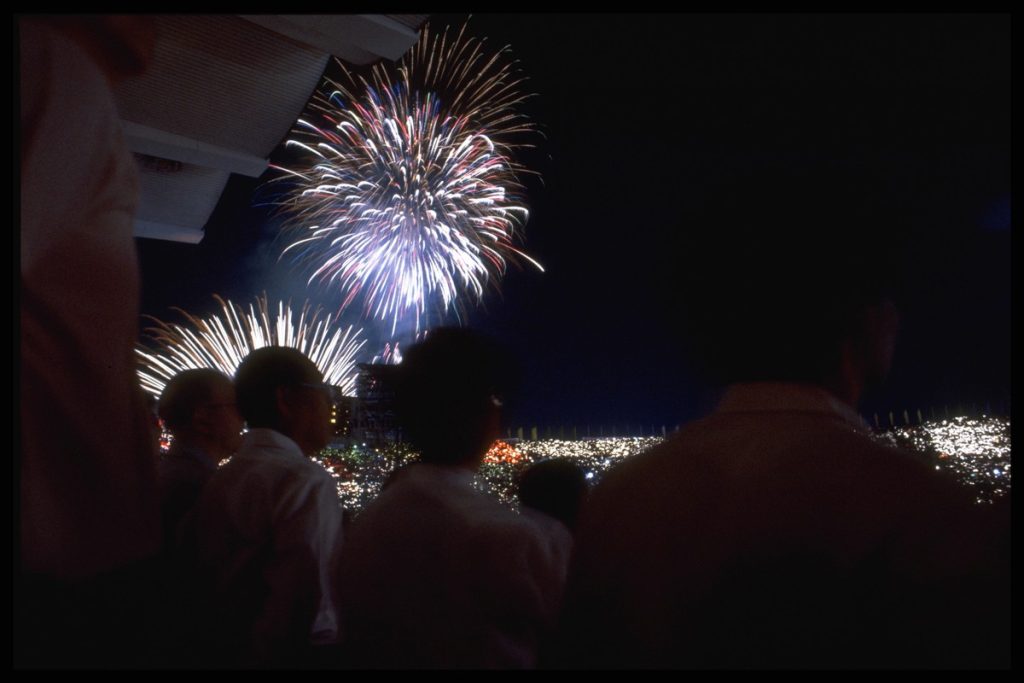
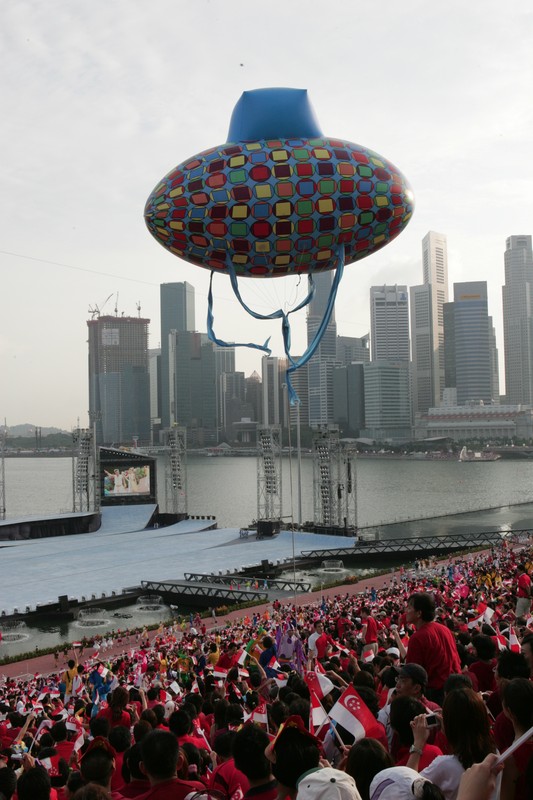
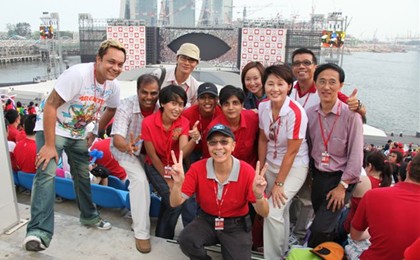
In 2007, when the National Stadium closed for renovations, the NDP was relocated to The Float @ Marina Bay. The vast space at Marina Bay provided the production team with an ideal location from which to capture the 21-gun salute, the thrilling Red Lions parachute displays, and spectacular fireworks.
Over the years, the TV production team strove to not only capture the images and sounds, but also the spirit of NDP through live telecasts of the spectacle, inspiring all Singaporeans to celebrate the nation’s birthday as one united people.
This is an edited and translated version of 【个人记述】从大草场到浮动舞台:国庆庆典现场直播. Click here to read original piece.
| 1 | “N-Day greetings,” The Straits Times, 13 August 1966; “Singapore’s first National Day celebrations,” Singapore Infopedia. |
| 2 | “Open letter to get people to Jurong parade centre,” The Straits Times, 8 August 1983. |
| 3 | Tay Philip J., Choo Lian Liang et al., eds, Huiwang jialigu shan [Reflections from Caldecott Hill], 16. |
Tay, Philip J., Choo Lian Liang et al., eds. Huiwang jialigu shan [Reflections from Caldecott Hill]. Singapore: Global Publishing, 2021. | |
“Singapore’s first National Day celebrations.” Singapore Infopedia. |