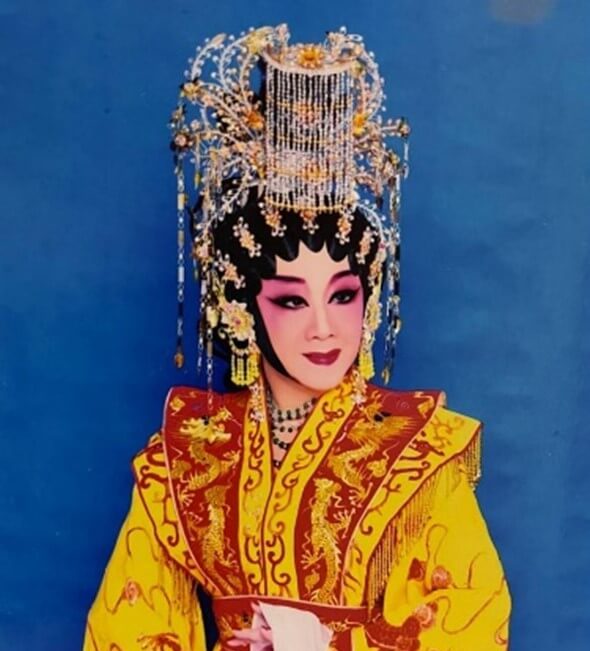
From Selatan Arts Ensemble to NanFang Arts Association


Selatan Arts Ensemble was founded in 1972 by teachers and former students of the post-1969 drama and dance classes of the Singapore Performing Arts School. After graduating, these students went on to set up different arts groups, such as drama, dance, singing and art and design societies. In 1971, under the “Singapore Performing Arts School” banner, these different groups came together to stage an “Arts Night”. Subsequently, they established an independent arts society — the Selatan Arts Ensemble — to stage performances, while the school focused on arts education and training. The Singapore Performing Arts School and Selatan Arts Ensemble became close partners and frequently co-organised activities and performances.
From 1972 to 1974, the Selatan Arts Ensemble held three editions of “Arts Night”, which featured locally-created plays, music and dance productions. In 1975, the group collaboratively produced a full-length play Growing Up written by Kuo Pao Kun, which ran for 15 consecutive sold-out performances at the Victoria Theatre. The production was hailed as the high point of Mandarin theatre in the 1970s.1
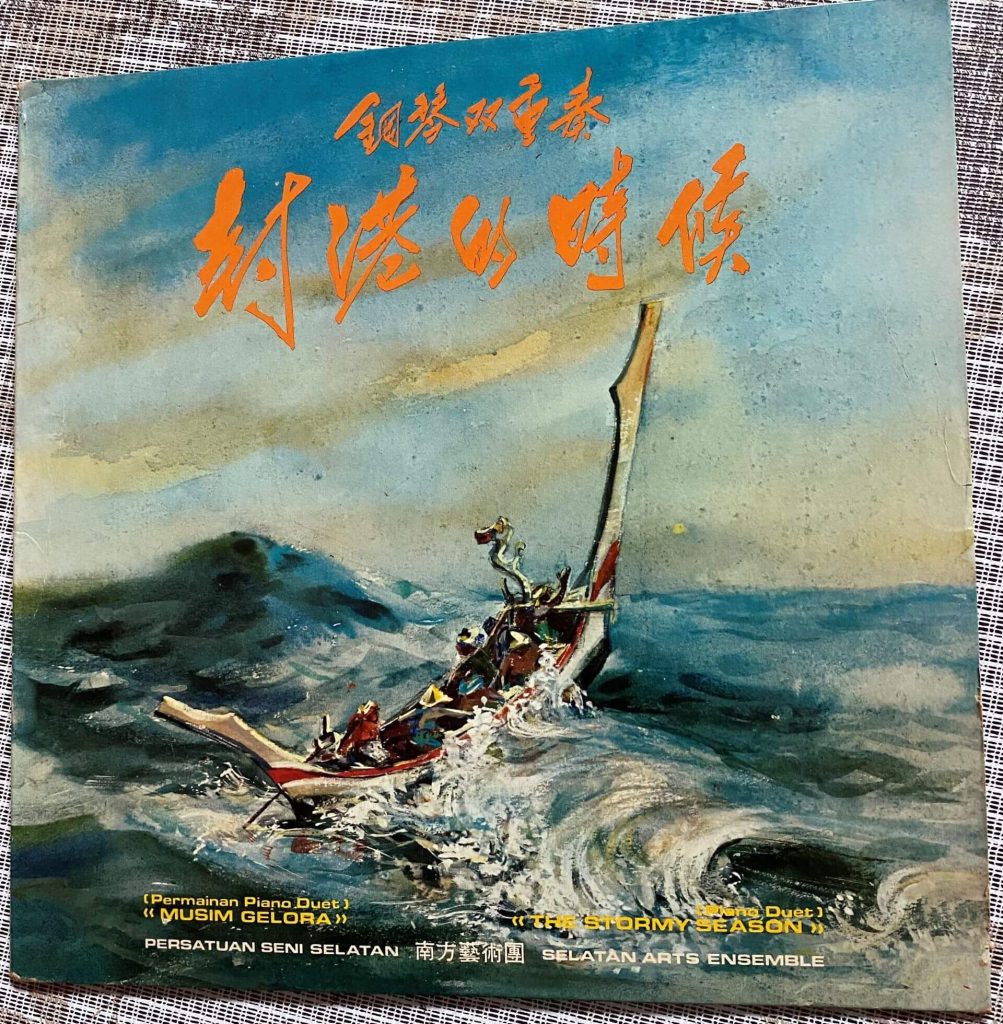
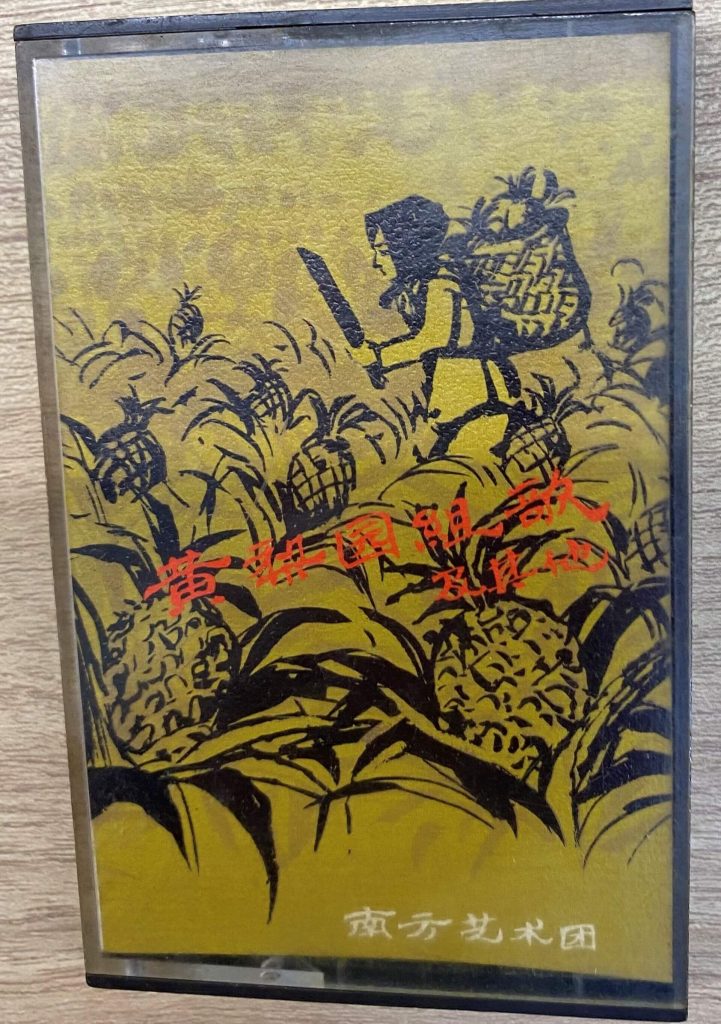
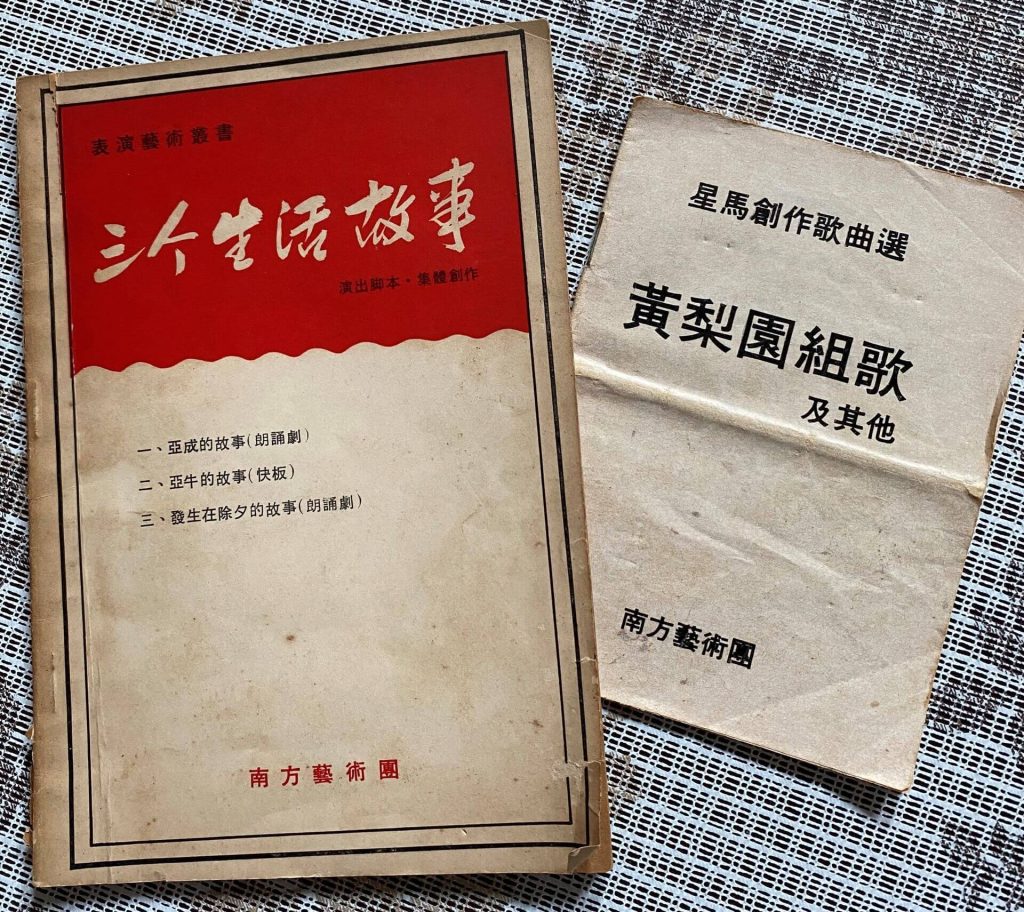
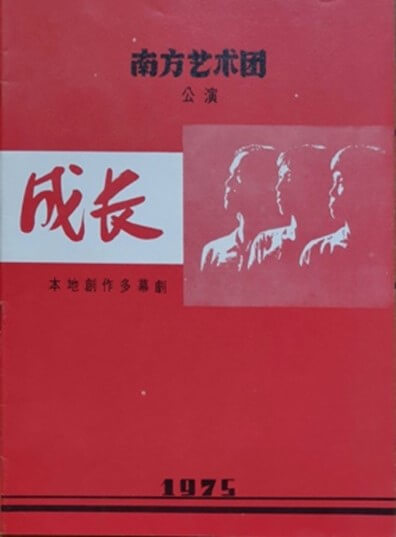
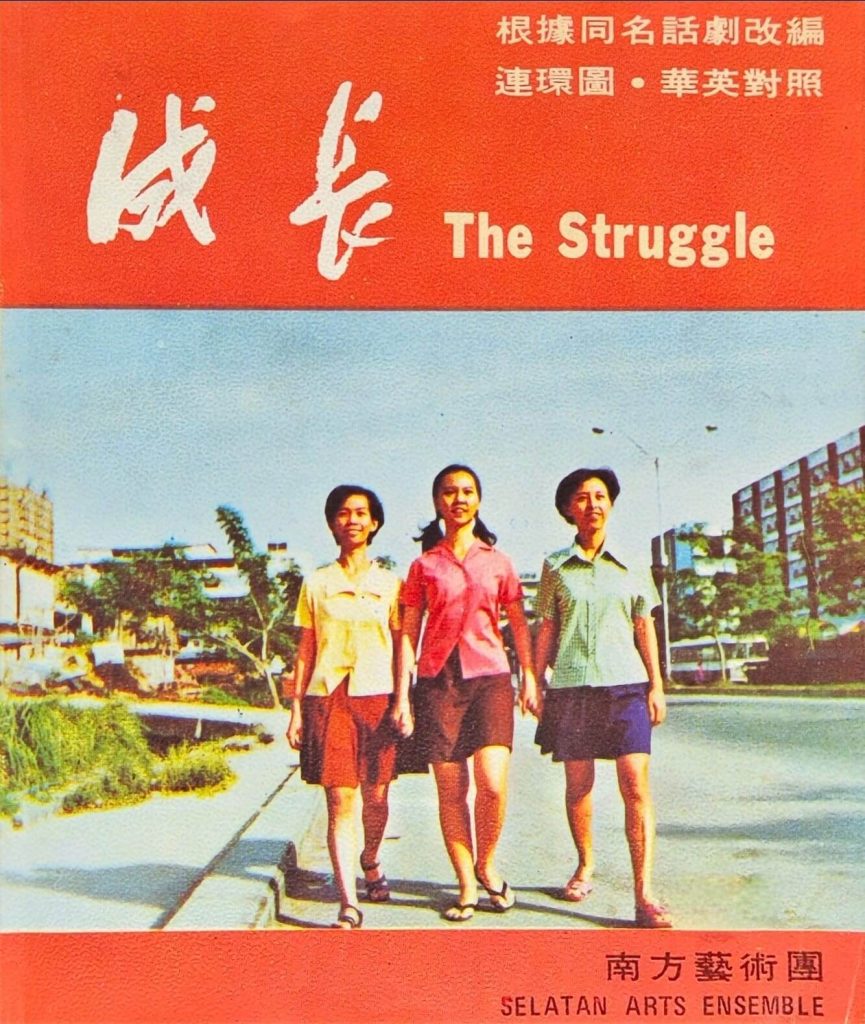
Renamed Southern Arts Society
In March 1976, a political incident affected many arts groups in Singapore, including the Selatan Arts Ensemble. One of its founders, theatre practitioner Kuo Pao Kun (1939–2002), was detained for four years and seven months under the Internal Security Act. That same year, Selatan Arts Ensemble registered as an amateur society and changed its name to the Southern Arts Society.
In the 1980s, the Southern Arts Society participated in various performances, including the Singapore Drama Festival organised by the Ministry of Culture, the radio programmes Xiangsheng duanju wanhui (Evening of Crosstalk and Short Plays) and Xiju zhi ye (Night of Comedy) staged by Lianhe Zaobao, Lianhe Wanbao and Shin Min Daily News’s joint drama group, Singapore Federation of Chinese Drama Associations’ theatre performance for the Singapore Arts Festival and charity show Chuangzuo xiju wanhui (Evening of Plays) to raise funds for the Chung Hwa Medical Fund. From 1981 to 1990, the society also took part in touring shows organised by radio stations and community centres.
The society’s members went on to receive critical acclaim for their work in theatre. At the 1981 Singapore Drama Festival, Yong Ser Pin won the Best Male Actor Award for his performance in the short play The Mishaps of the Inspector. At the 1982 Singapore Drama Festival, Han Lao Da’s full-length play Jinyinhua (Honeysuckle) was named the Best Performing Group (Chinese Drama), while Johnny Ng won the Best Male Actor Award for his role in the play. At the 1983 Singapore Drama Festival, Arthur Miller’s play The Cat and the Plumber directed by Li Zufu was named the Best Performing Group (Chinese Drama).2
In June 1981, more than half a year after his release from prison, Kuo Pao Kun directed the American short play Sorry, Wrong Number for Southern Arts Society. In 1982, Kuo directed the acclaimed South African play Sizwe Banzi is Dead. Both productions explored themes of humanity and justice, and introduced to the local scene the performance technique of “breaking the fourth wall” to acknowledge the presence of the audience. These works exerted a profound impact on the direction of Southern Arts Society and the Singapore theatre landscape.
In 1985, Huanle de jiezou (Joyful Rhythms), a production by arts groups under the Southern Arts Society, was staged. It featured a Chinese orchestral performance directed by Lee Ngoh Wah (1944–2024) and conducted by Wu Zhiyuan, and jointly performed by Southern Arts Society and Hsinghai Arts Association and Qun Yin Orchestra. Other highlights included female vocal performances, a choral piece conducted by Peng Zhusheng (1947–2016), dance works choreographed by Shen Zhihua, an improvisational theatre and crosstalk performance written by Han Lao Da, and an absurdist play directed by Li Zufu.
In 1986, Han Lao Da presented Five Libras at the Singapore Drama Festival. Critics noted the “distinctive approach of the play, which breaks away from the traditional didactic style of Chinese language theatre and instead portrays characters and plots that the audience can relate to”.3
Between October and December 1987, the Southern Arts Society brought theatrical activities to schools for the first time, conducting workshops on improvisational creations and performances at six institutions, namely Nanyang Junior College, Hwa Chong Junior College, St Nicholas Girls’ School, National University of Singapore Chinese Society, the Cultural Activities & Social Service Club of Ngee Ann Polytechnic, and Singapore Polytechnic’s Chinese Language Society.
In January 1989, the Southern Arts Society staged Shiqing zhi yue (A Rendezvous with Poetry), which combined musical accompaniment, recitation, and stage design for the first time to present the works of 22 Singaporean poets. In 1993, the National Arts Council sent a Southern Arts Society delegation to Bangkok to represent Singapore at the 3rd ASEAN Festival of Performing Arts — the first time a Mandarin theatre group from Singapore was participating in this international event.
In 1997, to celebrate its 25th anniversary, Southern Arts Society staged two performances: the drama group presented Yelin xuexiao (Schools Among Coconut Trees) written by Han Lao Da, while the choir put up a concert titled Changba, nanfang (Let’s Sing).
Subsequently, members of the association’s drama group and Chinese orchestra gradually ceased their activities due to personal reasons, while the choir and dance groups continued their activities with limited resources.
The formation of NanFang Arts Association
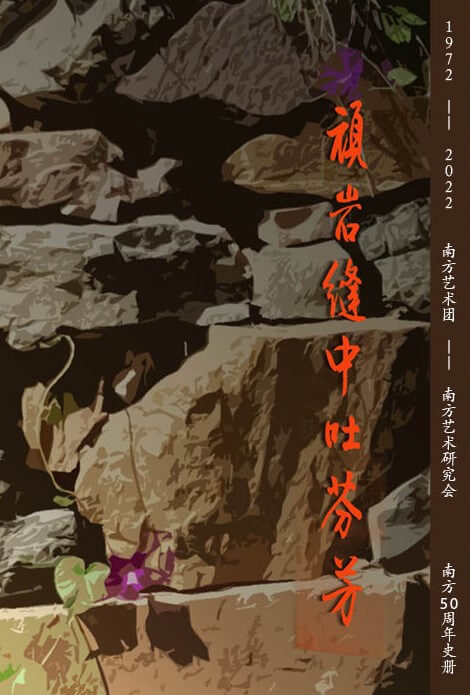
In 2022, a group of founding members of the Selatan Arts Ensemble, left the Southern Arts Society and established NanFang Arts Association to continue their artistic pursuits. Selatan Arts Ensemble’s 50th anniversary commemorative book, Wanyan feng zhong tu fenfang: 1972–2022 nanfang wushi zhounian jinian teji (Selatan Arts Ensemble’s 50th anniversary commemorative book: 1972–2022), was also released in conjunction with the formation of NanFang Arts Association.
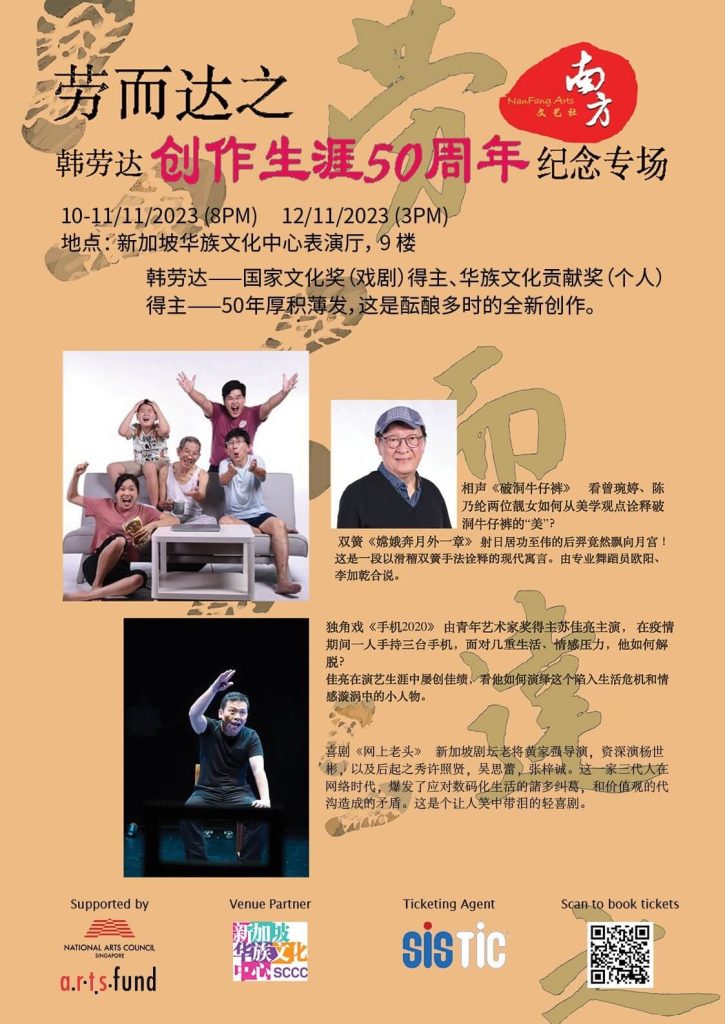
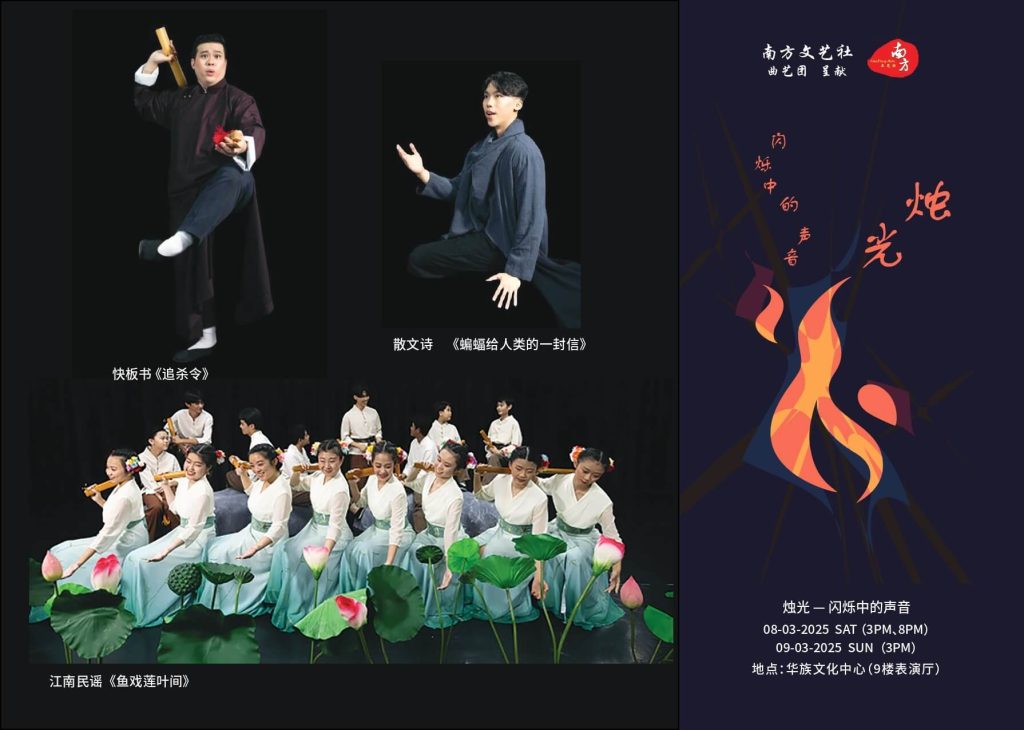
Following its inception, NanFang Arts Association organised a series of events, including a public lecture at the National Library (2022); three performances of 50 Years of Han Lao Da: A Journey of Creativity (2023); crosstalk lectures, arts showcases and a commemorative video on war hero Lim Bo Seng in two editions of the Lam Ann Festival (2023, 2024); two cultural variety shows jointly organised with Life Drama Society (2024); and three performances of Shimmering Voices in the Candlelight (2025).
This is an edited and translated version of 从“南方艺术团”到“南方文艺社”. Click here to read original piece.
| 1 | Quah Sy Ren, Xiju bainian: Xinjiapo huawen xiju 1913–2013 [Scenes: a hundred years of Singapore Chinese language theatre 1913–2013], 127. |
| 2 | Quah Sy Ren, Xiju bainian: Xinjiapo huawen xiju 1913–2013 [Scenes: a hundred years of Singapore Chinese language theatre 1913–2013], 146. |
| 3 | Quah Sy Ren, Xiju bainian: Xinjiapo huawen xiju 1913–2013 [Scenes: a hundred years of Singapore Chinese language theatre 1913–2013], 146. |
Han, Lao Da. “Wushi nian yitan lu, ban shiji huoban qing: xie zai nanfang wushi zhounian jinian teji fabu qian” [Fifty years of friendship through art: in commemoration of the Selatan Arts Ensemble 50th anniversary]. Lianhe Zaobao, 29 April 2022. | |
Nanfang yishu tuan gongyan: chengzhang [Selatan Arts Ensemble performance: The Struggle]. Singapore: Selatan Arts Ensemble, 1975. | |
Nanfang yishu tuan gongyan: shenghuo wenyi wanhui [Selatan Arts Ensemble variety show]. Singapore: Selatan Arts Ensemble, 1975. | |
Nanfang yishu tuan: shenghuowenyi wanhui [Selatan Arts Ensemble variety show]. Singapore: Selatan Arts Ensemble, 1973. | |
Quah, Sy Ren. Xiju bainian: Xinjiapo huawen xiju 1913–2013 [Scenes: a hundred years of Singapore Chinese language theatre 1913–2013]. Singapore: Drama Box, National Museum of Singapore, 2013. | |
Wang, Yiming. “Nanfang yishu yanjiuhui yuanlao ling qi luzao, nanfang wenyishe chengli, shou chang jiangzuo tantao yanyuan juese suzao” [From Selatan Arts Ensemble to NanFang Arts Association: first lecture on role shaping in theatre performance]. Lianhe Zaobao, 1 September 2022. | |
Wanyan feng zhong tu fenfang: 1972–2022 nanfang wushi zhounian jinian teji [Selatan Arts Ensemble 50th anniversary commemorative book: 1972–2022]. Singapore: NanFang Arts Association, 2022. |