Anglican High School


The Anglicans were some of the earliest Christians to set up and run schools in Singapore. Among the oldest Anglican schools on the island are St Andrew’s Secondary School (established in 1862), St. Margaret’s School (established in 1842; under diocesan administration since 1945).1
Anglican High School was founded on 9 January 1956 by five Chinese-speaking congregations of the Anglican Diocese of Singapore (St. Matthew’s Church, Church of the Good Shepherd, Holy Trinity Church, Church of the True Light, and St. Andrew’s Cathedral Mandarin Congregation). As the number of Chinese believers on the island continued to grow, these Chinese congregations believed Singapore needed a school that could not just promote Chinese education but also cultivate students who could share Christian values among the community.
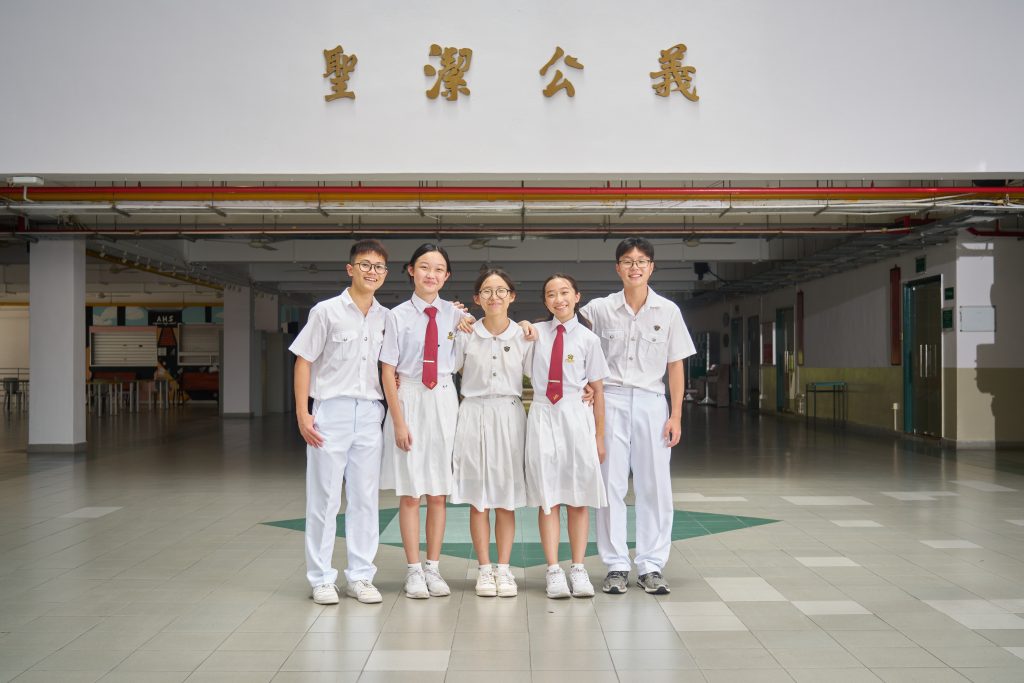
School motto
Aspiring towards Holiness and Righteousness
Brief history
As early as before World War II, the Anglican Diocese of Singapore had already planned to establish a Chinese-medium secondary school in Singapore. In 1938, the board of the Foochow (Hockchew)-speaking congregation of Holy Trinity Church held the first fundraising event for this purpose. However, the plan was put on hold due to the outbreak of World War II. In 1955, The Reverend Canon B. H. Lee (1903–unknown) revisited the proposal, and after it was approved by the government, Anglican High School was officially opened in January 1956, with lessons conducted in classrooms at St Andrew’s Secondary School.
When it was established, Anglican High had only three Chinese teachers, three English teachers, and 123 male students. Its founding principal was Reverend Canon Huang Yang Ying (1897–1978) from the Saint Andrew’s Cathedral Mandarin Congregation. He was a graduate of Trinity College Foochow, as was the Reverend Canon B. H. Lee. The school then comprised junior-middle and senior-middle sections, and was the only Anglican school in Singapore at the time with Chinese as the medium of instruction.
After its founding, the school’s board of directors actively sourced for a suitable site to build the school, but multiple land proposals fell through due to various reasons. By 1958, the school’s fundraising committee had raised funds to acquire its present site in Upper Changi Road, with the Ministry of Education subsidising half the acquisition amount. As the Lee Foundation was the biggest donor of the first phase of school-building, Anglican High named its first block after Lee Kuo Chuan (1854–1915), father of local philanthropist Lee Kong Chian (1893–1967). The main school building was named Mao Tze Kian Block, in memory of donor Y. S. Mao’s (birth and death years unknown) father. A hall was also donated by the Shaw Foundation, while the clock tower was donated by Lora Tong (Mrs Lee Seng Gee) (1920–1978), who named it after her father Tong Shao Yi (1862–1938). In January 1960, classes officially commenced on the new premises. Anglican High also began admitting female students that year.
More milestones would follow, such as the opening of Lee Kuo Chuan Stadium — the first indoor stadium in a secondary school in Singapore — in 1964, the completion of the Lee Kong Chian building in 1969, the switch to single-session school in 1972, and the unveiling of the Koh Swee Teng building in 1973. The year 1975 was particularly significant, with the completion of both the Lee Kuo Chuan Stadium and All Saints’ Church, the school’s chapel. The student hostel welcomed its first residents in 1976. Two years later, with the establishment of St Andrew’s Junior College, the school phased out its pre-university classes (previously senior-middle section) and expanded its secondary section. In 1979, Anglican High School was selected by the Ministry of Education (MOE) as one of the nine Special Assistance Plan (SAP) schools set up to develop bilingual students.2 In 1981, the inaugural issue of the school’s bilingual literary magazine Feiying (Falcon) was published.
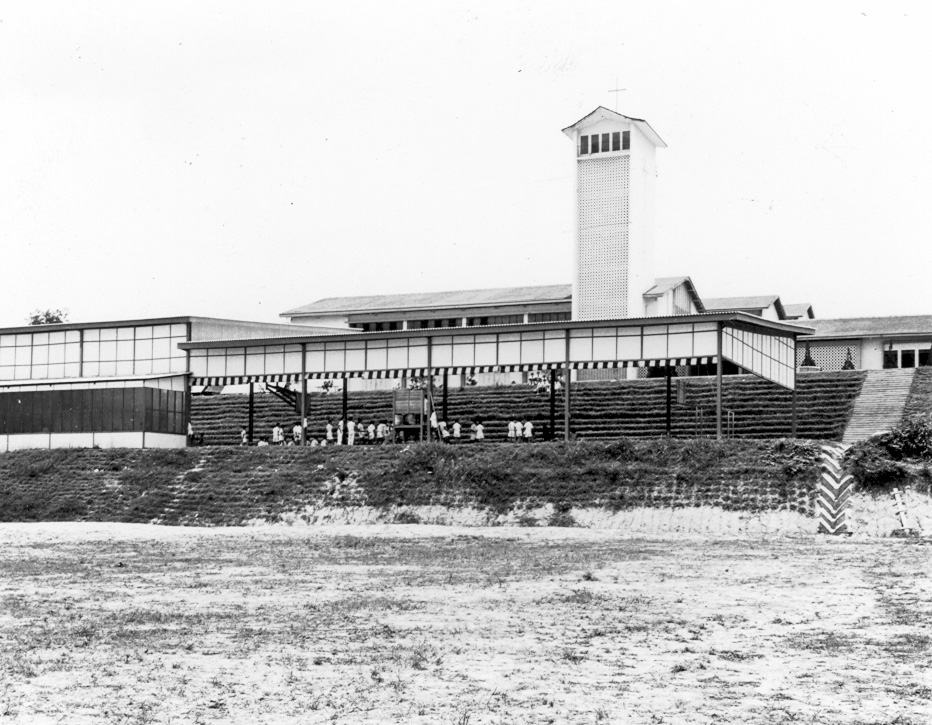
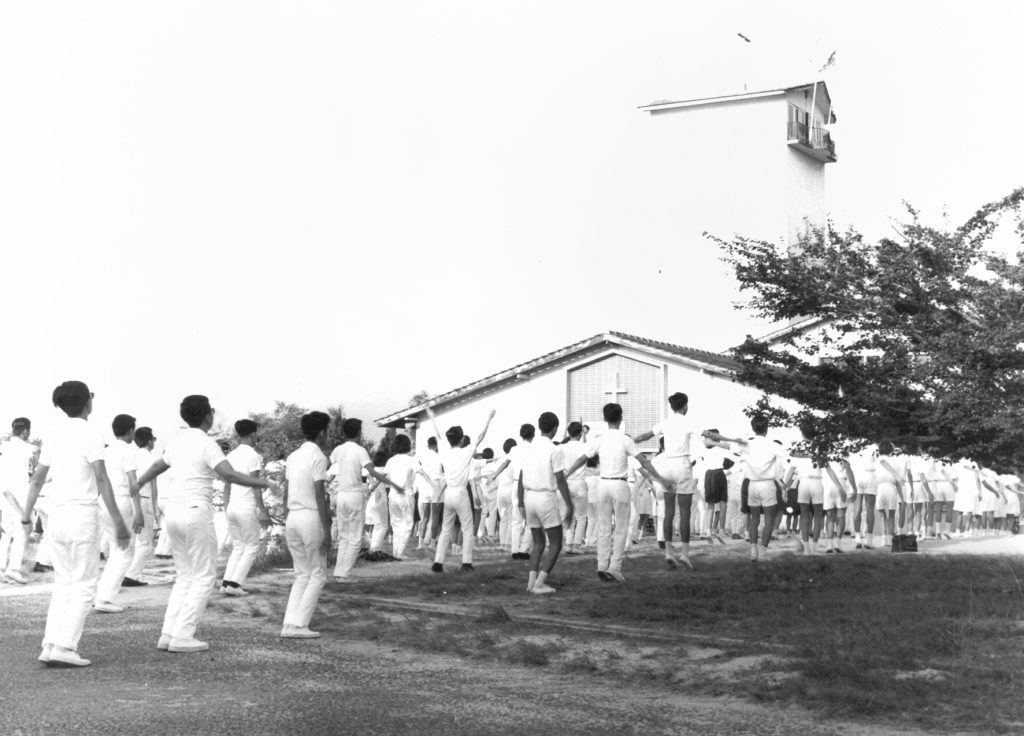
As the number of boarders grew, a new hostel, Anglican House, was built in 1983. In 1995, the school was conferred Autonomous School status, giving it greater control over its affairs.3 The school also launched a sports class under the initiative of principal Moo Soon Chong (1947–2010). Its buildings were revamped after an upgrading project from 2002 to 2005, which also saw the addition of a heritage centre.
Since becoming an SAP school, Anglican High has continued to build on its strong bilingual system, emphasising not just language proficiency but also a deep appreciation of Chinese culture through literature and history programmes. The school also introduces international exchange and learning programmes to enhance students’ English proficiency and cross-cultural understanding. Other unique programmes include the critical thinking programme ACTSperience, i-SCoRe integrated curriculum, and AHS Global Classroom programme where students visit schools in Australia and China. In 2020, Anglican High School was one of the first nine schools to offer the Chinese Language Elective Programme at secondary level.4
Today, Anglican High School is equipped with modern classrooms, science laboratories, and a spacious auditorium, even as old landmarks such as the clock tower remain. The school also has a wide range of sports facilities, such as an Indoor Sports Hall completed in 2008, which also serves as a venue for major international sports events, such as Asian Youth Games in 2009.
The Anglican High School Alumni Association was set up in 1966. Among its notable alumni are the 8th Bishop of the Anglican Diocese of Singapore John Chew, and former political office holder John Chen.
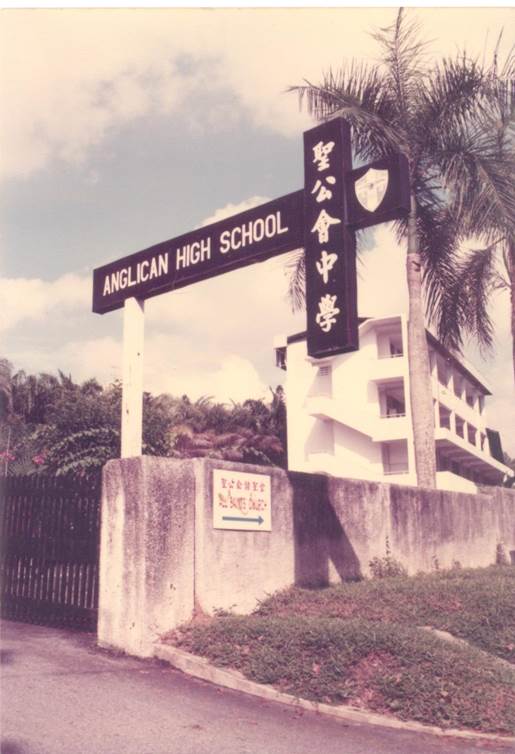
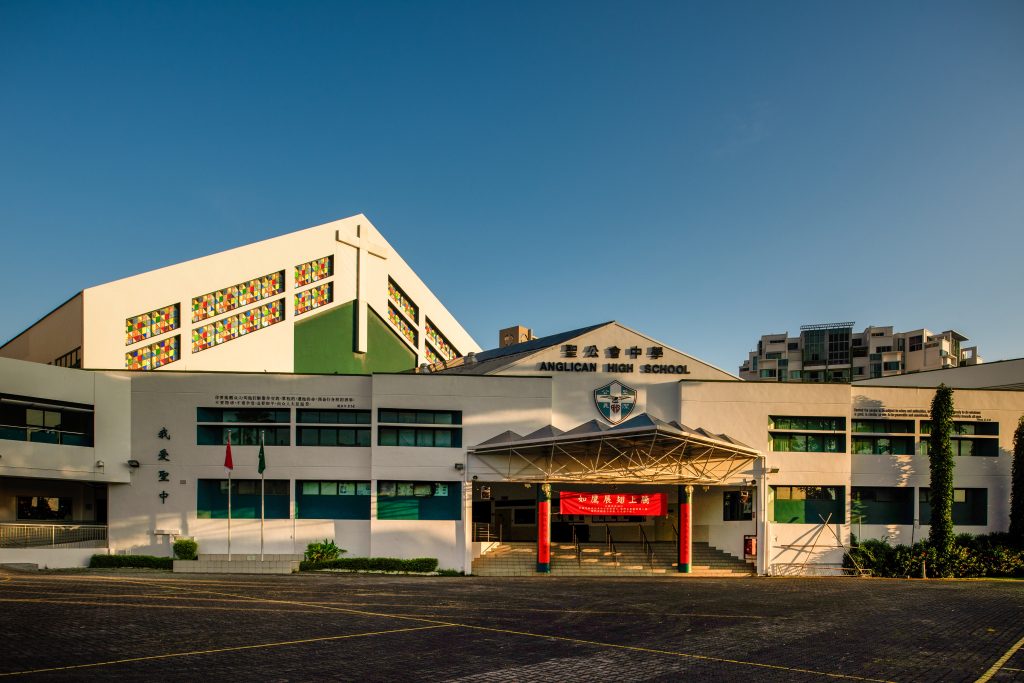
Principals and years in service
- Reverend Canon Huang Yang Ying (1956–1958)
- Chen Teh Neng (1959–1976)
- Tang Pui Eu (1976–1983)
- Moo Soon Chong (1983–2001)
- Wang Mei Hsiong (2002–2004)
- Zoe Boon Suan Loy (2005–2010)
- Maureen Lee (2011–2017)
- Khoo Tse Horng (2018–2023)
- Alvin Lim Hock Chuan (2024–present)
This is an edited and translated version of 圣公会中学. Click here to read original piece.
| 1 | St. Margaret’s School was founded as Chinese Girls’ School, and was set up by Maria Dyer (1803–1946), a missionary of the London Missionary Society, in 1842. In 1900, The Church of England Zenanah Missionary Society took over the management of the school. In 1945, the school came under the diocesan administration, and was renamed St Margaret’s. For more info, see Oh Kiat Muay, “Peihe chuangxiao 180 zhounian, shengmagelie zhongxiaoxue mingnian huifu jiu xiaoming” (St Margaret’s School to revert to old school name in light of 180th school anniversary), Lianhe Zaobao, 29 November 2022. |
| 2 | The Special Assistance Plan (SAP) was introduced in 1979 to nurture students with bilingual aptitude. The schools under this plan are called SAP schools, known to provide students with high quality teaching and an environment that emphasises bilingual learning. |
| 3 | Established in 1994, autonomous schools follow the Ministry of Education syllabus, while providing a wider range of programmes than regular government schools, to enhance students’ learning experience. |
| 4 | The Chinese Language Elective Programme (CLEP) is offered by selected secondary schools and junior colleges to nurture students who have an interest and aptitude in Chinese language and literature. |
ANGLICAN HIGH SCHOOL 30th Anniversary Souvenir Magazine. Singapore: Anglican High School, 1986. | |
“Anglican High School.” MOE Heritage Centre. | |
Shenggonghui zhongxue jianxiao tekan [Souvenir magazine commemorating the founding of Anglican High School]. Singapore: Anglican High School, 1960. | |
The Soaring Eagle — A History of Anglican High School 1956–2005. Singapore: Anglican High School, 2005. | |
The Soaring Eagle — A History of Anglican High School 1956–2016. Singapore: Anglican High School, 2016. | |
The Soaring Eagle — A History of Anglican High School 1956–2021. Singapore: Anglican High School, 2021. | |
Year Book 1981 Anglican High School 25th Anniversary. Singapore: Anglican High School, 1981. | |
Poon, Sing Wah. Xinjiapo xiaozhang fangtanlu [Interviews with Singapore school principals]. Singapore: Candid Creation Publishing LLP, 2006. | |
Wu, Hua. Xinjiapo huawen zhongxue shilue [A brief history of Chinese secondary schools in Singapore].Singapore: Educational Publishing House, 1976. |