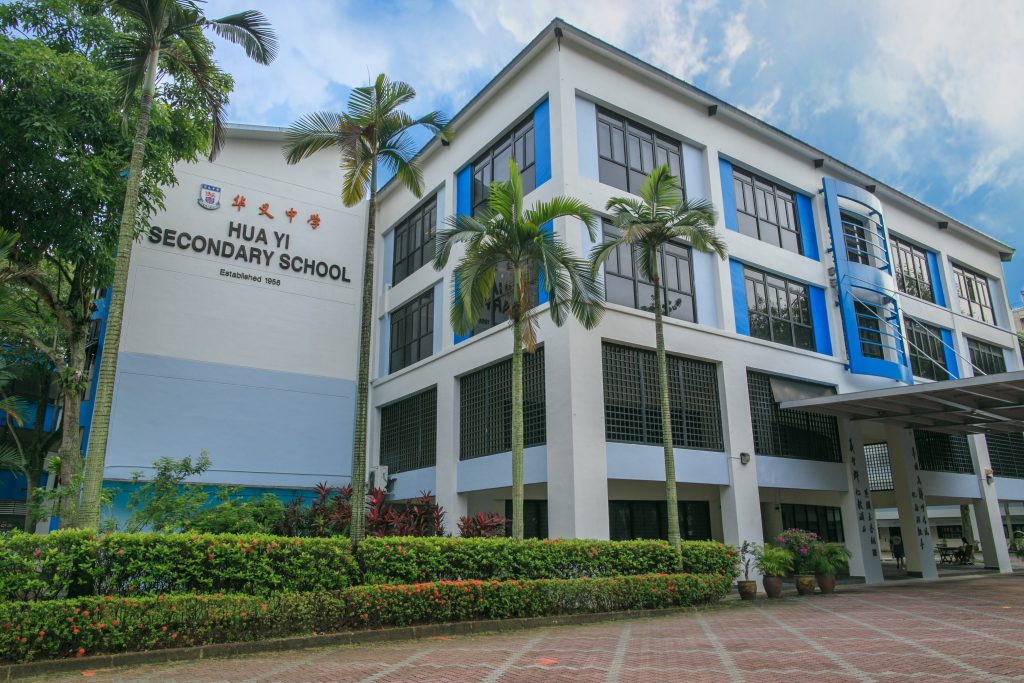
Hua Yi Secondary School


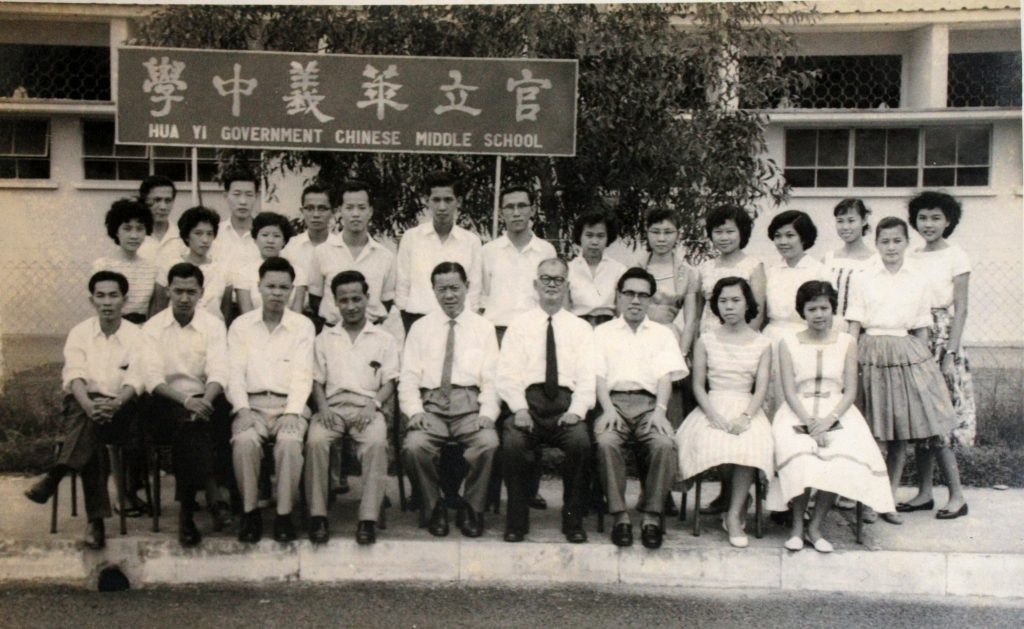
In the 1950s, Singapore faced widespread strikes and protests by workers and students, which disrupted community-run Chinese-medium schools. To provide students with a sustained education, the government, led by then-Chief Minister Lim Yew Hock (1914–1984), established the first four government-run Chinese-medium secondary schools in 1956. They were: Singapore Government Chinese Middle School1, Kallang West2, Gan Eng Seng3 and Hua Yi. All four schools bore the words “Government Chinese Middle School” in their names. Hua Yi was the first to be set up, and most of its first cohort were students from Chung Cheng High School who were not involved in strikes.4
Hua Yi Secondary School’s values are “Benevolence, Justice, Wisdom and Togetherness”, There are two versions of its school song. The original, composed in 1966 by pioneering local musician Samuel Ting Chu-San (1926–2007) with lyrics by Lin Hongdao (birth and death years unknown), was later revised and simplified.5
School Values
Benevolence, Justice, Wisdom and Togetherness
Brief history
In its founding year, Hua Yi borrowed the premises of an English primary school at Fowlie Road in Katong, and its name took reference from the word “Fowlie”. At that time, it had over 40 staff members, 578 students, and 26 classes. Its founding principal was Wang Hou Ren (1907–1994), a former chief writer of Chong Shing Yit Pao who previously taught at Chung Cheng High School and served as its head of academic affairs.6
In April 1957, the school moved to Winstedt Road in Newton Circus and shared its premises with Monk’s Hill Primary School. The student population grew to 1,240 with 30 classes, the largest enrolment among the four government-run Chinese middle schools then.
In December that year, Hua Yi relocated to a new campus at Margaret Drive in Queenstown. As enrolment continued to grow, the school added new facilities to meet students’ needs. In 1959, Hua Yi became the first Chinese-medium middle school to establish a National Cadet Corps. The same year, Lee Kuan Yew (1923–2015) became Prime Minister of Singapore and visited several government departments. In October, he toured Hua Yi to learn more about the school and students.
Singapore achieved self-governance in 1959 and was determined to revitalise its economy by promoting industrial development. Hua Yi set up five technical classes to nurture talent for the industrial sector. As the existing campus struggled to cope with the surge in student enrolment, the school added 18 classes at the adjacent Hua Yi Primary School in 1963, bringing the total student population to over 2,000. During Huang Shu Fen’s (birth and death years unknown) tenure as principal, she commissioned the design of the school building and sports field. In 1965, the new campus was completed, comprising the original three-storey block, a new four-storey block with 16 classrooms, a sizeable science building, a home economics block and an auditorium. The canteen and a hostel were also expanded. In 1966, the new campus was completed. Under Huang’s leadership (1964–1972), Hua Yi students excelled in various fields, which elevated the school’s standing. To honour her contributions, the Hua Yi Alumni Society set up a scholarship named after her in 2014 to support current students.
In 1964, the Ministry of Education (MOE) launched a policy to introduce extracurricular activities (ECAs) in schools to strengthen students’ physical fitness and broaden their knowledge outside the classroom. As a government school, Hua Yi actively responded to the initiative by promoting all-rounded development of its students. By 1966, the school was offering more than 40 ECAs. Three years later, Hua Yi achieved a milestone by constructing a large sports field — funded by a government-led public donation drive. That year, then-PM Lee Kuan Yew visited Hua Yi again to celebrate the 150th anniversary of Singapore’s founding and the school’s 13th anniversary.
In 1971, Hua Yi’s student population reached 2,207, with 40 secondary and 17 pre-university classes. As enrolment in Chinese-medium schools declined in the late 1970s, MOE designated nine Chinese schools as Special Assistance Plan schools in 1978, where Chinese and English would be taught as first languages.7 Hua Yi, which was not among them, started English-stream classes in 1979. The school was renamed “Hua Yi Secondary School” and ceased the enrolment of pre-university students.
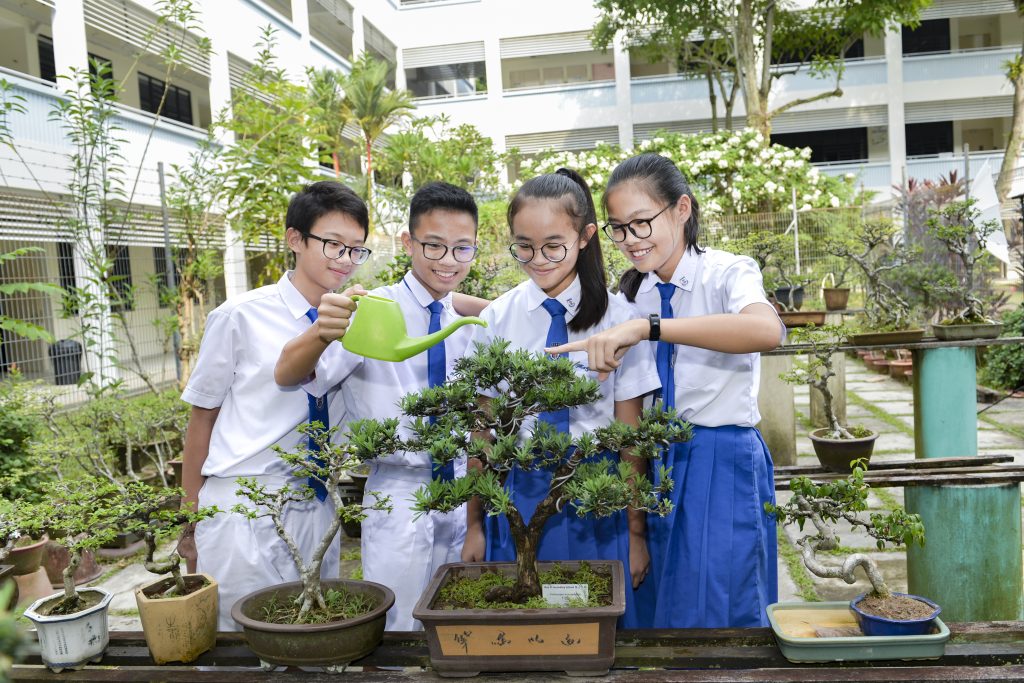
Hua Yi is one of the few schools in Singapore with a Bonsai Sanctuary, and many of its plants are between 30 and 50 years old. The bonsai culture, first promoted during Wong Sun Fei’s tenure as principal, has since become a source of pride for Hua Yians. Hua Yi’s bonsai activities began in 1979 as an extension of the Government’s “Use Your Hands Campaign”. Starting with just 18 water jasmine, the collection grew to hundreds of bonsai plants, making Hua Yi’s Bonsai Sanctuary the largest among secondary schools in Singapore at one point.
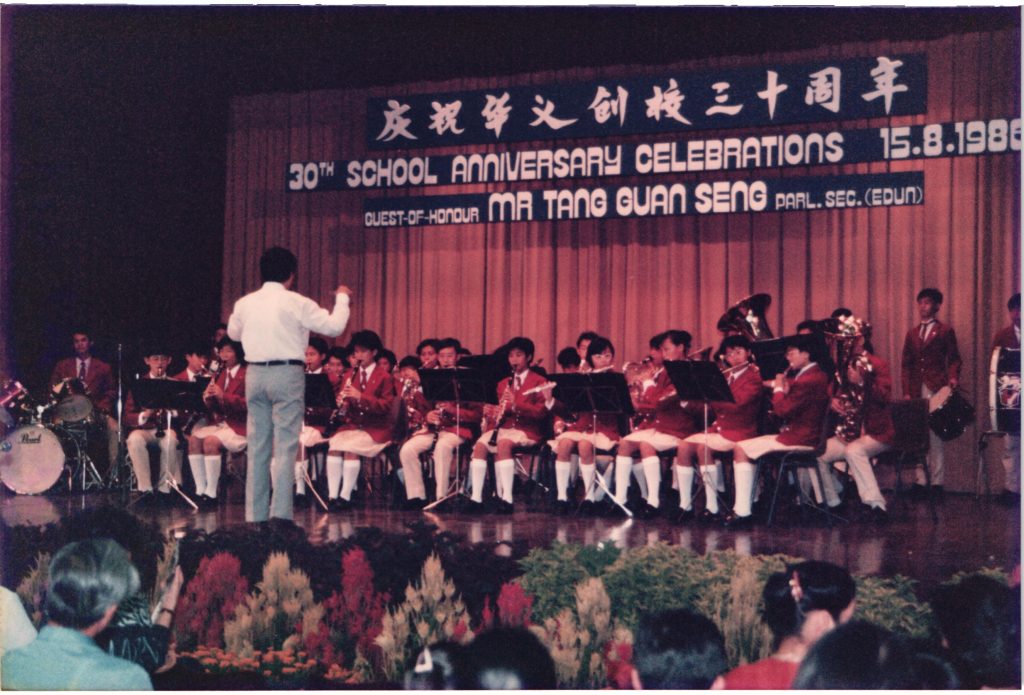
In 1983, Hua Yi moved to its new campus at Depot Road. The new campus at Depot Road was officially opened in 1985, and Hua Yi became the first secondary school in Singapore to have an underground shooting range. In 1988, Hua Yi transitioned from a school using Chinese as the medium of instruction to one with English as the first language and the mother tongue as the second language.
The school later went through a challenging period during its time at Depot Road — its enrolment declined due to the greying neighbourhood and inconvenient public transportation in the area. In contrast, new towns such as Jurong and Yishun were seeing a population boom. As Hua Yi’s student population reached a low of around 200 in early 1999, the school announced its closure and transferred its students to other secondary schools nearby. The situation turned around at the end of the year when MOE appointed Kong-Tan Yen Fong as Hua Yi’s principal and moved the school to a larger campus at Jurong West Street 42, a densely populated area with a convenient transport network. In 2000, Hua Yi commenced nine Secondary 1 classes, marking a fresh start for the school. In 2002, the new campus at Jurong West was officially opened.
The Hua Yi Alumni Association was formed in 1980 and ceased operations in 2002. A younger group of alumni subsequently formed the Hua Yi Alumni Society in 2012.In 2013, the alumni re-created on campus the “Loong Moon Coffee House”. The now-defunct Loong Moon Coffee House was a coffee shop opposite Hua Yi’s former campus at Margaret Road where Hua Yi students used to gather.
The Hua Yi Secondary School Heritage Gallery was established in 2006 and officially opened during the school’s 50th anniversary celebrations. In 2011, Hua Yi alumni set up a team to revamp the gallery. Former Hua Yi students responded enthusiastically by donating artefacts and memorabilia. The newly refurbished gallery, named Hua yi yuan, was officially opened in 2016.
Alumni of Hua Yi have contributed to the nation in various fields. The school has also nurtured a number of talents in the performing arts and music industries. In particular, it played an active role in promoting xinyao, which are Mandarin songs written by Singaporeans.
Principals and years in service
- Wang Hou Ren (1956–1958)
- Liu Pai Hu (1959)
- Wu Tsung Kan (1960–1963)
- Huang Shu Fen (1964–1972)
- Tan Ching Luen (1973–1978)
- Wong Sun Fei (1979–1992)
- Loke Kay Khee (1993)
- Molly Ooi (1994–1999)
- Mrs Kong-Tan Yen Fong (2000–2005)
- Mrs Mabel Leong-Boey Wai Wah (2006–2011)
- Tay Siok Hwa (2012–2016)
- Sandra Gwee (2017–2024)
- Lim Siew Yee (2025–present)
This is an edited and translated version of 华义中学. Click here to read original piece.
| 1 | Now known as River Valley High School. |
| 2 | Now known as Dunman High School. |
| 3 | Now known as North Vista Secondary School. |
| 4 | See “Sidik opens Govt. Chinese school, and there are more to come, he says,” The Straits Times, 18 May 1958. |
| 5 | The Chinese school song is followed by the English version, which goes “Observe the school motto, and spread its guiding principles, seek racial harmony, and foster prosperity, O serve our nation our Hua Yi”. |
| 6 | Refer to oral history interview with Principal Wang: Wong Hou Ren, oral history interview (accession no. 000688), National Archives Singapore, 30 July 1986. |
| 7 | The Special Assistance Plan (SAP) was introduced in 1979 to nurture students with bilingual aptitude. The schools under this plan are called SAP schools, known to provide students with high quality teaching and an environment that emphasises bilingual learning. |
Hua Yi Government Chinese Middle School Graduation Souvenir Magazine 1977. Singapore: Hua Yi Government Chinese Middle School, 1977. | |
Hua Yi Government Chinese Middle School, Singapore, 1974. Singapore: Hua Yi Government Chinese Middle School, 1974. | |
“Hua Yi Secondary School.” MOE Heritage Centre. | |
Singapore Hua Yi Government Chinese Middle School Souvenir Magazine 1958 Senior Middle Graduation Groups. Singapore: Hua Yi Government Chinese Middle School, 1958. | |
Souvenir Magazine, Fifth Senior Middle Graduation Class, Hua Yi Government Chinese Middle School, Singapore. Singapore: Hua Yi Government Chinese Middle School, 1960. |