Singapore’s calligraphy societies (1900–2000)


Before 1945, there were no societies in Singapore dedicated to calligraphy. In the 45 years from 1900 to 1945, although there have been renowned arts and culture figures such as Khoo Seok Wan (1874–1941) and Huang Man Shi (1890–1963), as well as literati and calligraphers such as Yeh Chih Yun (1859–1921), Zhang Shu’nai (1895–1939), Xu Beihong (1895–1953) and Yu Dafu (1896–1945) (who came to Singapore before it fell to the Japanese), calligraphy was only practised by a small circle of literati.1
The Society of Chinese Artists: Singapore’s first calligraphy and painting society
The Nanyang Calligraphy and Painting Society that was established with the approval of Selangor’s Resident Councillor in 1929, and the Yin-Yin Art Circle established in 1936, were groups straddling Singapore and Malaysia. It was the official establishment of the Society of Chinese Artists on 20 January 19362that marked the real start of Chinese calligraphy and painting societies in Singapore.3
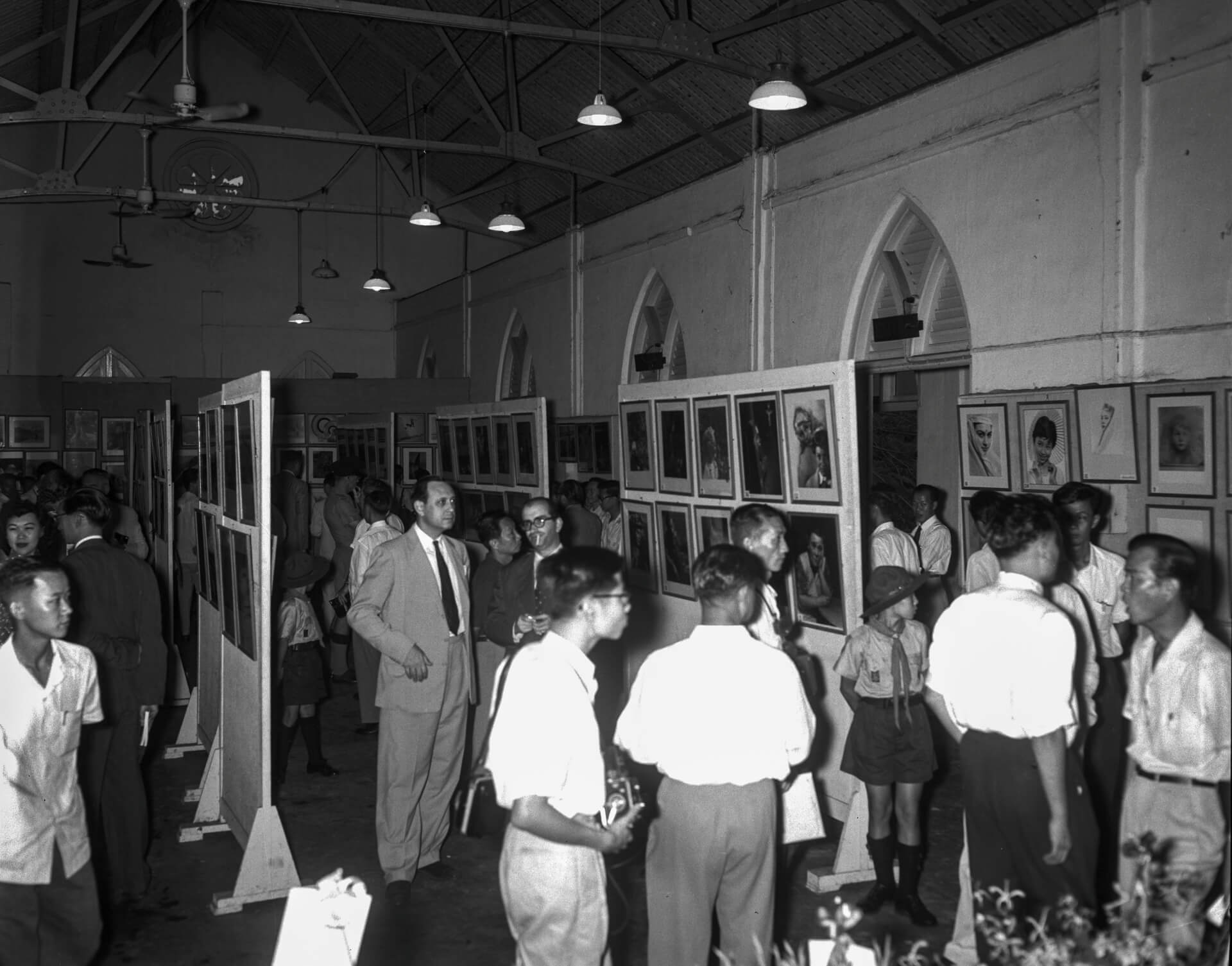
The Society of Chinese Artists was known as the Salon Art Society when it was founded in April 1935. A meeting was held in November that same year, where it was decided that “the organisation would be expanded to accept membership of other fellow artists”, and the society was thus renamed Singapore Society of Chinese Artists. The society reconvened in 1946 after World War II,4rewrote its charter and changed its name to The Society of Chinese Artists, as it is known today. Besides organising annual exhibitions of members’ works, the society also actively holds exhibitions for overseas calligraphers.5
In May 1967, Shangguan Shaomao, Yee Sze Fook (1944–2024), Nai Swee Leng, Zhuang Shengtao and Oh Khang Lark set up the Molan Art Association, with the objective to increase interaction among members, as well as promote and conduct research on Chinese calligraphy, painting and seal carving. The association’s annual exhibitions by members mainly showcase calligraphy, as well as ink and colour painting.6
The Chinese Calligraphy Society of Singapore and other groups
Xinjiapo shufajia xiehui (新加坡书法家协会), which was set up later than Molan Art Association, mainly focused on research in calligraphy. Established in December 1968, it was initially known as Xinjiapo zhonghua shuhua yanjiuhui (新加坡中华书画研究会). Its founders were Tan Siah Kwee, Yeo Eng Jiang and Choo Pee Moy, who were students of Tan Keng Cheow (1907–1972), a teacher at Chung Cheng High School (Main). The society was renamed several times, from Xinjiapo zhonghua shuxue yanjiuhui (新加坡中华书学研究会) in 1979 to Xinjiapo zhonghua shuxue xiehui (新加坡中华书学协会) in 1983 to Xinjiapo shufajia xiehui (新加坡书法家协会) in 1996. But its English name, the Chinese Calligraphy Society of Singapore, has stayed the same to this day. It is an important local calligraphy organisation that actively promotes the development of calligraphy in Singapore by running calligraphy classes, holding calligraphy competitions and seminars, as well as organising calligraphy exhibitions within and outside Singapore.7
In May 1971, several young graduates of Nanyang Academy of Fine Arts, such as Tan Kian Por (1949–2019), Lee Hock Moh, Tan Kee Sek and Lim Buan Chay (1951–2024), founded the Siaw-Tao Chinese Seal Carving Calligraphy & Painting Society. Their objective was to bring together those passionate about calligraphy, painting and seal carving so that they could learn from one another’s techniques and styles, and to organise annual exhibitions of members’ works. Siaw-Tao is currently a very active local arts group with various sub-groups on seal-carving and calligraphy, where members gather every month. First-generation calligraphers, painters and seal carvers such as Wang Jai Ling (1895–1973), Chen Chong Swee (1910–1985), Huang Paofang (1912–1989), Chen Jen Hao (1908–1976) and See Hiang To (1906–1990) were former advisers of Siaw-Tao.8

Hwa Hun Art Society was founded on 8 March 1973. Its core members were mainly students of local pioneer Chinese ink artist Fan Chang Tien (1907–1987), including Ling Cher Eng (1940–1995), Tan Oe Pang, Tan Joo Jong (1951–1984), Low Eng, Chen Shaoyi and Chuan Keng Boon (1953–2010). The society was set up to study Chinese ink painting, calligraphy and seal carving. However, as seen from the past exhibitions of members’ works, the society focuses more on ink and colour painting, and calligraphy is secondary.9
The Pachui Art Society, established in 1969, focused on research in Western painting. The Singapore Teachers Art and Crafts Association, set up in 1974, had members mainly from the education sector. Exhibitions held by these two groups also include a small number of calligraphic works by members.10 This showed that before the 1980s, the Chinese Calligraphy Society of Singapore was the only society dedicated to calligraphy.
In the 1980s and 1990s, China’s economic reform, the influence of its flourishing calligraphy and arts scene, and Singapore’s booming economy resulted in more people in Singapore taking up calligraphy. This led to more calligraphy groups being set up. In 1986, former Chung Cheng High School teacher Zhuang Youming (1908–2007), together with students from the school in the 1940s, set up the Senior Citizens Calligraphy and Painting Society. Its members include calligrapher Lim Tze Peng (1921–2025), Chen Hong (1924–2000), Yang Wee Chyun (1926–1997), Chui Choo Sin and Fu Zizhao.11In 1988, students of local Cultural Medallion recipient Wee Beng Chong, including Goh Yao Kee, Lo Seng Hock, Guan Mingji and Wee Leng, set up the Lanting Art Society that focuses on research in calligraphy and painting, while annual exhibitions by its members also showcase a considerable number of calligraphic works. The Hanshi Calligraphy Society was founded by Wong Kok Liang (1920–2004), known for his clerical script, and his students in 1992. Its core members are still active in the local calligraphy scene. The Shicheng Calligraphy & Seal-Carving Society (Singapore), established in 1994, is another important group actively promoting calligraphic activities in Singapore. It is committed to showcasing Singaporean calligraphic works on international platforms, and has participated in various exhibitions organised by different organisations in many countries. This has contributed to Singapore’s international reputation for preserving traditional Chinese calligraphy.
In addition, the Singa City Chinese Calligraphy and Painting Society set up by Liu Pau Kiang (1935–2023) and his students in 1995; the Xin Hai Calligraphy Society established by Chang Sow Yam and his students in 1999; the Zui Mo Xuan Calligraphy Society set up by Khoo Seow Hwa and his students, and the Hua Yuan Calligraphy Club and the Evergreen Chinese Arts Society of Singapore set up by Ho Ngiap Poh (1937–2013), have all helped promote the development of Chinese calligraphy in Singapore.
This is an edited and translated version of 新加坡的书法社团(1900年至2000年). Click here to read original piece.
| 1 | Yeo Mang Thong, Xinjiapo zhanqian huaren meishu shilunji [Essays on the history of pre-war Chinese painting in Singapore], 2–5. |
| 2 | Xie Guanghui and Chen Yupei, Xinjiapo malaixiya huawen shufa bainianshi [100 years of Chinese calligraphy in Singapore and Malaysia], 8–10. |
| 3 | Yeo Mang Thong, Xinjiapo zhanqian huaren meishu shilunji [Essays on the history of pre-war Chinese painting in Singapore], 40–41. |
| 4 | Yeo Mang Thong, Xinjiapo zhanqian huaren meishu shilunji [Essays on the history of pre-war Chinese painting in Singapore]. In Yeo’s book, it was called Shalang yishu yanjiuhui (莎郎艺术研究会), but according to The Society of Chinese Artists’webpage and Xinjiapo de zhonghua meishu tuanti [Singapore’s Chinese art group] (in Xinjiapo meishu [Singapore art magazine] 8) written by Tan Siah Kwee (pen name Youzi), it was called Salon Art Society. |
| 5 | About SOCA, the webpage of The Society of Chinese Artists. |
| 6 | Tan Siah Kwee (pen name Youzi), Xinjiapo de zhonghua meishu tuanti [Singapore’s Chinese art group]; Xie Guanghui and Chen Yupei, Xinjiapo malaixiya huawen shufa bainianshi [100 years of Chinese calligraphy in Singapore and Malaysia], 62–63. |
| 7 | Xie Guanghui and Chen Yupei, Xinjiapo malaixiya huawen shufa bainianshi [100 years of Chinese calligraphy in Singapore and Malaysia], 62–63. See also 1968: Singapore Chinese Calligraphy and Art Society established, the webpage of Singapore Calligraphy People, 1 April 2012. |
| 8 | Xie Guanghui and Chen Yupei, Xinjiapo malaixiya huawen shufa bainianshi [100 years of Chinese calligraphy in Singapore and Malaysia], 62–63. See also About, the webpage of Siaw-Tao Chinese Seal Carving Calligraphy & Painting Society. |
| 9 | Tan Siah Kwee (pen name Youzi), Xinjiapo de zhonghua meishu tuanti [Singapore’s Chinese art group]. |
| 10 | Ibid. |
| 11 | 1986: The Senior Citizen Calligraphy and Painting Society established, webpage of Singapore Calligraphy People, 17 June 2012. |
Tan, Siah Kwee (pen name Youzi). Xinjiapo de zhonghua meishu tuanti [Singapore’s Chinese art group]. In Xinjiapo meishu [Singapore art magazine], no. 28 (July 1977), 20–21. | |
Xie, Guanghui and Chen, Yupei. Xinjiapo malaixiya huawen shufa bainianshi [100 years of Chinese calligraphy in Singapore and Malaysia]. Guangzhou: Jinan University Press, 2013. | |
Yeo, Mang Thong. Xinjiapo zhanqian huaren meishu shilunji [Essays on the history of pre-war Chinese painting in Singapore]. Singapore: Singapore Society of Asian Studies, 1992. |