Chinese ritual theatre in Singapore


“Ritual theatre”, a term widely used by scholars researching Chinese culture, typically refers to traditional Chinese performances — often staged during funerals or the Hungry Ghost Month — that communicate with deities and expel malevolent forces.1 Unlike “celebratory theatre” or entertainment for the deities performed on Feast Days, “ritual theatre” usually involves religious specialists such as priests and monks.2 The two most classic examples of ritual theatre in Singapore are “Mulian plays” and the “North dipper play”, both based on famous Chinese folk legends.
These plays came to Singapore from immigrants from southern China in the late 19th and early 20th centuries. They practised rituals according to the tradition of their hometowns, and these were passed down, though details may have been lost or localised through the years. The topic of discussion and comparison on ritual theatre in Singapore will include the Henghua and Hokkien (Minnan) communities.3
The Mulian plays of the Henghua and Hokkien traditions
The most famous example of Chinese ritual theatre is the Mulian play.4 The story of Mulian saving his mother from the deepest realm of hell exists in almost every regional tradition in China. The tradition of the Mulian play spread to Singapore, and is still practised by the Henghua and Hokkien groups. While the Henghua and Hokkien communities both hail from Fujian province, their languages and customs vary. They will hence be referred as two separate groups discussed below.
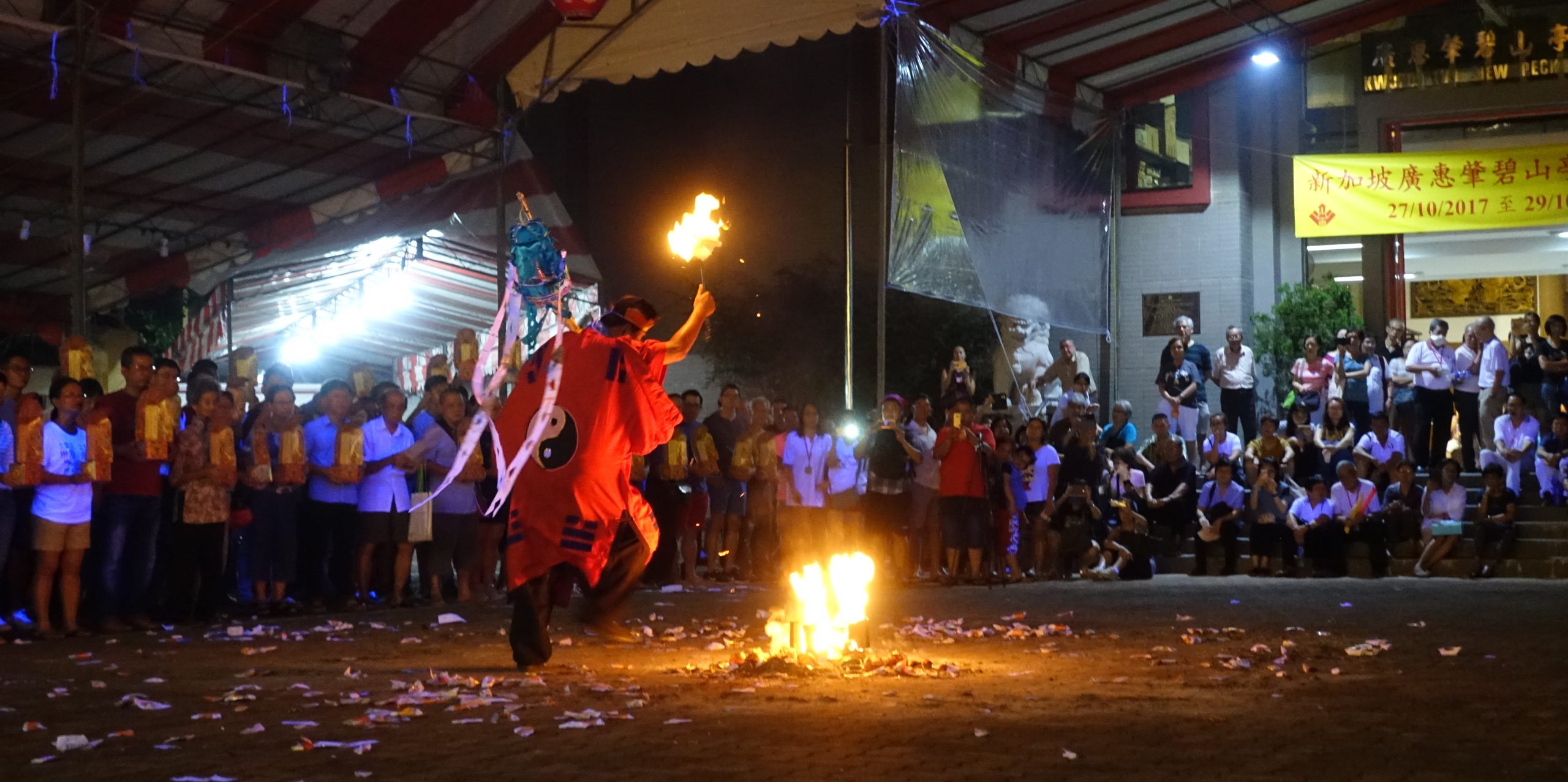
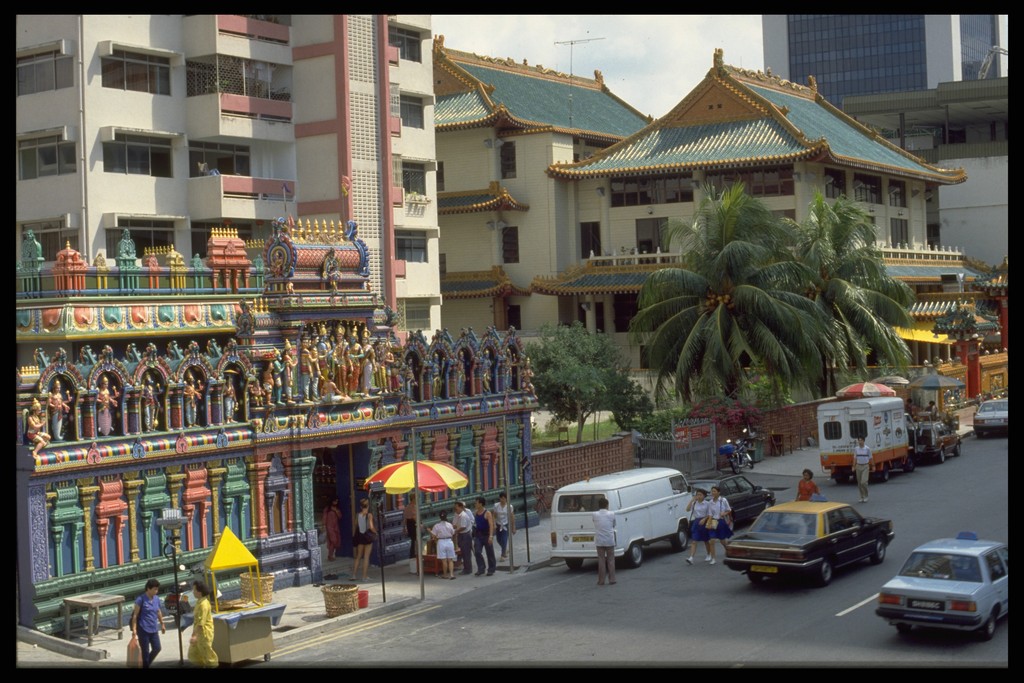
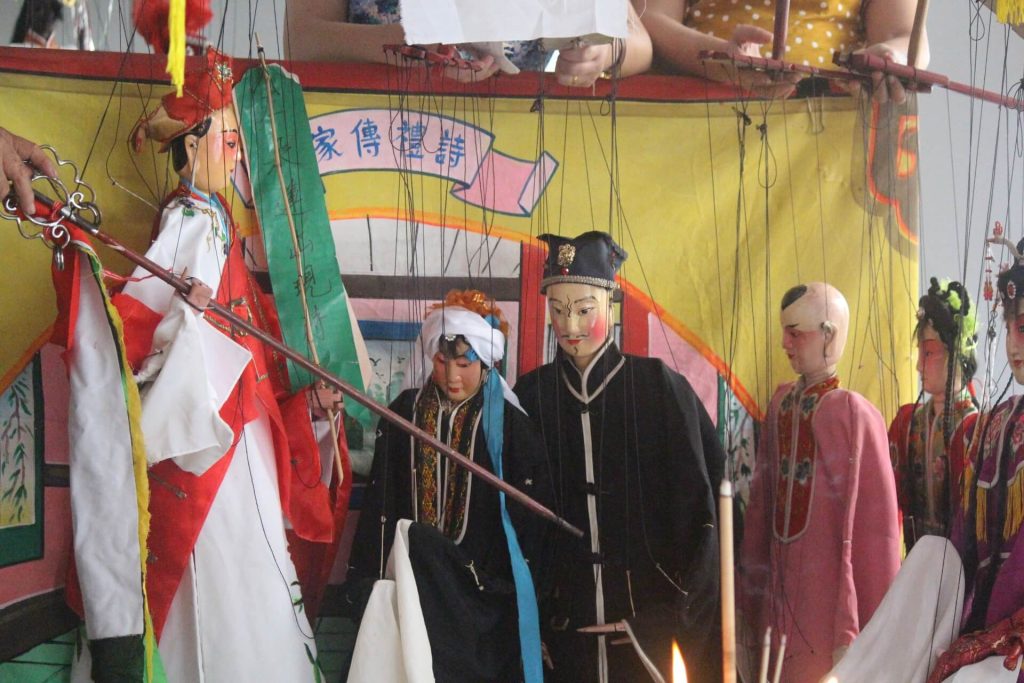
In the Henghua community in Singapore, the Mulian play is presented as either opera or puppetry. The opera is performed every 10 years, whereas puppetry is usually performed every year during the lunar seventh month, also known as the Middle Primordial (Zhongyuan) or Ghost Festival, when the gates of the underworld are believed to open, allowing the spirits to roam the mortal world.5 The Henghuas have been staging Mulian plays in Singapore since at least 1944.6 Kiew Lee Tong Temple is the primary temple for performing the play. These plays aim to engage in the universal salvation of ancestors and wandering spirits in purgatory (pudu). The lead performer must undergo strict ritual training, including chanting of mantras and sutras and observing a vegetarian diet. This way, the performer becomes a ritual specialist believed to have the ability to save the lost souls from purgatory.
In the Henghua Mulian play, devotees are invited towards the end of the performance to take part in a salvation ritual where they hold incense sticks and the clothes of deceased family members. The lead puppeteer, standing with his legs in a T-shaped formation, raises a staff held by the puppet representing Mulian, and makes a movement to mimic writing a talisman. This act symbolises that Mulian has the magical power to save those in purgatory. The T-shaped formation also represents the power conferred by stepping on the eight-trigram so that it protects the performer and others from possible harm.7
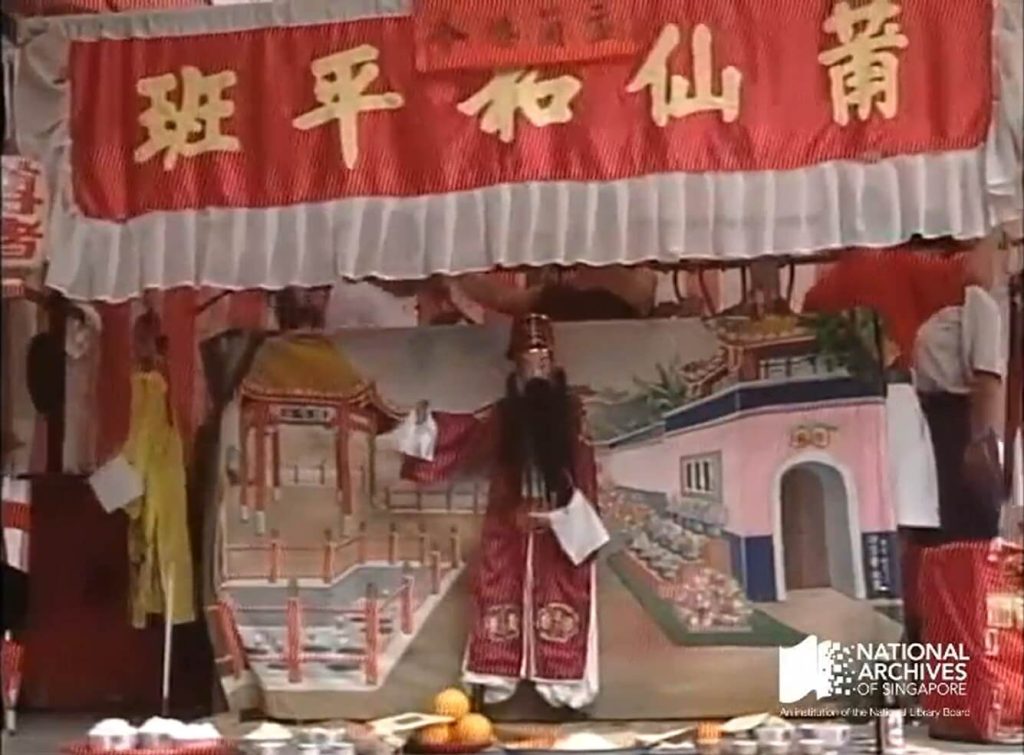
The Hokkien Mulian play in Singapore can be divided into two periods: early to mid-20th century, and the contemporary period after that. In the earlier period, Mulian performances were a form of “merits and virtue theatre”, meaning that they were staged during funerals.8 Performances of Chinese folk legends such as Zhong Kui Travels to Hell and Li Shimin Roams Hell were usually included. The contemporary Hokkien Mulian play are typically performed by local theatrical troupes and are not staged during funerals or the seventh lunar month. The performer in the contemporary Hokkien opera sticks to the role of an actor and does not engage in any ritual or universal salvation.
In the Henghua rendition of the Mulian opera, the performer is both an actor and a ritual specialist. He would have gone through strict training, such as observing a vegetarian diet, chanting sutras, and learning mantras to engage in universal salvation of lost souls. Given its association with death, the Mulian play is filled with taboos for both the Hokkien and Henghua performers, who usually pray at a temple or the shrine for protection from possible encounters with spiritual forces.
Although the contemporary Hokkien Mulian play tends to differ from the one performed before the mid-20th century, the Hokkien Mulian rendition conducted by Taoist priests during funerals seems to follow the older tradition of “merits and virtue theatre”.9 This ritual is known as “Making merit from the grand retreat of the Yellow Register”. The Yellow Register is said to contain the names of spirits of the underworld. A makeshift altar featuring the Three Pure Ones — Lord of Primordial Beginning, Lord of the Numinous Treasure, and Honoured Lord of the Tao and the Virtue — would be set up. This Taoist rendition is a more classic form of ritual theatre that has also been observed in Fujian and Taiwan.10 Although the Mulian story is performed by Taoist priests and not theatrical performers, there are various segments that illustrate the characteristic of “theatre with sacrificial rites, sacrificial rites with theatrical elements.” 11
The Siege of Hell in Mulian play is an important ritual seen in many Mulian renditions. In this ritual, the hell fortress, made from paper and bamboo, stands almost as tall as a grown man. There are four hell gates, namely, East, South, West and North. Dressed in a black robe and carrying a staff, the lead priest plays the Mulian (secular name Fu Luobo), accompanied by drum beats and other priests. After he enters the fortress from the East gate and steps out, he narrates his encounter in the underworld, while other priests echo the main parts of his speech or respond with questions for him to carry on with his tale. Besides the ritualistic purpose of merit-making and universal salvation, there are also typical theatrical elements such as speech, singing, and movement.
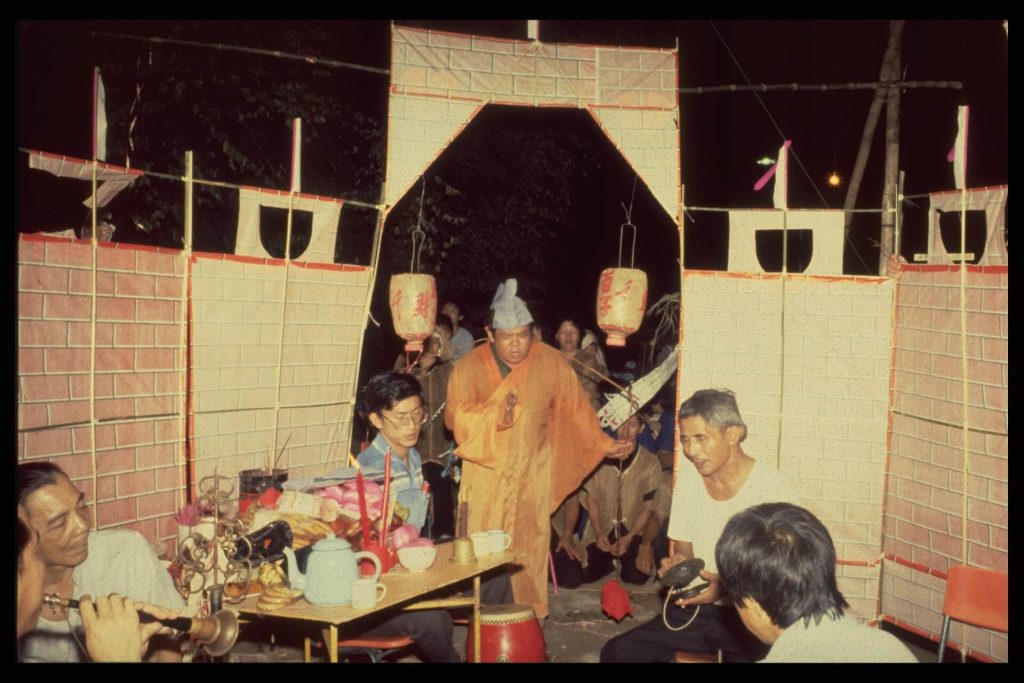
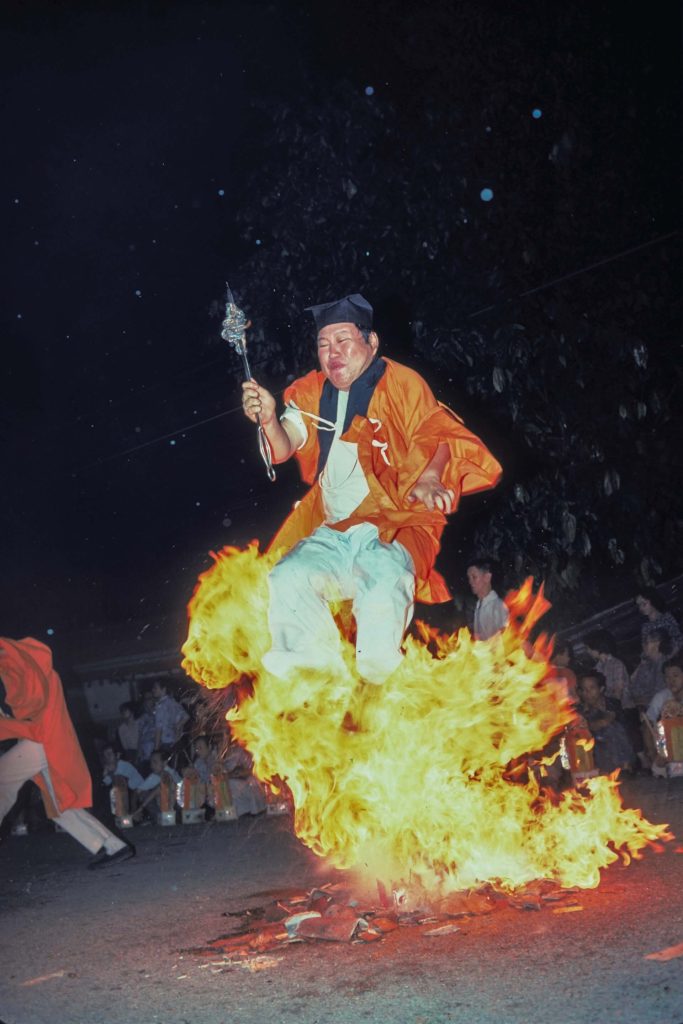
Lei Yousheng, a prominent character in Hokkien folklore in southern Fujian, Taiwan, and Singapore, often appears in both the operatic and funeral renditions of the Hokkien Mulian story.12 The frivolous Lei is a foil to the sincere and determined Mulian. Lei leads the mourners in a light-hearted manner by making funny faces and hilarious movements, helping to cheer up the grieving family. In the final segment of crossing the Naihe Bridge, all family members of the deceased are expected to take part. The chief mourner carries scriptures and ashes, just like Mulian when he saved his mother from the underworld. This is then followed by the Siege of Hell. Once the siege is completed, the chief mourner, carrying the ancestors’ censer, is guided by the lead priest to place it on the offerings table. The priest then guides the mourners to pay their respects by bowing.
Northern Dipper play
Another classic but lesser-known representation of ritual theatre is the Northern Dipper play by the Henghuas. Unlike the Henghua Mulian play, which is often performed during the seventh lunar month, the Northern Dipper play is staged only on request. The objective of the play is to express gratitude towards deities for their protection.
The storyline revolves around the unborn Crown Prince of Emperor Song Taizong who is at risk of being captured by the demonic Sage Mother of the Celestial River. As protector gods of fertility, the Northern Dipper, Southern Dipper, and Lady Linshui, or Chen Jinggu, come forward to protect the Crown Prince. This story is then extended to the participant (usually an adult), whose parents are invited to the stage when he crosses the “Bridge of the Hundred Flowers”.13 Crossing the bridge symbolises arriving to safety, and the participant is deemed to be free from demonic forces.
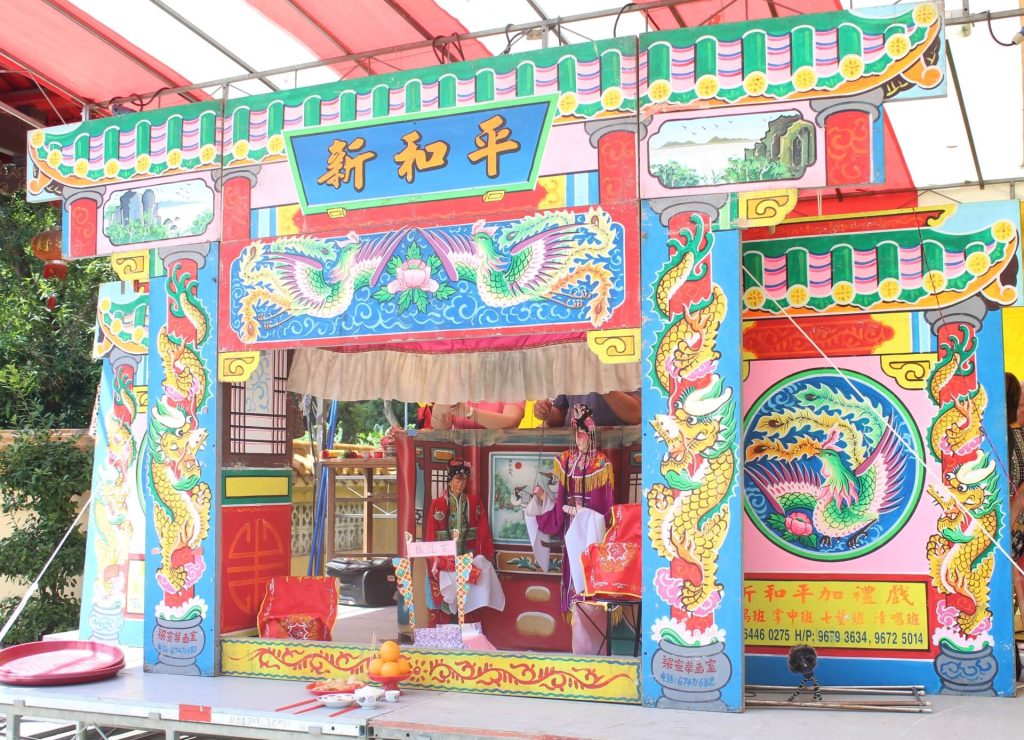
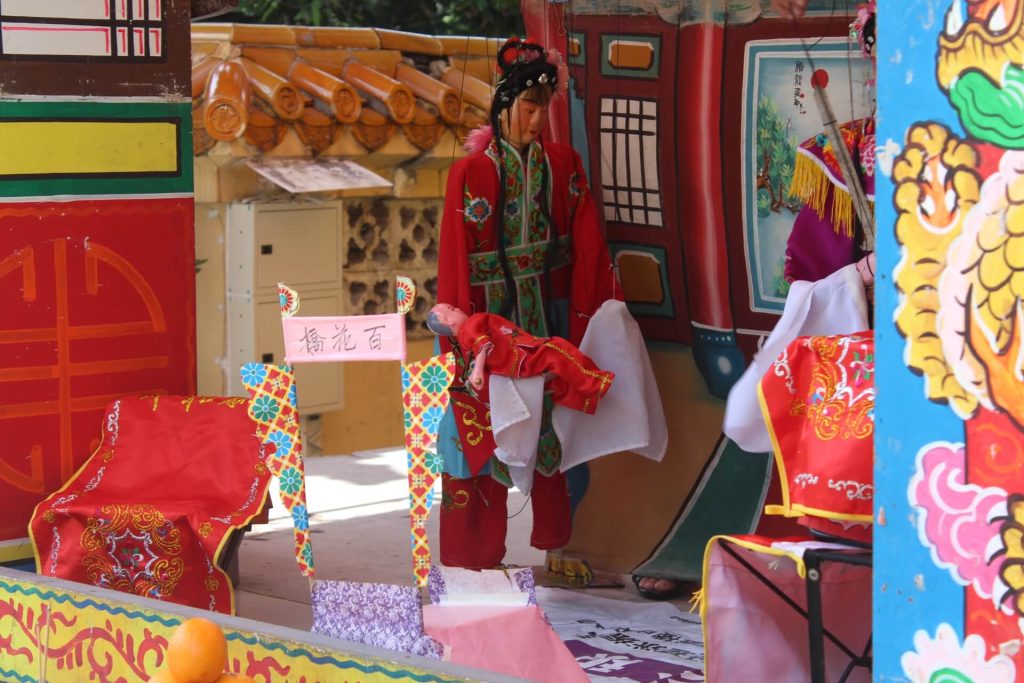
Over the years, the number of trained ritual theatre specialists in Singapore has been on the decline as fewer young people continue the tradition — a phenomenon also seen in mainland China, Taiwan, and other Chinese communities in Southeast Asia. The trend in Singapore, however, is particularly concerning, as changes in the socio-religious landscape have further contributed to the rapid decline of ritual theatre.
| 1 | Notable scholarly works on the topic of ritual theatre include David Johnson, ed., Ritual Opera, Operatic Ritual: “Mu-lien Rescues His Mother” in Chinese Popular Culture; Ch’iu Kuei Wang, “Studies in Chinese Ritual and Ritual Theatre: A Bibliographical Report,” CHINOPERL, 18:1 (1995): 115–29. Liturgical plays (fashixi) are also regarded as ritual theatre. See Piet van der Loon, “Fashi xi chutan”; Yung Sai-shing, Xiqu renlei xue chutan; and Qitao Guo, Ritual Opera and Mercantile Lineage: The Confucian Transformation of Popular Culture in Late Imperial Huizhou. For the function of ritual theatre, see Ch’iu Kuei Wang, “Studies in Chinese Ritual and Ritual Theatre”; Jian Xie, “Local Community Ritual Theatre in Guangxi, South China,” Asian Theatre Journal, 36/1 (2019): 207; Robin Ruizendaal, “Performance as a ritual: The performance practice of the marionette theatre of Southern Taiwan,” in Images and enactments: possible worlds in dramatic performance, edited by Göran Aijmer and Åsa Boholm (Göteborg, Sweden: IASSA, 1994), 151. |
| 2 | Ni Caixia categorises Chinese theatre into “theatre for temple fairs” (miaohuixi) and “theatre for liturgical ceremonies” (fashixi). While these are similar to our understanding of celebratory theatre versus ritual theatre, I have adopted the terms most commonly used in the Singapore context. Johnson also mentioned that ritual theatre involved “exorcism and spectacle”. See Ni Caixia, Daojiao yishi yu xiju biaoyan xingtai yanjiu (Guangzhou: Guangdong gaodeng jiaoyu chubanshe, 2005), 152–64 and David Johnson, Spectacle and Sacrifice: The Ritual Foundations of Village Life in North China (Los Angeles: University of California Press, 2009), 2–4, cited in Jeremy Fan Zhang, “‘Drama Sustains the Spirit’: Art, Ritual, and Theater in Jin and Yuan Period Pingyang, 1150–1350” (Doctoral Dissertation, Brown University, 2011), 172, Note 33. |
| 3 | The focus of discussion here is on the ritual theatre practices of the Hokkien and Henghua groups in Singapore, which is based mainly on the author’s past fieldwork observations. Yung observed the Chaozhou/Teochew performance “Carp leaping over the dragon gate” (Liyu tiao long men) is a form of ritual theatre, see Yung, 167–92. The Hokkien has a form of ritual prelude known as “Opening the temple door” (Kai gong men) or “moo-soo” in the Hokkien vernacular (mosu), better known as “The Complete Performance of Su” (da chu su) in Quanzhou as documented by Ruizendaal. See Ruizendaal, Marionette Theatre in Quanzhou, 285–339. This ritual is usually conducted in the consecration of a new temple and Chief Marshal Tian (Tiandu Yuanshuai), the God of Theatre, who appeared in a string puppet form, is invited by the priest or ritual specialist to preside over the ritual. In the subsequent descriptions, people whose origin or ancestry come from southern Fujian would be referred as Hokkien (differs from the Chinese translated version) but it should be made clear that the term “Hokkien” (transliterated term of Fujian) to refer to this particular group is a misnomer, as not all people from Fujian are from the south. This is especially the case of the Henghua (referring to people originating from Putian and Xianyou, and their language is known as Puxianhua or Puxian language) who also come from Fujian province. The term “Henghua” (transliterated term of Xinghua, other spellings include Hinghwa, Hinghoa) is commonly used in Singapore, which may be related to the “Xinghua” administrative area, besides Putian and Xianyou, which used to exist, and this term continues to be used in Southeast Asia (old term “Nanyang”) including Singapore. |
| 4 | Other terms include Mulian drama, Mulian opera, and Mulian theatre. |
| 5 | Choi Chi Cheung, “Yinyang guodu”; Yee Sok Kiang, “Xinjiapo jiulidong de mulian xi”. |
| 6 | Tanaka Issei, Zhongguo de zongzu yu xiju, 391. |
| 7 | This T-shaped formation was shared by Mr Yeo Lye Hoe (1950–2024) of Sin Hoe Ping, a Henghua puppet troupe in Singapore, 18 December 2019. |
| 8 | Lee Chye Ee, oral history interview, 12 June 1988, audio, National Archives of Singapore (accession no. 000936), Reel 4; Robin Ruizendaal, Marionette Theatre in Quanzhou, 187. |
| 9 | For the full ethnographic details, refer to Chia, Chapter 6. |
| 10 | David Johnson, ed., Ritual Opera, Operatic Ritual: “Mu-lien Rescues His Mother” in Chinese Popular Culture. |
| 11 | Yung, 16–17. |
| 12 | See Dean, “Lei Yu-sheng (‘Thunder is Noisy’) and Mu-lien in the Theatrical and Funerary Traditions of Fukien,” 69. As noted by Dean, “the Mu-lien sequences in Buddhist and Taoist funerals reveal the ongoing interconnection of theatre and ritual in Chinese culture”. Observations on liturgical plays related to Mulian in Singapore were made by Piet van der Loon between 1966 and 1984. See Piet van der Loon, 9–30. |
| 13 | In Putian, where I conducted fieldwork in 2013, the Northern Dipper Play usually lasted about 20 minutes and the main participant was a child. See also Yung, 202–204. |
Chia, Caroline. Hokkien Theatre Across the Seas: A Sociocultural Study. Singapore: Springer, 2019. | |
Choi, Chi Cheung. “Yinyang guodu: 2004 nian xinjiapo jiulidong fengjia dapudu” [Crossing the yin and yang realms: ritual and theatre in 2004 Kiew Lee Tong’s grand ceremony of universal salvation of souls] Journal of the South Seas Society) 61 (2007): 1–12. | |
Guo, Qitao. Ritual Opera and Mercantile Lineage: The Confucian Transformation of Popular Culture in Late Imperial Huizhou. Stanford: Stanford University Press, 2005. | |
Johnson, David, ed. Ritual Opera, Operatic Ritual: “Mu-lien Rescues his Mother” in Chinese Popular Culture. Berkeley: University of California, 1989. | |
Ni, Caixia. Daojiao yishi yu xiju biaoyan xingtai yanjiu [Research on Taoist rituals and theatrical performance forms]. Guangzhou: Guangdong Gaodeng jiaoyu chubanshe, 2005. | |
Ruizendaal, Robin. Marionette theatre in Quanzhou. Leiden; Boston: Brill, 2006. | |
Tanaka, Issei. Zhongguo de zongzu yu xiju [Lineage and theatre in China]. Translated by Qian Hang et al. Shanghai: Guji chubanshe, 1992. | |
Van der Loon, Piet. “Fashixi chutan” [A study on liturgical plays]. Minsu quyi 84 (1993): 9–30. | |
Ye, Mingsheng. “Yishi yu xiju: Minsu xue dekaocha” [Ritual and theatre: folklore studies approach]. Minsu quyi 126 (2000): 237–271. | |
Yee, Sok Kiang. Xinjiapo jiulidong de mulian xi: Zhongguo zongjiaoyishi ju geanyanjiu [The Mulian play in Singapore Kiew Lee Tong Temple: A case study of Chinese ritual theatre]. PhD thesis. Singapore: National University of Singapore, 2010. | |
Yung, Sai-shing. Xiqu renleixu chutan: yishi, juchang yu shequn [Anthropology of Chinese opera: rituals, theatre and community]. Taipei: Rye Field Publishing Co, 1997. |