Pioneer musician: Teng Mah Seng


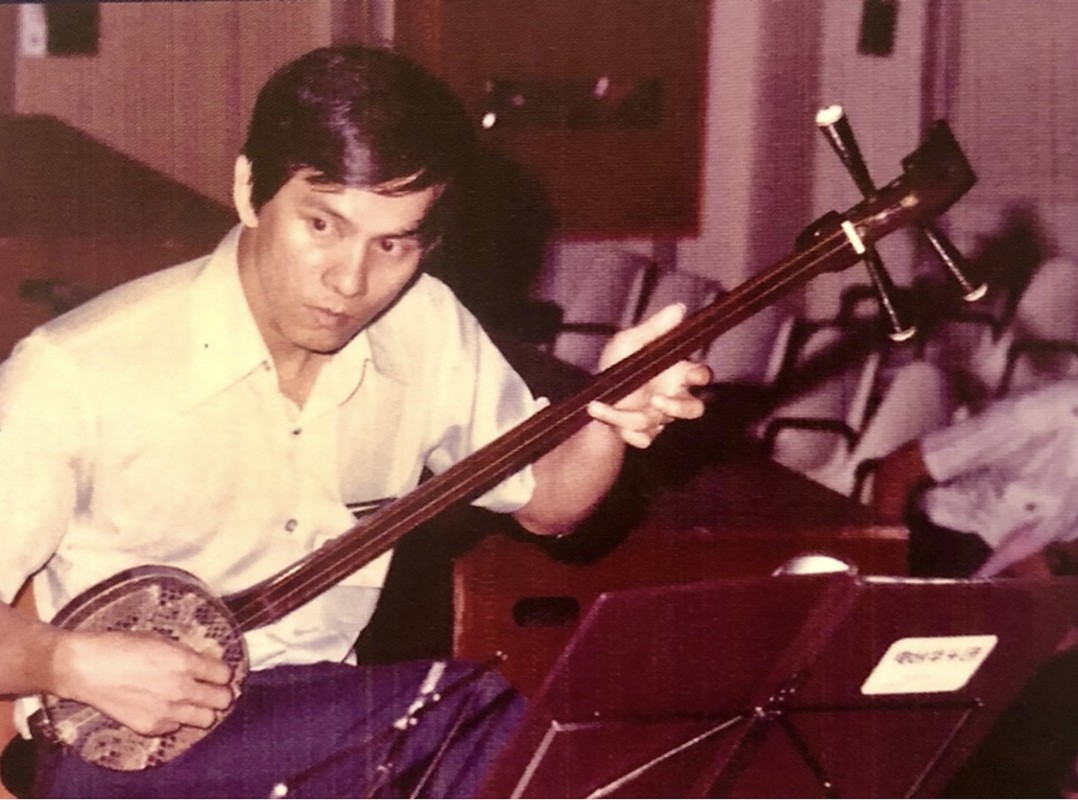
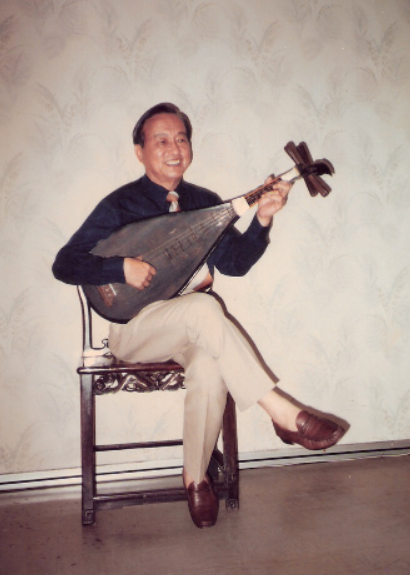
Teng Mah Seng (1916–1992) was born in the city of Jinjiang in China’s Fujian province, and died in Singapore.1As a musician, lyricist and composer, he has been heralded as a tireless champion of traditional Hokkien nanyin music. Teng took nanyin to new heights through his compositions, making the old art form more appealing to modern audiences and raising its profile internationally. In recognition of his contributions, he received the Cultural Medallion, Singapore’s highest accolade for the arts, in 1987.
Early life and career
Raised by his widowed mother, Huang Chou (birth and death years unknown), Teng had an elder sister and two younger sisters. He was originally named 丁妈成 (pronounced ding ma cheng in Mandarin) as a nod to his mother (妈). Teng later changed the character 妈 to the homonym 马.
As Teng came from a poor family, he attended only a few years of private school before being sent to work at a rice mill.2It was there that the young Teng was introduced to nanyin. As it turned out, the miller had a big love for the nanyin genre, and often sang nanyin ballads while working at the mill. The miller also frequently brought Teng along to attend nanyin or Liyuan opera shows, especially during festive occasions. The seeds of this ancient Fujian art were sown in Teng’s heart, and he soon developed a lifelong passion for the genre.
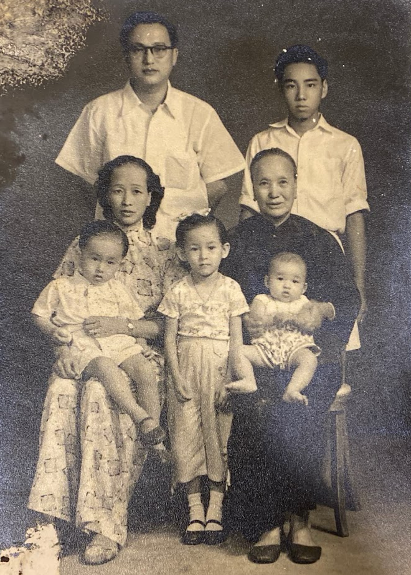
In 1935, at the age of 19, Teng decided to leave his hometown in search of a better life in Nanyang, and eventually came to Singapore. However, as his married elder sister had already moved out, Teng was worried that there would be no one to take care of his ageing mother. Thus, before he departed, Teng married He Wan (1918–1983), a young woman two years his junior, and left her in Quanzhou to care for his mother.
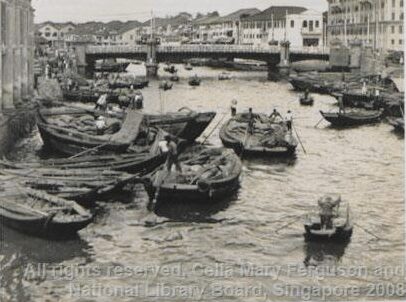
In Singapore, Teng’s first job was to work at a rice shop owned by a businessman from his hometown. Learning the ropes quickly, Teng was able to manage the whole shop independently within two years of working. As his career took off, Teng planned to return to his hometown and bring his entire family to Singapore. Unfortunately, World War II broke out and his plans were brought to a halt.
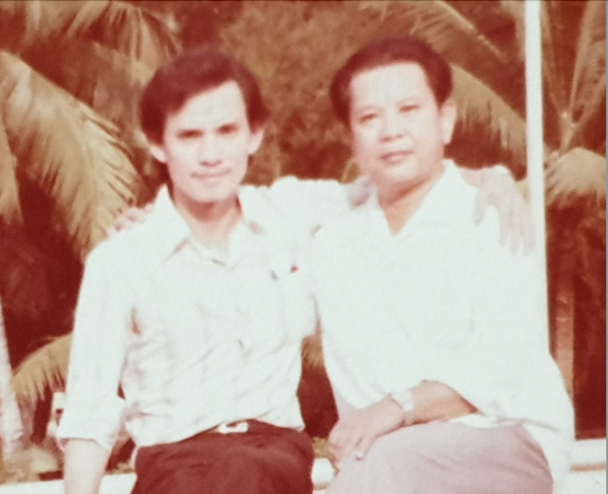
During the Japanese Occupation (1942–1945), Teng made the acquaintance of fellow villager Ho Yeow Koon (1920–1987). After the war ended, both men decided to start a company called Keck Seng, which brokered the buying and selling of commodities such as rice and sugar. It was through this company that Teng formed friendships with many wealthy businessmen, such as rubber tycoon Lee Kong Chian (1893–1967). In 1949, Teng was finally reunited with his family after he was able to relocate them from China to Singapore. Being very knowledgeable, Teng invested in rubber futures, earning him quite the fortune. However, as years passed, things took a turn for the worse. Due to disagreements with the shareholders of his company, Teng chose to dissolve the partnership.3Shortly after that, in March 1977, Teng’s mother died. During her funeral, Teng, who had been acquainted with musicians from Siong Leng Musical Association (SLMA), invited them to perform nanyin at the funerary hall. It was through their nightly performances that Teng reignited his passion for nanyin music.4
Siong Leng Musical Association
Teng’s misfortunes were a catalyst for his accomplishments in the nanyin scene, as he devoted his energies into championing the art form. As the SLMA’s honorary chairman, Teng launched the first ever ASEAN Nanyin Conference from 22 to 24 September 1977, inviting nanyin groups across Southeast Asia to perform together on stage and celebrate the legacy of nanyin.
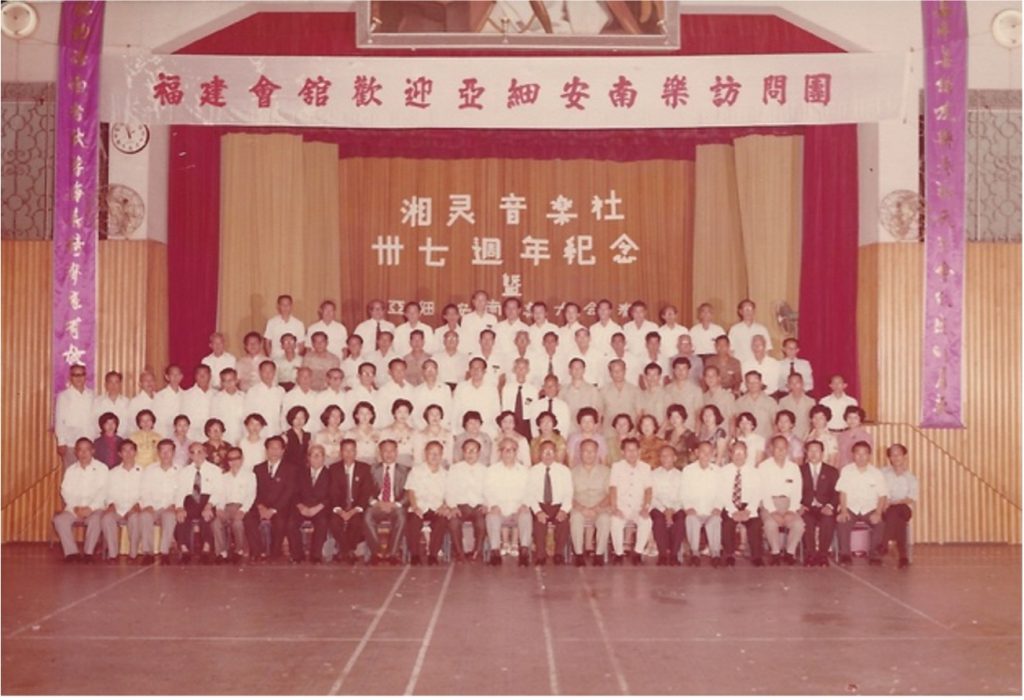
After the inaugural ASEAN Nanyin Conference, Teng became well-known. The following year, in 1978, he succeeded Zhang Kecai (birth and death years unknown)5 as chairman of SLMA.6As Quanzhou scholar Zheng Guoquan noted, the conference spurred authorities in Quanzhou, nanyin’s origin location, to organise a large-scale nanyin event of their own. The first Quanzhou Nanyin Grand Concert of China was then held in 1981. Following in Teng’s footsteps, the event also invited local and foreign nanyin ensembles to perform in the event.
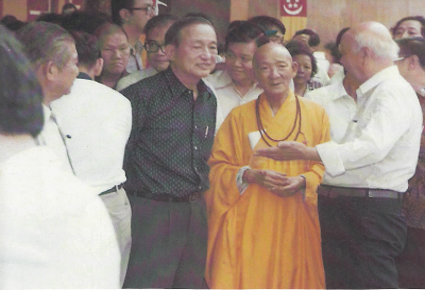
Teng’s enterprising spirit cemented his reputation in the nanyin scene, prompting business leaders, community leaders and even religious figures of Hokkien origin to assist him in the event. Notable names included businessman Goh Tjoei Kok (1905–1994), clan association leader Ng Aik Huan (1908–1985), religious figure Venerable Seck Hong Choon (1907–1990), and even former Minister for Labour Ong Pang Boon.7
Teng also organised many overseas trips for SLMA, including to Manila and Taiwan, promoting friendship and cultural exchange with nanyin groups of the region.
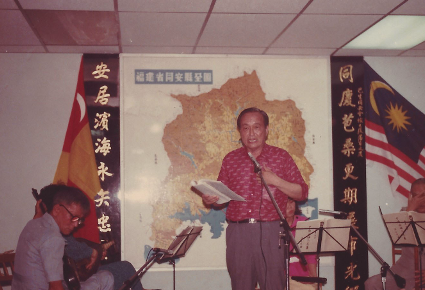
In July 1983, Teng led a 13-member group from SLMA to participate in the 37th Llangollen International Music Eisteddfod in Wales. This likely marked the first time nanyin was performed on an international stage in Europe. One of the association’s vocalists, Ong Guat Huah (1923–2011), came third in the folk solo category with her rendition of Teng’s composition, Reminiscence; while the quintet of Zhuo Shengxiang, Yang Piaojing, Quan Yunju, Wu Guowen and Hong Cailan won fourth place in the folk ensemble category with the traditional nanyin piece, Trotting Horses.8
In his 14 years helming SLMA, Teng worked hard to introduce innovations that might ensure the survival of nanyin and help it gain appeal with a wider audience. Teng did this through his compositions, which broke away from the tradition of having only the four main instruments of pipa, sanxian, dongxiao and erxian.9He experimented with different ensemble settings, such as dongxiao duets or solo singing, and incorporated stage play elements. This allowed Teng to showcase nanyin on a modern stage, giving it the recognition it deserved.
Final years
Teng was diagnosed with prostate cancer in February 1987.10 Knowing he had little time left, Teng focused his energies on finding a successor. Eventually, he found the ideal candidate in Celestina Wang Pheck Geok, a young woman who had been learning nanyin under him. It was unusual then for a woman to be appointed the head of a traditional Chinese community association. To smoothen the transition for his protégé and help her gain support from the community, Teng took her to meet his friends and associates, including the then Chairman of Lee Foundation, the late Lee Seng Gee (1921–2016).11
Teng succumbed to his illness on 5 December 1992. During his funeral, Ong Guat Huah was tasked with singing Teng’s final nanyin composition, Farewell, which he had penned right before his death.12However, choking with emotion, Ong was unable to sing, and Wang stepped in to perform the song.
Even after Teng passed away, SLMA continues on with his legacy. The name Teng Mah Seng inevitably springs to mind during discussions of Siong Leng or nanyin in Singapore.
| 1 | Chia Yei Yei, Blazing A Trail in Nanyin (Singapore: Siong Leng Musical Association, 2022), 3. |
| 2 | Chia, Blazing A Trail in Nanyin, 3. |
| 3 | Anne Low, “Saviour of Nanyin Music,” The Straits Times, 17 January 1988. |
| 4 | Chia, Blazing A Trail in Nanyin, 10. |
| 5 | Chia, Blazing A Trail in Nanyin, 23. |
| 6 | Chia, Blazing A Trail in Nanyin, 36. |
| 7 | Siong Leng Musical Association: Celebration of 37th Anniversary and Combined Performance of South Hokkien Classical Music by ASEAN Countries (Singapore: Siong Leng Musical Association, 1977), 4–5. |
| 8 | Canjia Yingguo Zhuban Shijie Ge Minzu Yinyue Gechang Bisai Jinian Tekan [Commemorative Special Edition for Participating in the UK-hosted World Ethnic Music and Singing Competition] (Singapore: Siong Leng Musical Association, 1983). |
| 9 | Nanyin da Gongchen Ding Ma Cheng Nanyin Zuopin Pinglun [Nanyin’s Great Contributor Teng Mah Seng’s Nanyin Works Review] (Singapore: Siong Leng Musical Association, 1995). |
| 10 | Huang Xiuqin, Jiezhe yongye [The Man Singing the Verse is Brave] (Singapore: Siong Leng Musical Association, 2011), 40. |
| 11 | Chia, Blazing A Trail in Nanyin, 96. |
| 12 | Ding Ma Cheng Shenghuo Dao Hui [Memorial service of Teng Mah Seng] (Singapore: Siong Leng Musical Association, 1993). |
Canjia Yingguo Zhuban Shijie Ge Minzu Yinyue Gechang Bisai Jinian Tekan [Commemorative special edition for participating in the UK-hosted world ethnic music and singing competition]. Singapore: Siong Leng Musical Association, 1983. | |
Chia, Yei Yei. Blazing A Trail in Nanyin. Singapore: Siong Leng Musical Association, 2022. | |
Ding Ma Cheng Sheng Zhui Dao Hui [Memorial service of Teng Mah Seng]. Singapore: Siong Leng Musical Association, March 1993. | |
Ding Ma Cheng Nanyin Zuopin Pinglun [Teng Mah Seng’s review of Nanyin works]. Singapore: Siong Leng Musical Association, 1995. | |
Goh, Joen. “Nanyin: An Evolution in Singapore.” MuseSG Volume 9 Issue 2, April to June 2016. | |
Liu, Xiazong and Xu, Yangting. Jiezhe yongye [The Man Singing the Verse is Brave]. Singapore: Siong Leng Musical Association, 2011. | |
Low, Anne. “Saviour of Nanyin Music.” The Straits Times, 17 January 1988. | |
Nanyin da Gongchen Ding Ma Cheng Nanyin Zuopin Pinglun [Nanyin’s Great Contributor Teng Mah Seng’s review of Nanyin works]. Singapore: Siong Leng Musical Association, 1995. | |
Huang, Xiuqin. Xinjiapo nanyin chutan [An Exploration of Nanyin in Singapore]. Singapore: The Singapore Chinese Opera Institute, 2010. | |
Siong Leng Musical Association: Celebration of 37th Anniversary and Combined Performance of South Hokkien Classical Music by ASEAN Countries. Singapore: Siong Leng Musical Association, 1977. |