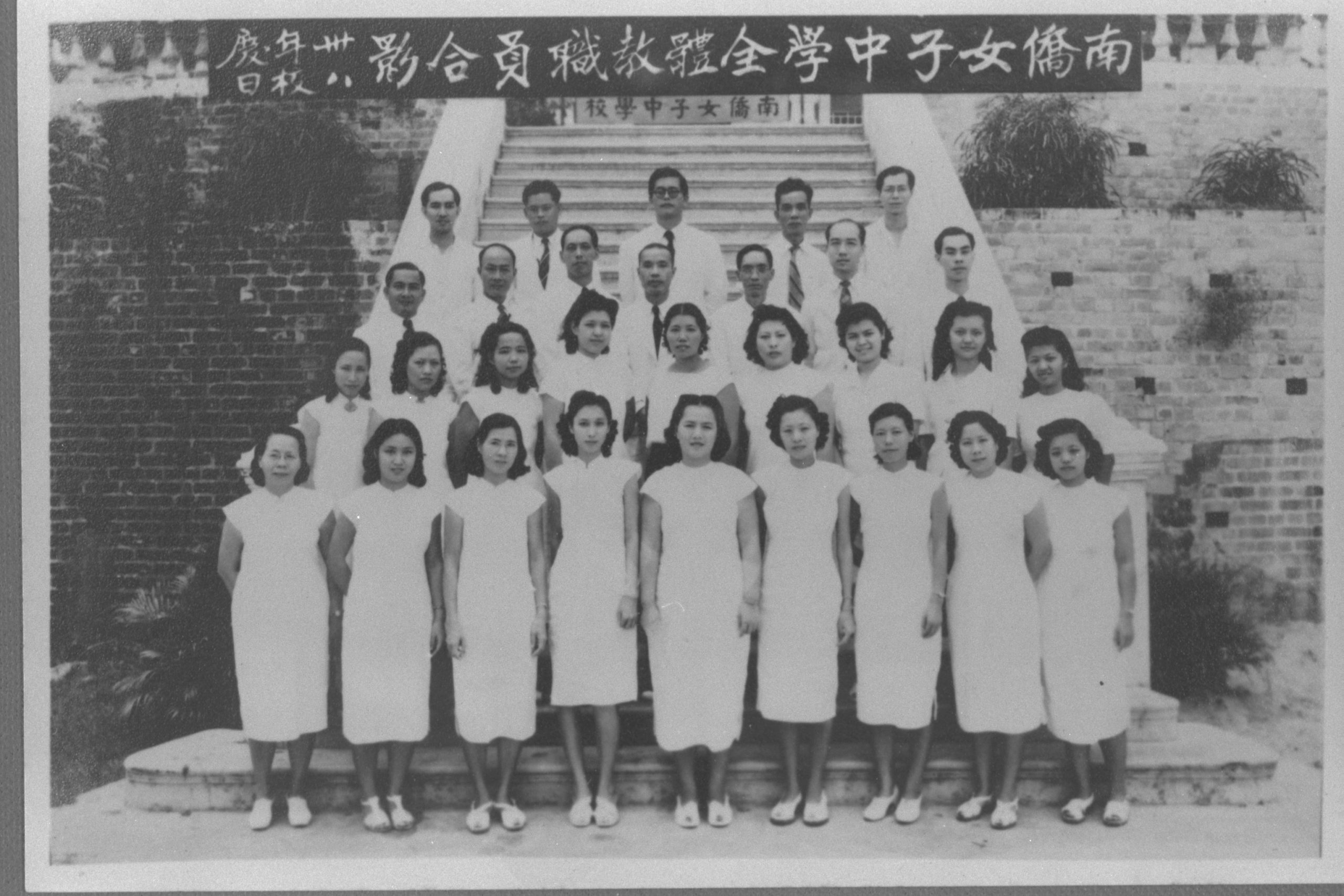
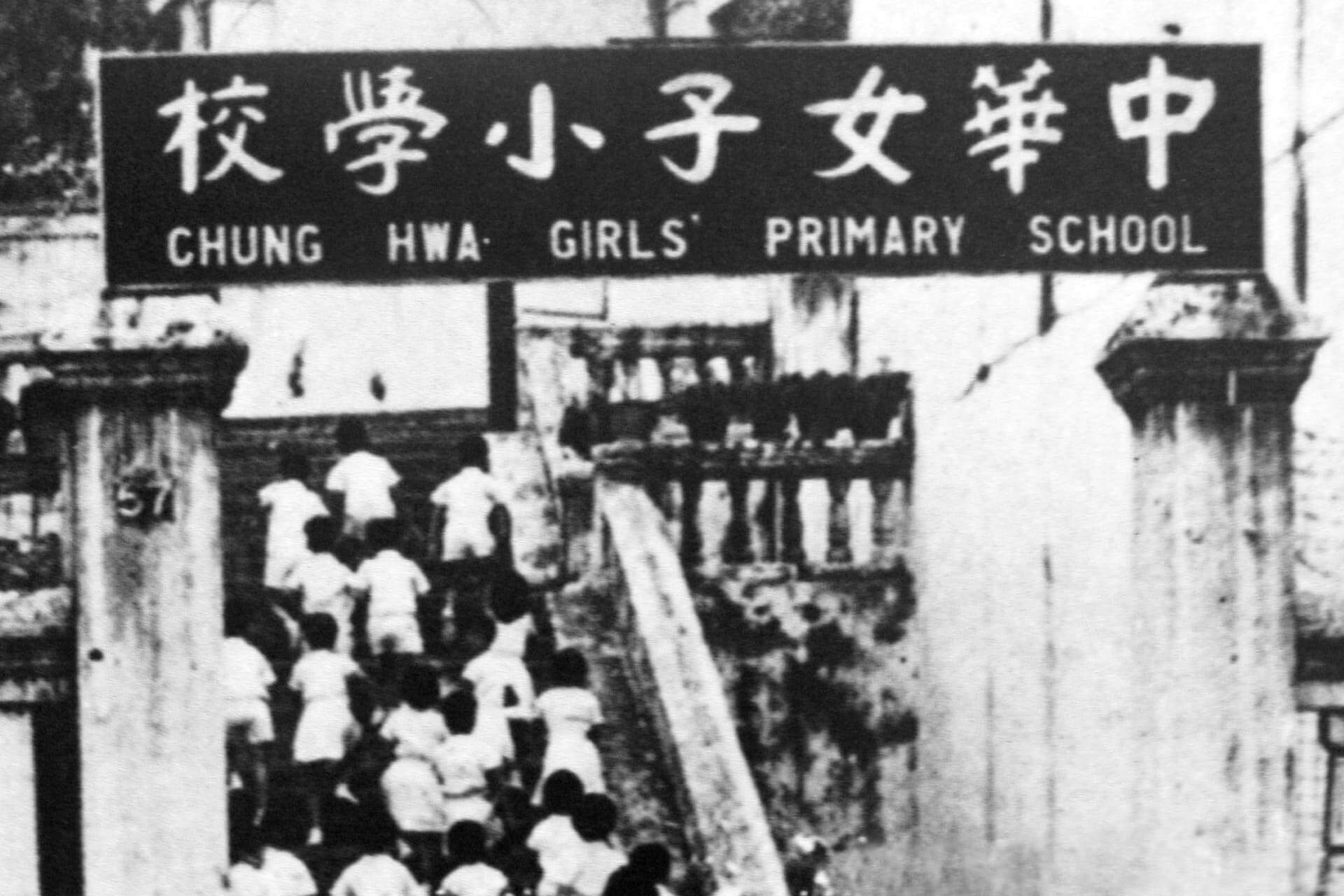
CHIJ St Nicholas Girls’ School


CHIJ St Nicholas Girls’ School was established in Singapore in 1933 by nuns from the Charitable Mistresses of the Schools of the Holy Infant Jesus — a Catholic congregation founded by Father Nicolas Barré (1621–1686) in France in 1666, who aimed to provide an education to girls from poor families.
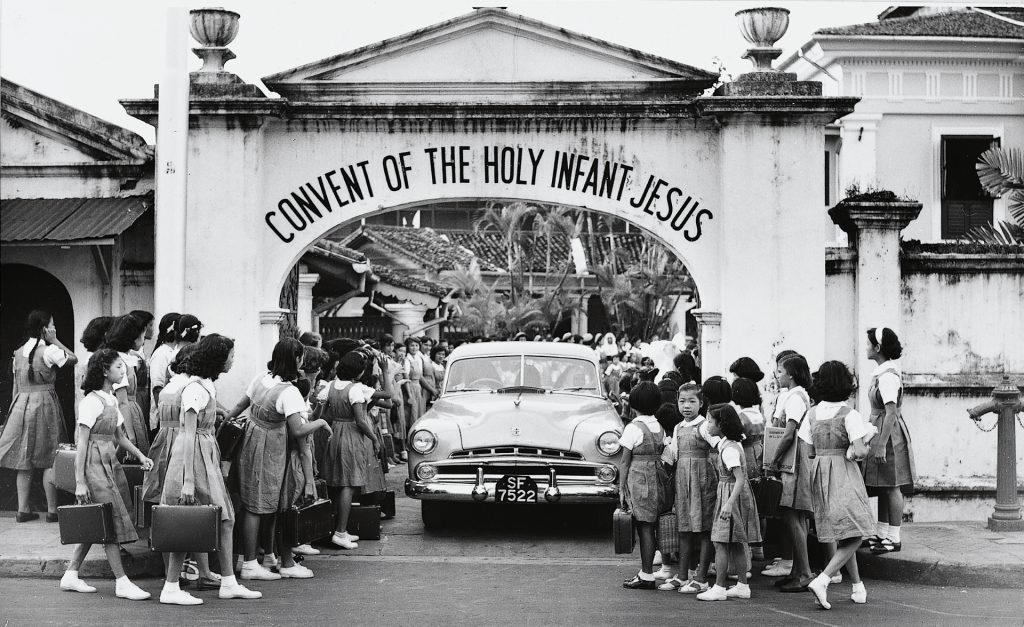
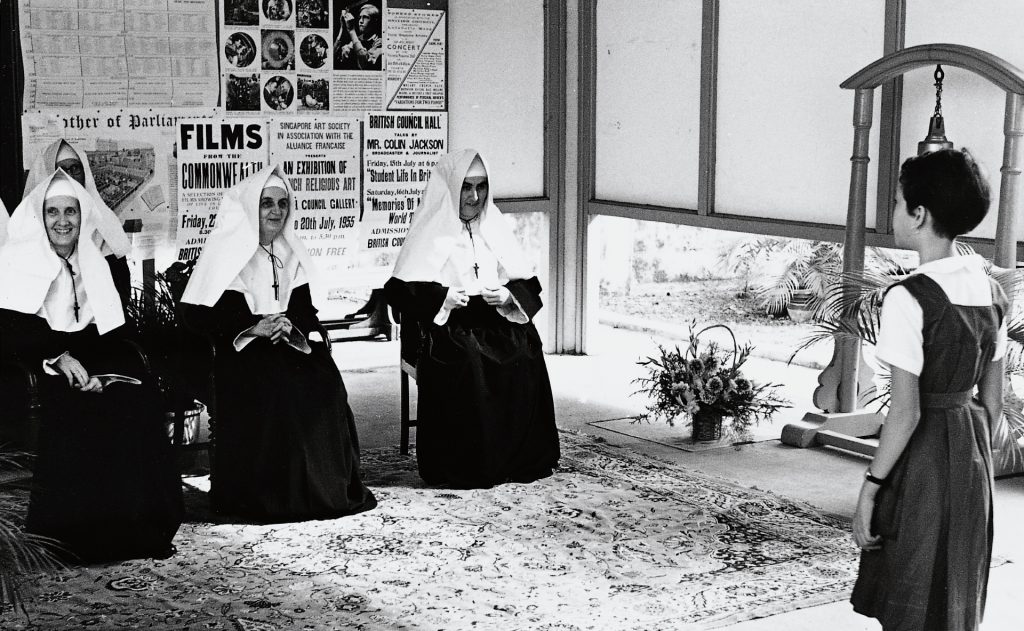
In 1854, four Sisters (three French and one Irish) from the congregation set up the first Convent of the Holy Infant Jesus (CHIJ) in Singapore. Located in the city centre, the school was known as Town Convent and laid the foundation for the establishment of 10 other CHIJ schools on the island, including CHIJ St Nicholas Girls’ School — the only Chinese-medium school set up by CHIJ in Singapore.
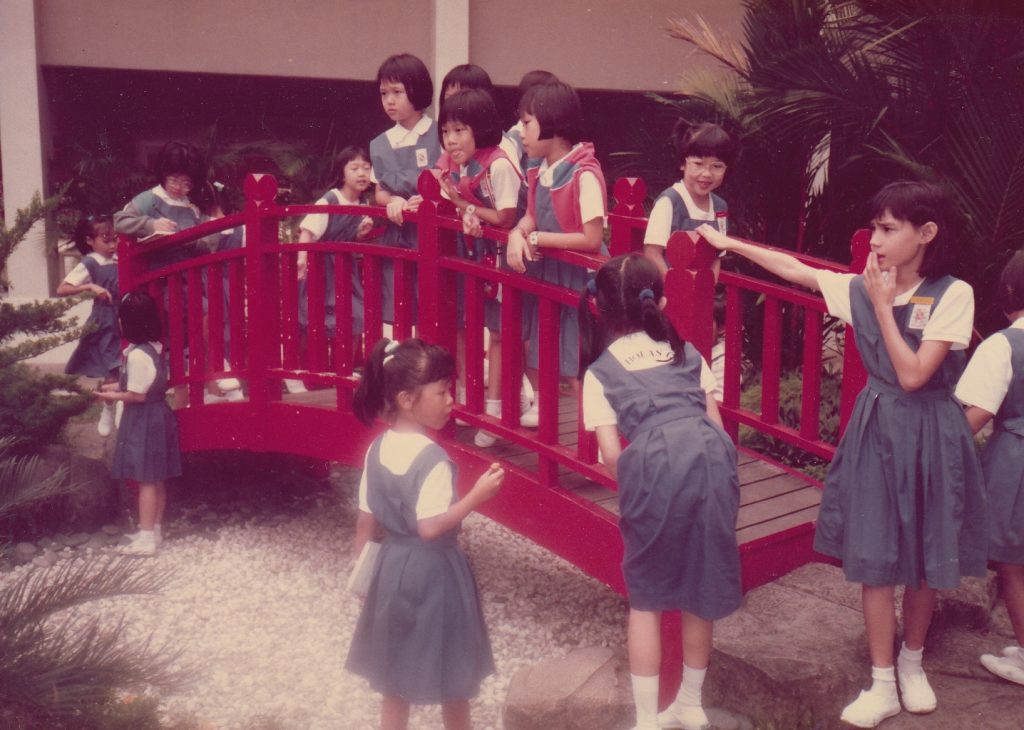
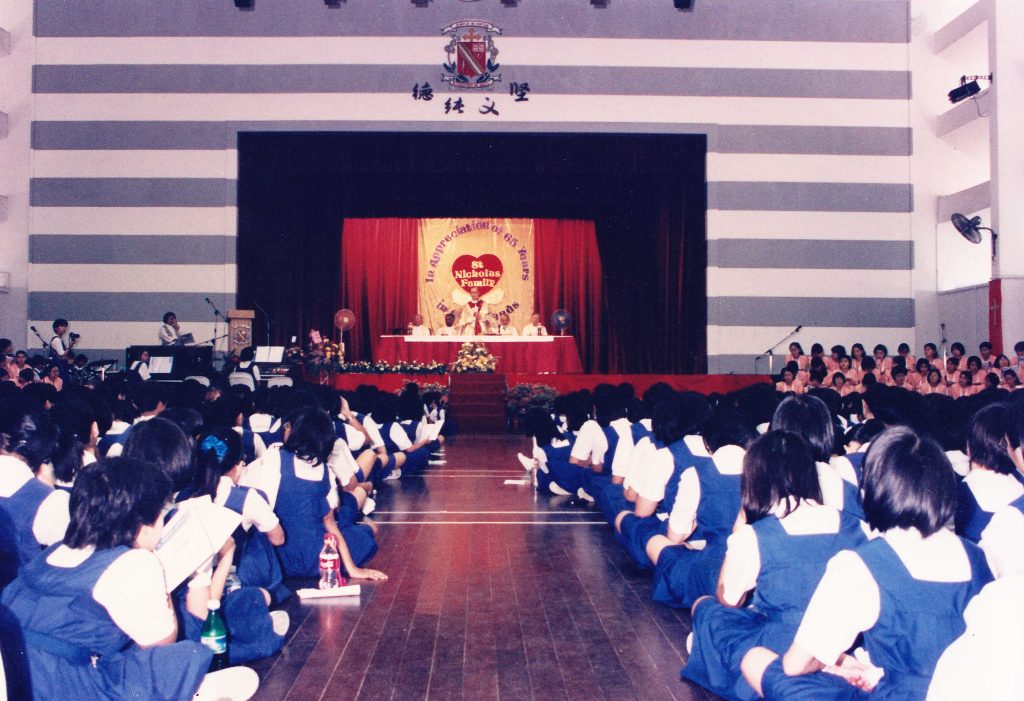
Since 1991, these schools have borne the prefix “CHIJ”, and their uniforms consist of a white blouse and blue pinafore inspired by French styles. The colour blue, like the sky, symbolises openness, clarity, and vitality.
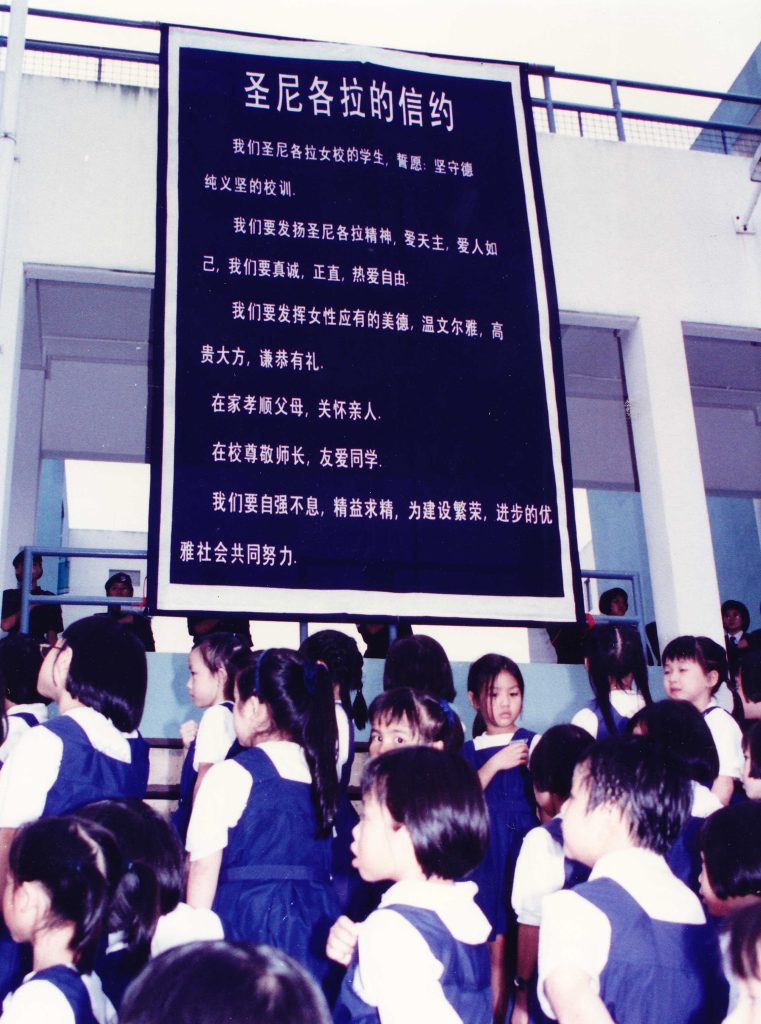
The school song of CHIJ St Nicholas Girls’ School is sung in Chinese, reflecting a commitment to Chinese values, especially Confucian ethics, while reinforcing the school’s motto of “Simple in Virtue, Steadfast in Duty” — a modern take on traditional virtues associated with women.
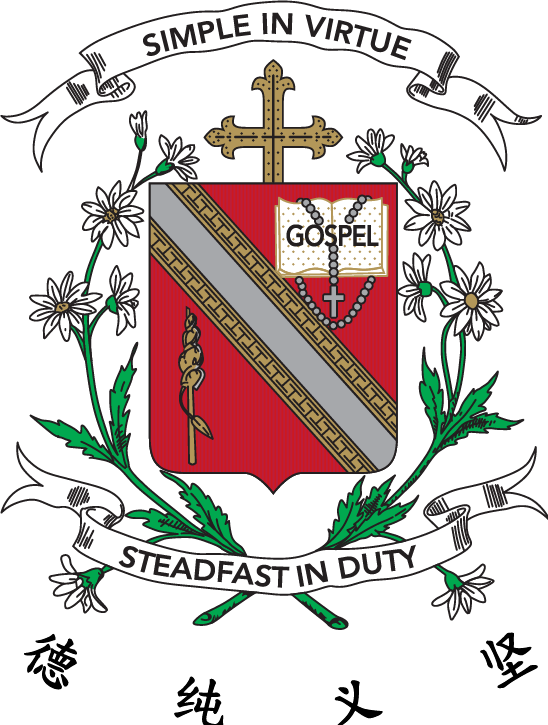
School motto
Simple in Virtue, Steadfast in Duty
Brief history
In the 1930s, the Chinese population in Singapore was growing rapidly. To cater to the community’s needs, CHIJ decided to establish a Chinese-medium primary school for girls.
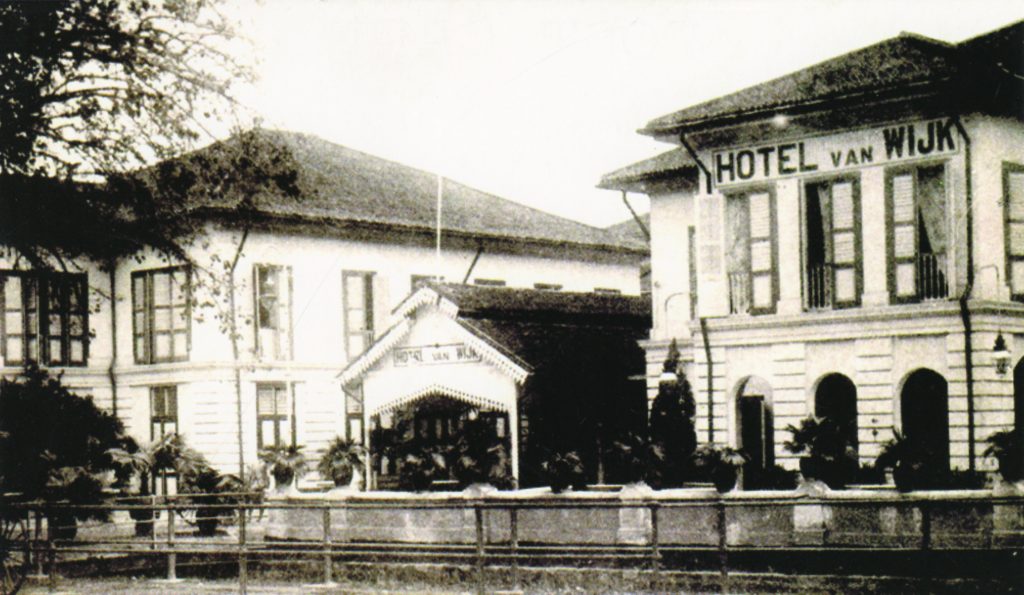
On 16 January 1933, it established a new school on the former premises of Hotel Van Wijk in Victoria Street and named it Victoria Girls’ School. The school is known as CHIJ St Nicholas Girls’ School today. Initially, the school had about 40 students, offering only Primary 1 and Primary 2 classes. The first principal was Sister Solong (birth and death years unknown), a French national who taught English. She recruited a Chinese teacher to teach Chinese, laying the foundation for the school’s bilingual education. In 1937, the school expanded to include classes up to Primary 6, becoming a full-fledged primary school.
In 1938, the school started a teacher training section (discontinued in 1952) to nurture lower-primary teachers. The first batch of student teachers under this programme graduated in 1941. After World War II, the school resumed its classes in November 1945, and student enrolment grew to 700. In honour of Father Nicolas Barré, Victoria Girls’ School was renamed St Nicholas Girls’ School that same year. With the increased student enrolment, and Hotel Van Wijk’s state of disrepair, the school had to hold some of its classes in Town Convent in Victoria Street, while its old campus underwent renovations and was rebuilt as a two-storey building. When renovation works were completed in 1949, Town Convent moved into the new building, while St Nicholas Girls’ School formally relocated into Town Convent’s campus (now the dining and lifestyle complex CHIJMES), a more spacious compound with a variety of facilities. That same year, St Nicholas Girls’ School started its junior middle school section.
The first batch of junior middle school students graduated in 1951. A year later, in 1952, the senior middle section was introduced, with the first batch graduating in 1954. Following the adoption of the new school system, in 1962, the pre-university section was established, though it was terminated in 1976. In 1979, the school was selected by the Ministry of Education (MOE) to become one of nine Special Assistance Plan (SAP) schools in Singapore, and a pre-primary section was also established.1
The school relocated five times between 1980 and 1985. In 1980, with the building at Victoria Street no longer being able to house the entire school, St Nicholas Girls’ School once again turned to borrowing spaces — this time a building on Armenian Street belonging to Tao Nan School (run by the Singapore Hokkien Huay Kuan), so some of its primary school students could have classes there. The secondary school students borrowed the old Raffles Girls’ Primary School’s premises in Victoria Street.
In 1982, as the old Raffles Girls’ Primary School’s premises risked collapsing, some of the pre-primary, primary, and secondary students had to move once again to a campus on Ang Mo Kio Street 44 (now Pathlight School Campus 2). As a result, St Nicholas Girls’ School’s teachers had to shuttle between Victoria Street and Ang Mo Kio. In 1984, the campus at Victoria Street was affected by the development of the Mass Rapid Transit (MRT), and some students had to use Townsville Primary School’s premises at Ang Mo Kio Avenue 8, marking the school’s fourth relocation.
After five years of relocating, the school finally settled into its permanent premises on Ang Mo Kio Street 13 in 1985. In 1992, St Nicholas Girls’ School was renamed CHIJ St Nicholas Girls’ School. In 1995, the school was accorded autonomous status by the MOE in recognition of its performance.2 From end-2009 to 2012, it underwent the Programme for Rebuilding and Improving Existing Schools (PRIME) to develop a future-ready campus.
Since becoming a SAP school in 1979, CHIJ St Nicholas Girls’ School has become one of the pioneers of Singapore’s bilingual education. The SAP curriculum focuses on developing students’ proficiency in both Chinese and English, as well as a strong understanding of Chinese culture. In 2013, the school, together with Catholic High School and the Singapore Chinese Girls’ School, introduced the Joint Integrated Programme (JIP), where IP students are exempted from GCE O-Level examinations and can progress directly to Eunoia Junior College .3 The same year, the school also built a Chinese Heritage Corner to showcase Chinese culture. In 2015, the school introduced the four-year Bicultural Studies Programme (BSP) for upper secondary students .4 In 2016, this programme was extended to IP schools that CHIJ St Nicholas Girls’ School collaborated with.
Many of the school’s former principals contributed significantly to its development, one of the most notable being local-born Sister Francoise Lee (1909–1986), who dedicated 31 years of service to the school. She was the first educator to promote bilingual education in Singapore Catholic schools, laying a solid foundation for CHIJ St Nicholas Girls’ School. Another notable figure was principal Hwang-Lee Poh See, the school’s first principal who was not part of the religious order. She introduced modern management ideas and led the school through a crucial period of educational reform in Singapore. She advocated fiercely for the school in many ways, bringing an end to its years of relocating when CHIJ St Nicholas Girls’ School settled permanently in its current Ang Mo Kio campus.
Since its founding, the school’s vision of cultivating “Girls of Grace”, “Women of Strength”, and “Leaders with Heart” reflects its dedication to shaping young women of character, resilience, and benevolent leadership. The spirit of sisterly love is embedded in the culture of the school, where students address each other as sisters (“jiejie”, “meimei”). The CHIJ St Nicholas Girls’ School Alumnae Association was founded in 1980, and many of the school’s staff today are alumnae, including current principal Winnie Tan Sin Wei.
Over the years, CHIJ St Nicholas Girls’ School has produced outstanding alumnae across the public service, media, and the arts, including political office holder Sun Xueling; He Ting Ru and Hazel Poa Koon Koon, who hold or have held parliamentary seats; former nominated parliamentarian Tan Su Shan, now CEO of DBS Group; as well as Cantonese opera singer and Cultural Medallion recipient Lou Mee Wah. Alumnae who currently serve as top civil servants (Permanent Secretary) include Lim Wan Yong and Teoh Zsin Woon. The school’s eighth principal Tan-Soh Wai Lan is also an alumna, who is currently President of the Nanyang Academy of Fine Arts (NAFA).
Principals and years in service
- Sister Solong (1933–1935)
- Sister Felix (1936–1937)
- Sister Marie Mercedes (1938–1939)
- Sister Francoise Lee (1940–1971)
- Mrs Hwang-Lee Poh See (1972–2000)
- Helen Choo Chieh Chien (2001–2006)
- Chan Wan Siong (2007–2011)
- Mrs Tan-Soh Wai Lan (2012–2016)
- Mrs Fiona Tan Su Ling (2017–2024)
- Winnie Tan Sin Wei (2025–present)
This is an edited and translated version of 圣尼各拉女校. Click here to read original piece.
| 1 | The Special Assistance Plan (SAP) was introduced in 1979 to nurture students with bilingual aptitude. The schools under this plan are called SAP schools, known to provide students with high quality teaching and an environment that emphasises bilingual learning. |
| 2 | Established in 1994, autonomous schools follow the Ministry of Education syllabus, while providing a wider range of programmes than regular government schools, to enhance students’ learning experience. |
| 3 | Integrated Programme: A six-year course covering the secondary school and junior college curricula that leads to certification examinations such as the Singapore-Cambridge General Certificate of Education Advanced Level (GCE A-Level) examination. The programme allows students who scored in the top 10% of their cohort to proceed directly to junior college without taking the O-Level examination, giving them more time to develop their intellectual curiosity, creativity, critical thinking, and leadership skills; Singapore-Cambridge General Certificate of Education Ordinary Level (GCE O-Level): An annual national examination jointly organised by the Singapore Examinations and Assessment Board (SEAB), Ministry of Education (MOE), and Cambridge Assessment International Education which leads to the Singapore-Cambridge General Certificate of Education Ordinary Level, commonly referred to as the “O-Levels”. |
| 4 | Bicultural Studies Programme: The Ministry of Education established the Bicultural Studies Programme in 2005 to nurture bilingual and bicultural talents who can engage with both Chinese and Western cultures, while maintaining local awareness and a global perspective. Students in the programme have opportunities to participate in various learning activities, including immersion trips, as well as seminars and lectures on Chinese history, culture, and contemporary developments. |
Au, Yue Pak. “Sheng nigela 60 nian” [St Nicholas 60 years]. Lianhe Zaobao, 1 August 1993. | |
Au, Yue Pak. Xian’ge bujue [The music and singing never cease]. Singapore: The Youth Book Company, 2006. | |
Chan, Yen Teng. Xinjiapo huaxiao lianhehui 60 zhounian jinian 1947–2007 [The 60th anniversary commemorative booklet of the Singapore Chinese Schools’ Conference 1947–2007]. Singapore: Singapore Chinese Schools’ Conference, 2007. | |
Huang, Hui Lin. “Xiaofu ye you shi: chuang xin yu bao shou” [School uniforms also have a history: innovation and conservatism]. Lianhe Zaobao, 18 April 2000. | |
“CHIJ St Nicholas Girls’ School.” MOE Heritage Centre. | |
Phua, Kok Khoo, and Poon, Sing Wah. Huaxiao fazhan de huigu yu qianzhan — 2008 nian “xiaozhang luntan” wen ji [Review and prospect of the development of Chinese schools — collection of essays from the 2008 “Principal Forum”]. Singapore: 2008 Chinese School History Joint Exhibition Organising Committee, 2009. | |
Poon, Sing Wah. Xinjiapo xiaozhang fangtan lu [Interviews with Singaporean principals]. Singapore: Candid Creation Publishing, 2006. | |
Tang, Eva, dir. Cong weiduoliya jie dao hongmaoqiao [From Victoria Street to Ang Mo Kio]. Singapore: St Nicholas Girls School Alumnae Association, 2019. | |
Wu, Hua. Xinjiapo huawen zhongxue shi lüe. [Brief history of Singapore Chinese secondary schools]. Singapore: Education Press, 1976. |