Nanyang Girls’ High School


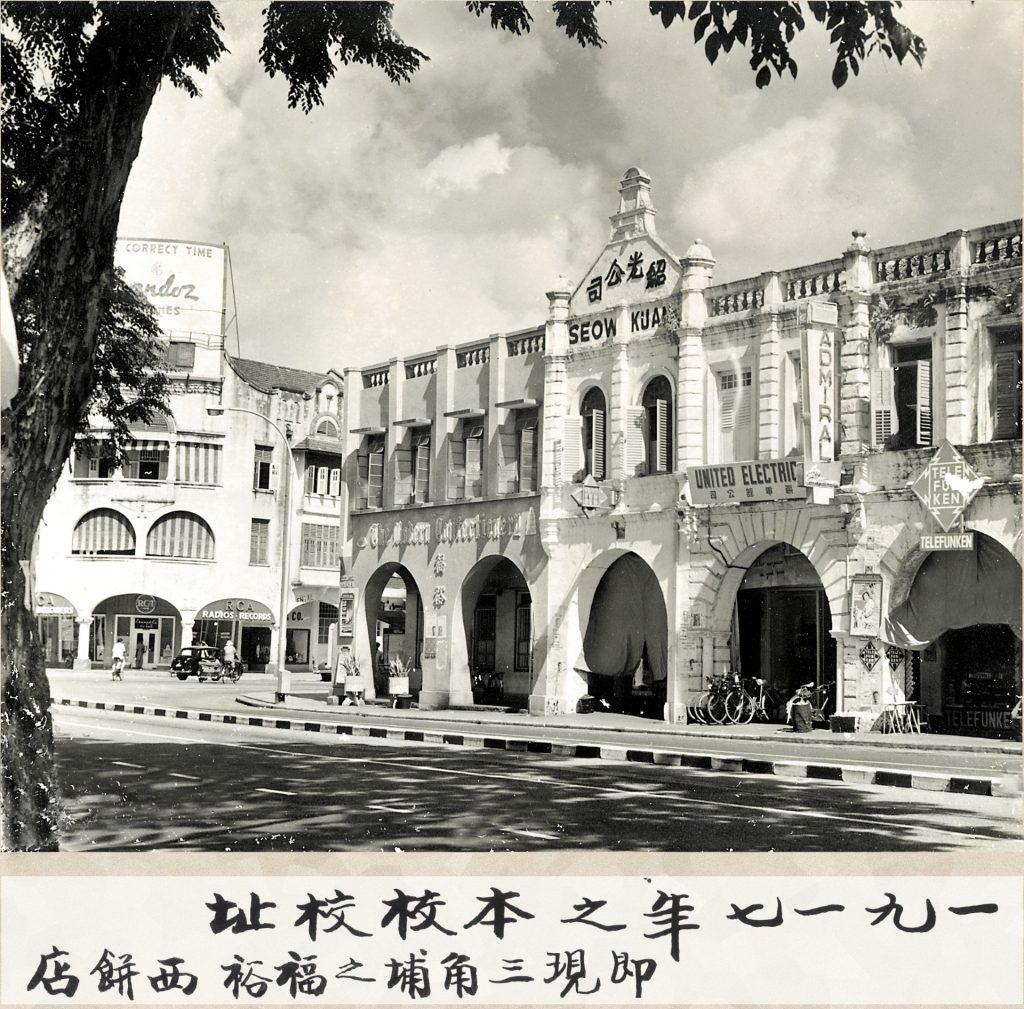
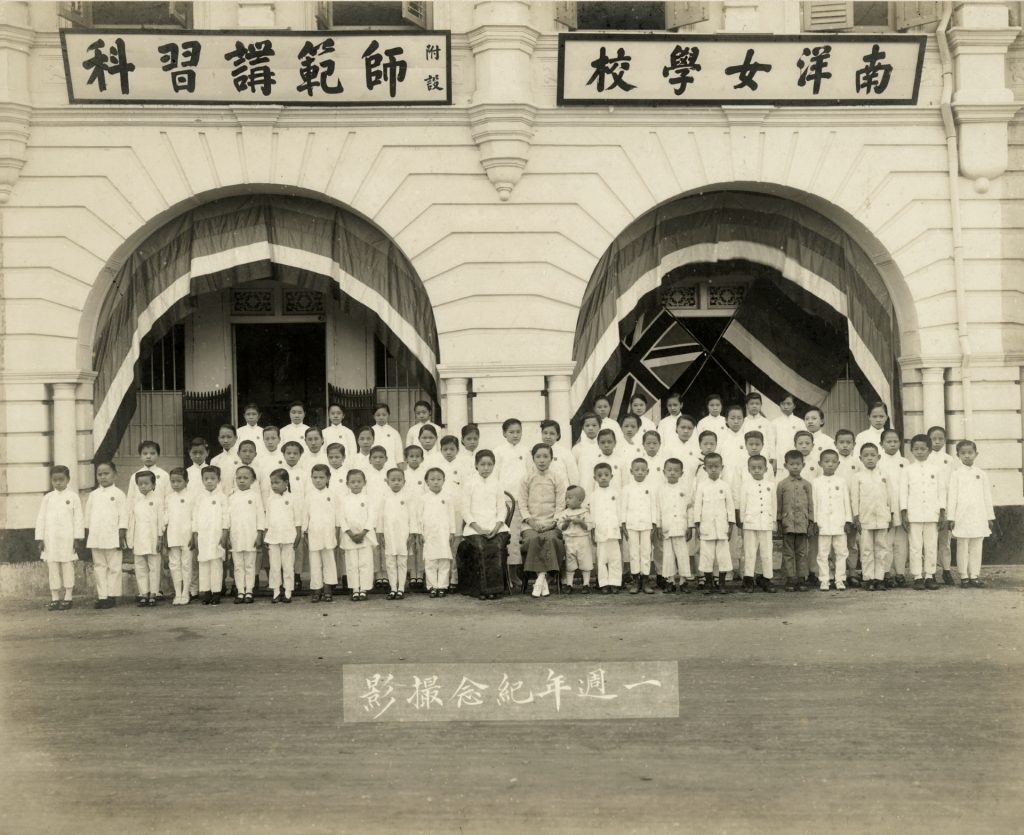
Nanyang Girls’ High School was founded in 1917 by a group of leaders from the Tongmenghui, a Chinese underground resistance movement, who had a passion for women’s education. It was founded by members Teo Eng Hock (1872–1959), Tan Chor Lam (1884–1971), Chuang Hee Tsuan (1888–1988), Lin Rui Xuan (birth and death years unknown), and Huang Xiao Yan (1887–1940), and subsequently supported by Chng Phee Tong (1889–1962), Kum Cheng Soo (1884–1923), and Ang Shin Hu (birth and death years unknown). With the help of Yu Pei Gao (1888–1934), former principal of Guangxi Guilin Women’s Normal School who had rich experience in school management, they rented the No. 7 shophouse unit at the Sanjiaopu area (today’s Dhoby Ghaut) and established what was initially called Nanyang Girls’ School on 15 August 1917, with an inaugural cohort of around 100 students. This consisted of Primary One students and the school also offered a two-year course equivalent to lower secondary education which served as teacher training. The graduates from this course would later become primary school teachers.
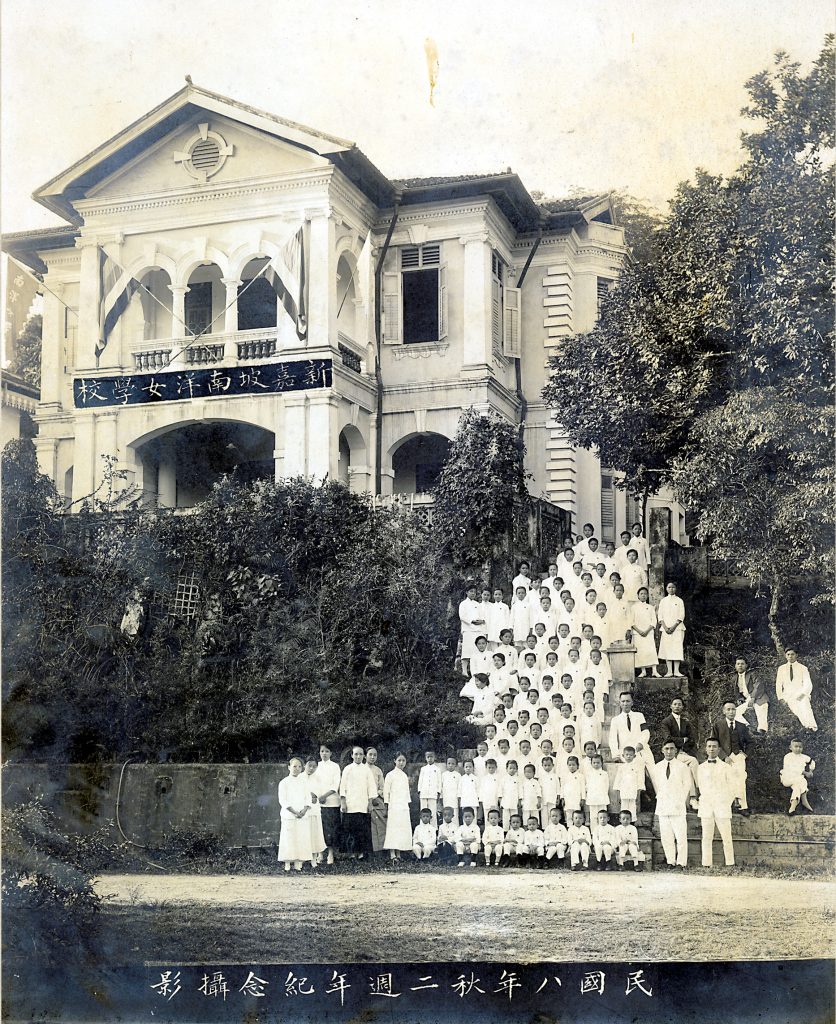
In 1918, with a spike in enrolment, the school rented an adjacent shophouse to meet the growing demand. By 1919, as student numbers continued to increase and classroom space remained insufficient, it relocated to a two-storey private bungalow at No. 10 Sophia Hill.
The motto of Nanyang Girls’ High School is “Diligence, Prudence, Respectability, and Simplicity”, reflecting the school’s aspiration for its students to embody these virtues in their daily lives. The lyrics of its school song were written by Fu Wu Men (1892–1965), while the melody was composed by Shen Bing Lian (1900–1957). The song encourages students to keep pace with the times and contribute to society.
School motto
Diligence, Prudence, Respectability, Simplicity
Brief history
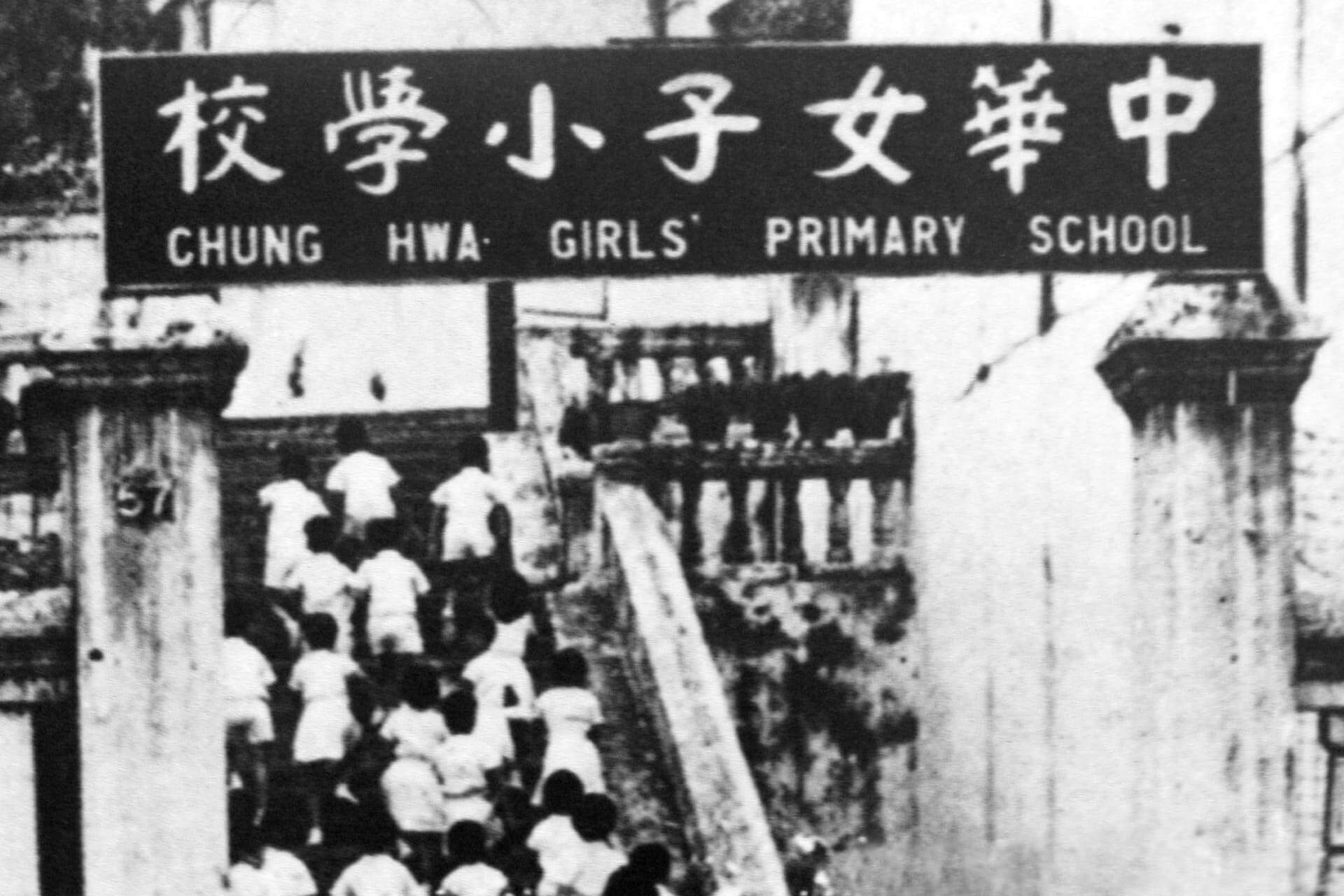
Initially, the school offered only primary education and a secondary-level course designed for teacher training. In 1919, it relocated to No. 10 Sophia Hill due to a spike in student enrolment, and the surrounding empty space was converted into a sports field. On 10 October 1922, then-Principal Peng Meng Min (1892–1975) organised a combined sports meet with two other girls’ schools — Wah Kiew Nui Hok and Chung Hwa Girls’ School — becoming one of the first Chinese schools in Singapore to organise a combined sports meet.
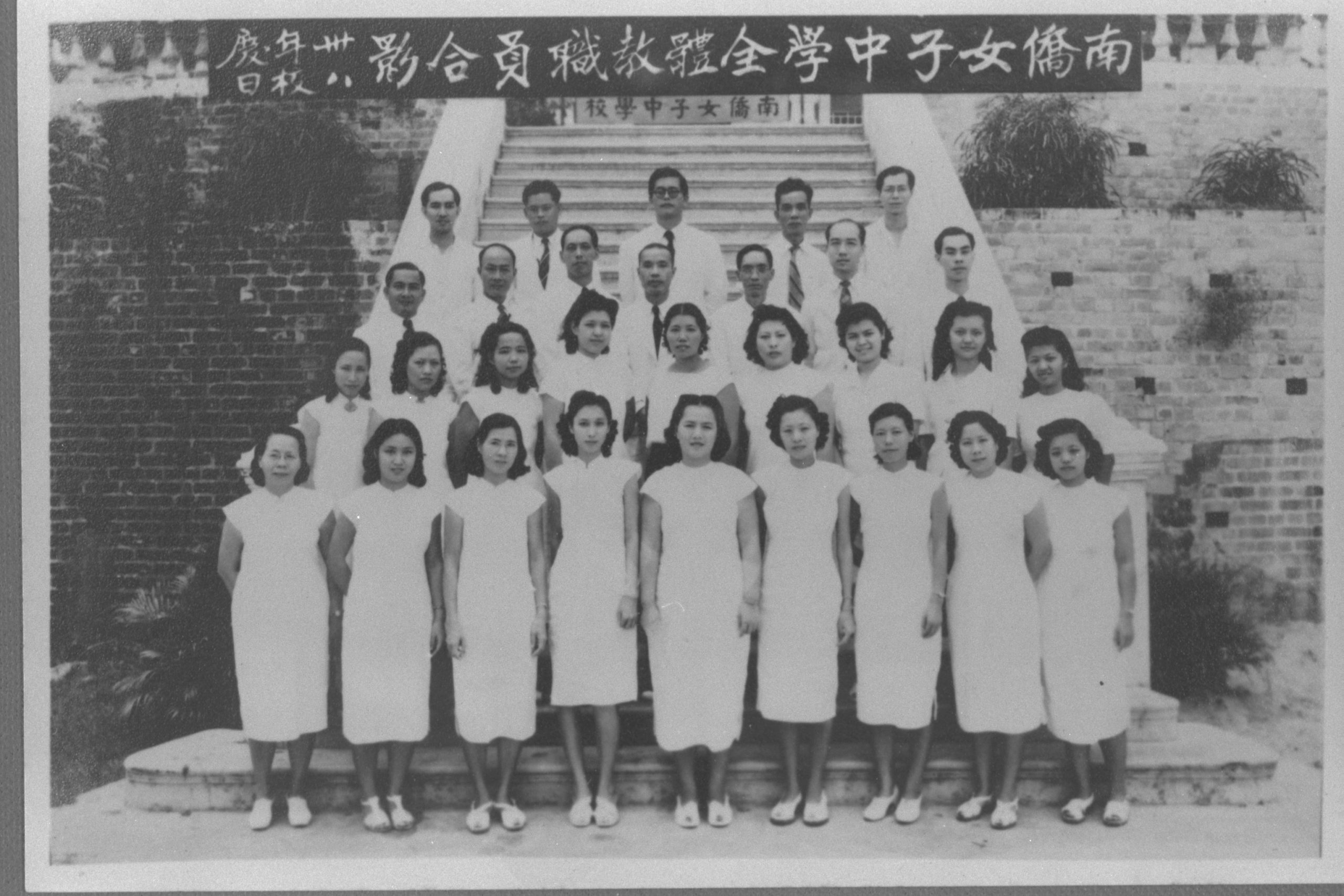
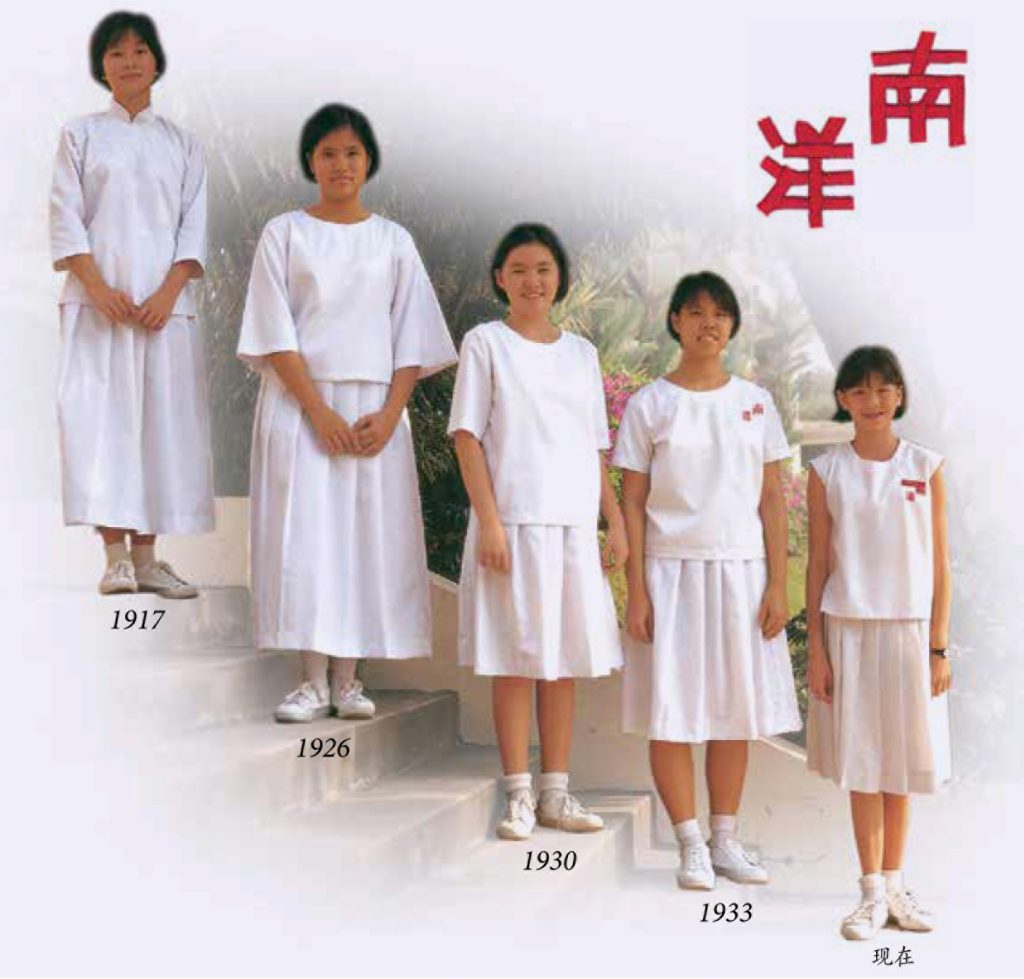
In 1927, Liew Yuen Sien (1901–1975) took over as principal, and committed herself to improving school administration, reforming the curriculum, and strengthening the teaching of the Chinese language. In 1930, together with the Chinese Industrial & Commercial Continuation School (now Gongshang Primary School) and the Singapore Hokkien Huay Kuan, Principal Liew established the Primary School Examination Standard to standardise the Primary 6 examinations, which sparked the practice of implementing leaving examinations in Chinese primary schools. That same year, inspired by a student who had transferred from Jimei Primary School, Xiamen, China, Principal Liew redesigned the school uniform to what it is today. By 1933, the Chinese characters for “Nanyang” were embroidered in red onto the uniform. Over time, as styles evolved, the skirt and sleeves gradually became shorter and the pocket was eventually removed, though the overall style and colour of the uniform remained the same over the years.
In 1930, Honorary Chairman of the school’s Board of Directors Aw Boon Haw (1883–1954) suggested that Nanyang Girls’ School expand its premises, kicking off the effort by donating $5,000. The school eventually bought a plot of land at King’s Road, where a large building was renovated into a school compound. The school was officially renamed Nanyang Girls’ High School, while the primary school section became the Nanyang Girls’ High School Affiliated Primary School.
In January 1931, both sections officially moved to its new campus. That same year, Nanyang Girls’ High School changed the three-year teacher training course to a “3-3 system”, which meant three years of junior high school1, followed by an addition of three years senior high school.2 In July, one additional class each of senior high school and junior high school students were enrolled. Due to the difficulty in recruiting female teachers for the senior high school at that time, Nanyang Girls’ High School decided to hire male teachers — a move that was supported by members in the local literary scene and some volunteered to teach for free. Among these male educators, Zheng Shaoya (birth and death years unknown) taught Senior High School Chinese, while Fu Wu Men taught Chinese, History, and Ethics.
In 1933, Principal Liew embarked on a trip to Shanghai to learn about their education system and lay the groundwork for starting kindergarten classes. In 1934, the school realised its vision of offering classes from kindergarten to the senior high school level. During the Japanese Occupation (1942–1945), the school suspended all lessons as it became a military hospital for the Japanese. It resumed lessons after the war ended.
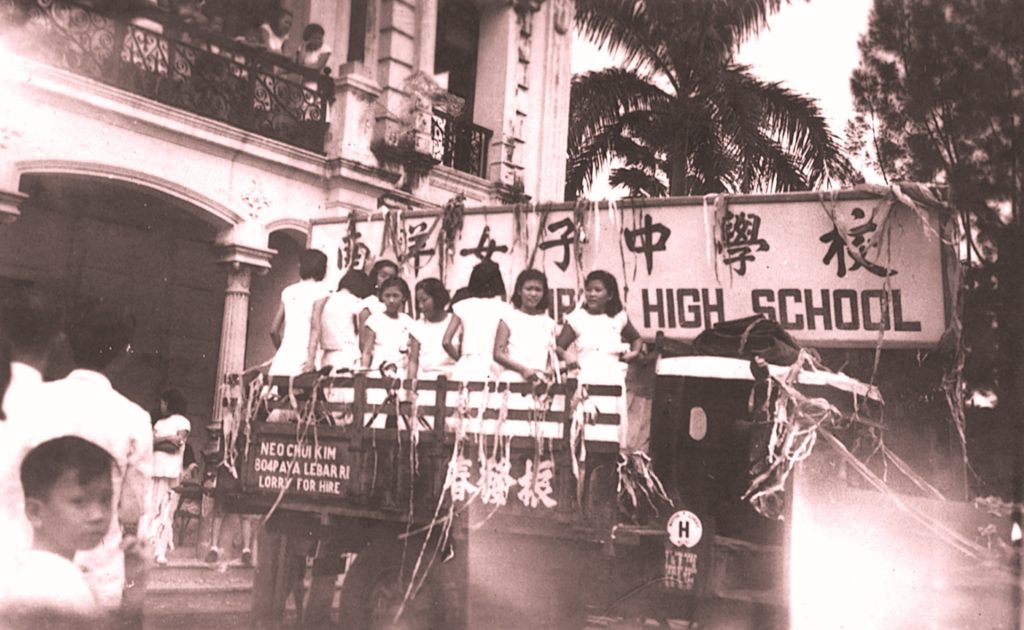
In 1956, Nanyang Girls’ High School held its annual combined sports meet with The Chinese High School (which eventually merged with Hwa Chong Junior College to form Hwa Chong Institution in January 2005) — a tradition that continues today. In the 40 years since its founding, Nanyang Girls’ High School had always been a public school that was funded by the Chinese community. It was only in 1957 that it became a government-aided school.3
In 1961, in accordance with the Ministry of Education’s new system, Nanyang Girls’ High School moved from the “3-3 system” (three years of junior high school and three years of senior high school) to the “4-2 system” (four years of secondary school and two years of pre-university education).
In 1977, Chua Liang, an alumna of Nanyang Girls’ High School, became its principal and introduced a bilingual curriculum. In May that year, then-Director-General of Education Lim Kim Woon (1933–2014) led a team of inspectors on a visit and proposed that the primary and secondary sections be separated. This led to the establishment of Nanyang Primary School in 1978. In 1979, Nanyang Girls’ High School was selected by the Ministry of Education to be one of nine Special Assistance Plan (SAP) schools, where English and Chinese were offered as a first language.4 In 1984, the school was selected to offer the Art Elective Programme (AEP). As a result, all Secondary 1 students who opted for this programme travelled to Nanyang Girls’ High School for lessons.
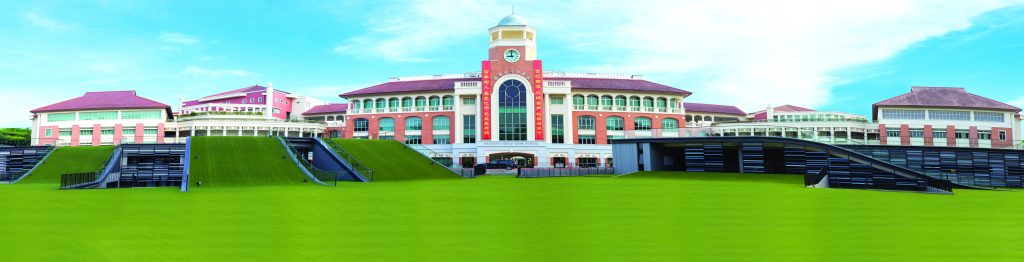
In 1993, Nanyang Girls’ High School officially became the first independent girls’ school in Singapore.5 Ling Siew May (1937–1999), an alumna of the school and wife of former President Ong Teng Cheong, chose the former site of National Junior College at 2 Linden Drive for the school’s new campus and also served as its architect. Construction began in 1996 and was completed in 1999. In the same year, the school introduced the Gifted Education Programme (GEP).6 In 2000, then Senior Minister Lee Kuan Yew (1923–2015) attended the opening ceremony of the new campus as its guest-of-honour.
In 2004, Nanyang Girls’ High School partnered with The Chinese High School to introduce the Integrated Programme (IP).7 The following year, the school launched the MOE Bicultural Studies Programme (BSP).8 It also introduced “The Connected Classroom” curriculum in 2015 to equip students with 21st century skills and competencies, and the Secondary 4 graduates of 2018 later organised the first “Bilingual Youth Model United Nations”. In 2020, Nanyang Girls’ High School implemented the MOE Chinese Language Elective Programme (CLEP) aimed at nurturing bilingual talents and enhancing students’ proficiency in the Chinese language and literary appreciation.9 In 2022, Nanyang Girls’ High School celebrated its 105th anniversary, collaborating with the Singapore Council of Women’s Organisations to hold the “Singapore Women’s Hall of Fame” exhibition.
Nanyang Girls’ High School has nurtured many distinguished women. Notable alumni include architect and former First Lady Ling Siew May; former Dean of the Singapore Teachers’ Training College (later known as the National Institute of Education) Lau Wai Har (1925–2020); dancer and Cultural Medallion recipient Goh Soo Khim; as well as Grace Fu and Yu-Foo Yee Shoon, who hold or have held political office.
Principals and years in service
- Yu Pei Gao (1917–1921)
- Wu Jiang Xiao (1921)
- Peng Meng Min (1922–1923)
- Xuan Wei Ling (1924)
- Fang Wen Jun (1925)
- Wang Shu Ying (1925)
- Wang Wei Dan (1926)
- Huang Meng Heng (1927)
- Liew Yuen Sien (1927–1966)
- Low Pei Kim (1967–1976)
- Chua Liang (1977–1995)
- Mrs Ng-Gan Lay Choo (1995–2001)
- Mak Lai Ying (2002–2006)
- Yap Wah Choo (2007–2009)
- Heng Boey Hong (2010–2017)
- Ng Chuen-Yin (2018–2022)
- Siau Fong Fui (2023–present)
This is an edited and translated version of 南洋女子中学校. Click here to read original piece.
| 1 | Also known as junior middle school. |
| 2 | Also known as senior middle school. In 1923, the teacher training course was changed from a two-year programme to a three-year programme. |
| 3 | Government-aided schools: Schools set up by various community organisations to cater to the educational needs of their respective communities. They receive funding from the Singapore government and maintain the same education standards as Government schools. |
| 4 | The Special Assistance Plan (SAP) was introduced in 1979 to nurture students with bilingual aptitude. The schools under this plan are called SAP schools, known to provide students with high quality teaching and an environment that emphasises bilingual learning. |
| 5 | Independent schools have the flexibility to set their own fees and decide on their academic and non-academic programmes. |
| 6 | Gifted Education Programme: The Ministry of Education rolled out the Gifted Education Programme in 1984, catered to intellectually gifted students. |
| 7 | Integrated Programme: A six-year course covering the secondary school and junior college curricula that leads to certification examinations such as the Singapore-Cambridge General Certificate of Education Advanced Level (GCE A-Level) examination. The programme allows students who scored in the top 10% of their cohort to proceed directly to junior college without taking the O-Level examination, giving them more time to develop their intellectual curiosity, creativity, critical thinking, and leadership skills. |
| 8 | Bicultural Studies Programme: The Ministry of Education established the Bicultural Studies Programme in 2005 to nurture bilingual and bicultural talents who can engage with both Chinese and Western cultures, while maintaining local awareness and a global perspective. Students in the programme have opportunities to participate in various learning activities, including immersion trips, as well as seminars and lectures on Chinese history, culture, and contemporary developments. |
| 9 | The Chinese Language Elective Programme (CLEP) is offered by selected secondary schools and junior colleges to nurture students who have an interest and aptitude in Chinese language and literature. |
“Nanyang Girls’ High School.” MOE Heritage Centre. | |
“Milestones.” Nanyang Girls’ High School. | |
Nanyang Girls’ High School. Nan zhong ba shi: cheng xian qi hou [Nanyang in Celebration]. Singapore: Nanyang Girls’ High School, 1997. | |
Nanyang Schools Alumni Association. Nanyang Glory — 105 Years of Splendour: History of Nanyang 2018–2022. Singapore: Nanyang Schools Alumni Association, Nanyang Girls’ High School, Nanyang Primary School, Nanyang Kindergarten, 2023. | |
Wu, Hua. Xinjiapo Huawen Zhongxue Shilue[A Brief History of Chinese Secondary Schools in Singapore]. Singapore: Educational Publishing House, 1976. |