Whampoa Secondary School


Whampoa Secondary School, also known as Whampoa Secondary School (Chinese), was established in 1961 and ceased operations in 1994. When it was founded, the school was located at St George’s Road by the Whampoa River. As the school was opened in the middle of the academic year, there was no enrolment during its first year. The Ministry of Education (MOE) therefore transferred 382 students from Serangoon Garden Government High School and Thomson Government Chinese Middle School — to Whampoa Secondary School and placed them in eight Secondary 1 classes.
Whampoa Secondary’s school motto was “Towards an all rounded education”. Its school song was composed in 1961 by local pioneer musician Samuel Ting Chu-San (1926–2007), with Chinese lyrics by pioneer calligrapher and painter Wong Jai Ling (1895–1973). The lyrics reflected the school’s founding mission to nurture all-rounded students through values-driven education. In 1986, following changes to the school system, the school song was changed to English.
School motto
Towards an all rounded education
Brief history
The first principal of Whampoa Secondary School was Ling Hiong Kiat (1901–1978), who graduated from the Whampoa Military Academy in Guangdong. The school was named “Whampoa” in honour of Hoo Ah Kay (1816–1880), a prominent leader of the local Chinese community who was also known as “Mr Whampoa”. In its early years, the school was poorly equipped and its campus was run-down. Ling ran the school diligently and led students to plant flowers and trees throughout the campus, and the school gradually expanded.
In 1962, the assembly hall was completed and 10 new classes were added, with all students attending school in the morning session. In the afternoon, the school’s classrooms were loaned to the nearby Cheng Nam Primary School.1 The first cohort of Secondary 4 graduates achieved a pass rate of 95.5% in the 1964 Secondary 4 Examination, with half of them obtaining a First Division. The following year, the school set up pre-university classes and became a full-fledged school.2
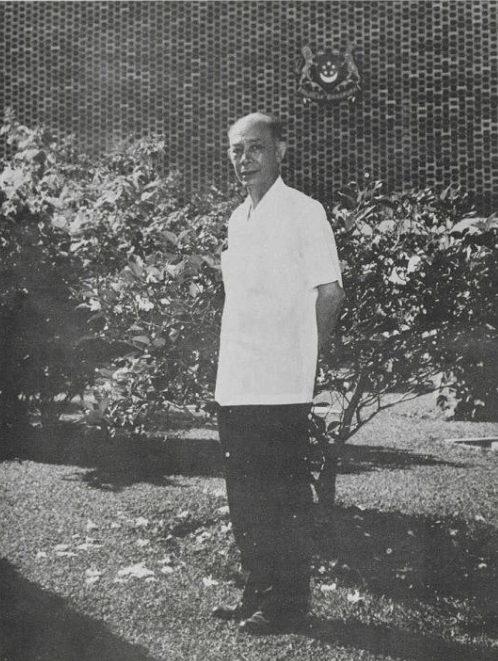
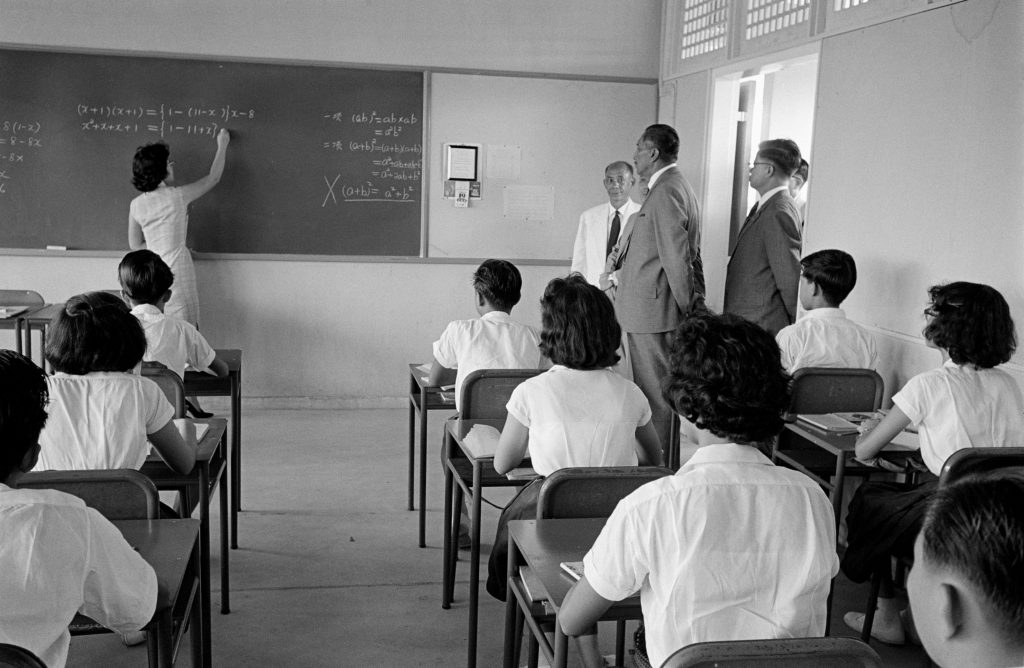
Ling retired in 1967, after which Ho Kuin (birth and death years unknown) briefly stood in as principal. Shortly after, Chiang Peng (birth and death years unknown) took over. In May of the same year, Ling was reappointed as head of the school, a position he held until his retirement in April 1968. On 29 June 1968, Liu Man Ling (1927–1989) became the new principal. Under her leadership, Whampoa Secondary School students made significant progress in academic and extra-curricular activities (ECAs), and was one of the top Chinese-medium secondary schools in Singapore. In early October 1968, the school set up an advisory committee. Under the leadership of then-chairman Dato Tan Kim Chua (1926–1997), the school launched many activities, including fundraising events to support its ECAs. This was in line with the Government’s new education policy, which placed importance on ECAs. In end-1968, the school held its first parade and awards ceremony for its uniformed groups. By this time, Whampoa Secondary School had grown into an institution with 1,098 students and 58 staff members. In 1970, the school published the first issue of its literary magazine, Lüye (Meadow).
In early 1969, the advisory committee proposed the construction of a library, which began at the end of 1970. The library was completed in early October 1971, setting a precedent for other government secondary schools in Singapore. In 1972, the students staged a variety show titled Huangpu zhi ye (An Evening with Whampoa) at the National Theatre over two evenings to cover the cost of running the library and raise funds for the school’s ECAs. The same year, the school participated in the Singapore Youth Festival, with 1,000 students performing a mass exercise routine. The school was subsequently invited to perform the mass exercise routine at the National Day Parade.
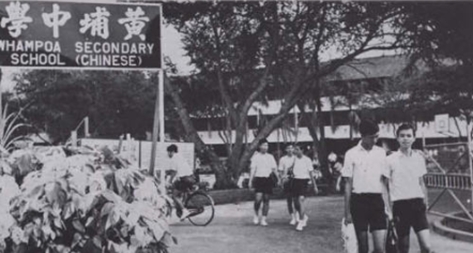
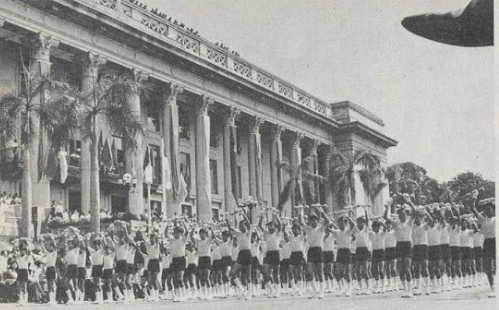
The expanded Whampoa Secondary School not only maintained strong academic performance but also excelled in sports. In particular, it consistently won volleyball and basketball championships in national and inter-school tournaments. From 1983 till its closure in 1994, the school was the national convenor for volleyball, organising a total of 10 National School Games.
Whampoa Secondary School set up its first English-stream classes in 1981 with two Secondary 1 classes, as Singapore’s education system underwent changes in the 1980s. Whampoa Secondary School, together with other Chinese-medium schools founded during the same period, such as Hua Yi Secondary School and Thomson Government Chinese Middle School, saw a decline in its Chinese-stream enrolment. In 1987, the last cohort of its Chinese-stream Secondary 4 students graduated, marking the end of the school’s mission as a traditional Chinese-medium institution, and becoming a government secondary school which taught English as the first language and Chinese as the second.
Following its 30th anniversary celebrations in 1991, the school switched to single-session classes as its number of students continued to fall. In 1994, there were only 280 students from Secondary 2 to Secondary 5. MOE then moved these students to other schools, after which Whampoa Secondary School officially ceased operations. Rebeca Lee (birth and death years unknown), the principal of the nearby Bendemeer Secondary School, temporarily took over the school’s affairs. A new Bendemeer Secondary School campus was also built on the site of the former Whampoa Secondary School. Following Whampoa alumni’s unsuccessful request to MOE to preserve the school’s name, Whampoa Secondary School became part of history.
In 2009, 15 years after the school was closed, over 800 former students, teachers and principals returned to the old campus at St George’s Road for their largest ever reunion.3 In 2011, to commemorate the 50th anniversary of the school’s founding, Whampoa alumni held a gathering of 1,000 guests at the auditorium of Bendemeer Secondary School, and published a commemorative book titled Qingyuan: Huangpu qingyuan wushi jinianji (50 years of Whampoa Secondary School).
Many Whampoa alumni have established themselves in various fields, notably in the local media, cultural and education sectors. This is inextricably linked to the school’s strong tradition of emphasising the importance of writing, calligraphy, public speaking, and debate. Whampoa’s distinguished alumni include the Cultural Medallion recipient Chinese ink painter Nai Swee Leng.
Principals and years in service
- Ling Hiong Kiat (1961–1968)
- Liu Man Ling (1968–1981)
- Goh Lai Chin (1981–1984)
- Loke Kay Khee (1985–1991)
- Mrs Kok Jeok Eng (1991–1994)
This is an edited and translated version of 黄埔中学. Click here to read original piece.
| 1 | Cheng Nam Primary School was later renamed Whampoa Chinese Primary School and ceased operations in 1963. |
| 2 | Pre-University Education: An educational programme in preparation for university, typically taking two years (junior college) or three years (centralised institute). |
| 3 | Ong Jue Qi, “Huangpu zhongxue guanbi 15 nian hou 800 xiaoyou hui ‘muxiao’ zaixu huangpu qingyuan” [800 Whampoa alumni rekindle their bond at “alma mater” 15 years after its closure], Lianhe Zaobao, 16 March 2009. |
Huangpu zhongxue yijiuliuba niandu daxue xianxiuban zhongsi biyeban tekan [Whampoa Secondary School’s 1968 pre-university class Secondary 4 graduation issue]. Singapore: Whampoa Secondary School, 1968. | |
Ong, Jue Qi. “Huangpu zhongxue guanbi 15 nian hou 800 xiaoyou hui ‘muxiao’ zaixu huangpu qingyuan” [800 Whampoa alumni rekindle their bond at “alma mater” 15 years after its closure]. Lianhe Zaobao, 16 March 2009. | |
Poon, Sing Wah, ed. Xiaoshi de huaxiao: guojia yongyuan de zichan [Vanishing Chinese schools: A perpetual national asset]. Singapore: Federation of Chinese School Alumni Association, 2014. | |
“Whampoa Secondary School.” MOE Heritage Centre. | |
Whampoa Secondary School (Chinese) 10th Anniversary Edition. Singapore: Whampoa Secondary School (Chinese), 1971. | |
Whampoa Secondary School 15th Anniversary Edition (1961‒1976). Singapore: Whampoa Secondary School, 1976. | |
Whampoa Secondary School Sec. 4 Souvenir Magazine. Singapore: Whampoa Secondary School, 1983. |