The Foochow community in Singapore


Foochow immigrants began arriving in Singapore in the late 19th and early 20th centuries, later than other Chinese dialect groups. Early Foochow settlers primarily resided along the Rochor River and Queen Street. They relied on the “three knives” — the cleaver, the scissors, and the razor — to earn a living, reflecting their dominance in the culinary, tailoring, and barbering trades, as well as the coffeeshop industry.1
Although Fuzhou is located in China’s Fujian Province, the “Hokkien community” in local term generally refers to the Minnan people from Quanzhou and Zhangzhou prefectures and does not usually include those who are Foochow, Henghua (Hinghwa), or Futsing (Hockchia), despite their shared provincial origins in Fujian. The Singapore Census of Population also reflects this distinction by recording separate statistics for the Foochow community.2
The Singapore Foochow Association
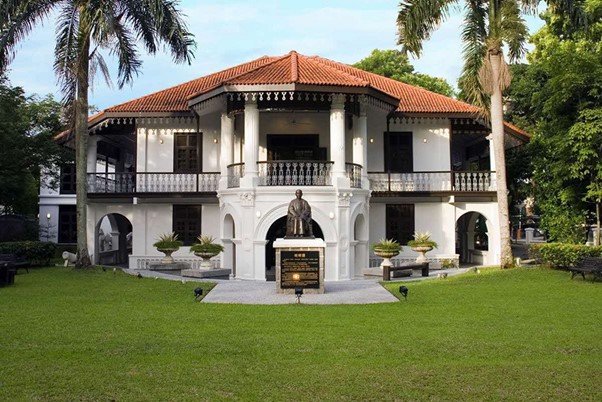
Founded in 1910 by community leaders, the Singapore Foochow Association currently has approximately 1,000 members and 18 affiliated groups. It is one of the seven founding groups of the Singapore Federation of Chinese Clan Associations.
Like other clan associations, it was initially established to foster connections among clansmen from the 10 counties in Fuzhou, providing a vital support network to address common challenges and offer help to the poor. Over time, its mission expanded into broader public services, including education and philanthropy. As society evolved, the association adapted by diversifying its activities, continuing to play a pivotal role in preservation and promotion of traditional Chinese culture and values.
To engage the younger generation, the association established a youth group and formed several performing arts units, including a Chinese orchestra, a dance troupe, a children’s dragon dance team, a choir, and a shifan[3] music troupe. It also offers classes in folk songs, ink painting, and calligraphy.
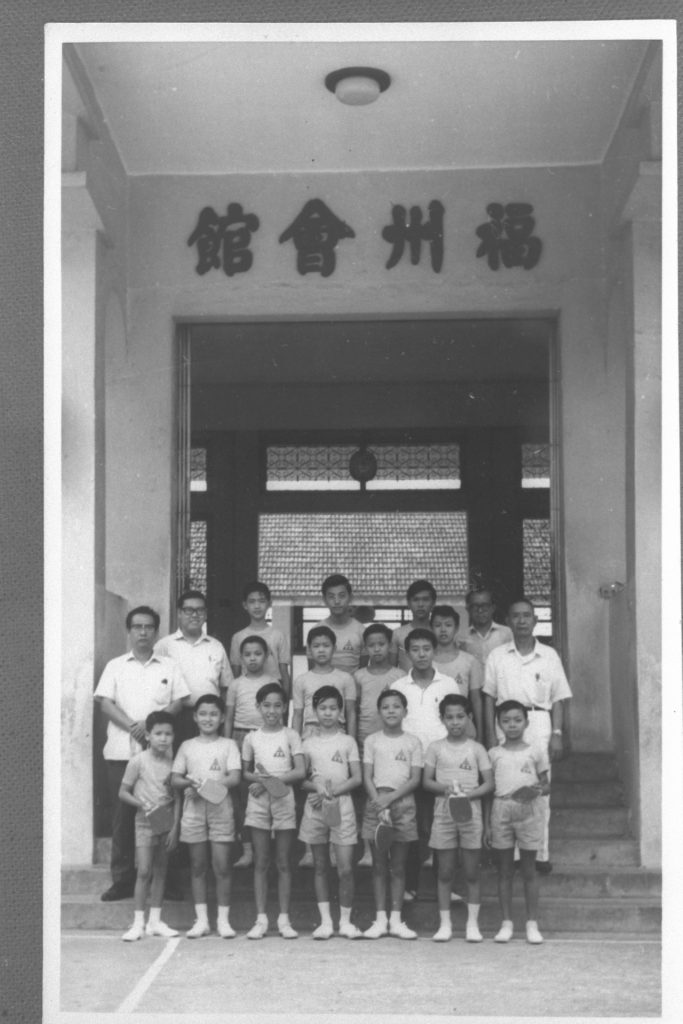
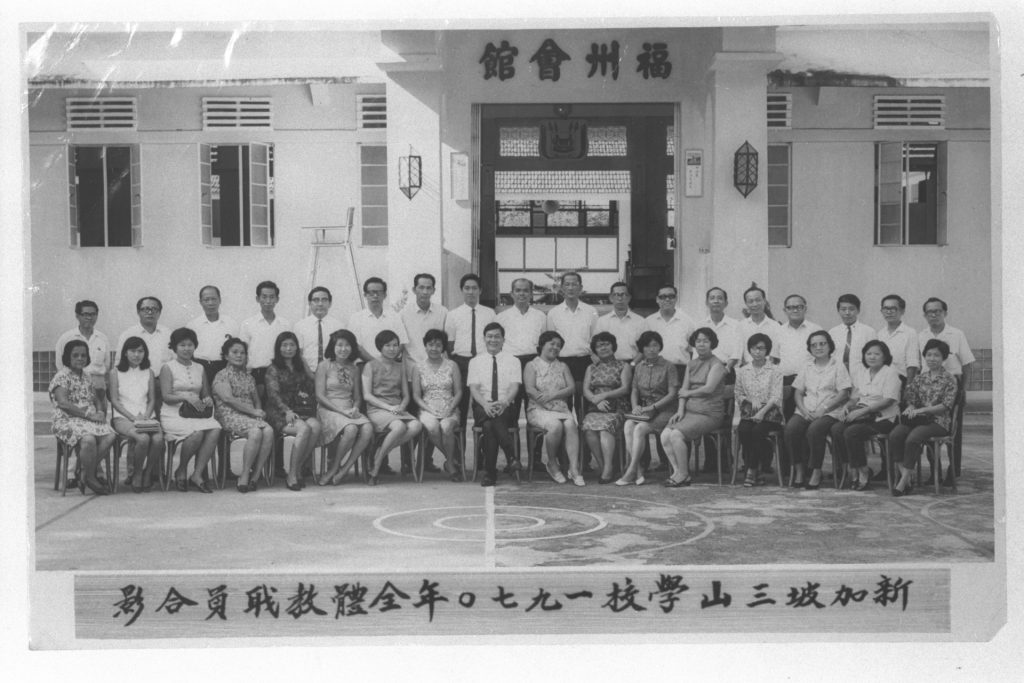
The association’s commitment to education is best reflected in the founding of San Shan School in 1926. The school’s name was inspired by the three famous mountains of ancient Fuzhou: Pingshan, Yushan, and Wushishan. After closing down several times in its early years due to operational challenges, the school reopened in 1946 following World War II. In its initial post-war phase, classes were held at the association’s premises in Craig Road and that of the Foochow Coffee Merchants Association in Queen Street. In 1947, the school moved to its new campus in Sophia Road. It relocated to Toa Payoh North in 1982 and was renamed San Shan Primary School. In 2002, it merged with two neighbouring schools to form First Toa Payoh Primary School.
In the 1980s, driven by its passion for education, the Singapore Foochow Association leased the former San Shan School campus in Sophia Road to the Nanyang Academy of Fine Arts for a nominal fee, making a significant contribution to the development of local arts education.
Singapore Foochow Coffee Restaurant and Bar Merchants Association
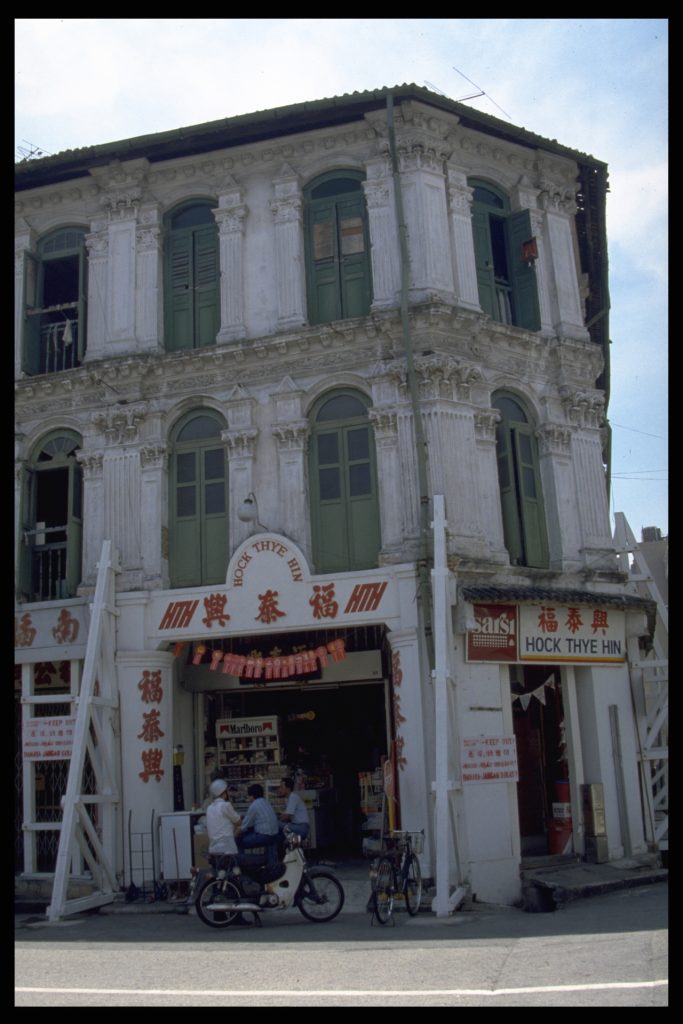
Coffee shops — serving coffee, tea, and simple meals — represented one of the primary trades of early Foochow immigrants in Southeast Asia. Interestingly, neither Fuzhou nor the 10 counties in the city produce coffee, and coffee shops were not common in that region of China. However, after arriving in Southeast Asia, many Foochow settlers entered the coffee shop trade, which the Hainanese had pioneered. By the 1980s, records indicate there were approximately 1,000 Foochow-operated coffee shops in Singapore, making them the largest dialect group in the industry.4 A prominent figure was Chen Yipeng (unknown–1963), a Foochow immigrant who started more than 10 coffee shops and was dubbed the “Coffee King”.5 In the early days, many of these establishments were known as cha shi (teahouse). Chen’s ventures included Chen Zhenzhen Teahouse, Chen Zhenhua Teahouse, Zhonghua Teahouse, and Jinguan Teahouse, none of which survive today.
A unique characteristic of these early Foochow-run coffee shops was the use of couplets on their shopfronts. These couplets typically incorporated two characters from the shop’s name, usually placed at the beginning of each line.6
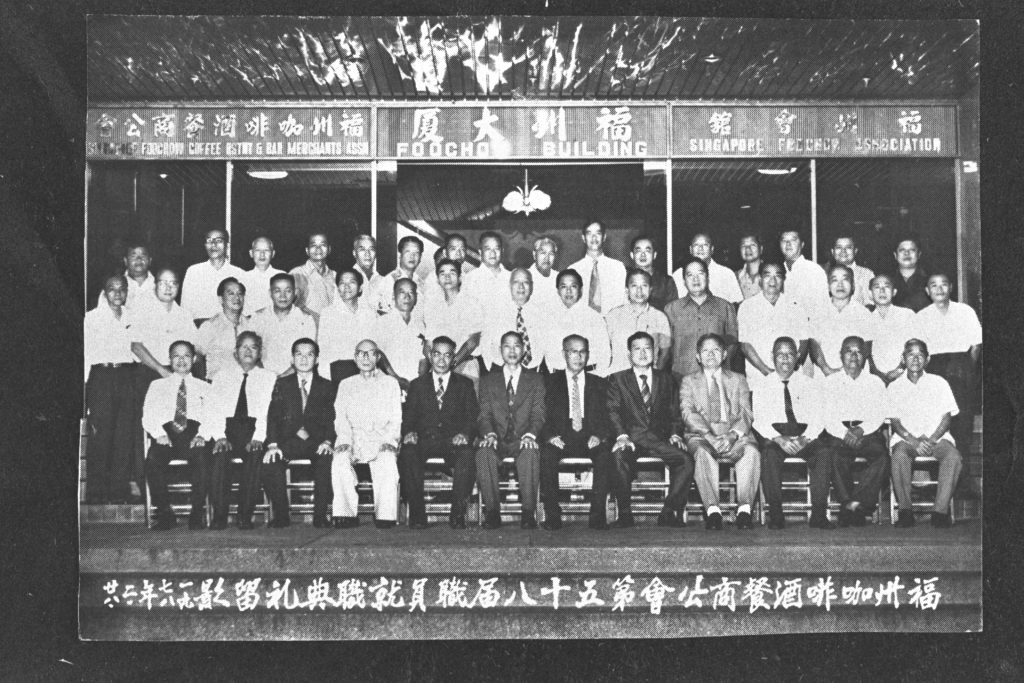
In 1920, there were several dozens of Foochow-operated coffee shops, prompting those in the trade to form an association. The Foochow Coffee Guild was established the following year and operated within the Singapore Foochow Association. In 1928, it was registered as an independent organisation and renamed the Foochow Coffee Merchants’ Association, leasing an office at 82 Tras Street. In 1956, the association was renamed Singapore Foochow Coffee Restaurant and Bar Merchants Association. A mutual aid fund was also launched that year. In 1976, the construction of Foochow Building was completed, and the association moved to its new premises the following year. The association published its inaugural newsletter in 2000. In 2024, it renovated its premises at a cost of $600,000 and launched the Singapore Coffee Shop Heritage Gallery, which is open to the public.7
The hairdressing trade
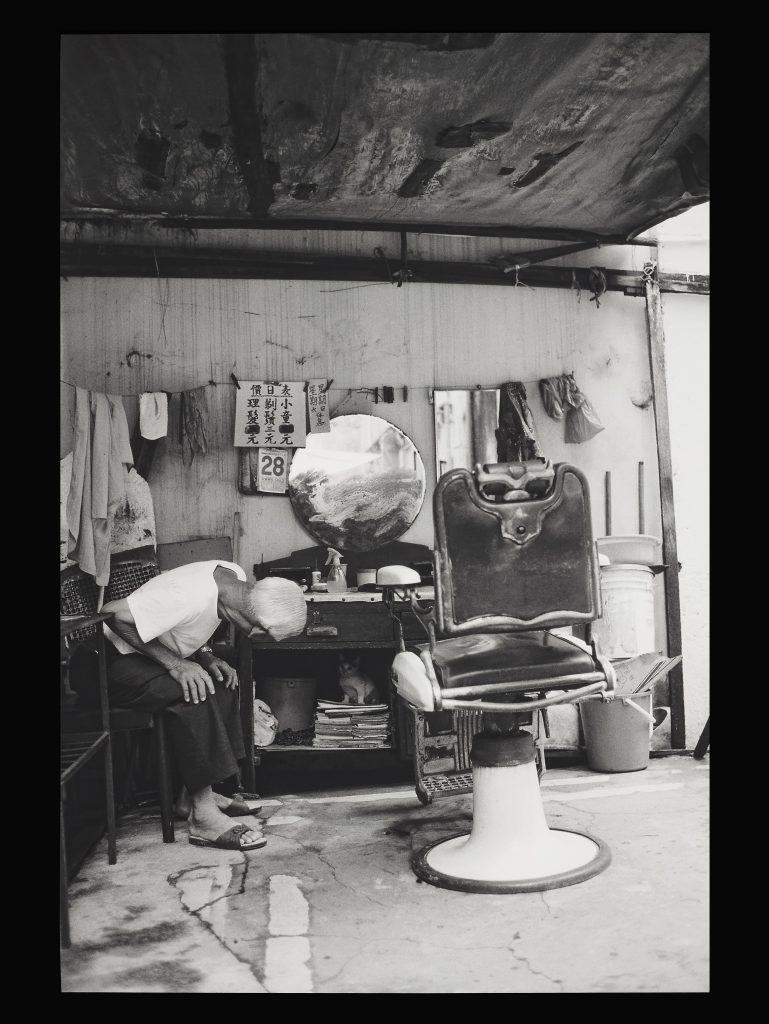
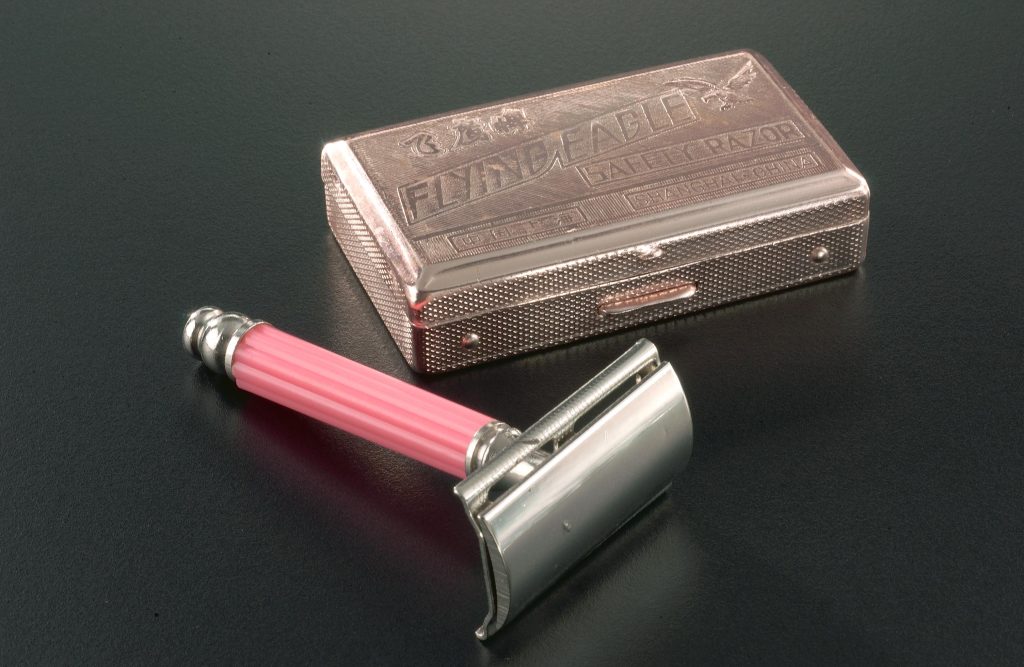
Around the 1930s, most barber shops in Singapore were owned and staffed by the Foochow community. As early as 1909, the Foochows established Zheng Ke Xuan, the earliest hairdressers’ association in Singapore.8
Foochow barbers’ techniques were heavily influenced by styles from Taiwan and Japan. Following the 1911 Revolution, the newly established Republican China’s mandate to cut off queues (braided pigtails) created a surge in demand for barbers, further stimulating the trade. During the wave of migration, some barbers from Fuzhou came to Singapore, bringing their barbering skills with them.9 In the 1920s and 1930s, the hairdressing industry adopted an apprenticeship system whereby shop owners would sign contracts — known in trade jargon as yi bang — with the apprentices’ parents or guardians. Upon completing their training, the apprentices were required to work in the shops for six months before they could seek employment elsewhere.10
In 1920, the Hokkien Barber Association was established and operated within the Singapore Foochow Association. Two years later, it moved to Bukit Pasoh as an independent organisation, demonstrating that the Foochow hairdressing trade had grown considerably. During the Japanese Occupation, the association relocated to Victoria Street and was renamed the “Syonan Barber Association” by the Japanese military government. After the war, it was renamed the Singapore Barber Association. Later, employers and workers in the trade set up the Singapore Barber Employers’ Union and the Singapore Barber Assistants’ Union (later renamed the Singapore Hairdressers Union) respectively. Another similar trade association, the Singapore Hairdressing Workers Union, was established in 1955.
Associations and community leaders
In addition to those listed above, the local Foochow community established a variety of other associations as well as temples. These include the Foochow Kuan Hong Villagers’ Association (established in 1935), the Foochow Ngee Su Wong Clan Association (established in 1936), the Chee Clan Association (established in 1936), the Foochow Dionglok Association (established in 1940), the Hong Kang Tong Hiuang Huay (established in 1948), the Yun Xian Gong Si Zhi Tan (established in 1947), and the Gow Hong Temple (established in 1954).
Prominent local Foochow community leaders during the colonial period include Wong Nai Siong (1849–1924), who served as the chief editor of Sing Po and Jit Shin Pau; Dr Chen Su Lan (1885–1972), a philanthropist and social reformer; Sng Choon Yee (1897–1991) and Homer Cheng Hui Ming (1906–1954), who both served as Assistant Secretaries of Chinese Affairs (formerly known as the Chinese Protectorate); and businessman Yeo Jin Guat (1905–1958), who served as a member of the Chinese Advisory Board and chairman of the Singapore Foochow Association.
Religion
The Foochow community played a significant role in the early spread of Christianity in Singapore. In 1859, American missionaries established the Methodist Church in Fuzhou, China, marking the beginning of the spread of Christianity. After 1890, many migrants from Fuzhou who came to Nanyang (Southeast Asia) were Christians. In 1897, Rev Ling Chin Mee (Rev Ling Ching Mi, 1853–1915) arrived in Singapore to minister to these believers and founded the Singapore Foochow Methodist Church. Foochow believers also attended services at the Telok Ayer Chinese Methodist Church, which was built in 1924.11 Another Christian congregation providing services in the Foochow dialect was the Holy Trinity Church, an Anglican parish established in 1941.
The community also has strong roots in Buddhism. As early as the Guangxu reign, monks from Fuzhou’s Xichan Temple and Yongquan Temple in Gushan travelled to Southeast Asia to establish ties with the Chinese community in the region. Singapore’s renowned Shuang Lin Monastery, founded in 1898, was established as a branch of Fuzhou’s Xichan Temple. During the Chinese War of Resistance against Japan, many monks from Fuzhou or Xichan Temple, including Master Benzhong (1866–1936), Master Huiguan (1906–1977), and Master Qingkai (1910–1985), came to Singapore to promote Buddhist teachings. Venerable Qingkai founded the Fa Hua Monastery in 1942 and Venerable Huiguan co-founded the Leong Hwa Monastery in 1944 with Venerable Zengguang (birth and death years unknown).
In addition, Huang Mun Se (also known as Huang Cong, 1890–1963), a prominent figure and collector of calligraphy and paintings who was born in Fuzhou, with ancestral roots in Nan’an, played a key role in the establishment of Mee Toh School. In 1934, he helped establish The Singapore Buddhist Lodge and served on its preparatory committee. He subsequently held positions including director of the Singapore Buddhist Federation and The Singapore Buddhist Lodge, and was also a member of the Chinese Advisory Board.12
This is an edited and translated version of 新加坡的福州人社群. Click here to read original piece.
| 1 | Kua Bak Lim ed, Xinjiapo huaren tongshi [A general history of Chinese in Singapore] (Singapore: Singapore Federation of Chinese Clan Associations, 2015), 60. |
| 2 | The 2020 Singapore Census of Population categorises the Chinese community as Hokkien, Teochew, Cantonese, Hakka, Hainanese, Foochow, Henghua, Shanghainese (Sam Kiang), Hockchia, and others. |
| 3 | a traditional folk instrumental art named for its use of ten types of instruments. |
| 4 | Au Yue Pak, “Fuzhouren kai kafeidian, chu le yige ‘kafei dawang’” [From Foochow coffee shop to Coffee King], Lianhe Zaobao, 24 April 1988. |
| 5 | Au Yue Pak, “Fuzhouren kai kafeidian, chu le yige ‘kafei dawang’” [From Foochow coffee shop to Coffee King], Lianhe Zaobao, 24 April 1988; Toh Lam Huat, “Chuanqi toushou: nanyang kafei kouwei kaichuangzhe Ding Jiyao” [The legendary pioneer of Nanyang kopi: Ding Jiyao], Lianhe Zaobao, 28 May 2016. |
| 6 | Han Tan Juan, “Yazuo ke tanxin: fuzhouren yu kafeidianye” [Conversations over coffee: the Foochow legacy in the coffee shop trade], Lianhe Wanbao, 12 January 1986. |
| 7 | Tang Ai Wei, “Xinjiapo kafeidian wenhuaguan kaimu, fuzhou kafei jiucanshang gonghui jiangshu bainian fazhanshi” [Singapore Coffee Shop Heritage Gallery opens as the Singapore Foochow Coffee Restaurant and Bar Merchants Association traces a century of legacy], Lianhe Zaobao, 2 December 2024. |
| 8 | See Perng Peck Seng and Tan Kian Choon et al, Toulu: xinjiapo fujianren de hangye [Occupation: the trades of the Hokkiens in Singapore] (Singapore: Singapore Hokkien Huay Kuan, 2008), 209. |
| 9 | See Han Tan Juan, “Zaoqi lifaye de xuetuzhi” [The early days of hairdressing apprenticeship], Lianhe Zaobao, 12 October 1996; Perng Peck Seng and Tan Kian Choon et al, Toulu: xinjiapo fujianren de hangye [Occupation: the trades of the Hokkiens in Singapore], 208–209. |
| 10 | Han Tan Juan, “Zaoqi lifaye de xuetuzhi” [The early days of hairdressing apprenticeship], Lianhe Zaobao, 12 October 1996. |
| 11 | The century-old time capsule unearthed at Telok Ayer Chinese Methodist Church in 2024 contained Christian scriptures printed in Fuzhou. See Bainian shijiannang yu weili gonghui zhiluoyayi libaitang xiufu gongcheng zhong chutu [A century-old time capsule was unearthed during the restoration works of the Telok Ayer Chinese Methodist Church], 15 February 2024. |
| 12 | Bainian bilu: xinjiapo fuzhou huiguan shiji daqing [The centenary celebrations of the Singapore Foochow Association] (Singapore: Singapore Foochow Association, 2010), 138–140. |
Bainian bilu: xinjiapo fuzhou huiguan shiji daqing [The centenary celebrations of the Singapore Foochow Association]. Singapore: Singapore Foochow Association, 2010. | |
Perng, Peck Seng, and Tan Kian Choon et al. Toulu: xinjiapo fujianren de hangye [Occupation: the trades of the Hokkiens in Singapore]. Singapore: Singapore Hokkien Huay Kuan, 2008. | |
Singapore Hair Dressers Employers’ Association Publication of 28th Anniversary Special Issue. Singapore: Singapore Hair Dressers Employers’ Association, 1976. | |
The Singapore Foochow Association 50th Anniversary and San Shan School 14th Anniversary Souvenir Magazine. Singapore: Singapore Foochow Association, 1961. | |
The Singapore Foochow Association 70th Anniversary Souvenir 1910–1980. Singapore: Singapore Foochow Association, 1983. | |
Wong Nai Siong, Reference@NLB, National Library Board, Singapore. |