Singapore Chinese Internet literature


Singapore Chinese internet literature refers to local Chinese literature that is published and disseminated via the internet. It first appeared in the late 1990s and has evolved with advances in technology.
With the rise of the internet, Lianhe Zaobao launched its online edition in 1995, becoming the first Chinese newspaper in the world to go online. Its supplement’s Literary City section is believed to be one of the earliest platforms featuring Singapore Chinese literature online, though it was then a digitalised version of traditional literature.
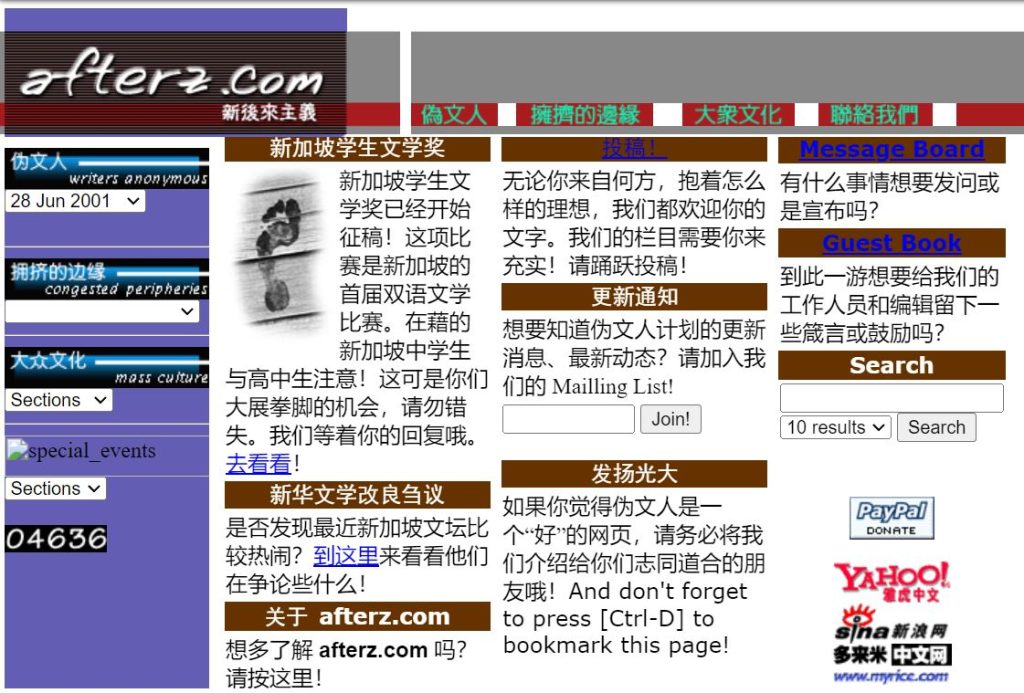
In 1998, as the internet gained popularity, a group of young literary enthusiasts in Singapore began engaging in web writing, marking the early development of Singapore Chinese internet literature. Toh Wei Hong and Lim Heng Lee founded the bilingual e-magazine Wei wenren, which provided a platform for publishing poetry, prose, fiction and reviews. In the same year, Tan Chee Lay jointly launched the Grand Canal website with eight young Chinese studies students and graduates from Singapore, China and Taiwan. The website focused on literary criticism, philosophy and linguistics, and attempted to build a cross-regional and academic-oriented online literary space.
Wang Junyi, who was studying in China then, also leveraged the internet’s ability to bridge geographical distances to co-found Judian with six classmates in Singapore. Using the web as a medium to promote literary criticism of Singaporean works, they actively linked up literary websites in China, Hong Kong and Taiwan. Blending personal reader reflections with formal literary critique, they demonstrated the immediacy and diversity of online exchanges. Meanwhile, working professionals passionate about literature also started to engage in web writing. For instance, Chew Boon Leong and others founded the online publication got one magazine, which covers literature, film reviews, art and photography, and presents local culture with a light-hearted approach.
During this period, Singapore Chinese internet literature was still in a nascent stage with limited interactivity, and submissions were typically reviewed and published by online editors.
The rise of computers and mobile phones
By the turn of the 21st century, Singapore’s internet literature began to mirror internet trends in China, Taiwan and Hong Kong. The popularity of Taiwanese web writers inspired Singaporean authors, while China’s expanding internet literature and the wave of adaptations of popular works spread to Singapore. Even though web writers were often neither paid nor given access to proper publishing channels, many were still attracted to this barrier-free form of expression.
By this time, Singapore Chinese internet literature had taken on traits of web writing. Writers and readers interacted with one another, and readers could leave comments after a work was posted, which sometimes inspired or influenced authors.
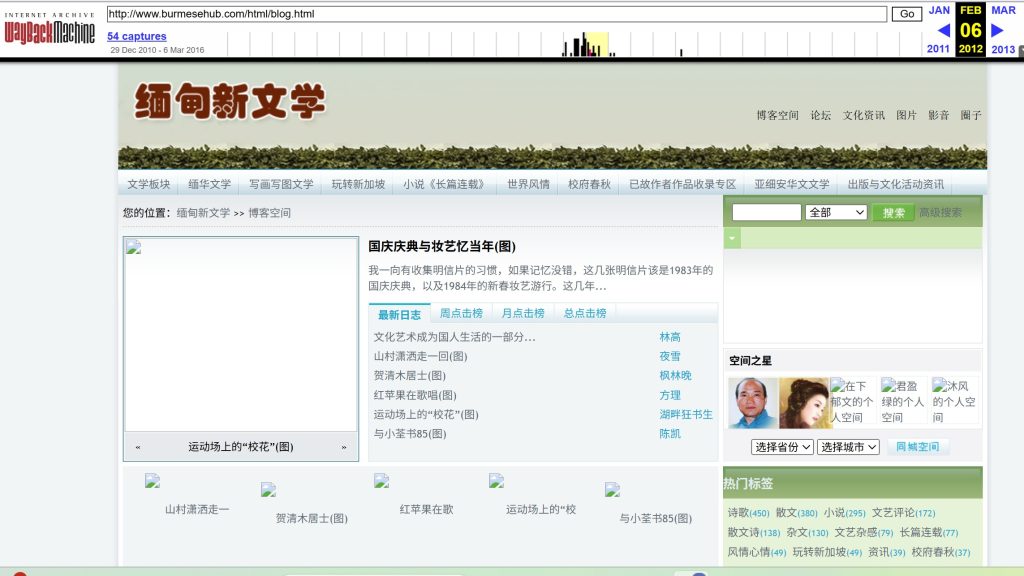
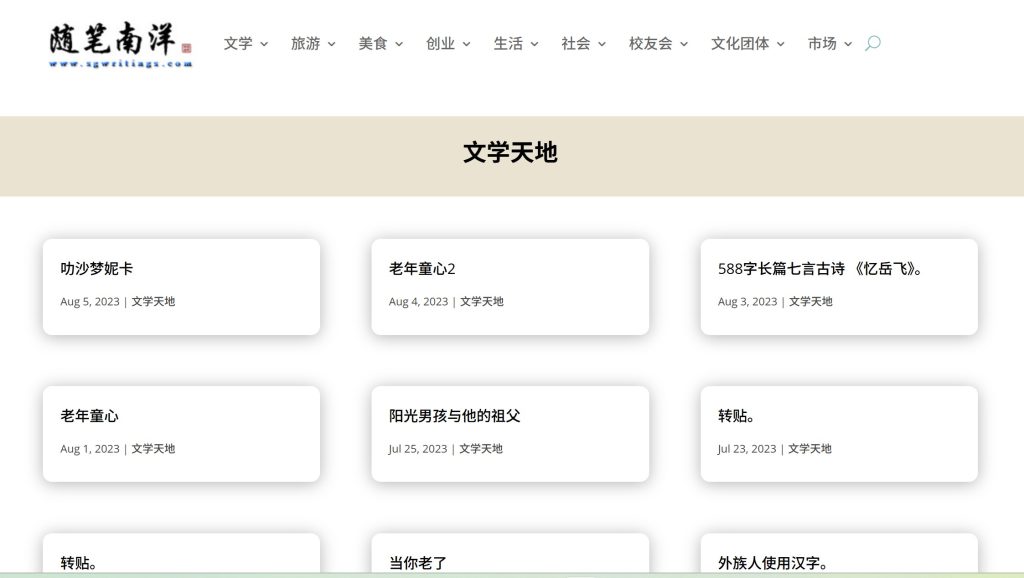
In 2003, the poet Tao Zongwang and his associates founded the online forum Hetero Poetry Club, the first Singapore-based online forum dedicated to modern Chinese poetry. In 2006, new immigrant Li Yeming (1970–2026) and others founded Sgwritings (which has since been revamped), pioneering a forum for original literary works. In 2010, local writer Huai Ying and Myanmar-born Chinese writer Duan Chunqing, who resides in Singapore, jointly founded Writingsingapore.com (Miandian xinwenxue wang) These forum-style platforms attracted local and overseas authors to co-create works, and also served as the starting point for many web writers looking to publish books. In the same year, the Singapore Association of Writers and Singapore Literature Society launched their official websites. Despite differing in style and function, both leveraged the internet to expand the channels for disseminating literary works.
With the advent of mobile internet and widespread use of smartphones around 2010, internet literature migrated further towards platform-based and community-driven models. In 2012, students from the Chinese Faculty of Nanyang Technological University, including Ang Lai Sheng, founded TrendLit Society. Since 2014, the society has been organising the online poetry creation activity In the Space of a Poem, bringing together over 1,000 poetry enthusiasts on Facebook. Young people also turned to Instagram to create literary expressions with images and words. For instance, groups such as Matter.Less, founded by Lee Xin Yi and others, promoted the integration of online writing with offline activities, fully demonstrating the literary vitality of digital natives.2
Many well-known Singaporean writers also often use social media to publish essays and reflections or promote their works, drawing comments from netizens. All this reflects the vibrancy of Singapore’s Chinese literary scene.
From 2019 to 2021, around the period of the COVID-19 pandemic, web writing flourished as young and established writers, immigrants and students turned to online creation. Blogs, vlogs and social media platforms became new channels for literary expression. Renowned writers such as Zhou Can, You Jin and Huai Ying were active contributors to online writing. The internet has not only reshaped the approach of literary creation, but also expanded the readership and influence of Singapore Chinese literature.
Today, Singapore Chinese internet literature is still in a phase of exploration and expansion. While it has yet to fully enter the sphere of mainstream publishing or official cultural narratives unlike in China, its openness, interactivity and innovation signal its potential as a significant force in contemporary Chinese literary creation.
List of referenced websites and their active periods
| Website | Founder | Active period |
| Wei Wenren | Toh Wei Hong et al. | 1999–2001 |
| Grand Canal | Tan Chee Lay et al. | 1997–circa 2000 |
| Judian | Wang Junyi et al. | 1998–2008 |
| got one magazine | Chew Boon Leong et al. | 1999–circa 2000 |
| Writingsingapore.com (Miandian xinwenxue wang) | Huai Ying et al. | 2010–circa 2013 |
| Hetero Poetry Club | Tao Zongwang et al. | 2003–2009 |
| Sgwritings | Li Yeming et al. | 2006–present |
| Singapore Literature Society official website | 2009–2019 | |
| Singapore Association of Writers official website | 2005–present |
This is an edited and translated version of 新加坡华文网络文学. Click here to read original piece.
| 1 | Screenshot of the defunct website Wei wenren was taken from the Wayback Machine. |
| 2 | The term “digital natives” was first coined by American educator and author Marc Prensky in his work, Digital Natives, Digital Immigrants. It refers to the generation born during the era of widespread digital technology, such as the internet, computers and smartphones. Having grown up surrounded by digital technology, they perceive it as a natural and indispensable part of life, much like air. In contrast, “digital immigrants” refers to those born before the digital age. Although they use the internet, they often retain habits from the “pre-digital era”. |
Bian, He. “Tiaochu kuangkuang de xiaobaima” [The little white horse that jumped out of the box]. Lianhe Zaobao, 30 October 2019. | |
Chen, Nan. “Wangluo kongjian, shihun aoxiang” [Cyberspace, where the spirit of poetry soars]. Lianhe Zaobao, 20 November 2019. | |
Neo, Guat Hoon. “Wangshang ban zazhi, chuangdi mei cunhuo, suban zazhi yuan wenxue meng” [Publishing online: Where a literary dream takes shape]. Lianhe Zaobao, 21 April 1998. | |
Ou Yang, Youquan. Wangluo wenxue gailun [Introduction to internet literature]. Beijing: Peking University Press, 2008. | |
Teoh, Hee La. “Cong xianxia dao xianshang — xinhua wenxue xinyidai tuishou” [From offline to online: The new generation of Singapore Chinese literature advocates]. Lianhe Zaobao, 22 June 2020. | |
Teoh, Hee La. “Wenxue E shidai? Bendi wangluo wenxue mianmao” [The E-era of literature? The landscape of local internet literature]. Lianhe Zaobao, 27 August 2011. |