Literary awards in Singapore Chinese literature


Literary awards play a crucial role in the development of Singapore Chinese literature, keeping it alive for successive generations.
The vibrant 1970s
Literary awards from different eras bear distinct characteristics and significance. From the 1970s to the early 1990s, many cultural organisations held various writing competitions to discover new literary talent. One such award was the National Writing Competition organised by the Singapore Youth Association in 1972. It comprised open and student categories, with each divided into four genres: fiction, poetry, prose and drama. More than 50 years on, many of the student winners of the competition are still writing.
In 1973, Tow Yee Cultural Society organised the transnational Singapore-Malaysia-Hong Kong Short Story Writing Competition, which attracted close to 100 submissions. Ten entries were awarded prizes, with winners hailing from all three territories.
The 1978/79 National Short Story Writing Competition organised by the People’s Association’s periodical Citizen was a landmark event, as it set a record for the highest prize money offered at that time. The winners of that competition, in order of ranking, were Meng Zi, Teoh Hee La, Cai Shuqing, Ang Eng Tee, Soon Ai Ling, Yang Qiuqing, You Qin, He Yakun, Xi Ni’er, Chia Joo Ming and Cai Lisi. Today, most of them are prominent novelists in Singapore’s literary scene.
Passing the torch (1980s and 1990s)
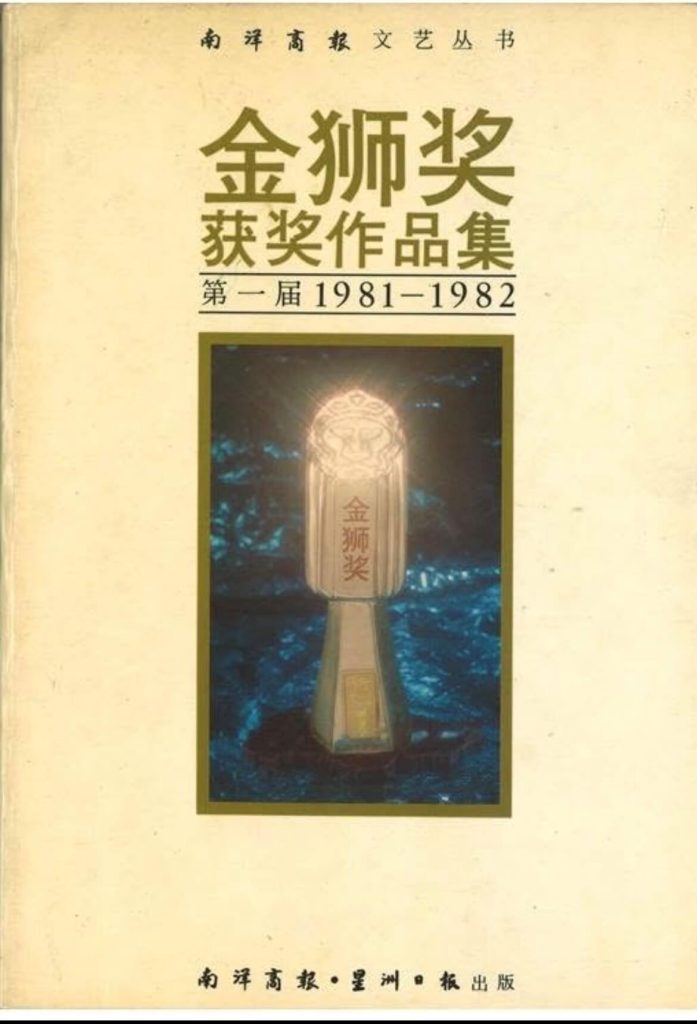
In the 1980s and 1990s, local Chinese media and associations played a significant role in organising and promoting literary awards. The Golden Lion Literary Awards, jointly hosted by Lianhe Zaobao and Lianhe Wanbao, was a biennial highlight of the scene and a benchmark for local Chinese literary prizes. The first Golden Lion Literary Awards was held in 1981, and its sixth and final edition took place in 1993.
Notably, the award invited renowned overseas Chinese literary figures to serve as judges for each edition. Prominent writers from China, Taiwan, Hong Kong and the United States have served as judges, including Yao Xueyin (1910–1999), Xiao Qian (1910–1999), Zhang Xianliang (1936–2014), Shen Rong (1936–2024), Mo Yan, Chen Yingzhen (1937–2016), Pai Hsien-yung, Huang Chun-ming, Ya Hsien (1932–2024), Yu Kwang-chung (1928–2017), Ye Si (1949–2013), Chang Shi-Kuo, Chiang Hsun and Chung Ling. Drawing on their literary expertise and aesthetic sensibilities, the judges provided balanced evaluations of the winning works.
The Singapore Hokkien Huay Kuan also presents a series of literary awards, including Primary Schools Chinese Essay Writing Competition for its affiliated primary schools, National Secondary School Chinese Essay Writing Competition and Singapore Tertiary Chinese Literary Awards. The last is held in partnership with the Chinese societies of Nanyang Technological University (NTU) and National University of Singapore, with support from Lianhe Zaobao. Zhang Yueran and Zhang Huiwen are notable past winners who remain active in China’s literary scene. Both women participated in the competition and won awards while studying in Singapore between the late 1990s and early 2000s.
In addition, the magazine Yuan published by the Singapore Federation of Chinese Clan Associations launched the Outstanding Literary Award in 2016. The annual award invites submissions in three genres — fiction, prose and poetry, with selected works published in the magazine.
Singapore Chinese Literature Prize and Nanyang Chinese Literature Award
Since the 1990s, several local grassroots organisations have introduced literary awards to recognise the achievements of established writers. Some of these awards transcended geographical boundaries, with recipients being Chinese writers from other regions.
The Singapore Literature Society launched the Singapore Chinese Literature Prize in 1991, which is presented every three years. Past recipients include You Jin, Zhou Can, Tan Swie Hian, Soon Ai Ling, Chen Meihua, Zhuang Xin, Shi Ying, Teoh Hee La, Zhang Hui, Huai Ying, Yeo Song Nian and Ding Yun.
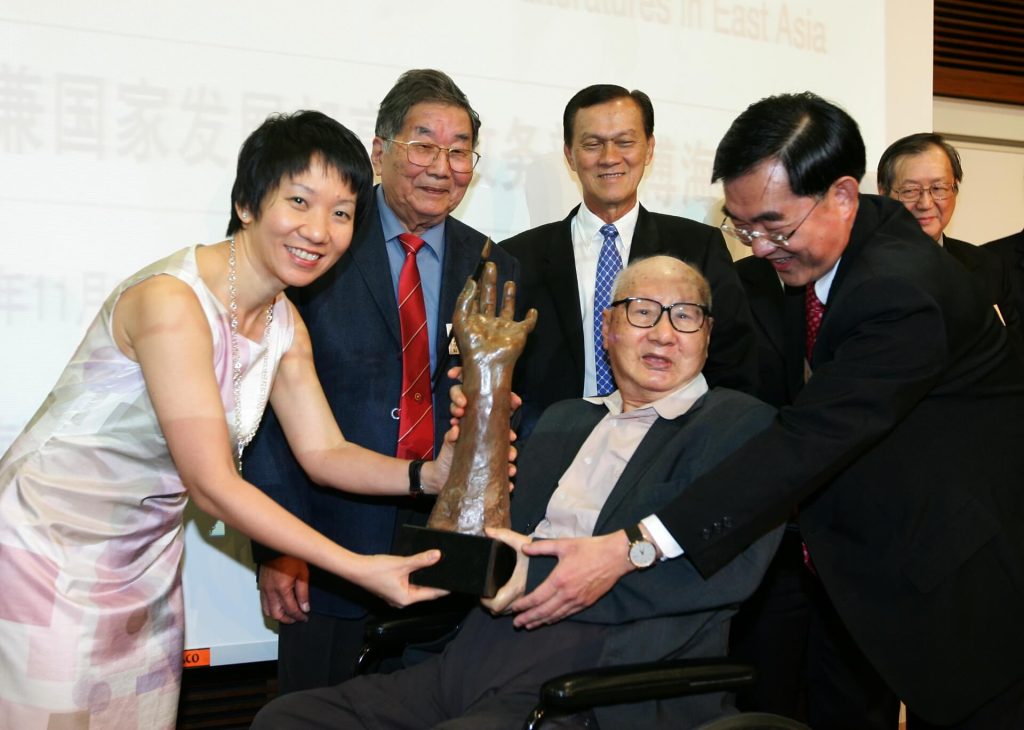
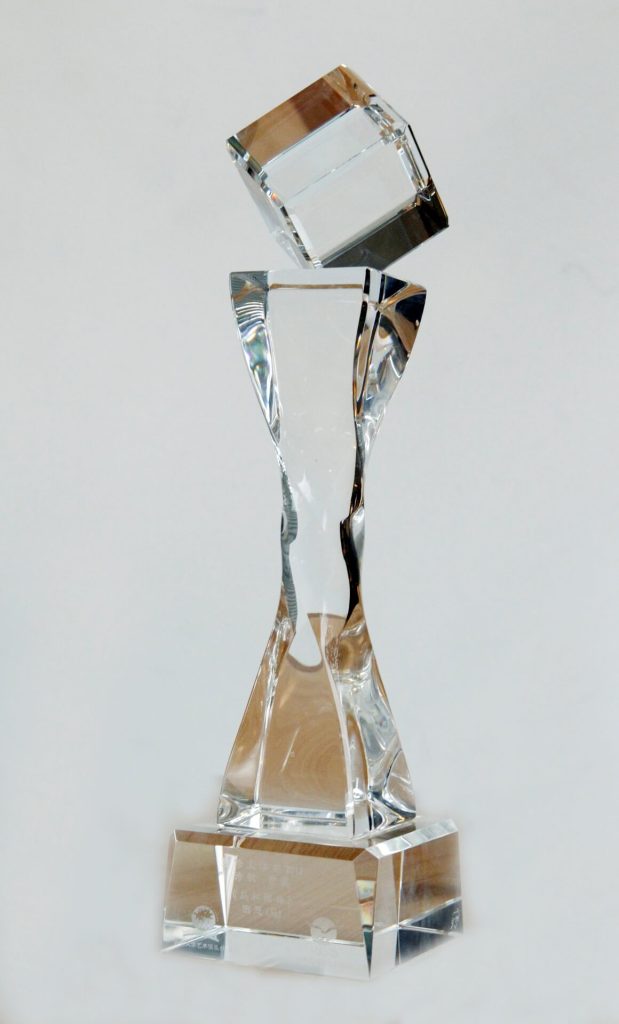
The Nanyang Chinese Literature Award, organised by the Confucius Institute at NTU, was first initiated by Nanyang University alumnus Liew Sing Hun in 2006. He donated $100,000 to the award and rallied several local entrepreneurs and the Char Yong (Dabu) Association to make contributions, raising over $1 million in total. Officially established in July 2007, the award offers a prize money of $30,000, the highest so far for Chinese literary awards in Singapore. Past recipients from Singapore and Malaysia include Fang Xiu (1922–2010), Wong Meng Voon, Luo Ming, Wong Yoon Wah, Li Zishu, Tan Cheng Sin, Khor Ewe Pin and Xi Ni’er.
The Nanyang Chinese Literature Award is closely linked to the Fang Xiu Literary Award that was established later. In 2008, the inaugural Nanyang Chinese Literature Award was presented to local literary historian Fang Xiu. He then donated the prize money and got the Tropical Literature and Art Club to set up the Fang Xiu Literary Award on his behalf. Believing that Chinese literature in Singapore and Malaysia shares common roots and origins, he opened the award to writers from both countries.
Awards by the government
The Singapore government has also introduced several literary awards for works in the country’s four official languages: Chinese, English, Malay and Tamil. From 1982 to 1988, the Ministry of Culture collaborated with Nanyang Siang Pau, Sin Chew Jit Poh, The Straits Times, Berita Harian and Tamil Murasu to organise the National Short Story Writing Competition.
In 1992, the National Arts Council (NAC) and Singapore Press Holdings jointly launched the Golden Point Award, which also encompasses the four official languages. Today, the award is organised by Arts House Group, in partnership with Singapore Book Council (SBC) and supported by NAC. The competition comprises categories for short stories, poetry and non-fiction.
The SBC previously organised the Singapore Book Awards to evaluate published literary works. The award has since been renamed Singapore Literature Prize, which is held biennially.
There is also an award dedicated to young talent. Launched in 2019 by the Singapore Association of Writers, the Singapore Chinese Youth Literary Awards is an annual writing competition which features a specific literary genre each year. It is open to Singapore citizens and permanent residents aged 18 to 35.
This is an edited and translated version of 新华文学的文学奖. Click here to read original piece.
Dierjie ji disanjie fangxiu wenxuejiang dejiang zuopinji [Collection of winning works from the second and third Fang Xiu Literary Award] (Three-volume set). Singapore: Tropical Literature and Art Club, 2020. | |
Disijie fangxiu wenxuejiang dejiang zuopinji [Collection of winning works from the fourth Fang Xiu Literary Award]. Singapore: Tropical Literature and Art Club, 2022. | |
“Kongzi xueyuan choude 200 wan yuan sheli shijie huawen wenxuejiang” [Confucius Institute raises $2 million to establish Global Chinese Literary Award]. Lianhe Zaobao, 15 July 2007. | |
Jinshijiang huojiang zuopinji: diyijie, 1981–82 nian [Collection of winning works from the inaugural Golden Lion Literary Awards, 1981–82]. Singapore: Nanyang Siang Pau and Sin Chew Jit Poh, 1982. | |
Jinshijiang huojiang zuopinji: dierjie, 1984–85 nian [Collection of winning works from the second Golden Lion Literary Awards, 1984–85]. Singapore: Lianhe Zaobao and Lianhe Wanbao, 1986. | |
Jinshijiang huojiang zuopinji: disanjie [Collection of winning works from the third Golden Lion Literary Awards]. Singapore: Lianhe Zaobao and Lianhe Wanbao, 1988. | |
Jinshijiang huojiang zuopinji: disijie [Collection of winning works from the fourth Golden Lion Literary Awards]. Singapore: Lianhe Zaobao and Lianhe Wanbao, 1990. | |
Shoujie fangxiu wenxuejiang huojiang zuopinji: xiaoshuo juan, shangce [Collection of winning works from the inaugural Fang Xiu Literary Award: Fiction, Part I]. Singapore: Global Publishing, 2015. | |
Shoujie fangxiu wenxuejiang huojiang zuopinji: xiaoshuo juan, xiace [Collection of winning works from the inaugural Fang Xiu Literary Award: Fiction, Part II]. Singapore: Global Publishing, 2015. | |
Shoujie fangxiu wenxuejiang huojiang zuopinji: shige juan [Collection of winning works from the inaugural Fang Xiu Literary Award: Poetry]. Singapore: Global Publishing, 2015. | |
Shoujie fangxiu wenxuejiang huojiang zuopinji: sanwen juan, shangce [Collection of winning works from the inaugural Fang Xiu Literary Award: Prose, Part I]. Singapore: Global Publishing, 2015. | |
Shoujie fangxiu wenxuejiang huojiang zuopinji: sanwen juan, xiace [Collection of winning works from the inaugural Fang Xiu Literary Award: Prose, Part II]. Singapore: Global Publishing, 2015. | |
“Xinjiapo wenyi yanjiuhui sheli xinhua wenxuejiang” [Singapore Literature Research Society establishes Singapore Chinese Literature Prize]. Lianhe Zaobao, 21 June 1990. | |
Yongheng de ai: xinmagang duanpian xiaoshuo chuangzuo dabisai jiazuo xuanji [Collection of outstanding works from the Singapore-Malaysia-Hong Kong short story competition]. Singapore: Island Cultural Society, 1977. |