Teochew food in Singapore


Singapore’s Teochews can trace their origins to China’s Chaoshan region — spanning the cities of Chaozhou, Shantou, and Jieyang — in the eastern part of Guangdong province. Their cuisine is often regarded as a sub-tradition of Guangdong or Cantonese cuisine, one of the eight major Chinese culinary traditions.1
After Shantou became a trading port in 1860, many Teochew people flocked south to Southeast Asia, including Singapore. They set sail on eye-catchingly painted “red head junks” (ang tau zung), bringing with them little more than their hopes and dreams — and their food. Over time, their traditional foods, such as muay (Teochew porridge), orh nee (taro paste), lor gor (braised goose), and kway teow (broad rice noodles) evolved and acquired a distinct Nanyang style.
‘Light’ and ‘subtle’ flavours
Teochew immigrants settled in two main areas in Singapore: near the Singapore River, where they engaged in trade; and in northern neighbourhoods near the coast, such as Sembawang and Punggol, where they worked as fishermen, boatmen, fishmongers, and fish wholesalers. Ellenborough Market (“Teochew Market”) at Boat Quay (destroyed by a fire in 1968), and hawker stalls near the old Thong Chai Medical Institution, were some places where Teochew food could be readily found.
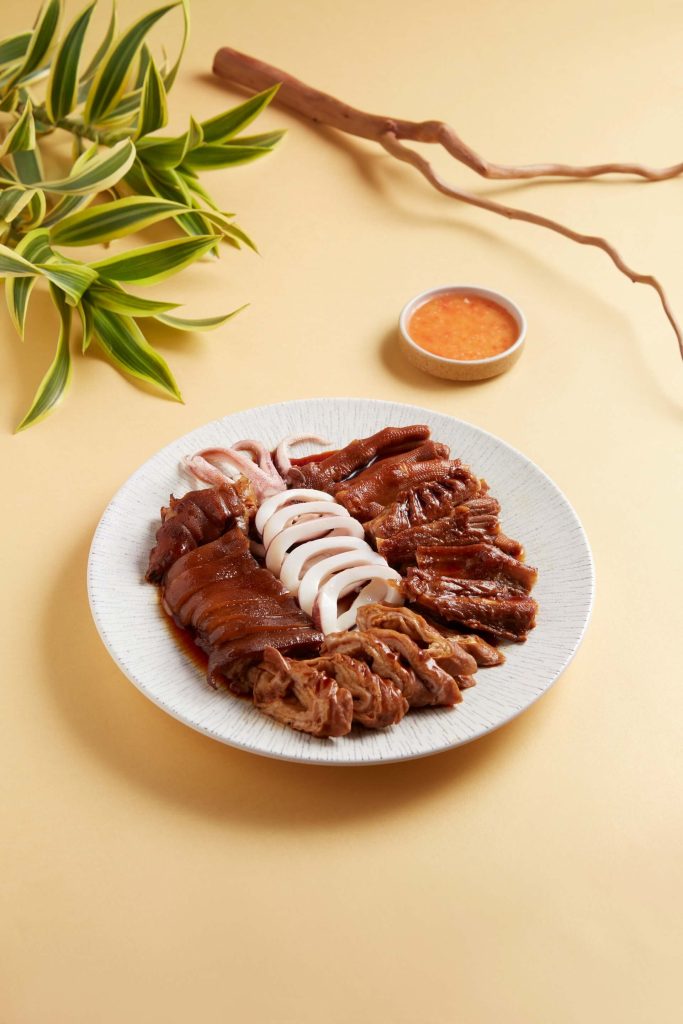
Teochew fare has a reputation for being “light” and “subtle”. It favours cooking methods such as steaming, braising, stewing, and blanching, which are thought to retain and draw out the natural flavours of fresh meat and vegetables. Given the importance of braising, the most precious commodity at a Teochew restaurant is its braising liquid — typically made of water, soy sauce, liquorice, and sugar, in addition to spices such as cinnamon, galangal (also known as “Teochew ginger”), Chinese black cardamom, Sichuan pepper, and star anise. After having had uncountable ingredients soaked in it over many years, it imparts an unmistakable aroma to whatever dish it is accompanied with.
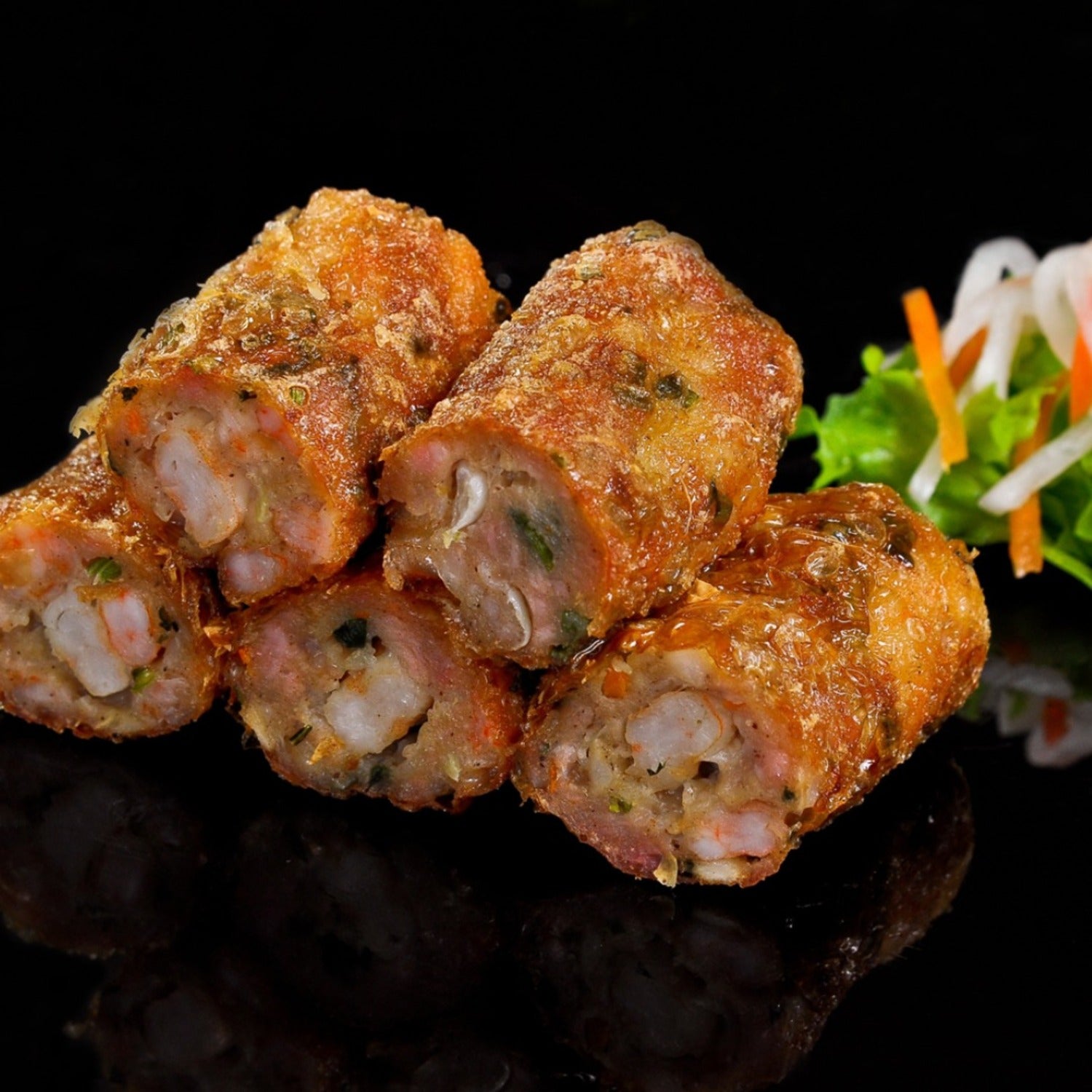
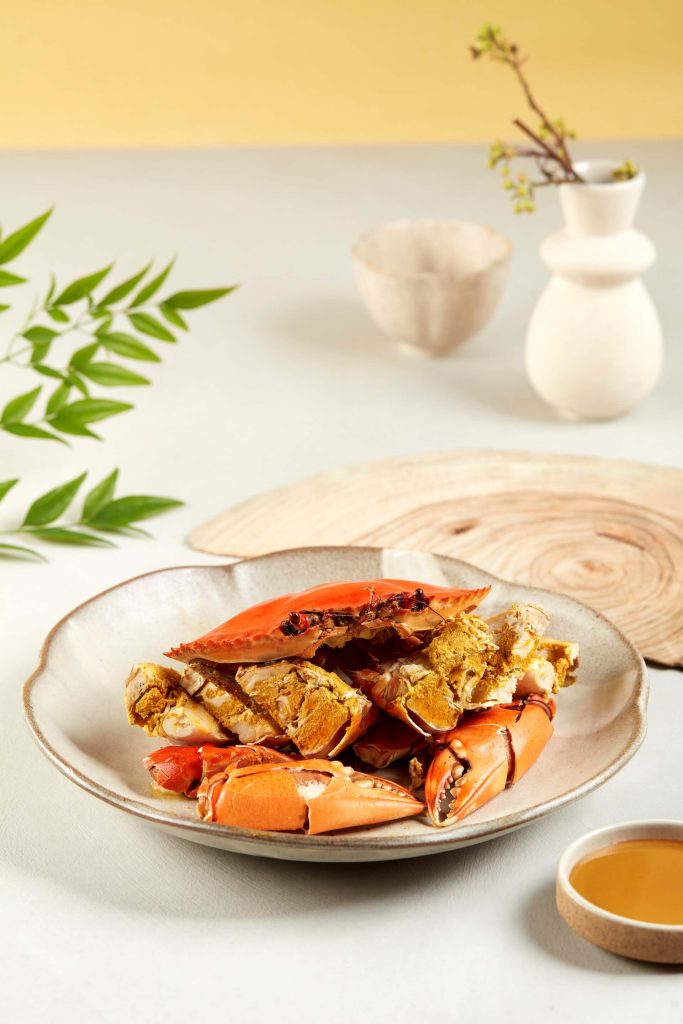
Given Chaoshan’s closeness to the sea, it is unsurprising that the Teochews should be known for their seafood. Quintessential foods include steamed Chinese pomfret, raw fish salad, cold crab, marinated raw crab, and the simple but increasingly uncommon dish of hu png, (literally “fish rice”), where fish is cooked in salty boiling water. Then there is orh luak, a hawker favourite where oysters are added to sweet potato slurry and then deep-fried, resulting in an omelette that is crisp on the outside but gooey on the inside. Also popular are deep-fried prawn rolls (hae zhor), which are more prawn-heavy than Hokkien “five spice” meat rolls (ngoh hiang).2 While Teochew food is generally light on seasoning, carefully-selected condiments play a crucial role in flavouring food after cooking. For example, tangerine sauce is served with hae zhor; orh luak goes with fermented fish sauce, while hu png is paired with bean paste sauce such as Puning soybean paste, a Chaoshan specialty.
Of kway teow and kueh
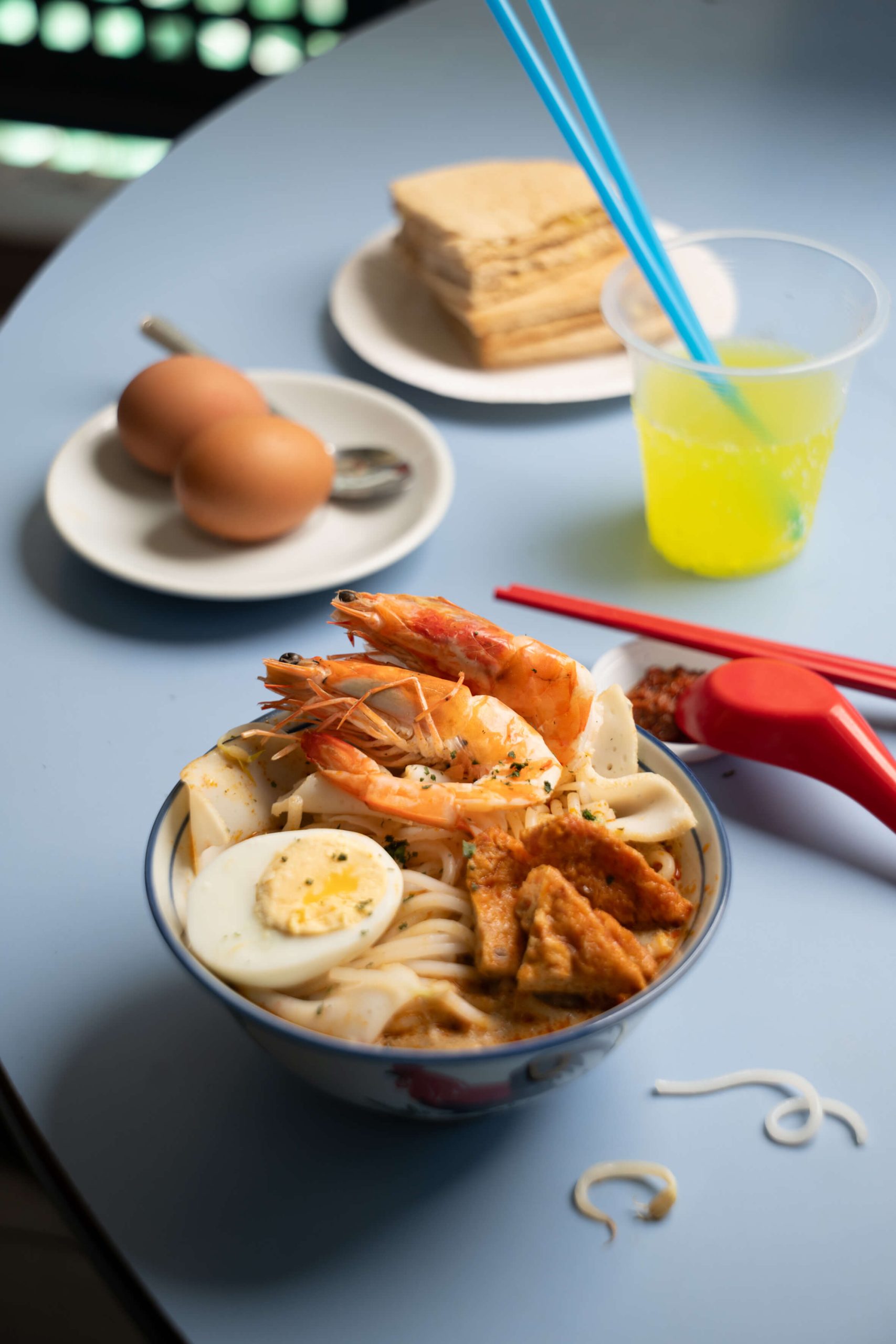
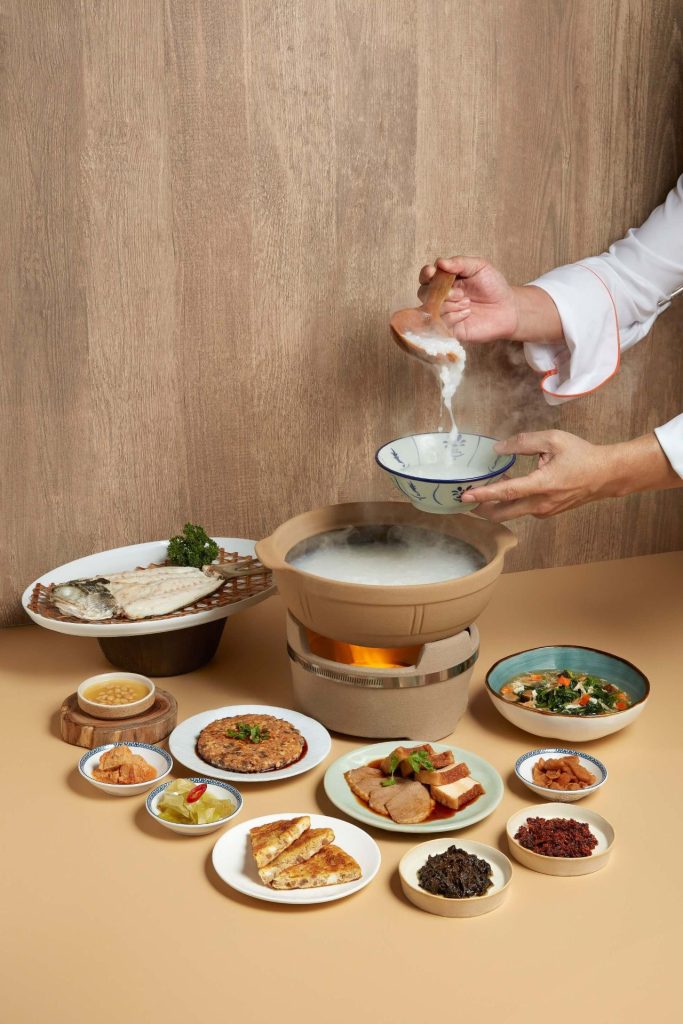
Rice-based foods — porridge, rice noodles, steamed rice cakes — play a prominent role in Teochew cuisine due to the cultivation of japonica rice in Chaoshan. Singapore’s early Teochew immigrants nourished themselves with bowls of muay (a watery porridge made from rice cooked under high heat until the grains begin to crack in the middle while otherwise remaining intact), typically eaten with chye poh (preserved radish) and other preserved foods. Also popular were kway chap (broad noodles typically paired with braised pork offal), chye tow kway (fried radish cake, known colloquially as “carrot cake”), and char kway teow (fried rice noodle sheets). A local saying in the mid-20th century, “Teochew kway teow, Hokkien mee, Hainan kopi, Hakka yong tau foo”, reflects how the Teochews in Singapore had long been associated with kway teow (broad rice noodles).
Many of these dishes used to be more laborious to prepare. An early hawker selling chye tow kway might mill the rice grains by hand to obtain a silky starch, add strips of cooked white radish to the mix, then steam it to form rice cakes (rather than using factory-made cakes). Afterwards, he might cut these cakes into chunks before frying them with lard, garlic, eggs, fish sauce, and chye poh.3 The popular dish comes in two versions in Singapore: “black” (fried with dark sweet sauce) and “white” (no dark sauce). Both had evolved from the simpler rice cakes fried by Singapore’s early Chaoshan immigrants, who did not initially add radish to them.
The Teochews are known for their kueh (dumplings or steamed “cakes” typically made from glutinous rice), such as soon kueh (“bamboo shoot cake”) and chwee kueh (“water rice cake”). Many kueh were originally created as offerings to Taoist deities or ancestors: Stir-fried cubes of radish cake (chye tow kway) symbolise good luck and are traditionally consumed on the 15th day of the Chinese New Year; red-coloured rice cakes, known as “red peach cakes” (ang to kueh), are also eaten during the New Year, while “white peach cakes” (peh to kueh), are offered to the deceased during the Hungry Ghost Festival; while the Mid-Autumn festival calls for glutinous rice cakes made with lard and sesame (la kor). “Kueh epitomises the essence of Teochew food and drink culture, which is to emphasise and highlight refinement and delicacy,” observes Singapore food writer Wong Chiang Yin. “The skin of kuehs have to be smooth, soft and thin. The appearance of the kuehs is also important. The wooden blocks that are used to press out certain kueh are carved with many intricate words and designs, so that the kueh skins are imprinted with them … There is a Teochew saying: ‘A woman with an untidy hair fringe cannot make good kueh’ … implying that making good kueh requires a certain fastidiousness and discipline.”4
Beyond offering kueh and meats to ancestors and deities, Teochew immigrants in Singapore continued to commemorate traditional festivities in other ways with food. At the beginning of Chinese New Year, spotted rabbit fish, or “white belly fish” (peh dou hu), regarded as a symbol of good fortune, is consumed. At the coming-of-age ceremony for Teochews aged 15, literally translated as “leaving the garden” (cug hue hng), celebrants bite the head of a chicken, before enjoying a luncheon comprising dishes representing desirable prospects for the future, such as chard (gao hab cai) for cooperation with others, Chinese mustard (dua cai) for growing tall, and pork innards for maturity.5 And during the Mid-Autumn Festival, people enjoyed la piah, large pastry cakes made with lard and mung bean filling.
Evolution in Singapore
In Singapore, the culinary customs of the early Teochew immigrants have evolved over time. Less-common ingredients were substituted with more readily available ones, and certain dishes saw a wane in popularity for reasons such as convenience and food safety.
Braised goose (lor gor) has long been a standout feature of traditional Teochew cuisine – as the saying goes: “No goose, no feast”. In China, after being offered to deities, goose meat was often chucked into a hot pot of braising liquid with other ingredients. This allowed villagers to consume the leftover meat for days, or even weeks.6 However, the increasingly strict poultry import laws in Singapore, especially following various bird flu outbreaks, have resulted in braised duck (lor ah) replacing braised goose (lor gor) as the local Teochews’ go-to poultry in many restaurants, although several local establishments now import frozen goose from Hungary.7 Similarly, pigeon (gab) was once found on menus, but is now non-existent in Singapore.
Meanwhile, so-called bamboo shoot cakes (soon kueh) sold by most Teochew dumpling makers in Singapore contain shredded jicama (mangguang) instead of bamboo shoots (soon), simply because edible bamboo cannot be obtained locally, unlike in Chaoshan. Similarly, the cudweed leaves that give “rat shell cakes” (chi kak kueh) their distinctive black hue cannot be easily found in Singapore, which has led to some people turning to black sesame as a substitute.
Another traditional but disappearing dish is jellied pig trotters (ter ka tang). Found in only a few restaurants today due to its time-consuming preparation process, it is made of diced pig trotters and skin encased in aspic, and thought to have been discovered by accident when people saved their leftover cooked pig trotters during the winter.8
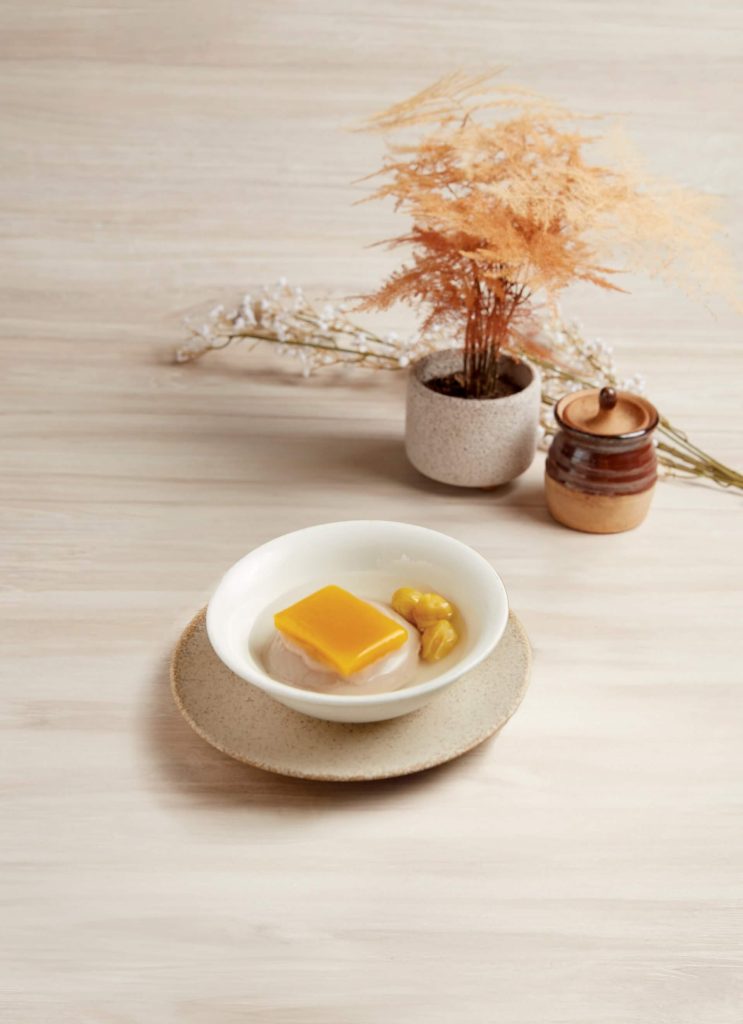
Many traditional Teochew desserts are made using cane sugar and taro,9 which were abundant in Chaoshan (by the Qing dynasty, Chaozhou had become China’s cane sugar capital). These include steamed taro paste (orh nee) and sugar-encrusted deep-fried taro sticks (huang sua orh).10 Orh nee, which remains popular today, is traditionally fried in lard, served with gingko nuts, shallots, chunks of pumpkin, and in some restaurants in Singapore, topped with water chestnut syrup. However, to reduce costs, many hawkers today choose to serve their orh nee with coconut cream and corn. Other modifications might be attributed to perceived health benefits and changing tastes. These days, lard is often substituted with vegetable oil. Some older Teochews in Singapore would have also eaten their orh nee with slices of sugared pork belly, but this combination is rarely seen in Singapore today.11
Teochew raw fish salad (hu say), accompanied with plum sauce and ingredients such as shredded radish, celery, and starfruit,12 tends to have a heavier focus on the fish (cut into slices after being air-dried), unlike the more familiar Cantonese yu sang (yu sheng in Mandarin), where the fish and some 15 other ingredients share equal prominence.13 The fish of choice in Chaoshan is the grass carp (cao hu), a freshwater fish prone to parasites, so Singaporean Teochews later opted for wolf herring (saito hu). But in the wake of a 2015 bacterial infection scare, which led to a ban on the sale of ready-to-eat raw freshwater fish, many Teochew restaurants switched to salmon sashimi or even smoked salmon.14
Several Chaoshan favourites have yet to enter mainstream consciousness in Singapore. One of them is a leafy dish known as “Patriotic Soup” (hook gok cai), thought to have been invented in the twilight of the Song dynasty while its young emperor Zhao Bing (1272–1279) took shelter in a monastery in Chaozhou.15 Conversely, a number of popular hawker foods attributed to the Teochews in Singapore, such as chye tau kway and bak chor mee (minced pork noodles served with vinegar), are not a common sight in Chaoshan.16 Teochew immigrants, who dominated the local pepper trade in Singapore, are also known for bak kut teh — a peppery soup made from pork spare ribs which later supplanted the darker, more herby Hokkien version of the dish as the most popular variant in Singapore.
The ‘Nanyang’ school of Teochew cooking
Rather than insist on “authentically” cooking food à la Chaoshan, many chefs at Singaporean Teochew restaurants have embraced what researcher Tan Gia Lim calls the “Nanyang” school of Teochew cooking, recognised for adapting to local conditions.17
In a country whose population is both dense and diverse, the inter-cultural localisation of traditional foods is inevitable. Over time, Singaporeans developed a preference for their mee pok — Teochew-origin flat noodles traditionally served in a broth — to be served dry and dressed in sambal belacan (a Malay chilli sauce made with shrimp paste). At Teochew porridge (muay) stalls in Singapore, it is not uncommon to see dishes of non-Teochew provenance — chicken curry, the Indonesian-origin grilled fish cake otak-otak, and Cantonese sweet-and-sour pork, to name a few — served alongside traditional Teochew savoury accompaniments (chap giam) such as cured seafood and salted vegetables. And given the widespread popularity of the lohei ritual in Singapore during Chinese New Year today, some Teochew restaurants serve Cantonese yu sang, instead of Teochew hu say.
Teochew immigrants are said to have been responsible for uniquely Singaporean creations such as satay bee hoon, which usually consists of rice vermicelli and other ingredients like cuttlefish, kang kong (water spinach), pork slices, liver, and cockles, slathered with a spicy peanut sauce inspired by that which accompanies meat skewers (satay) in Malay cuisine. In fact, returning Teochew immigrants introduced this sauce to those in Chaoshan — giving rise to Shacha sauce, which is now often referred to as “Chinese barbecue sauce”.
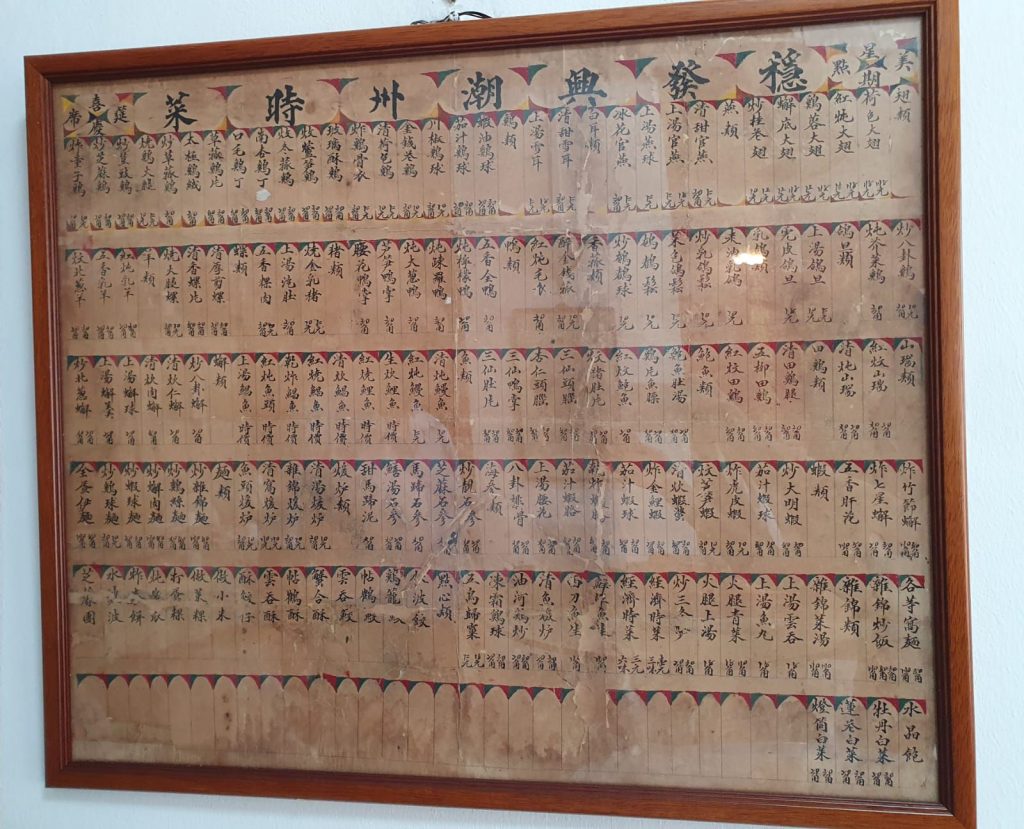
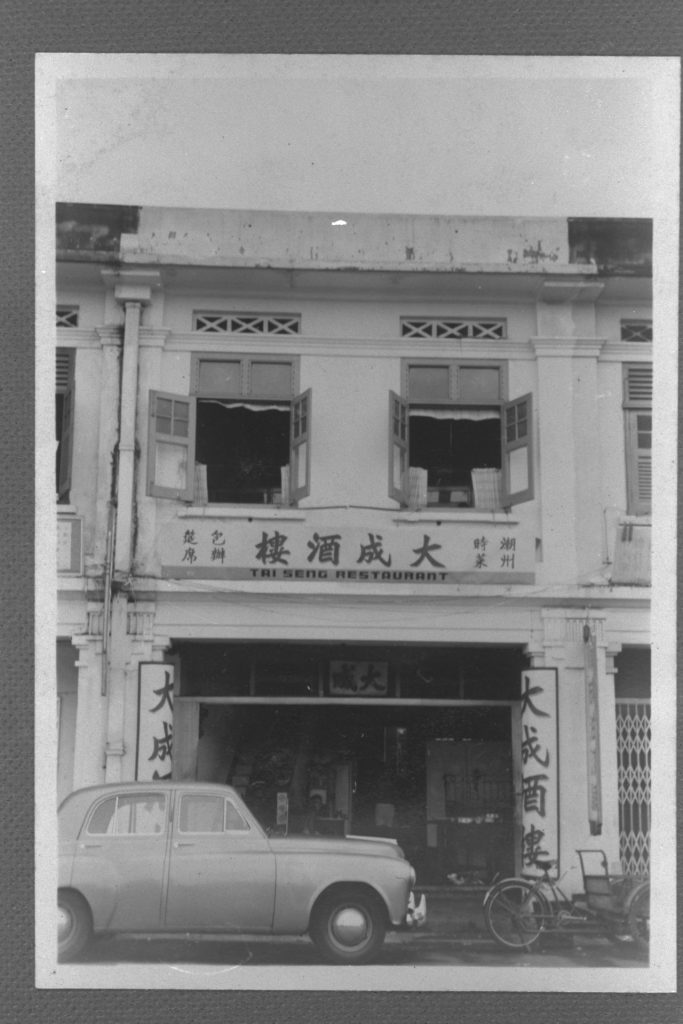
Some eateries in Singapore still preserve the old ways. At Cheng Hoo Thian Restaurant, which dates back to the 1930s, an old menu on the wall lists more than 150 dishes, including pigeon, that used to be sold in the early 20th century. While today’s usual offerings are considerably slimmer, the second-generation owner continues to serve up old-time classics such as braised goose (cooked in decades-old braising liquid), cold crab, jellied pig trotters, and hu say served with plum sauce. The orh nee is fried in lard and accompanied with gingko nuts, water chestnut syrup, and — in a unique twist — topped with preserved Mandarin oranges that have been dried, sugared, and cooked over charcoal fire in a nine-day process. Other establishments have been emphasising their “Nanyang-style” flavour. Chin Lee Restaurant, founded in 1973, offers classic fare like chye poh kway teow, braised platter, and fried prawn rolls, while also serving “bamboo charcoal dust” sio bee (a twist on Teochew small steamed dumplings, which are similar to Cantonese siu mai), and non-Teochew items such as coffee pork ribs.
Over time, the distinctions between mainland Chaoshan cuisine and the foods of the Teochew communities who settled in Singapore, Malaysia, Thailand, and Hong Kong may grow more pronounced, as tastes change and different cultural influences are exerted on these communities. In Singapore, several new Teochew restaurants founded by recent immigrants from Chaoshan have sprung up in recent years, although a general reluctance among younger locals to enter the industry poses a long-term challenge.
For now, “authentic” or otherwise, Teochew cuisine — be it a bowl of humble Teochew muay, or the more elaborate fare of fine dining restaurants — continues to hold a special place in the hearts and stomachs of many a Singaporean diner.
| 1 | The classification of Teochew cuisine as a subset of Cantonese cooking is a controversial matter. For a preliminary discussion, see Tang Zhenchang’s Yongsun ji (1995), in which he argues that Teochew cuisine cannot be categorised under any of the eight major Chinese culinary traditions. |
| 2 | Author’s interview with Chan Ka Cheong, chef consultant of Chui Huay Lim Teochew Cuisine, 26 May 2025. |
| 3 | Low Weiliang, Food Hometown (Singapore: Popular Book Co., 2010), 151–158. |
| 4 | Wong Chiang Yin, How to Eat (Singapore: Focus Publishing, 2021), 72–73. |
| 5 | “Chu huayuan” [Leaving the garden], Singapore Kityang Huay Kwan. |
| 6 | Zhang Xinmin, Chaoshan weidao, 69–71. Chaoshan boasts one of the largest goose species in the world — the aptly-named lion-head goose, which could weigh as much as 18kg. |
| 7 | Importing goose meat from China is no longer allowed. Frozen goose meat, the only sort available in Singapore, poses some challenges. Lots of European geese are bred for foie gras and their feathers, and so tend to be older and their flesh less suitable for consumption. See Tang Ai Wei, “Shicheng xun e cui yu xiang” [Searching for crisp and fragrant goose in the Lion City], Lianhe Zaobao, 3 April 2021. Frozen goose meat is also tougher than fresh goose meat. Author’s interview with Chan Ka Cheong, chef consultant of Chui Huay Lim Teochew Cuisine, 26 May 2025. |
| 8 | Author’s interview with Eric Chua, owner of Chin Lee Restaurant, 21 May 2025. |
| 9 | The terms “taro” and “yam” are often used interchangeably in Singapore. Strictly speaking, orh nee is taro paste, not yam paste. |
| 10 | Making huang sua orh is time-consuming as taro pieces need to be continuously stirred in the wok for at least 15 to 20 minutes. Author’s interview with Chan Ka Cheong, chef consultant of Chui Huay Lim Teochew Cuisine (established in 2011), who hails from Hong Kong. Mung bean is another popular ingredient, used for instance in split mung bean sweet soup (lek tau suan), and large pastry cakes made with lard and mung bean filling (la piah). |
| 11 | Author’s interview with Jimmy Koh, owner of Cheng Hoo Thian Restaurant, 19 May 2025. His restaurant used to sell orh nee with sugared pork meat. |
| 12 | Author’s interview with Jimmy Koh, 19 May 2025. |
| 13 | Unlike the Cantonese yu sang, Teochew hu say is not tossed at the dining table in a boisterous ritual (lohei in Cantonese); it is also eaten year-round and not just during Chinese New Year. |
| 14 | Author’s interview with Jimmy Koh, 19 May 2025. |
| 15 | A version of this dish is available on request at Cheng Hoo Thian Restaurant, where it is known as taiji jirong. |
| 16 | Wong Chiang Yin, How to Eat (Singapore: Focus Publishing, 2021), 56. |
| 17 | Tan Gia Lim, An Introduction to the Culture and History of the Teochews in Singapore, 115. |
Low, Weiliang. Food Hometown. Singapore: Popular Book Co., 2010. | |
Tan, Gia Lim. An Introduction to the Culture and History of the Teochews in Singapore. Singapore: World Scientific Publishing, 2018. | |
Tan, Pin Yen. “Yu xiwei chu pin Chao cai” [Tasting the subtlety of Teochew cuisine]. Lianhe Zaobao, 29 November 2015. | |
Thian Boon Hua, oral history interview by Jesley Chua Chee Huan, 8 August 2014, audio, National Archives of Singapore (accession no. 003888), Reel/Disc 20–22/66. | |
Wong, Chiang Yin. How to Eat. Singapore: Focus Publishing, 2021. | |
“Xinjiapo fangyan zuqun caiyao zhi er: Chaozhou cai” [Singapore’s dialect cuisines, #2: Teochew food]. Lianhe Zaobao, 24 November 2017. | |
Zhang, Xinmin. Chaoshan weidao [Flavours of Chaoshan]. Guangdong: Jinan University Press, 2012. |