A history of salon photography in Singapore


Pictorialism was an international movement that sought to elevate the artistic status of photography. In Europe and the United States, its influence lasted from the 1880s to the 1920s.1 Its imprint was quickly felt in Singapore with the founding of the Singapore Amateur Photographic Society in 1887. By the 1920s, the works ethnic Chinese photographers began to appear in exhibitions and newspaper and magazine spreads that showcased art photography. Since then, Chinese photographers have become the most active participants in pictorial photography in Singapore.
Instead of pictorial photography, this essay uses the more colloquial “salon photography” to acknowledge the enthusiastic involvement of these Chinese photographers in sustaining its practice till today. The term shalong was first popularised in Hong Kong where photographers transliterated “international salon of photography”, which referred to an exhibition of art photography, into Cantonese. It was subsequently adopted by Chinese photographers in Singapore.2
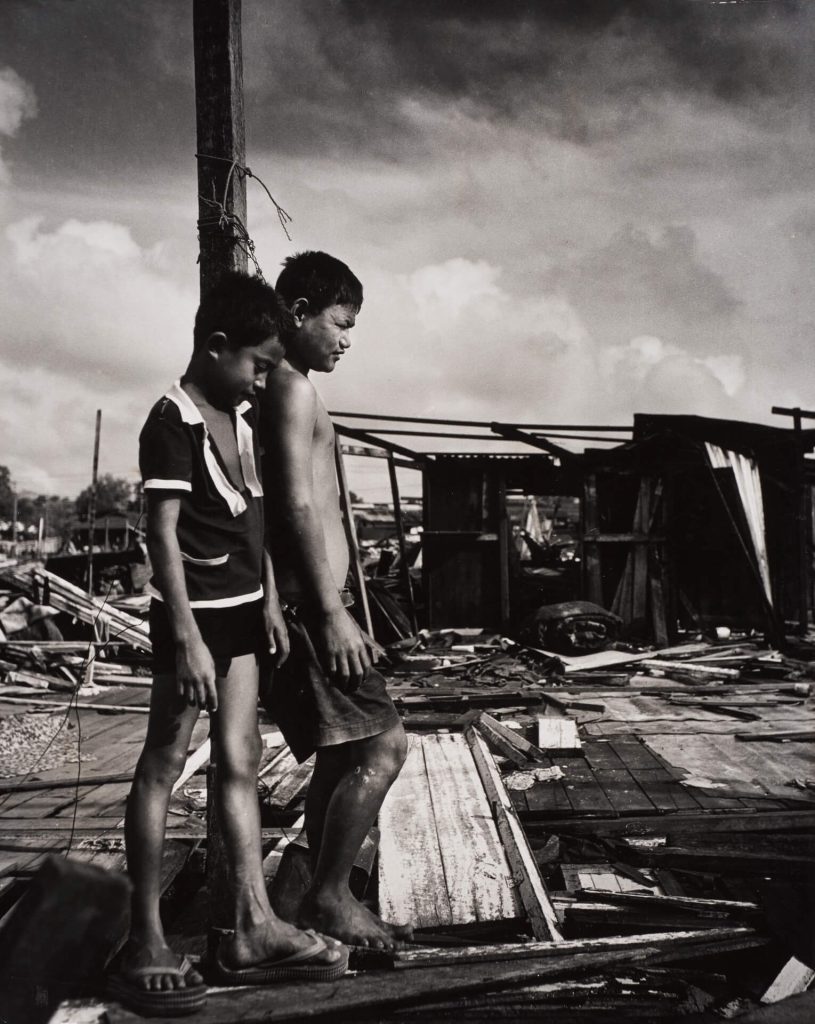
What does salon photography mean in terms of producing art photographs? In her landmark study of pictorial photography in Singapore from the 1950s to the 1970s, Charmaine Toh argues that the artistic practice privileged “aesthetics over fact”, informed by a pursuit of beauty defined by “technical perfection”. Technique was thought to be more important than originality or subject matter. The pursuit of beauty was seen in the “valourisation of balanced and harmonious composition as well as precise exposure and tones in the physical print”. It avoided “upsetting images” that reflected the problems of Singapore.3 Since the late 1950s, if not earlier, an aestheticised version of street photography has also been incorporated in salon photography.4
Camera clubs and photo societies
The practice of salon photography is largely driven by camera clubs and photo societies. In East and Southeast Asia, photo societies saw two main periods of growth, with clubs and societies established in the 1920s and 1930s, and from the late 1940s onwards.
In 1921, the Malayan Camera Club (MCC) was established in Kuala Lumpur, and targeted European amateurs across the colony. The Singapore Camera Club (unrelated to the club of the same name founded in Singapore in 1950) was founded in the same year, catering initially to the Japanese amateur photographers in Singapore and Johore. There were already a few Chinese photographers who participated in the competitions organised by the two clubs.5 In March 1936, the Oversea Chinese Photographic Society was established in Singapore. The idea germinated when a group of photo enthusiasts came together to organise the Oversea Chinese Photographic Exhibition, which opened on 24 March 1935 on the premises of the Nanyang Chinese Students Society in Singapore. Showcasing the works of Chinese photographers from Malaya, the exhibition was hailed as the first of its kind in various newspaper reports. Encouraged by the reception of the exhibition, the photographers formed the society the year after. The photographers were eager to highlight their huaqiao identity, reflecting an upswell in nationalist feelings for the Chinese motherland.6
In the 1950s and 1960s, several photo societies were established in Singapore. The Singapore Camera Club (SCC) was founded in 1950. It was part of the British-backed Singapore Art Society (SAS) that served as a coordinating agency for different art and cultural organisations. In 1956, SCC was renamed the Photographic Society of Singapore (PSS).
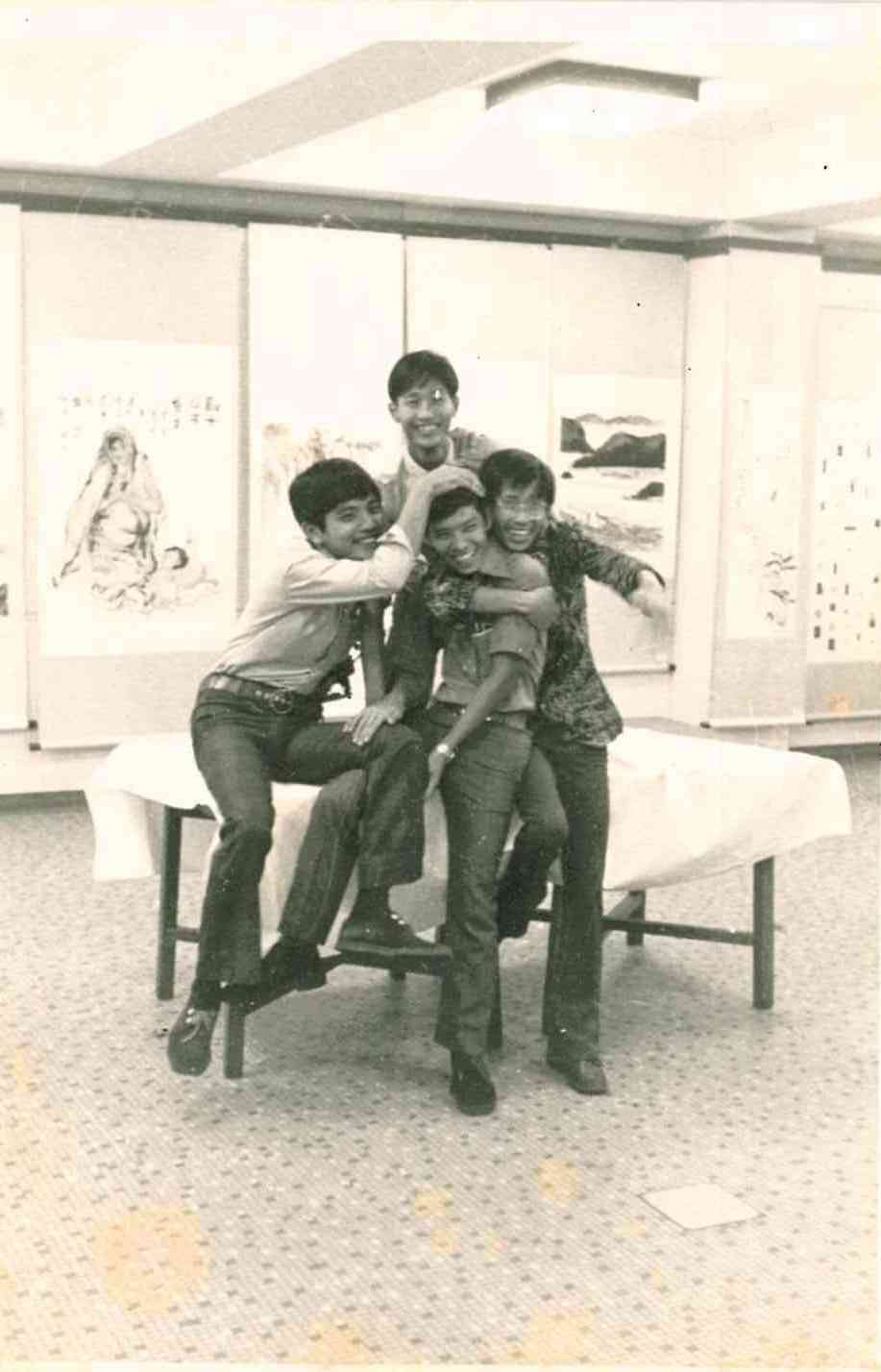
At the time, some photographers felt that the PSS had many affluent, English-speaking members and was somewhat exclusive in terms of membership. In 1958, a group of salon photographers formed the South-East Asia Photographic Society (SEAP). They wanted to promote photography as an art form and facilitate exchanges among photographers across Southeast Asia. SEAP was also known to be a Cantonese-speaking photo society.7 In 1961, Lim Kwong Ling became the first batch of students to attend photography classes run by the government’s Adult Education Board. After completing the beginner and intermediate courses, Lim and his newfound friends wanted more. Young and energetic, they pushed for a photo society for Mandarin speakers, which led to the founding of Photo-Art Association of Singapore in 1965. Most of its initial members were employees and teachers. As they were relatively inexperienced in photography, Photo-Art would often invite award-winning salon photographers from the PSS to deliver talks to them.8 In 1967, the Singapore Colour Photographic Society (SCPS) was formed, reflecting how colour photography had become increasingly common.
Excursions, contests and distinctions
Before the 1990s, it was not possible to major in photography at a tertiary institution in Singapore. Since the 1950s, photo societies had filled the gap by teaching photography to their members. A key highlight of their activities were the Sunday excursions to different parts of Singapore to look for photographic subjects. In these weekly sessions of informal tutelage, beginners mingled with accomplished photographers, receiving guidance while trying to replicate their award-winning shots.9 These sessions were collegial and mostly male-dominated.
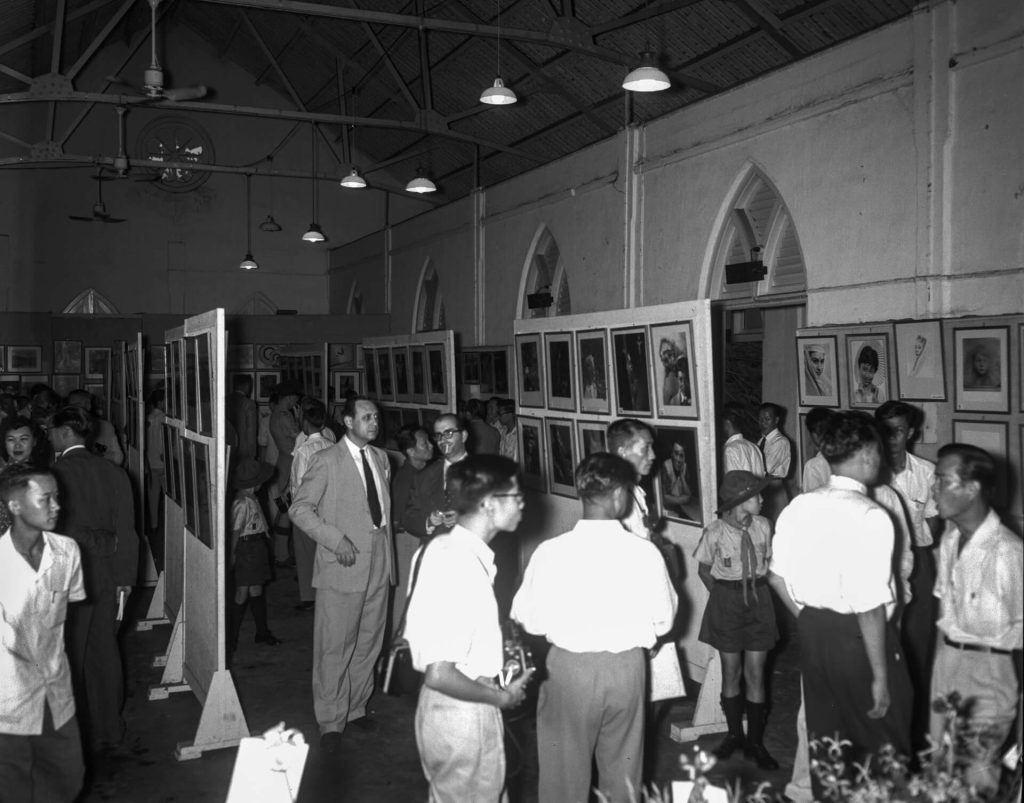
The photo societies also organised international and regional salon competitions, which led to exhibition opportunities for the selected participants. In 1950, the SAS organised the First Open Photographic Exhibition. The annual event was opened to international submissions. In 1953, the SCC organised the First Pan-Malayan Photographic Exhibition, welcoming submissions from Singapore, Malaya, Sarawak, Brunei and North Borneo. In 1957, PSS took over the Open Photographic Exhibition and renamed it Singapore International Salon of Photography. In 1960, SEAP organised the 1st International Pictorial Photography Exhibition of the State of Singapore, which became a biennial event until 1970. Photo-Art and SCPS also used to organise international salons regularly.
Beyond Singapore, there were many international salons that welcomed submissions from around the world. The distinctions awarded by the historic Royal Photographic Society (RPS) in the United Kingdom were amongst the most prized accolades that a salon photographer could receive during the 20th century in Singapore. The process remains the same today. Photographers have to first become RPS members before submitting their prints for examination to be considered for the distinction of Associate of the Royal Photographic Society (ARPS) and, after that, Fellowship of the Royal Photographic Society (FRPS). In the 1950s and 1960s, photographers in Singapore who received the ARPS or FRPS were given prominent coverage in local newspapers.
In Southeast Asia, these salons and distinctions were, for decades, the only way for local photographers to gauge their competency in photography.10 In Singapore, the Chinese-speaking photographers were the most active in committing time and money to participate in salon contests, both locally and around the world. Local-born photographer Foo Tee Jun (1935–2026) even suggested that the Chinese were motivated by a strong sense of competition to win awards and climb the ladder towards international recognition.11 The contests did not only attract participants with an interest in art photography. There were studio photographers who participated in salons because they knew that the publicity from winning awards would help their businesses. Unfortunately, the potential downside of contest culture was that it encouraged salon photographers to replicate winning shots from previous competitions, which discouraged them from trying something new. Newspaper reports began to mention malpractices in salon photography from the mid-1950s onwards.12 By the late 1970s, salon photography in Singapore had stagnated, with hardly any more innovation in photographic styles and subject matters.13
In 1979, Singapore inaugurated the Cultural Medallion, the highest arts award given by the state. Since then, all the nine photographers who received the accolade had been award-winning PSS members. This suggests that participation in the PSS and winning salon awards remain key criteria in validating art photographers in Singapore.
The Hong Kong factor
In the early 1950s, salon photography in Hong Kong was already a major reference point for salon photographers in Singapore. By then, Hong Kong had consistently produced winners in international salons. The colony also hosted many salons, which were extremely competitive. These developments contributed to Hong Kong’s reputation as the “kingdom of salon”. Hong Kong was also the centre of Chinese-language publishing for the Southeast Asian market during the Cold War. It published many pictorial periodicals and photo periodicals, which were very popular across the region. These periodicals provided space for salon photographers from Southeast Asia, including those who did not speak Chinese, to publish their photographs and their reports and writings on photography. They also covered the salon exhibitions in Singapore regularly, often reproducing the works of noteworthy photographers. In some cases, the Singapore photographers were even paid for their contributions.
Photo periodicals like Photoart (1960–63; 1980–97) and Photo Pictorial (1964–2005) also organised one-off and recurring contests for readers in Hong Kong and Southeast Asia. These contests were often judged by accomplished salon photographers in Hong Kong and offered another way for Southeast Asian photographers to gauge their skills. In short, Chinese-language periodicals from Hong Kong provided an additional source of recognition and revenue for photographers in Singapore, contributing to the longevity of salon photography in Southeast Asia during the Cold War.14
Collaborating with the government and state agencies
Salon photographers participated in competitions around the world to gain a better sense of how their photography skills measured up. During decolonisation and the first decades of nation-building, salon photographers helped to place Singapore on the global map by submitting works and winning awards in these exhibitions. In the catalogues of exhibitions hosted in Singapore and overseas, there is often a tabulation of entrants by nation, indicating the number of prints received and selected. Seeing Singapore listed alongside older and emerging nations helped to create a powerful national imagination for the photographers, their patrons and the audience.
Since the colonial era, photo societies and salon photographers have also collaborated with public agencies to organise exhibitions that addressed a variety of cultural, socio-economic and political issues. In some cases, the authorities are responsible for mobilising salon photographers and photo societies to organise exhibitions. In other situations, photo societies organise exhibitions to dovetail with the needs of the authorities.15
In 1961, Singapore tried to develop its tourism sector, then in its infancy, by organising a “Visit the Orient Year” campaign with neighbouring countries to attract long haul travellers to the region. Government bodies and commercial and cultural organisations were asked to organise programmes to engage potential visitors. SEAP and PSS contributed to the campaign by hosting different photo exhibitions. SEAP organised a themed exhibition titled Know Our Singapore. The submission guidelines listed potential subject matter that would fit the theme, including Singapore architecture, scenery, the customs and rituals of different races, local produce, domestic industries, important factories, and rare and exotic flora. In this way, the exhibition served to educate potential applicants in producing the right kinds of images that visualised the nation. Three of the founding members at SEAP served as judges of the competition.16 Speaking at the exhibition opening, Lee Khoon Choy (1924–2016), then parliamentary secretary to the Minister of Culture, cajoled the photographers whose works were selected to send their prints to salon contests around the world, so that people elsewhere could learn more about Singapore.17
Three months later, Lee Khoon Choy opened another photo exhibition titled Visit the Orient Year at the Singapore Chinese Chamber of Commerce (now the Singapore Chinese Chamber of Commerce & Industry). It was an exhibition organised by PSS, in collaboration with 11 photo societies from the region. The final selection featured 230 prints, contributed by leading salon photographers from the region. In his opening speech, Lee noted that in the past, the Orient was seen by the Western world as “a land of lotus eaters, mysterious, exotic, inscrutable and at the same time dirty, uncivilised, cruel and unchanging”. Speaking on behalf of the orient, Lee dismissed this picture as false. He added: “Some of our people have the most ancient civilisations and at the same time today we are in the forefront of progress.”18
Salon photographers and photo societies continue to collaborate closely with the public agencies today. In 2025, Singapore marked its 60th year of independence with a year-long line-up of events. PSS and the Housing & Development Board organised the SG60 Heartland Stories Photography Competition, with the aim of “capturing the charm of the HDB heartland”.19
| 1 | Mary Warner Marien, Photography: A Cultural History, 3rd edition (London: Laurence King Publishing, 2010), 165–172. |
| 2 | Lee Sow Lim, Li shaolin tan sheying [Lee Sow Lim on Photography] (Singapore: Xinjiapo sheying zhuanke xuexiao, 1992), 134. |
| 3 | Charmaine Toh, Imagining Singapore: Pictorial Photography from the 1950s to the 1970s (Leiden: Brill, 2023), 37–45. |
| 4 | Zhu Xuan, “Mantan jietou sheying” [A casual discussion on street photography], Nanyang Siang Pau, 11 February 1965; Lee, Li shaolin, 120–123. |
| 5 | “Singapore Camera Club: Interesting Memorial Hall Exhibition,” Singapore Free Press and Mercantile Advertiser, 6 July 1926; “Malayan Camera Club,” Pinang Gazette and Straits Chronicle, 30 July 1925. |
| 6 | Zhuang Wubin, “Exhibiting Photography in Pre-War Singapore,” BiblioAsia 17, no. 3 (December 2021): 59–61. |
| 7 | Lee Sow Lim, oral history interview by Teo Kian Giap, 27 April 2010, audio, National Archives of Singapore (accession no. 001818), Reel/Disc 2 of 16; Kong Yen Lin, “Rise of Modernism in Singapore Photography, 1950s to 1980s: Aesthetic Negotiation Under an Ethnic and National Identity Prism” (Master’s thesis, LASALLE College of the Arts, 2016), 189. |
| 8 | Lim Kwong Ling, interview by author, Singapore, 11 June 2019. |
| 9 | Toh, Imagining Singapore, 68–70. |
| 10 | Karen Strassler, Refracted Visions: Popular Photography and National Modernity in Java (Durham and London: Duke University Press, 2010), 47–49; Clare Veal, “Thainess Framed: Photography and Thai Identity, 1946–2010” (PhD diss., University of Sydney, 2015), 257–259. |
| 11 | Kong, “Rise of Modernism,” 177. |
| 12 | Hoo Watt, “Meishu zhaopian de goutu: Ping diqijie gongkai yingzhan” [The composition of art photographs: Critiquing the Seventh Open Exhibition of Photographs], Nanyang Siang Pau, 17 February 1956; K. Huang, “‘Shalong’ mantan” [A casual discussion on “salon”], Nanyang Siang Pau, 2 April 1961. |
| 13 | Toh, Imagining Singapore, 81–83. |
| 14 | For an extended discussion on the historic connections between Hong Kong and Southeast Asia in the praxis of salon photography, see Zhuang Wubin, “Resurfacing Hong Kong in Southeast Asia: Circulations of Photography from the 1930s to the Handover,” Asia Art Archive, February 2023. |
| 15 | 1922, a competition of pictorial photography was included in the melee of business, cultural and sporting events held during the Malaya Borneo Exhibition, which was organised with the likely intention of reviving colonial trade in Singapore after the end of World War I. For a brief description of the photo exhibition, see Zhuang, “Exhibiting Photography,” 58–60. |
| 16 | “Youlan dongfang nian dongnanya sheying xiehui juban yingzhan sanyue sanshi ri kaimu” [Visit the Orient Year: South-East Asia Photographic Society organises photo exhibition, opening on 30 March], Nanyang Siang Pau, 17 February 1961; Sunny Giam, “Send in your best prints,” Singapore Free Press, 29 December 1960. |
| 17 | “Dongnanya sheying xuehui zhuban renshi benbang yingzhan kaimu” [Opening of Know Our Singapore photo exhibition, organised by South-East Asia Photographic Society], Sin Chew Jit Poh, 31 March 1961. |
| 18 | “Photography and False Pictures,” Straits Times, 1 July 1961; “‘Photography Is Best Art Form to Record Our Progress’,” Singapore Free Press, 30 June 1961; “Sheying xuehui zhuban, Dongfang nian yingzhan zuo kaimu” [Organised by photographic society, orient year photo exhibition opened yesterday]’, Sin Chew Jit Poh, 30 June 1961. |
| 19 | Isabelle Liew, “60 Winners Picked from Among 12,600 Photo Competition Entries Showcasing HDB Heartlands,” The Straits Times, September 29, 2025. |
Kong, Yen Lin. “Rise of Modernism in Singapore Photography, 1950s to 1980s: Aesthetic Negotiation Under an Ethnic and National Identity Prism.” Master’s thesis, LASALLE College of the Arts, 2016. | |
Toh, Charmaine. Imagining Singapore: Pictorial Photography from the 1950s to the 1970s. Leiden: Brill, 2023. | |
Zhuang, Wubin. Shifting Currents: Glimpses of a Changing Nation. Singapore: National Library Board, 2018. | |
Zhuang, Wubin. “Resurfacing Hong Kong in Southeast Asia: Circulations of Photography from the 1930s to the Handover.” Asia Art Archive, February 2023. |