Pioneer artist: Liu Kang


Singapore pioneer artist Liu Kang (1911–2004) loved colour, a key aspect of his oeuvre which also served as a metaphor for his rich and colourful life. Thus observed an essay on him in Liu Kang — Colourful Modernist, a book published by the National Art Gallery, Singapore in conjunction with the commemorative exhibition, Liu Kang: A Centennial Celebration, at the Singapore Art Museum in 2011.1
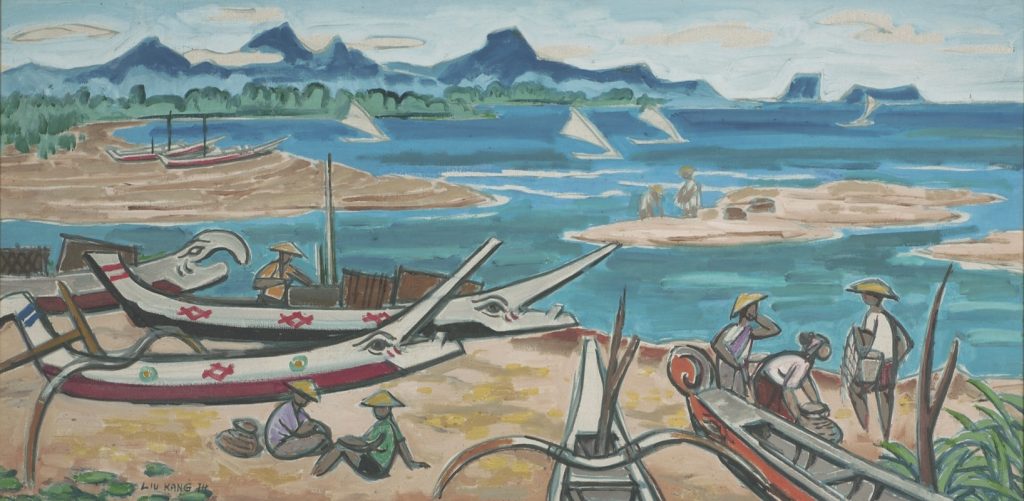
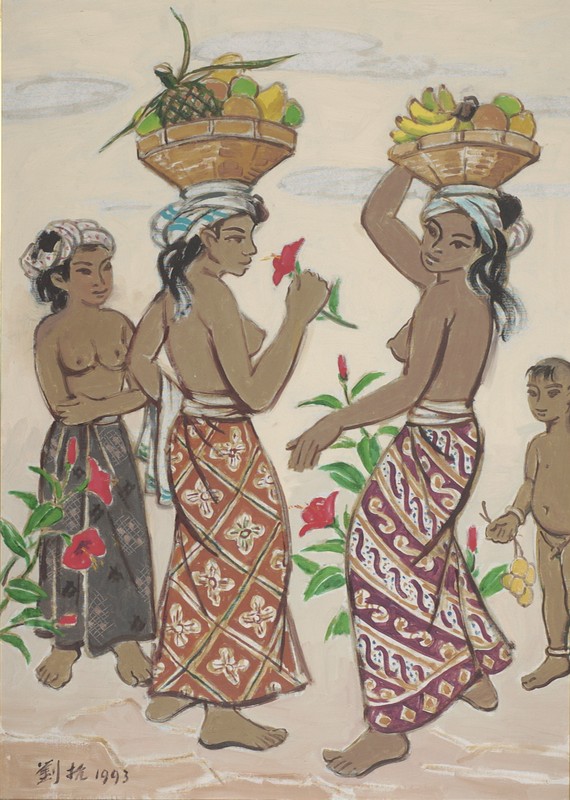
“Art and life intermingle to produce works that are recognisable for their striking colour and scenes of vibrant Southeast Asian life,” added the essay penned by writers Ong Zhen Min and Susie Wong.
Decades earlier in 1957, Frank Sullivan (1909–1989), an influential art writer in pre-independence Singapore, had already noted Liu’s bold use of colour in his works. In his introductory essay, “Liu Kang — His Art and Life”, published in the catalogue for Liu’s first solo exhibition in Singapore that same year, he wrote: “In terms of sheer colour, he is the boldest painter in the country; no one else tries, and gets away with, such flaring contrasts of red and blue as Liu Kang does. He loves big canvases, over which his brush can sweep and range with firm touch and definite line.”
The exhibition at the Victoria Memorial Hall (now Victoria Concert Hall) also marked Liu’s 30 years as an artist at the age of 46. The show featured his early works from the 1920s, such as Indian Dancers which he painted in oil in 1955.
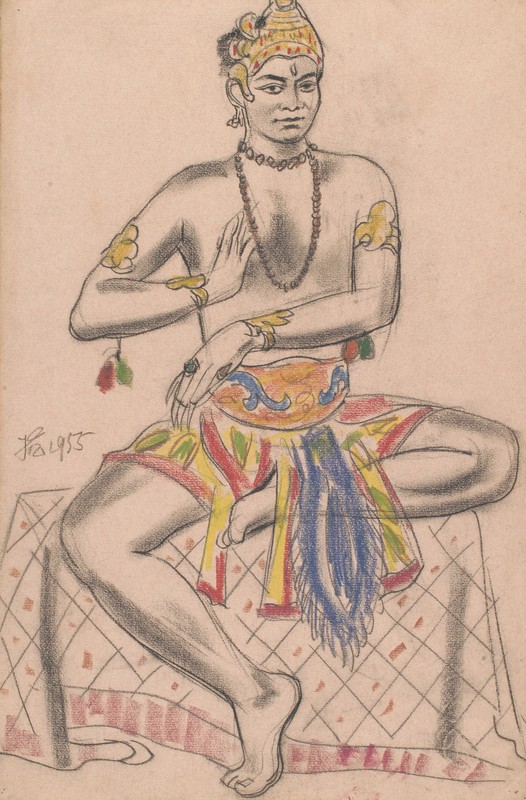
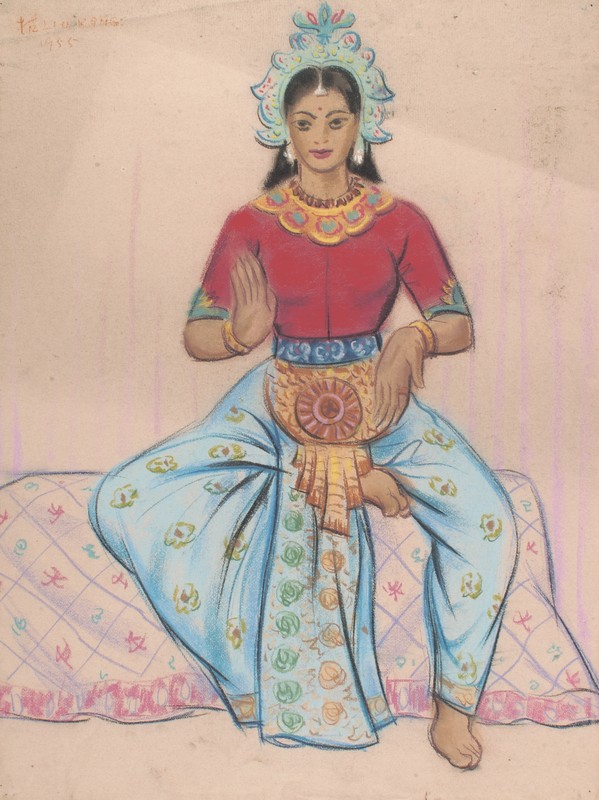
Liu’s love of colour influenced the eldest of his five children, prominent architect Liu Thai Ker, who designed the Nanyang Academy of Fine Arts’ (NAFA) $150-million campus on Bencoolen Street which was completed in 2004.
The younger Liu, in an interview for the book Art and Soul, published in 2018 to mark the 80th anniversary of NAFA founded by his father’s friend and fellow Chinese émigré artist Lim Hak Tai (1893–1963), said colour was a “keynote design consideration” of the new campuses whose exterior was originally painted entirely in white. But he added strips of warm orange, verdant green and azure blue on the façade and on selected wall surfaces inside and outside the buildings. Some of those colours were later removed.
He said the bright colours, which depicted tropical Nanyang, were used by artists like his father, who had come from China since the early 20th century, to capture the flora and fauna of Malaya and Singapore.
There are many examples of the senior Liu’s large canvases of bright and colourful oil paintings in the National Heritage Board’s collection today. Among them are Bathers (118 x 169 cm), painted in 1997, and early works such as Artist and Model (84 x 124 cm) and Outdoor Painting (85.5 x 127.2 cm), both painted in 1954.
The vibrant colours in his works are testament to the breadth and depth of a life well-lived in China, France, British Malaya, and finally Singapore where he settled with his family after World War II and died in 2004, aged 93. As he was fond of saying: “Like my paintings, my life has been very colourful.”
His life spanned two World Wars, and the Japanese Occupation in British Malaya and Singapore in the early 1940s. He also witnessed Singapore’s merger with Malaysia in 1963, and its separation from the federation to be an independent nation two years later.
Early years
Liu was born in Yongchun county, Fujian province, China, in 1911, the year the Chinese republican government was formed following the success of the revolution led by Sun Yat-sen (1866–1925). World War I broke out three years later in 1914. In 1916 when he was six, Liu went to Muar, in what was then British Malaya, with his mother to join his father who was involved in the rubber business. He had his early education at the Chung Hwa Primary School where he discovered his interest in drawing and painting.
Liu went back to China to continue secondary school in 1926 when he was 15. He then studied at the Shanghai College of Fine Arts, later renamed Shanghai Academy of Fine Arts, which was founded by his mentor Liu Haisu (1876–1994). He later moved to Xinhua Academy of Fine Arts, also in Shanghai, where he graduated in July 1928. One of his Xinhua professors encouraged him and his classmate Chen Jen Hao (1908–1976) to go to Paris to further his studies.
He enrolled at the Academie de la Grande Chaumiere for a time and his works were shown at the Salon d’Automne in Paris in 1930 and 1931.
During his four years in the French capital, he was influenced by the painting styles of the School of Paris and works of post-impressionist masters such as Cezanne (1839–1906), Gauguin (1848–1903) and Van Gogh (1853–1890). But he was perhaps most influenced by the works of Henri Matisse (1869–1954), a leading figure of the Fauvist movement, known for the use of colour in his works.
He became close to the Chinese literary figure and writer Fu Lei (1908–1966) and met the artist Georgette Chen (1906–1993) and her first husband Eugene Chen (1878–1944), who were also in Paris.
In 1933, he returned to China to teach at the Shanghai Academy of Fine Arts, at the invitation of his mentor Liu Haisu.
Barely 22, he was the academy’s youngest teacher. His older colleagues included Pan Tianshou (1897–1971) and Huang Binhong (1865–1955). Both later became great 20th century Chinese ink masters.
In 1937, he married his classmate Chen Jen Hao’s younger sister, Chen Jen Ping (1914–2009), who was a school teacher. When the Sino-Japanese War broke out that same year, the couple left Shanghai. He expected to be away six months or a year but instead only returned to China 37 years later, in 1974.
Life in Singapore
Liu’s 34-year teaching career in schools in Malaya and Singapore began in 1937, starting with Chung Hwa Primary School in Muar, Malaysia, before he moved to Singapore where he taught at Chung Cheng High, Dunman High, Nanyang Girls’ High, and Nan Hwa Girls’ School (now Nan Hua High School).
Liu was in Singapore when the Japanese started their attack on Malaya and Singapore. He returned to Muar where he briefly ran a small coffee shop but after being called in and questioned by the Japanese military office he left for Singapore where he felt he would be more safe. At the end of the war his family joined him, living in a rented shophouse at Dhoby Gaut where he opened a design firm called Morrow Studio.
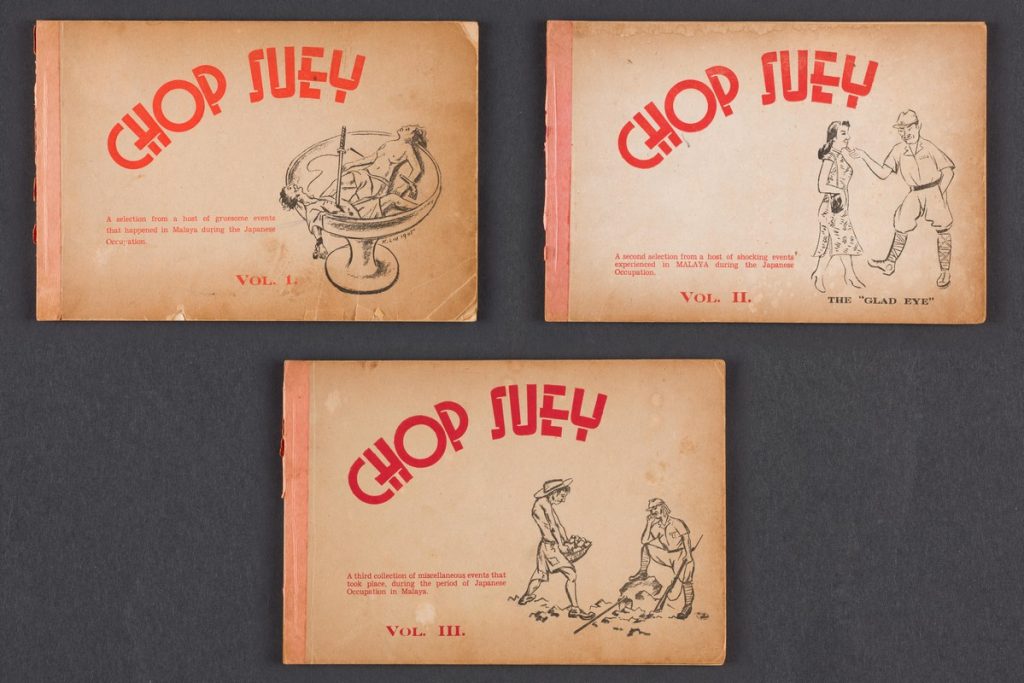
The war atrocities committed by the Japanese during their three-year occupation of Malaya and Singapore (1942–1945) were documented by Liu Kang in sketches published in English and Chinese as Chop Suey or Zasui Huaji in 1946. A selection of these sketches was published in a bilingual (English and Chinese) edition in 1991.
Liu became the first post-war president of the Society of Chinese Artists in 1946, serving as either president or vice president for 12 years until 1958. He was also a co-founder of the Singapore Art Society, Singapore’s first multi-racial art society, in 1949.
Bali trip in 1952
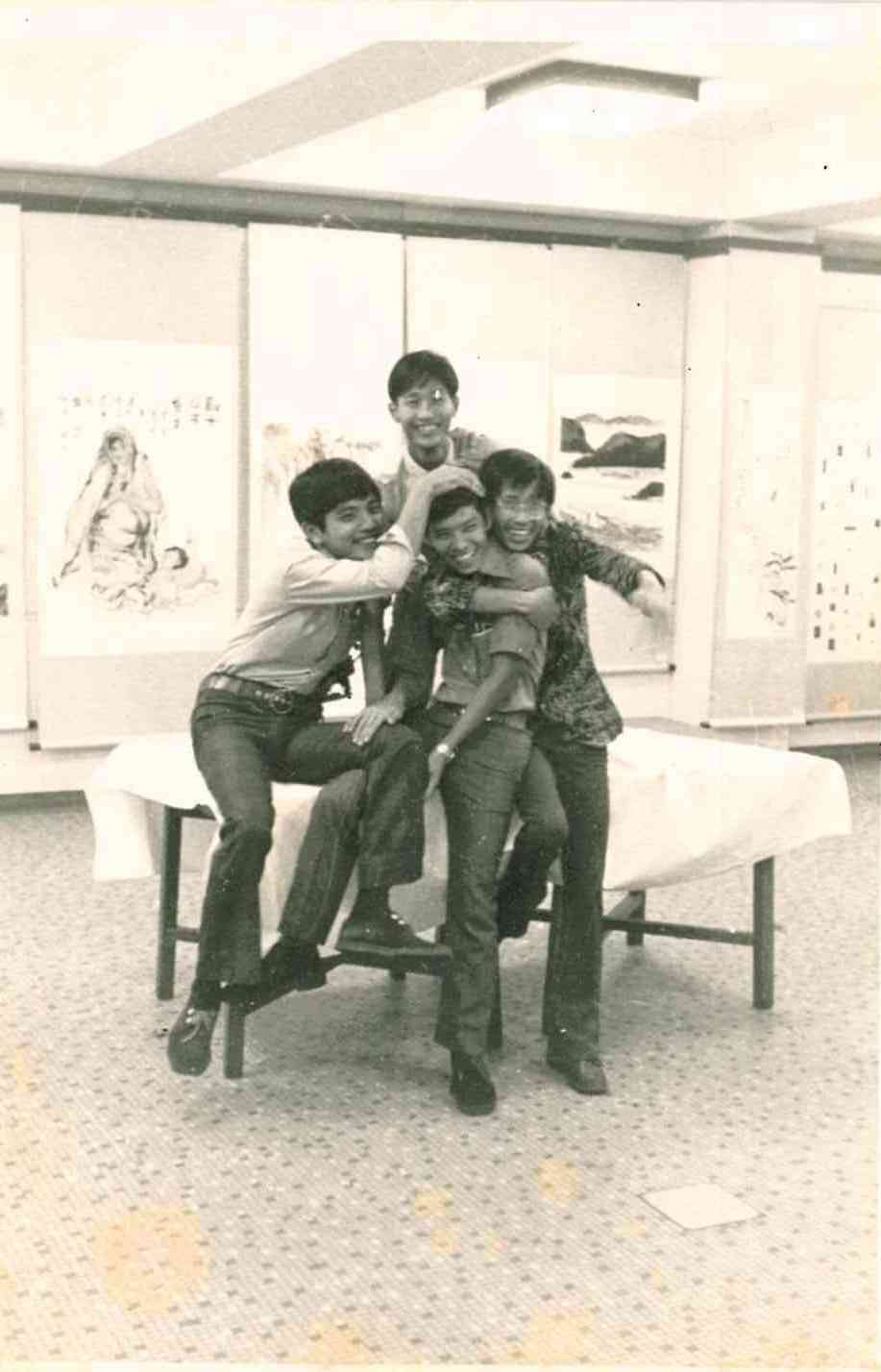
In 1952, Liu and three other pioneer Nanyang artists Chen Chong Swee (1910–1985), Chen Wen Hsi (1906–1991) and Cheong Soo Pieng (1917–1983) went on a seven week sketching trip to Java and Bali. In 1953, they held a joint exhibition of the art inspired by the trip titled “Bali”, which is considered a milestone in Singapore art history.
Liu was active in the Singapore art scene after the second Sino-Japanese War. He held his first solo exhibition in 1957 and travelled widely to paint and exhibit from the 1960s. These included China, the United States, Europe, India, and most East Asian and Southeast Asian countries.
A retrospective of his works, presented by the then-Ministry of Culture and the National Museum, Singapore, was held at the National Museum Gallery in 1981.
A travelling solo exhibition of Liu’s works in Singapore, Shanghai and Beijing, titled, Journeys: Liu Kang and His Art, was later presented by China’s Ministry of Culture, and Singapore’s Ministry of Information and the Arts between 2000 and 2001.
Liu donated of over 1,000 pieces, including his 1957 oil painting, Offerings (130.5 x 97.5 cm) and those in pastels and other media, to the Singapore Art Museum in 2003, the year before his death.
An English translation of his selected writings over the years, Liu Kang: Essays on Art & Culture, was published in 2011.
Liu was awarded the Public Service Star and the Meritorious Service Medal by the Singapore government in 1970 and 1996 respectively. He also received the Order of Arts and Letters from the French government in 1999.
| 1 | Yeo Wei Wei, ed., Liu Kang: Colourful Modernist, 12. |
Kwok, Kian Chow et al. Journeys: Liu Kang and His Art. Singapore: National Arts Council, 2000. | |
Liu, Gretchen. Bali 1952: Through the Lens of Liu Kang. Singapore: National Library Board Singapore and World Scientific Publishing Co Pte Ltd, 2025. | |
Liu, Kang. Chop Suey. Singapore: Global Arts & Crafts, 1991. | |
Low, Sze Wee. “A Bridge Between East and West.” BiblioAsia, April to June 2025. | |
Siew, Sara, ed. Liu Kang – Essays on Art and Culture. Singapore: National Gallery Singapore, 2011. | |
Yeo, Wei Wei, ed. Liu Kang: Colourful Modernist. Singapore: National Art Gallery Singapore, 2011. |