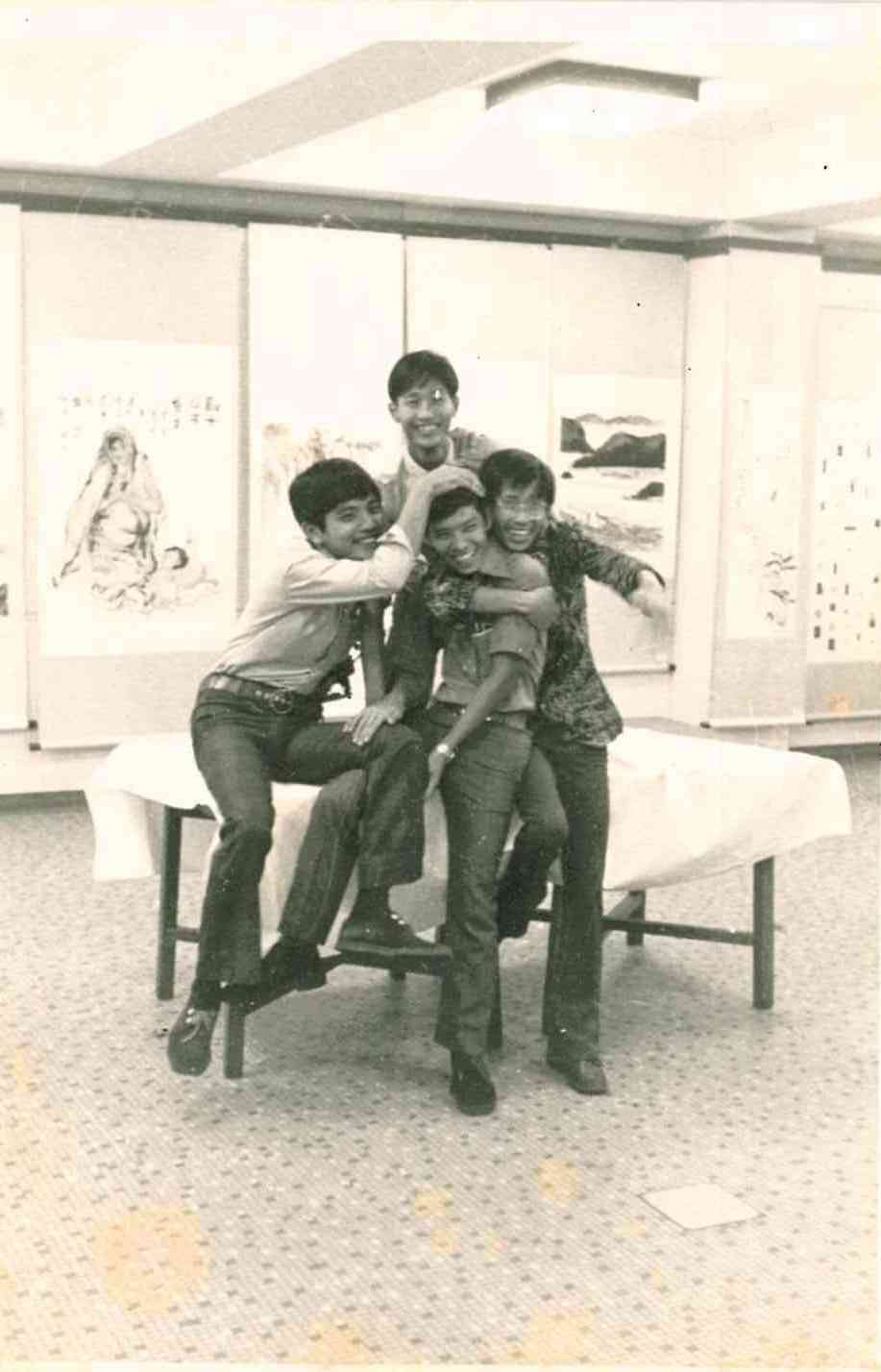
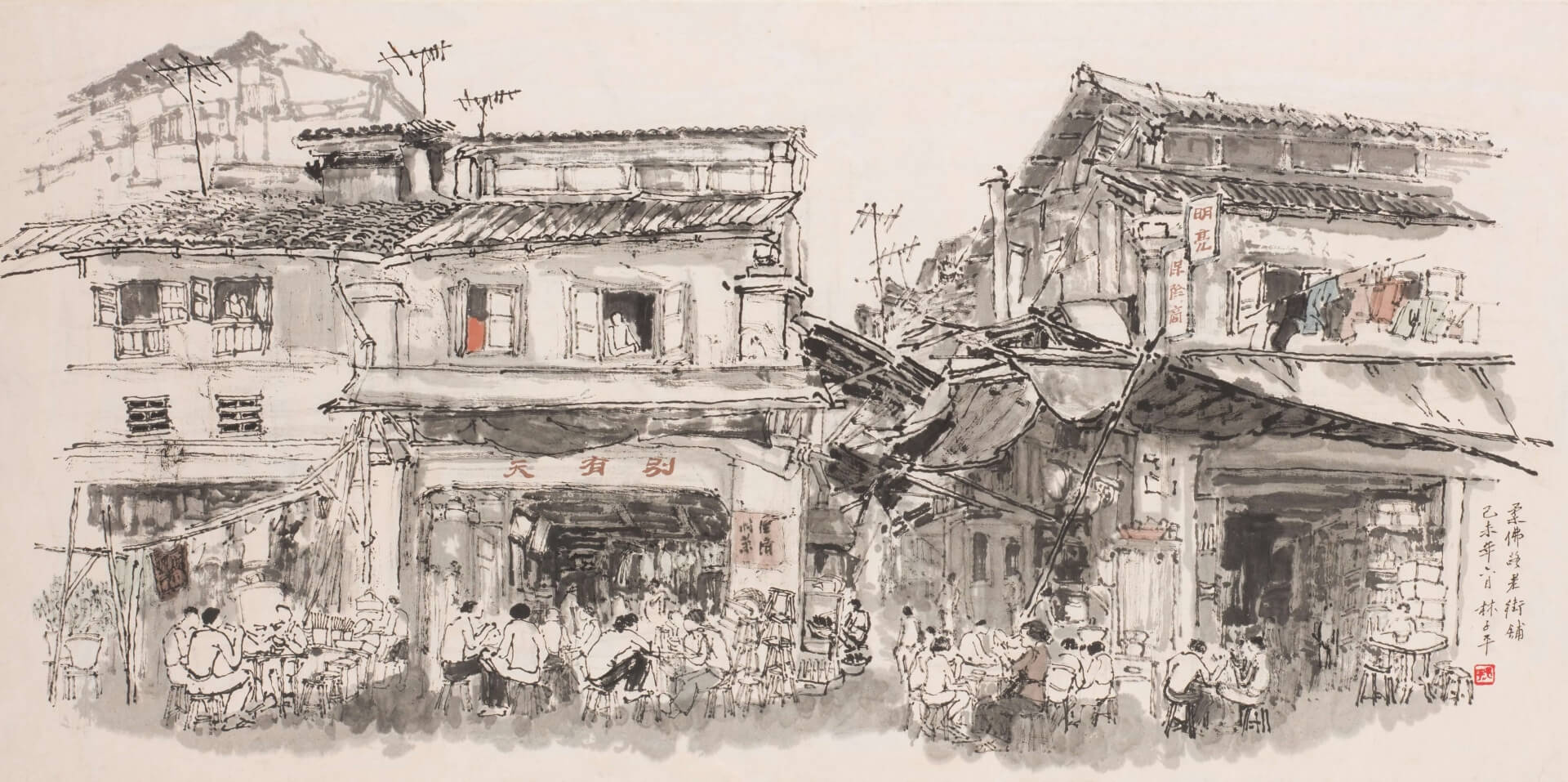
Overview of Singapore’s Chinese calligraphers (1900–2000)


Discussions on Singapore’s Chinese calligraphers can be traced back to the late 19th and early 20th centuries. According to the book Huizhu shiyi (Flicking the Dust and Picking up the Remnants) by Khoo Seok Wan (1874–1941), published in 1901, there were many poets from China residing in Sit Lat Po (an old name for Singapore) at that time. Some of them engaged in academic discussions or exchanged poems with Khoo. While their handwritten records have likely been lost to time, Khoo’s have survived, making him Singapore’s earliest known calligrapher.
Khoo was born in 1874 in Zhangzhou, Fujian, and came to Singapore in 1881. In 1894, he passed the provincial examinations and obtained the qualification of a juren (provincial-grade scholar), but failed the central government imperial examinations in 1895. He eventually settled in Singapore and became known as the “master poet of the southern overseas Chinese”. In his book titled Qiu Shuyuan shengping (Khoo Seok Wan’s Biography), local veteran educator and historian Chiou Sin Min (1914–1995) said: “Khoo’s handwritten reproduction of Chinese philosopher and politician Kang Youwei’s preface for the book Shuyuan shijixu (Collected Poems of Khoo Seok Wan) in xiaokai (a variant of the regular script) was as neat as that demanded by examinations.” This suggested that Khoo’s handwriting was of the standard of scholar calligraphy.
Chinese calligraphers who came to Singapore from 1900 to 1942 generally fall into three categories: those who worked in the business or newspaper industry; those who taught in schools; and those who did both. Strictly speaking, they were not professional calligraphers.
Singapore’s three great calligraphers: Koh Woon Chi, Tan Hengfu and Wu Weiruo
Koh Woon Chi (1890–1960), Tan Hengfu (1874–1954), and Wu Weiruo (1900–1980) were known as the three great calligraphers of Singapore in the early 20th century. A poet as well as a skilled calligrapher and seal carver, Koh was a native of Kinmen and came to Singapore in 1910. His mother’s death brought him back to his hometown, before he returned to Singapore in the early years of Republican China and worked for the Oversea-Chinese Banking Corporation.
On the other hand, Tan, a former Qing dynasty scholar from Xinhui, Guangdong, was an expert in classical texts and calligraphy. He came to Singapore in 1932 and ran a private school at Tiang Thye Kai (Upper Hokkien Street) in the South Bridge Road area, before teaching at the Yeung Ching School. At that time, many plaques belonging to shops in the city centre were written by Tan.
Lastly, Wu, a native of Dabu, Guangdong, came to Singapore around 1913 and worked as a clerk at Singapore Thong Chai Medical Institution from 1932 to 1944. He also inscribed plaques for many business establishments, such as Hong Leong Finance, Wong Yiu Nam Medical Hall, and Lin San Temple. The Singapore Chinese Chamber of Commerce and Industry’s plaque, which reads “wan shang yun ji” (congregating the business community), was also written by Wu.
Calligraphers who came to Singapore before the war
Calligraphers who came to Singapore before World War II also had a profound impact on Singapore’s calligraphy scene.
- See Hiang To (1906–1990), a native of Longxi in Zhangzhou, Fujian, came to Singapore in 1938. He taught at the Nanyang Academy of Fine Arts for 36 years and once served as the principal of Xinya Primary School. Not only was he adept at different calligraphy scripts, he was equally renowned for his paintings and seal carvings. Besides students within and outside the school, he also took outstanding participants of calligraphy competitions under his wing. As a result, he had a profound influence on the calligraphy and painting circles in Singapore and Malaysia. For example, Cultural Medallion recipients Wee Beng Chong and Tan Kian Por (1949–2019), linguist Lim Buan Chay (1951–2024), and artist Zhuang Shengtao (who currently resides in Suzhou) were among his students. See’s published works include Xiangtuo conggao (Collected Works of See Hiang To), Xiangtuo shufa (Calligraphy of See Hiang To), and Shi Xiangtuo zhuanke tuhui heji (Collected Works of See Hiang To: Chinese Paintings and Seal Engravings).
- Pan Shou (1911–1999), also known as Pan Guo Qu, was a native of Nan’an, Fujian. He arrived in Singapore in 1930, and once served as the principal of Tao Nan School and Chung Hwa High School in Muar. In 1937, Pan volunteered to be chief secretary of the South-East Asia Federation of the China Relief Fund in China’s anti-Japanese war efforts. When the Pacific War broke out, Pan sought refuge in Chongqing and only returned to Singapore after the war ended. After Chinese scholar Lin Yutang (1895–1976) left Nanyang University, Pan was invited by Tan Lark Sye, chairman of Nanyang University Council, to succeed Lin as its head. Pan’s calligraphy style was influenced by leading ancient calligraphers Yan Zhenqing (709–785) and Yu Shinan (558–638). Later on, he incorporated the cursive script of Ming dynasty calligrapher He Daozhou as well as techniques from Shupuxu (A Narrative on Calligraphy) to develop his own style of calligraphy. He was hailed as a national treasure by Singapore’s former Cabinet minister George Yeo for his outstanding poetry and calligraphy. Since the 1980s, many young people in the calligraphy circle have sought to emulate Pan’s style of calligraphy.
- Yu Longsun (1895–1991), a native of Sheng County, Zhejiang, arrived in Singapore in 1924. He studied under Zheng Xiaoxu (1860–1938) and also drew influence from the calligraphic style found in inscriptions on steles from the Wei and Jin dynasties. Yu held a solo exhibition and published a book titled Longsun moyuan (Calligraphic Works of Longsun) before returning to China.
- Ng Here Deog (1910–1994), a native of Kinmen, came to Singapore in 1934. He once served as the principal of Tao Nan School and was also a businessman. While he adopted the cursive script of Yu Youren (1879–1964), he later developed his own distinctive style of calligraphy and published a book titled Jinshitang shenggao, which included his poems and essays.
- Wong Jai Ling (1895–1973), a native of Taishan, Guangdong, came to Singapore in 1939. He graduated from the law faculty of University of China (now defunct) in Beijing, and used to travel with prominent intellectuals like Liang Qichao (1873–1929) and Huang Huiwen (1873–1935). He excelled in poetry, calligraphy, and painting, and held various roles over the years as secondary school principal, head of department, and teacher.
- Zhang Shu’nai (1895–1939), who came to Singapore in 1919 to be chief editor at Sin Kuo Min Press.
- Cai Huanqing (1907–1970), who lived in Singapore since 1939 and once worked at the Chinese language departments of the University of Malaya and Nanyang University.
Post-war calligraphers
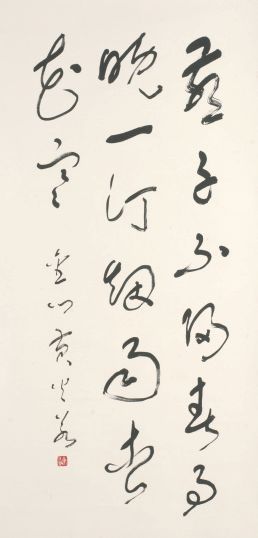
Out of the calligraphers who came to settle in Singapore after 1945, four were especially influential.
- Tan Keng Cheow (1907–1972), a native of Chao’an, Guangdong, graduated from Jinan University in Shanghai. He studied under Ye Gongchuo (1881–1968) and was known for his seal carving, calligraphy, and painting. In 1949, Tan moved to Singapore to become principal of Tuan Mong High School, subsequently teaching at Chung Cheng High School (Main). During his tenure at both schools, he actively promoted calligraphy and nurtured a pool of students who excelled in leaf calligraphy script. Both Tan Siah Kwee, president of the Chinese Calligraphy Society of Singapore, and Khoo Seng Kong, president of the Shicheng Calligraphy and Seal-Carving Society, were his students. Tan’s nephew, Wang Sizong, who used to run Tsing’s Book & Art at Bras Basah Complex, was deeply influenced by his style of calligraphy.
- Chang San Sheh (1898–1969), a native of Jiaxing, Zhejiang, studied calligraphy under Li Ruiqing (1867–1920) and specialised in semi-cursive, cursive, seal, and clerical scripts. In 1949, he was invited to Singapore to hold a solo calligraphy exhibition. He later taught at Chung Cheng High School (Main) and the Department of Chinese Language at Nanyang University. Many calligraphy enthusiasts from Chung Cheng High School were deeply influenced by his work.
- Chen Jen Hao (1908–1976), a native of Fuzhou, Fujian, furthered his studies in France after graduating from the Shanghai Academy of Fine Arts in 1932. He was known for his semi-cursive script, ink painting, and oil painting. He moved to Singapore in 1956 and became the principal of Dunman High School, where he actively promoted calligraphy. Cultural Medallion recipient Koh Mun Hong was one of his students.
- Tsue Ta Tee (1903–1974), a native of Beijing, was skilled in regular, cursive, seal, and clerical scripts, especially oracle bone inscriptions. In 1946, he held a calligraphy exhibition in Singapore, and later became a calligraphy teacher at Hua Yi Secondary School after moving to Singapore from Penang in 1965. Local calligraphers Wang Yuanren, Goh Yau Kee, and Yong Cheong Thye were among his students.
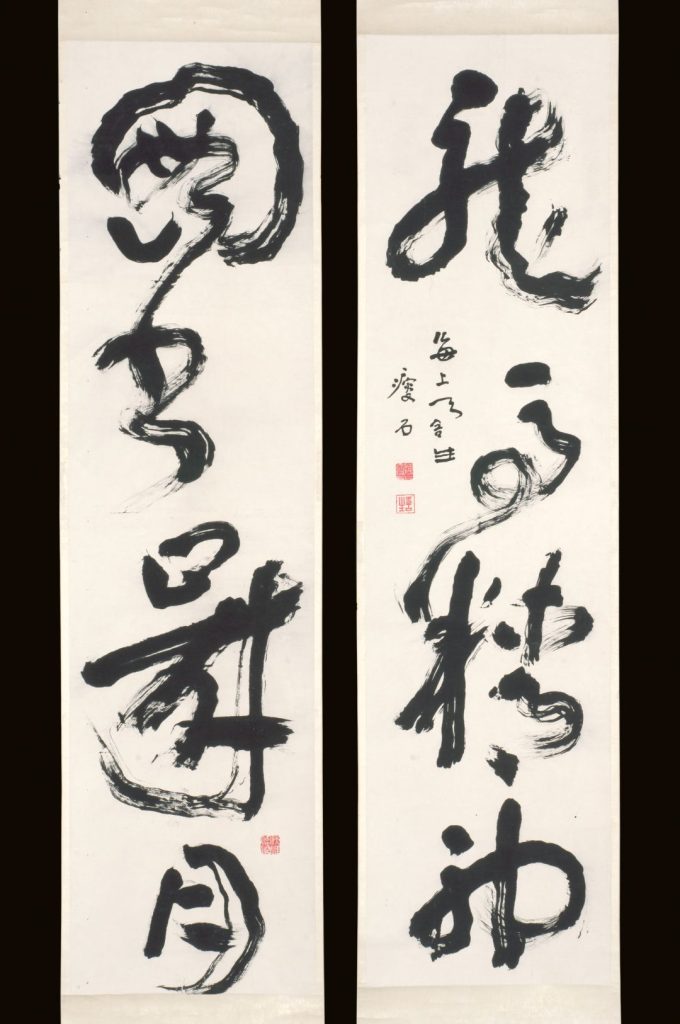

Other calligraphers who came to Singapore after the war also included:
- Huang Xuwu (1906–1980), a native of Chenghai, Guangdong, graduated from the National Central University in Taiwan and was known for his poetry and cursive script. After he came to Singapore in 1948, he taught at Catholic High School, the Teachers’ Training College, and the Department of Chinese Language at Nanyang University. Local academic and calligrapher Ler Chin Tuan was one of his leading disciples.
- Yan Lu (1907–1982), a native of Jinjiang, Fujian, graduated from the Faculty of Arts at the Shanghai University of Arts and was known for his semi-cursive script. After he came to Singapore in 1948, he worked as head of the resource centre at Nanyang Siang Pau. He also undertook a series of education stints, having taught at Chung Cheng High School and San Yu Adventist School, and served as an instructor for the Chinese Calligraphy Society of River Valley High School. His students included the well-known local calligrapher Khoo Seng Kong. Yan returned to China in 1981 and died the following year.
- Wang Siu Pick (1904–1998), a native of Anxi, Fujian, was renowned for his finger calligraphy. He moved to Singapore with his parents at a young age, later returning to Xiamen to study at Xiamen University. In 1954, he returned to Singapore from Xiamen and taught at Nanyang Girls’ High School. He was awarded the Cultural Medallion in 1992.
From the late 1990s to early 2000s, a second wave of calligraphers from China joined the local calligraphy circle, revitalising Singapore’s calligraphy scene in the 21st century.
This is an edited and translated version of 新加坡百年书法家概览(1900年至2000年). Click here to read original piece.
Khoo, Seng Kong. “Jianshu xinjiapo de shufa wenhua” [The calligraphy culture in Singapore]. Peking University Cultural Calligraphy website, Institute of Calligraphy Art, Peking University, 5 April 2024. | |
Nanyang Calligraphy Centre. “Xinjiapo shufa chuanbo de gengyunzhe” [Cultivators of calligraphy dissemination in Singapore]. Singapore Calligraphy People website, 11 August 2019. | |
Tan, Puay Hock compiled, “A List of Singapore’s Chinese calligraphers (1900–2000)”, 2024. | |
Xie, Guanghui and Chen, Yupei. Xinjiapo malaixiya huawen shufa bainianshi [100 years of Chinese calligraphy in Singapore and Malaysia]. Guangzhou: Jinan University Press, 2013. |