Pioneer artist: Georgette Chen


Among Singapore pioneer women artists, Georgette Chen (1906–1993) is perhaps the best known — for her works in oil as well as contributions she made to art education, especially her years teaching at the Nanyang Academy of Fine Arts (NAFA).
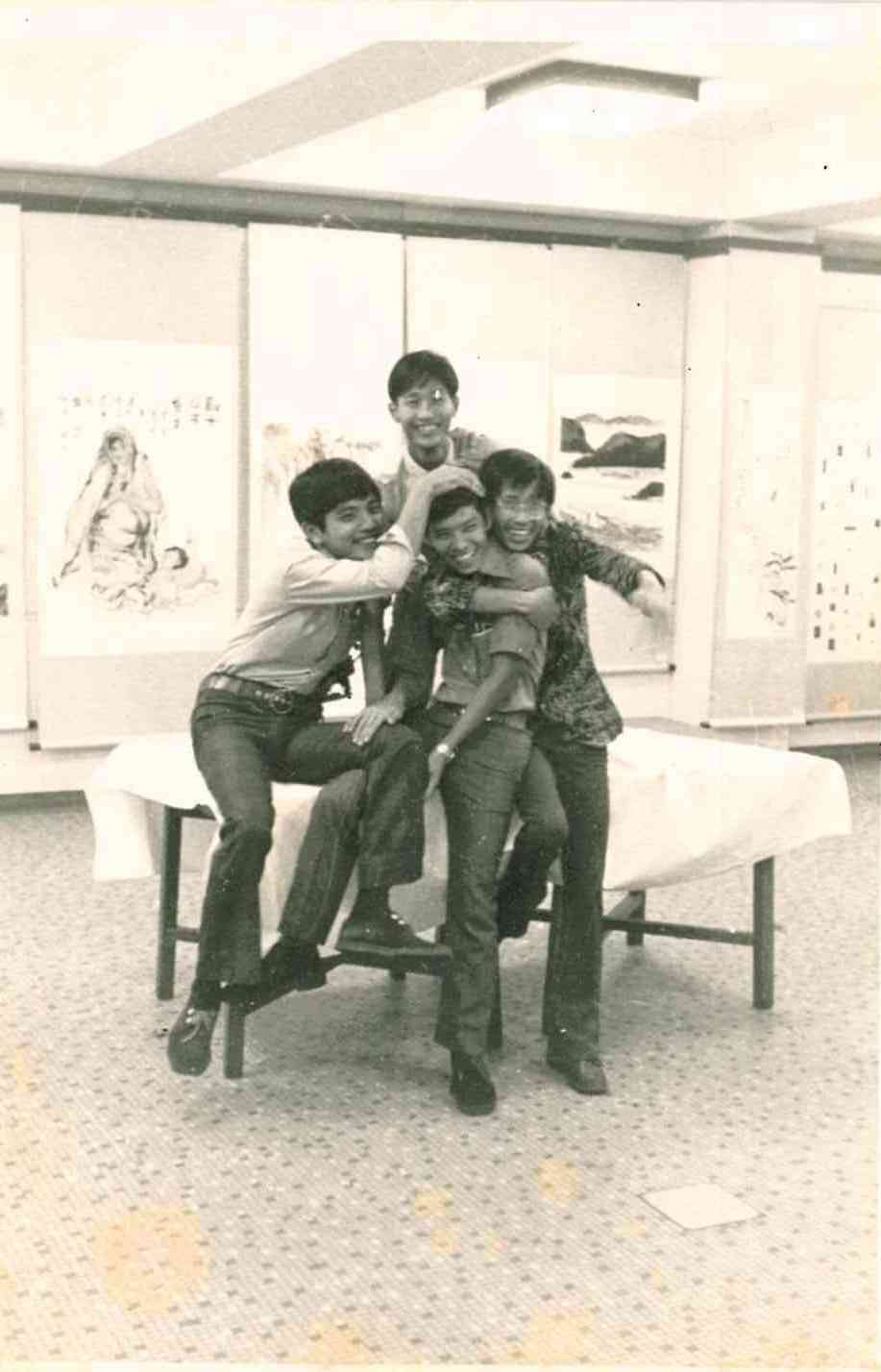
A long-time NAFA lecturer of 26 years between 1954 and 1980, she was one of its only two women teachers in the early years of the school founded by Chinese émigré artist Lim Hak Tai (1893–1963) in 1938. The other female teacher, her contemporary, was Lai Foong Moi (1931–1994).

Chen, also known by her Chinese name, Zhang Liying, was the first woman artist awarded the Cultural Medallion for artistic excellence by the Singapore government in 1982. Chen passed away in 1993, aged 87, after suffering from chronic rheumatoid arthritis for over a decade.
As of 2024, Chen remained one of only four women artists to have won the Cultural Medallion, Singapore’s highest accolade for the arts, since its inception in 1979. The others were Han Sai Por (1995), Chng Seok Tin (2005), and Amanda Heng (2010).
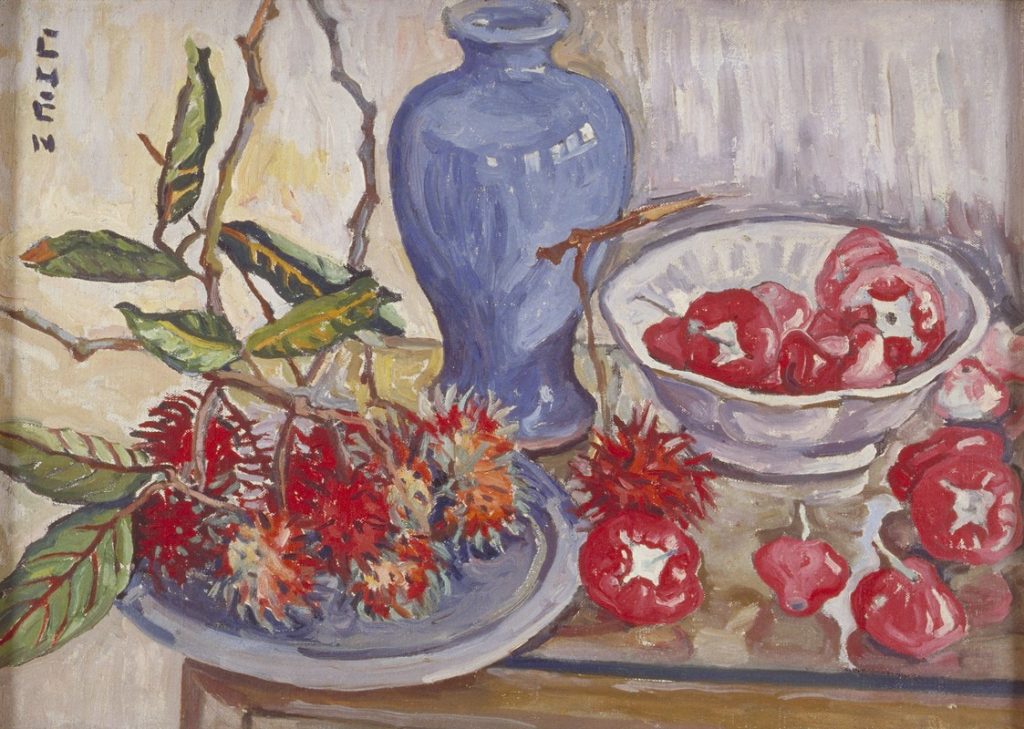
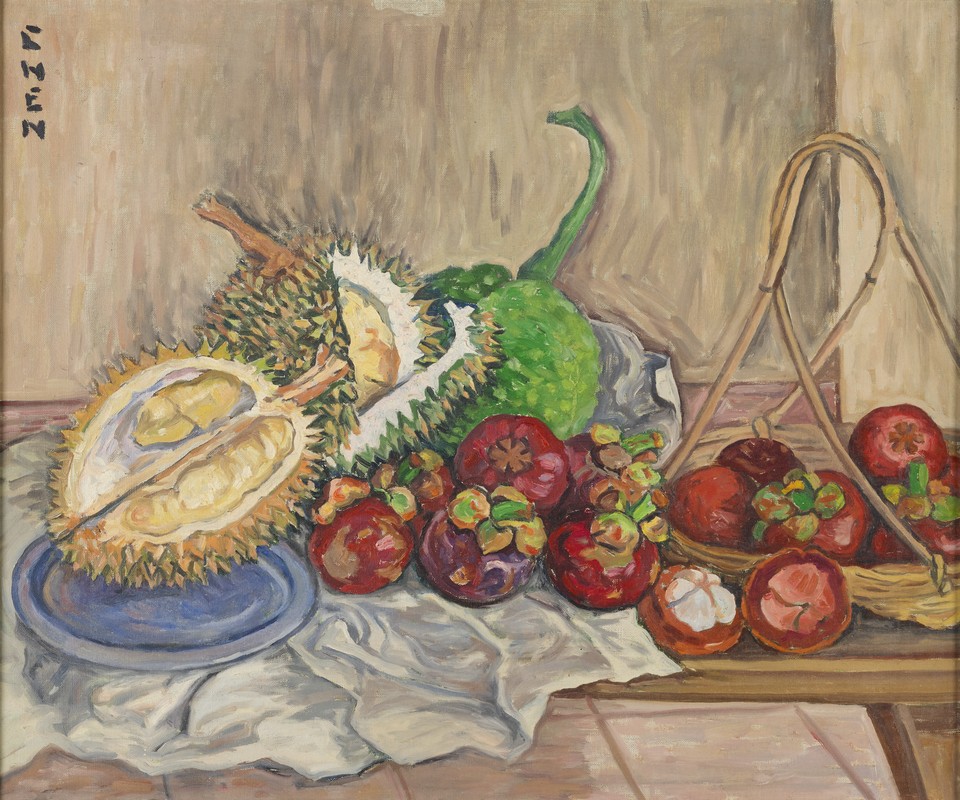
Chen stood out among the handful of top Singapore women artists not only because of her outstanding works in oil, for using post-Impressionist techniques on still lifes of tropical fruits and flowers, landscapes and portraits in Nanyang painting style, but also her colourful life in China, France, the United States and Malaya before settling in Singapore.
She was already an established painter at 47, twice married and a divorcee, when she came to Singapore to teach in 1953. She read and wrote in at least four languages — Chinese, English, French, and Malay.
A well-travelled cosmopolitan with an impressive portfolio — having staged solo exhibitions in Paris, New York and Shanghai — she became a celebrity artist of sorts, and the talk of the town in Singapore art circles.
Early years
Chen was born in 1906 in Zhejiang province, China. The daughter of a wealthy businessman dealing in art and antiques with offices in Europe and the US, she lived a privileged life with frequent travels and opportunities to study in some of the best schools overseas and in China. She had four sisters.
When her family relocated to Paris in 1914, and New York a few years later, she attended the Horace Mann School, and the Art Students’ League of New York, among others. She also later received art training at the Academie Colarossi and Academie Biloul in Paris.
Chen’s father Zhang Jingjiang (Chang Sen Chek, 1877–1950) was a friend and supporter of Sun Yat-sen (1866–1925), who led the 1911 Revolution ending Qing dynasty rule to form the new Chinese republic.
It was Sun’s wife, Soong Ching-ling (1893–1981) who introduced Chen to one her husband’s ablest lieutenants Eugene Chen (1875–1944), a Trinidad-born Chinese lawyer-turned newspaper editor who later acted briefly as China’s foreign minister.
When they met in Paris in 1927, Eugene was 52, and a widower with two sons and two daughters. His wife of African-French descent had died of cancer just two years earlier. Chen was then barely 21 years old.
In spite of the age gap, they got along well. And after a whirlwind romance, the couple was married in 1930 at the Chinese Consular Office in Paris.
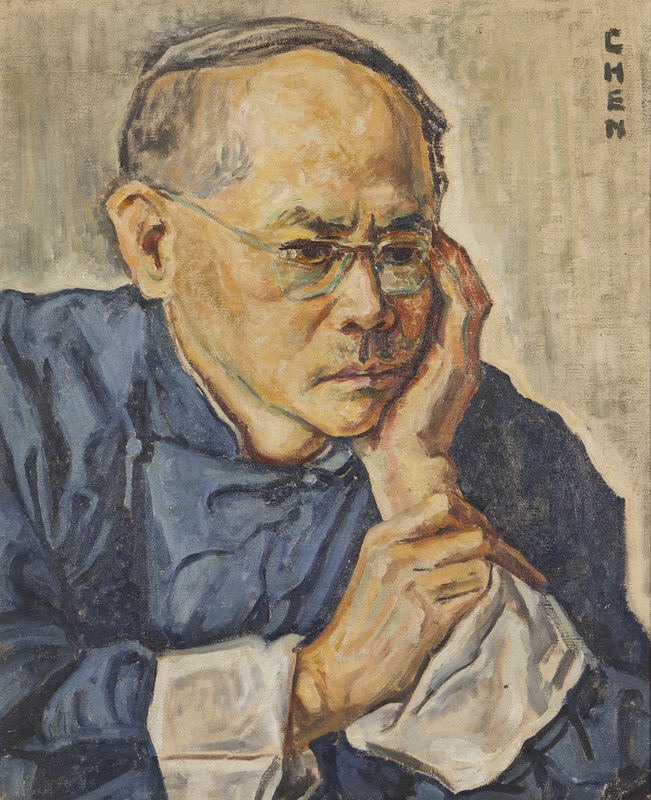
The 14-year marriage was a happy one and a significant period in Chen’s life. Her admiration for her husband can be seen from the many portraits she painted of him, such as Portrait of Eugene Chen in oil completed in 1944, the year he died unexpectedly from tuberculosis while under arrest by the Japanese in Shanghai, aged 69.
Chen’s life changed as she could not get away from war and politics with a politician husband during the turbulent 1930s and early 1940s. When Hong Kong fell in December 1941, both Chen and her husband were placed under house arrest in the then British colony. The Japanese later transferred them to the French Concession in Shanghai, where Chen lived till the war ended in 1945.
In 1947, three years after Eugene’s death, Chen held a solo exhibition in Shanghai featuring some 77 of her works done in Hong Kong, Beijing Shanghai, Suzhou and Hangzhou. After the show, she left for New York to marry Eugene’s former aide, Ho Yung Chi (1902–1979), a law-trained historian. She and Ho divorced six years later in 1953.
Singapore years
Single again, Chen left for Singapore the same year to spend the next 40 years as a teacher and a Singapore artist till she died in 1993.
She was immediately introduced to NAFA founder Lim Hak Tai and other prominent Singapore artists at a welcome reception hosted by the Society of Chinese Artists. Later in September 1953, she held her first solo exhibition at the Singapore Chinese Chamber of Commerce sponsored by The China Society.
In 1959, Chen was appointed council member of the Singapore Art Society while busy teaching at NAFA and participating in exhibitions between the late 1950s and the end of the 1970s. She held solo exhibitions across the Causeway in Kuala Lumpur too. One notable one was Oil Paintings – Ceramics by Georgette Chen in 1956 which was opened by her friend, Tunku Abdul Rahman (1903–1990), who was then prime minister of Malaya. He later commissioned Chen to do three paintings, including a portrait. Chen and her late husband Eugene had met Tunku Abdul Rahman in 1931 on board a passenger liner when they were on their way to Shanghai via Malaya, and they became good friends.
In 1985, three years after she received the Cultural Medallion, the Ministry of Community Development and the National Museum staged the Georgette Chen Retrospective 1985 exhibition at the National Museum Art Gallery, featuring some 172 of her works, mostly in oil, many also in charcoal, pastel and pencil, and an unsigned and undated piece, Self Portrait (27 x 27 cm), in watercolour.
A second and posthumous solo exhibition, Georgette Chen, featuring 112 of her works, was held at the Singapore Art Museum in June 1997, four years after she had died and three years after her estate donated 53 works to what was then known as the National Museum Singapore. A subsequent donation of 27 works from the Lee Foundation was also made to the museum.
Chen’s legacy and her contributions to Singapore art for almost half a century inspired writer Ng Yi-Sheng to write Georgette: The Musical, which was staged at the Singapore Arts Festival 2007. The pioneer artist’s life also led comic artist Sonny Liew to write and draw the 48-page graphic novel, Warm Nights, Deathless Days, for young people, in 2014.
The following year, a three-part docudrama, The Worlds of Georgette Chen, commissioned by the National Gallery Singapore and produced by Channel NewsAsia, was televised in English and Chinese, starring Singaporean actress Rui En as the pioneer artist. It coincided with the opening of the permanent DBS Gallery at the National Gallery Singapore which displays Chen’s works.
In 2020, National Gallery Singapore honoured her with the year-long exhibition, Georgette Chen: At Home in the World, featuring 69 of her best paintings. A 214-page coffee-table book on her life and works was also launched.
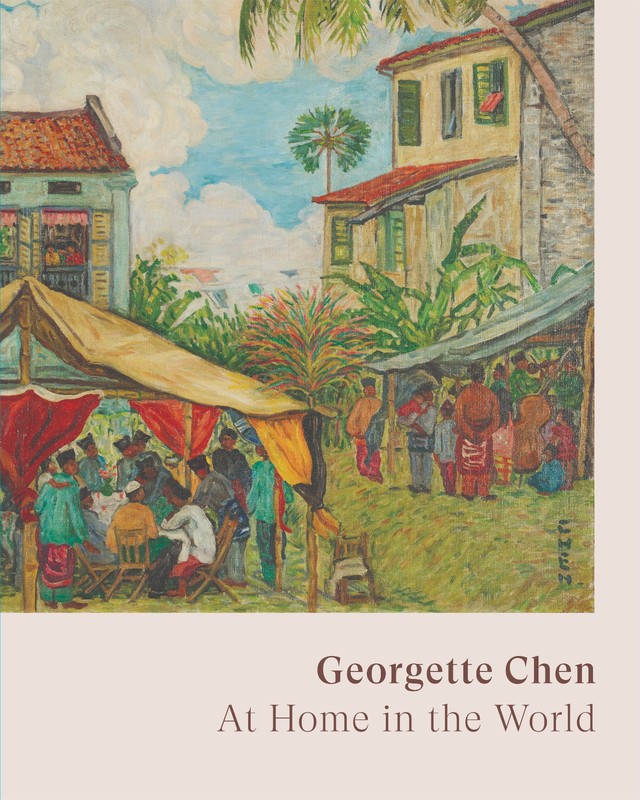
Cai, Heng, Lim, Shujuan, Teo, Hui Min et al. Georgette Chen: At Home in the World. Singapore: National Gallery Singapore, 2021. | |
Chen, Wenting and Yao, Qian. “The Extraordinary Life of Georgette Chen.” Nanyang Arts, Issue 5, 2007, 17–32. | |
Chia, Jane. Georgette Chen. Singapore: Singapore Art Museum, 1997. | |
Georgette Chen Retrospective 1985. Singapore: National Museum of Singapore, 1985. | |
Liew, Sonny. Warm Nights, Deathless Days. Singapore: National Gallery Singapore, 2014. |