Song and dance troupes and the entertainment industry in early Singapore


Song and dance troupes, active in Singapore between the 1920s and 1960s, were performance groups that combined singing with dance. Unlike the Chinese opera troupes that travelled south from China in the early years to put on traditional operas, song and dance troupes sought to attract audiences with their modern, westernised and trendy styles. Their performances predominantly featured female singers and dancers, while men handled the musical accompaniment and administrative tasks. Their repertoire also included comedic sketches and new plays, and many troupe members sported bob hairstyles modelled after the “flapper girl” look popularised by Hollywood films, flaunting their identity as modern women.
In 1927, Li Jinhui (1891–1967) founded a song and dance school in Shanghai which later evolved into touring troupes and singing societies. In his memoirs, Li referred to these groups collectively as Bright Moon Society (also known as Bright Moon Song and Dance Troupe). This was China’s earliest professional song and dance troupe. In 1928, Li came to Singapore with his troupe, performing several songs and the dance drama Chuntian de kuaile (Joy of Spring) at the Victoria Theatre. Advertisements prominently featured Li’s daughter, Li Minghui. According to the memoirs of troupe member Wang Renmei (1914–1987), Singapore was the final leg of the Bright Moon Song and Dance Troupe’s tour. Due to poor management, the troupe did not have funds to return to China as scheduled.1 Li Jinhui then complied with a publisher’s request to compose a series of pop songs and send them back to Shanghai in exchange for funds. These songs, including Peach Blossom River and The Express Train, swept the music scene and catapulted Li to overnight fame. His troupe nurtured many talented female performers, many of whom were swiftly scouted and went on to join Shanghai’s film industry. This showed that song and dance troupes provided a platform for training and nurturing stars, and more groups began performing in Singapore.2
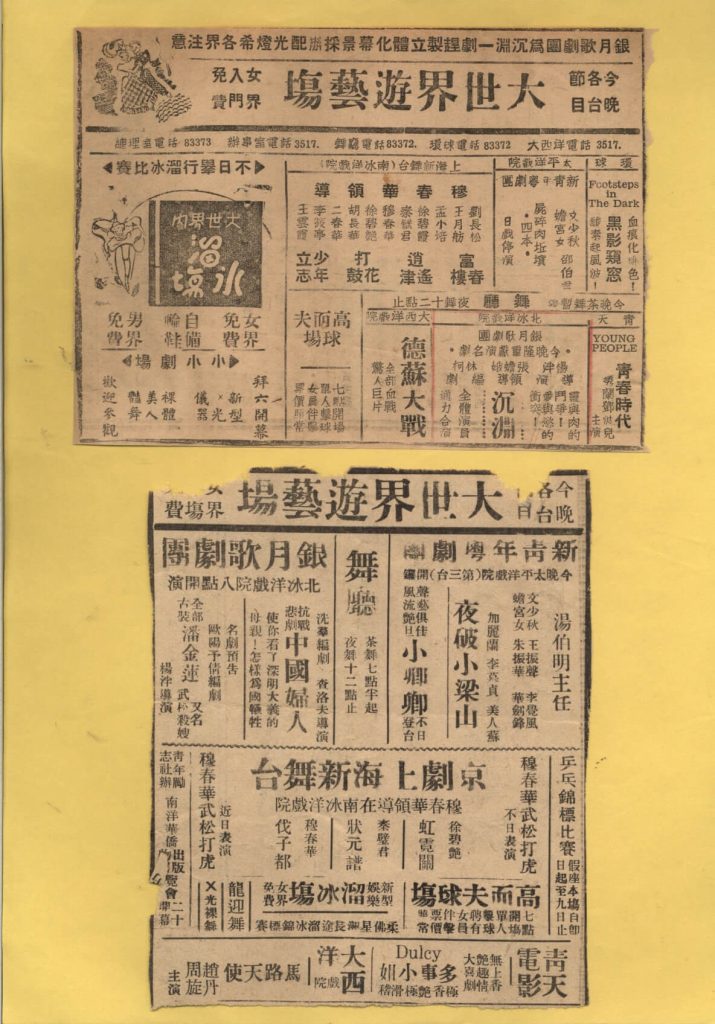
One example was the Plum Blossom Song and Dance Troupe led by Wei Yingbo (birth and death years unknown), which arrived in 1933. Encouraged by the positive response, troupe member Cai Wenjin (1905–1975) later returned to Shanghai to establish the Bai Xue Song and Dance Troupe. Its members included Lu Ding, Zang Chunfeng (unknown–1951), Xu Xinmin and Xiong Li Li.3 In 1935, the Wan Hua Song and Dance Troupe, founded by Shanghai businessman Liu Daliang (birth and death years unknown), performed to a full house in its first show at Tivoli Hall on North Bridge Road.4 The Silver Moon Song and Dance Troupe, led by Zhang Chan’e (unknown–1945), performed in Singapore and Malaya in 1938. Boasting members such as Meng Lijun, Ma Jun (unknown–1986), Zhu Jun and Bai Yan (1920–2019), the troupe also staged the patriotic musical On the Eve of the Great Battle in support of the anti-Japanese movement.5 Many other song and dance troupes subsequently incorporated singing, dancing, musicals and plays into their performances.
Rise of song and dance troupes
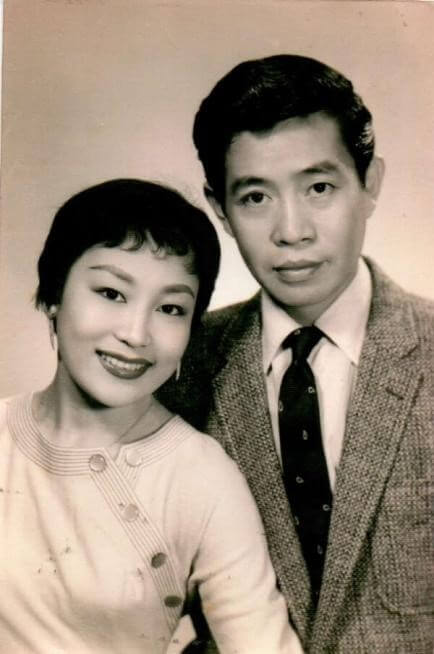
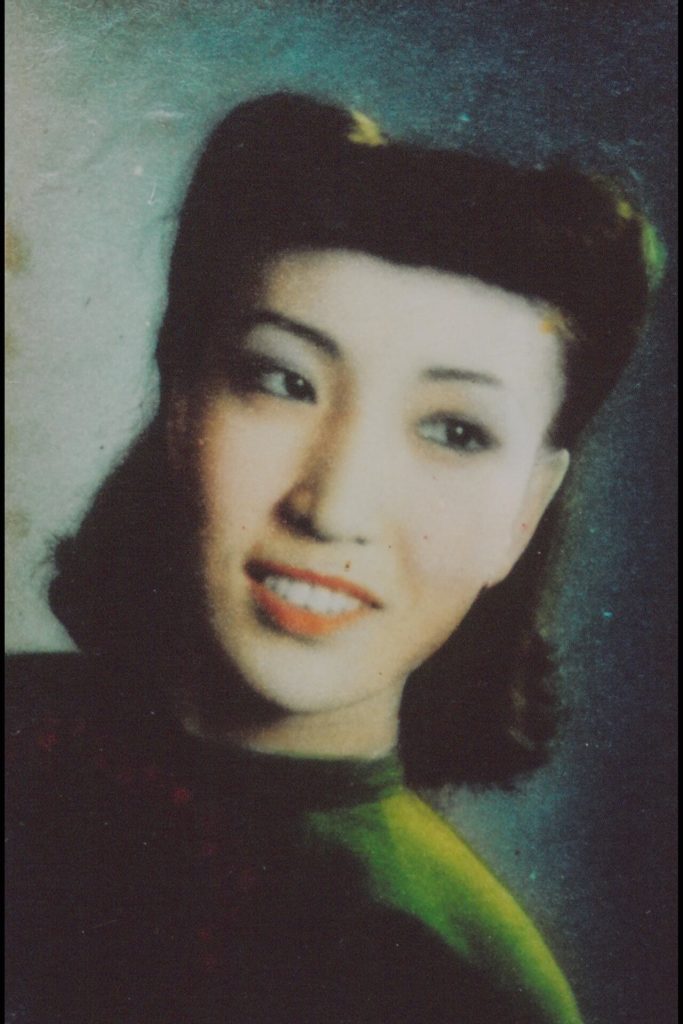
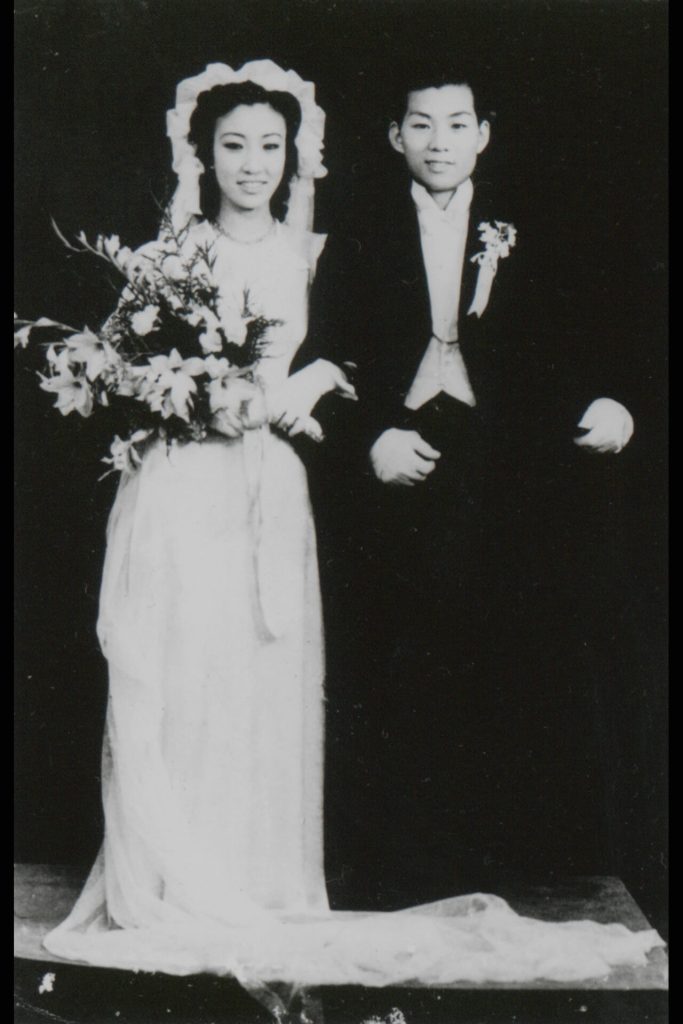
In an oral interview, actor Bai Yan (whose real name was Yein Pah Yuen) said the Silver Moon Song and Dance Troupe, of which he was a member, had signed a contract with film empire Shaw Brothers to raise its profile. At that time, troupe members enjoyed a steady income and had the opportunity to perform in various locations, such as Penang and Ipoh. Back then, the literati also enjoyed performances by song and dance troupes and getai. Prominent Hong Kong writer Lau Yee-cheung (1918–2018), who was invited to serve as editor of the supplement of Yi Shih Pao (Social Welfare) in Singapore, was said to have first met his future wife Lo Pai Wan while she was here in 1953 with a song and dance troupe. The troupe was performing at Happy World Amusement Park for several days then, including a dance drama called Love at the Pasar, which depicted life in Nanyang.6 In 1956, Lo led a newly formed Swan Song and Dance Theatre Troupe on a tour in Singapore and Malaya. Lau pursued her ardently, and they married in 1957.7
The 1950s saw a boom in song and dance troupes and getai shows in Singapore and Malaya, along with a shift from dance dramas and plays to more singing and dancing. For instance, getai star Chng Soot Fong founded her own touring choir at the age of 21 before venturing into the film industry with a cameo in The Lady of Mystery starring Li Hsiang-lan (1920–2014). Chng later rose to fame when she starred in the 1958 Amoy-dialect film Wandering Songstress directed by Wong Tin-lam (1927–2010). Chang Lye Lye also established her own choir, which collaborated with the Feng Feng Song and Dance Troupe in 1951. Together, they performed to a packed house night after night at New World Amusement Park. Members of the Feng Feng Song and Dance Troupe included Lei Zirong and Landi Chang (1941–1991), with the latter being the star of the Shen Chang Fu Circus. The “Queen of Striptease”, Rose Chan Wai Chang (1925–1987), also formed the Rose Chan Revue in 1953.8 Other popular troupes in Singapore at the time included the Hua Yi Song and Dance Drama Troupe formed by Lu Ding, the Da Zhong Opera Troupe headed by Dou Jinhuai (birth and death years unknown), the Hai Yan Opera Troupe led by Wang Jintong (birth and death years unknown) and the Golden Star Performance Troupe headed by Bai Yan.
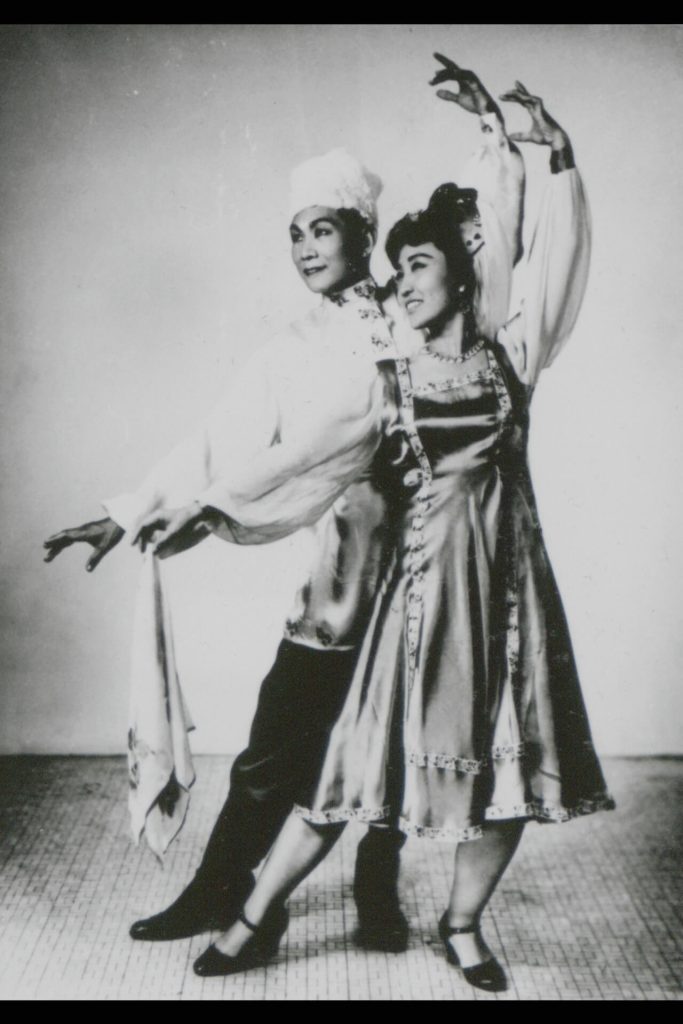
Apart from amusement parks, Han Toh Yee (1922–2013), a member of the Nanxing Song and Dance Troupe, recalled that the troupe also performed at the air-conditioned Cathay Cinema in 1949.9 Some troupes chose to feature more sensual dances. For instance, Lo Pai Wan’s troupe performed leg lifts inspired by American Broadway dance, and Rose Chan introduced the “Bath of the Concubine” act. Such performances caused many to view song and dance troupes in a negative light. But most troupes in the post-war era touted a relatively serious repertoire. For instance, Xu Lianmei of the Feng Feng Song and Dance Troupe created the “silver goddess dance”, and the New Life Revue was renowned for its folk myth-inspired musical, The Cowherd and the Weaver Girl. Following the closure of Golden Star Performance Troupe, Bai Yan and his wife, Ye Qing (1922–2016), ran folk dance classes to nurture local dance talent.10
From stage to screen
The first Chinese-language film produced in Singapore after World War II, Blood and Tears of the Overseas Chinese (1946), was financed and directed by Cai Wenjin, leader of the Bai Xue Song and Dance Troupe. Having led a touring troupe that regularly travelled to Southeast Asia, Cai was familiar with Singapore and Malaya before the war. Following the release of the film, Cai went on to produce Spirit of Overseas Chinese (1946) and Honour and Sin (1947), also known as Miss Nanyang. The Shaw Brothers, which had operated cinemas and amusement parks before the war, also swiftly released Song of Singapore, Second Motherland and Hard Times after the war. All three films were directed by Wu Cun (1904–1971) and featured members of song and dance troupes that had performed in Singapore, including Ma Jun and Ye Qing. In 1946, singer Yang Pei Yun invited Tan Mui Kwang (1933–2020), Xiong Li Li, Chng Soot Fong, Lynn Lee and Wu Mei Ling to sing at Ciro’s Café, which she had bought over. They performed with former song and dance troupe members Bai Yan, Zang Chunfeng and Kwan Sin Ngee (real name Ong Joo Hong, 1927–1996). Yang, Kwan and Chng later went to Hong Kong and established themselves as stars of Amoy-dialect films.
Singapore’s renowned comedic duo Wang Sha (1925–1998) and Ye Feng (1932–1995) also transitioned from song and dance troupes and getai performances to the movie industry in the 1970s. They starred in four films of the Crazy Bumpkins series produced by Shaw Brothers.11 The duo went on to shoot a number of films in Hong Kong and recorded many dialect comedy albums, which were reportedly so popular that record companies rushed to restock them before they had even been packaged.12 This demonstrated the close relationship between song and dance troupes and the film industry. Members of these song and dance troupes and getai were not only multi-talented, but also key players in Singapore’s entertainment history.
This is an edited and translated version of 歌舞团与早年新加坡的娱乐事业. Click here to read original piece.
| 1 | See “Diyige nanlai biaoyan de zhongguo gewutuan” [The first Chinese song and dance troupe to perform in Singapore], Shin Min Daily News, 14 February 1987, 10. |
| 2 | For Li Jinhui’s career, see Andrew F. Jones, Yellow Music: Media Culture and Colonial Modernity in the Chinese Jazz Age (New York: Duke University Press, 2001), 73–104. |
| 3 | Birth and death years of some members are unknown. |
| 4 | See “Wanhua gewutuan zuowan daxianshenshou, qingge manwu yuyin raoliang, zuihan chunmeng meinü ruyun” [The Wan Hua Song and Dance Troupe dazzled the crowd last evening with graceful songs, enchanting dances and beautiful women], Nanyang Siang Pau, 6 March 1935. |
| 5 | See “Yinyue gewutuan, jinwan zai huanggong gongyan ‘dazhan zhi qianye’” [The Silver Moon Song and Dance Troupe presents The Night before the War at the Queen’s Theatre tonight], Nanyang Siang Pau, 5 October 1938. Birth and death years of some members are unknown. |
| 6 | See “Xianggang gewutuan jinwan tuichu dawuju ‘yutui lingkong’” [The Hong Kong song and dance troupe performed a dance with leg lifts tonight], Nanyang Siang Pau, 6 November 1953. |
| 7 | The cover of Lau Yee-cheung’s three-cent novel, Yeshu xia zhi yu [Desire under the coconut tree], depicts a young lady in Peranakan costume. It was inspired by two studio portraits of Lo Pai Wan, taken during her performances in Singapore. For more on the love story between Lau and Lo, see Lim Fong Wei, “Chongyou xingzhou, zhuiyi huayang nianhua — Luo Peiyun huidao yu Liu Yichang de yuandian” [Back to where it all began — Lo Pai Wan revisits Singapore and retraces her love story with Lau Yee-cheung], Lianhe Zaobao, 8 June 2023. A three-cent novel, named for its low price, is a type of popular fiction that was published in Hong Kong during the 1950s. Due to their low price For more on Lau and the three-cent novels, see Teow Yong-long, “Liu Yichang de sanhaozi xiaoshuo yu zai chuangzuo” [Lau Yee-cheung’s three-cent novels and re-creation], in Nanyang shuhua: Xianggang, Nanyang, Minguo jiu shukan jishu [Nanyang book talk: records of old books and periodicals from Hong Kong, Nanyang and Republican China] (Taipei: Monsoon Books Ltd, 2023), 33–41. |
| 8 | For the biography of Rose Chan Wai Chang, see Cecil Rajendra, No Bed of Roses: The Rose Chan Story (Penang: Clarity Publishing Sdn. Bhd., 2023). |
| 9 | Han Toh Yee recalled that there were two performances at the Cathay Cinema: one from 6.45pm to 9pm, and another from 9.15pm to 11.30pm. Tickets cost 60 cents or one dollar. Seats on the upper floor were cheaper because they were further from the stage, whereas the more expensive seats were closer to the front and located in the lower rows. See Han Toh Yee, oral history interview by Loke Tai Tay, 22 March 2005, National Archives of Singapore (accession no. 002921), Reel/Disc 2–5. |
| 10 | See Lim Hong Jeok, “Yu wudao de yi duan yuan” [A fateful encounter with dance], Lianhe Zaobao, 12 August 1988; Ang Ming Hwa, “Jiandie qingshen 73 nian, Bai Yan qizi Ye Qing shishi” [A 73-year love story, Bai Yan’s wife, Ye Qing, passes away], Lianhe Zaobao, 17 June 2016. |
| 11 | According to independent researcher Su Zhangkai, director John Law initially conceived the role of Ah Niu for Ye Feng alone. However, Seong Koon Low Won (1922–2002) recommended adding the character of Uncle Chou, for which Wang Sha was invited to perform. After World War II, demand for songs in song and dance troupes, getai performances and film soundtracks spurred musicians in Singapore and Malaya to start composing. Seong Koon Low Won from Selangor, Malaysia, was the most renowned among them. Between the 1940s and 1970s, he composed over 300 songs, including The Midnight Kiss and New Malay Love Song. In 1952, he joined the Eng Yean Opera Troupe for its production of The Romance of the West Chamber. He later joined the Xin Man Jiang Hong Troupe, performing alongside Chng Soot Fong. A man of many talents, he was not only adept at composing lyrics and music, but also excelled in playwriting, directing, hosting and acting. See Seong Koon Low Won, Wuye xiangwen: shangguan liuyun huaiganlu [The midnight kiss: Seong Koon Low Won’s life story] (Singapore: Lingzi Mass Media, 1996). |
| 12 | See “Zaobao yuedu@NLB jiangzuo: Wangsha yefeng fu zhengnengliang rensheng gushi” [ZB Happy Read@NLB talk: the inspiring story of Wang Sha and Ye Feng], Lianhe Zaobao, 25 November 2019. |
Bai Yan. Cong gewutuan tan dao malaiya juyun [From song and dance troupes to the development of theatre in Malaya], news clippings 1951–1987. Bai Yan Collection, from NUS Libraries Digital Gems. | |
Chew, Wee Kai. “Nanfeiyan — bentu getai wenhua de lanshang” [The origins of local getai culture]. Lianhe Zaobao, 23 December 2019. | |
Wong, Chin Soon. Xinjiapo getai shihua [The history of getai in Singapore]. Singapore: The Youth Book Co., 2006. | |
Bai Yan, oral history interview by Tan Beng Luan and Lye Soo Choon, 21 June 1985, National Archives of Singapore (accession no. 000578), Reel/Disc 1–24. |