Crosstalk in Singapore


Crosstalk is an important Chinese performing art that originated in northern China. It first gained popularity in the working-class neighbourhoods of Beijing and Tianjin, and was often performed at temple festivities or in the residences of wealthy families and government officials. By the late Qing dynasty, crosstalk had flourished and by the Republican era, it had accumulated more than 300 classic routines, with over 100 performers in the trade.
By comparison, Singapore’s crosstalk lacked a natural cultural environment in which it could flourish. In the early years, individual routines were performed only in between shows at amusement parks and getai (literally “song stage”). As they were mostly delivered in the Beijing dialect, they hardly attracted the attention of local people. The public often simplistically viewed crosstalk as merely humorous dialogue between two people, or even mistakenly assumed that any casual banter between two individuals could be considered crosstalk. As a result, there was limited understanding of the professionalism and uniqueness of this art form.
Crosstalk pioneers (1950s to late 1960s)
In the 1950s, arts groups from China, such as Wuhan Songsters and some of the accompanying artistes, performed at major amusement parks in Singapore. Some of the performers, including Bai Yan (1920–2019), Lu Ding (birth and death years unknown), and Feng Xiang (birth and death years unknown), presented traditional performances that featured crosstalk and Shanghai farce, enriching the cultural life of local audiences at that time.
Meanwhile, local radio station Rediffusion aired a monthly variety show Huada baoli lianhuan wanhui, which included crosstalk segments. Active performers included Tan Poh Han, Lin Gang, Kuo Pao Kun (1939–2002), Zeng Pengxiang (1941–2006), and He Qizai (birth and death years unknown). The stable long-term performance platform allowed them to accumulate a wealth of adapted works. Some of Tan Poh Han’s adaptations also incorporated elements of local life and had a distinct Singaporean flavour.
Promoting crosstalk (1970s)
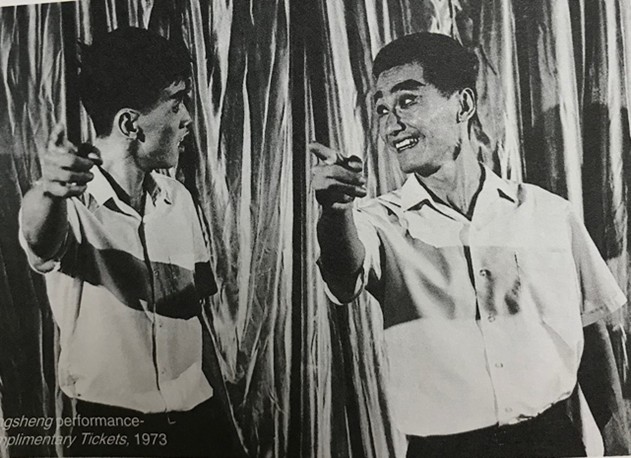
In 1973, Singapore’s Selatan Arts Ensemble staged an “Arts Night”, performing five shows at the Victoria Theatre and seven at the National Theatre. Among these shows was The Gift Ticket, written by Han Lao Da was considered the first locally produced crosstalk performance to be staged on a major theater stage. The piece later spread to towns and cities across Malaysia.
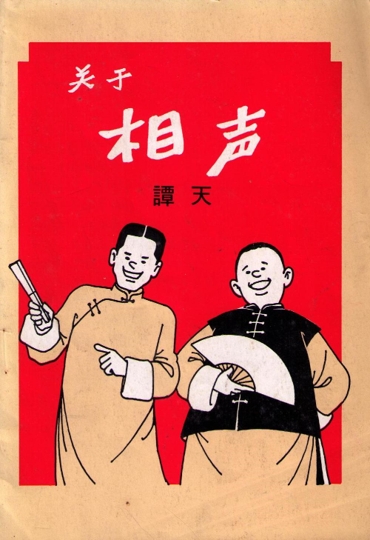
In 1979, Han Lao Da published Guanyu xiangsheng (On Crosstalk) under the pen name Tan Tian, which helped popularise knowledge of the art form and promote the creation of local crosstalk routines.
Taking off (1980s)
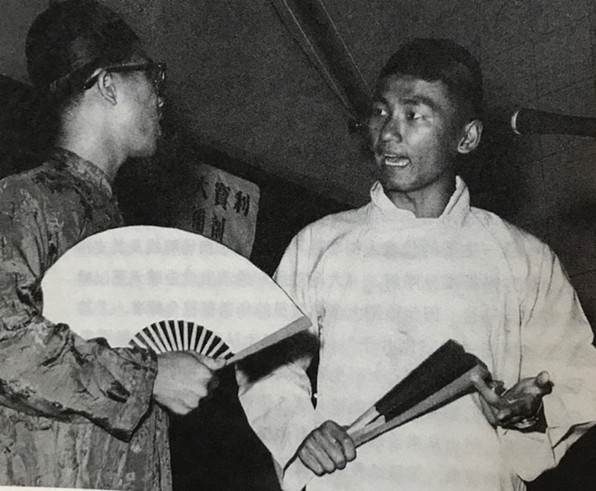
In 1985, Rediffusion jointly organised a national crosstalk competition with Lianhe Zaobao and Lianhe Wanbao. Chinese crosstalkers Jiang Kun and Tang Jiezhong (1932–2017), as well as playwright Wu Zuguang (1917–2003) and his wife, Ping opera actress Xin Fengxia (1927–1998), were invited as judges, allowing local audiences to witness the professional standards of Chinese crosstalkers.
1986 could be said to be the “Year of Crosstalk”, with many performances staged. From January to March, the Xiangsheng duanju wanhui (Evening of crosstalk and short plays), a collaboration between the Practice Performing Arts School and the People’s Association, toured 14 community centres. Subsequently, the Singapore Broadcasting Corporation co-hosted the sold-out event with several arts groups for three consecutive years. Meanwhile, the Practice Performing Arts School staged several shows of Talkers & Singers, while National Junior College launched the All Secondary School Xiang Sheng Competition, an event it continues to host to this day. The same year also saw the founding of Singapore’s first crosstalk group, the Sin Feng Xiang Sheng Society.
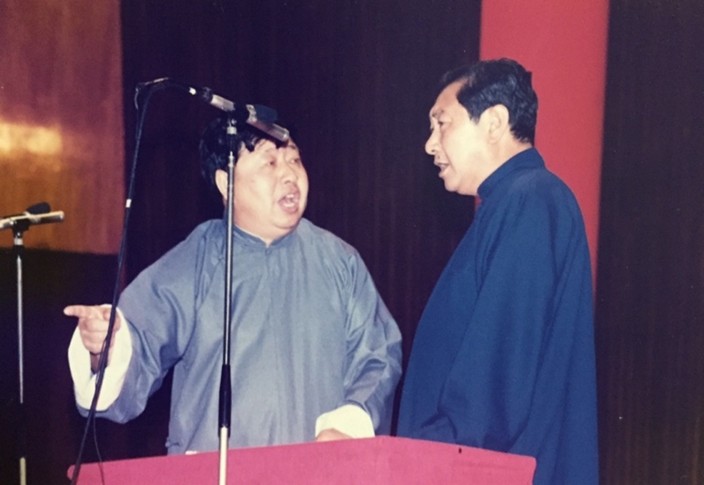
In 1987, Practice Performing Arts School presented Beijing xiangsheng (Beijing Crosstalk), which featured a series of high-quality classic crosstalk routines by the Beijing Traditional Folk Arts Troupe. In 1988, the China Broadcasting Performing Arts Troupe visited Singapore, with prominent artistes such as Jiang Kun, Tang Jiezhong, Feng Gong, and Liu Wei performing on the local stage.
In 1988, the Practice Theatre Ensemble’s Talkers & Singers brought together crosstalkers from China and Taiwan, which also served as an opportunity for them to interact overseas. The following year (1989), local television launched a 13-episode crosstalk series Smile a Little, Worry Less, led by renowned Chinese crosstalkers Ma Ji (1934–2006) and Zhao Yan. They were joined by guest performers from Singapore and Malaysia, with each episode featuring solo or duet crosstalk by Ma and Zhao. These high-calibre performances elevated the quality of crosstalk and audiences’ appreciation of the art form in Singapore and Malaysia. Some of the episodes even ranked among the station’s top 10 most-watched programmes at that time.
Refining and expanding crosstalk (post-1990s)
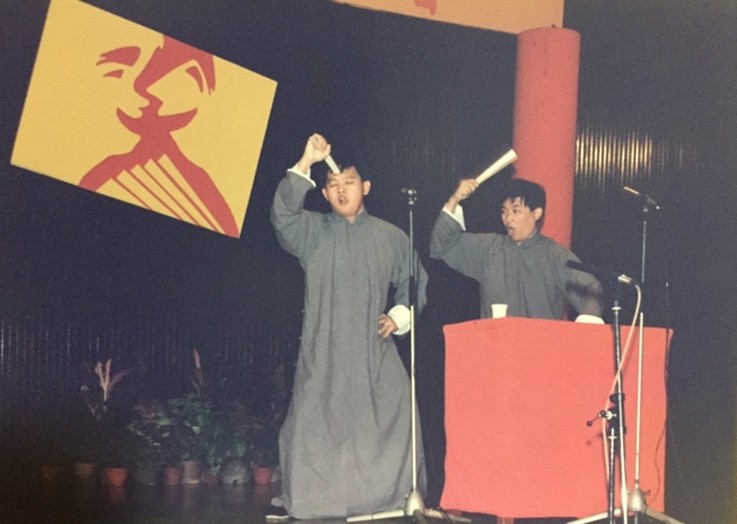
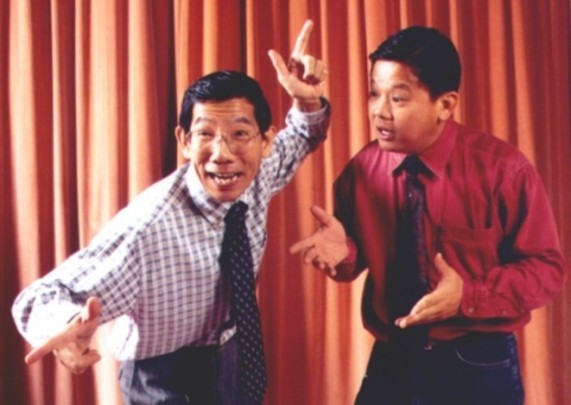
In 1990, the Sin Feng Xiang Sheng Society co-organised the large-scale National Crosstalk Competition with Telok Blangah Community Club and Radin Mas Community Club for the first time. Crosstalk groups and renowned performers from China were invited to perform and serve as judges alongside local artists. Local judges for the inaugural competition included Kuo Pao Kun, Chow Li Liang, and Tan Boh Han, while the overseas judges comprised Ma Ji, Zhao Shizhong, and Lian Chunming. The biennial competition continued until 2000, featuring distinguished overseas crosstalkers such as Tang Jiezhong, Li Lishan, Zhao Fuyu, Chang Baohua, Chang Guitian, Wang Peiyuan, Wang Qianxiang, Li Zengrui, Guo Zhijie, and Liu Zengkai. Each edition of the competition concluded with a performance by the top three winners and the overseas judges. For instance, the open category champions of the inaugural competition, Johnny Ng and Chen Tian Ci, then in their early 20s, performed the crosstalk piece Koutu lianhua (Spouting lotus flowers), while judges Ma Ji and Zhao Shizhong presented Da dengmi (Lantern Riddles), allowing local audiences to witness the profound skills of professional performers from Singapore and China.
The same year, Han Lao Da, Yong Ser Pin, and Johnny Ng were invited to Shanghai to participate in the International Crosstalk Exchange Performance. At this major Singapore–China crosstalk exchange, Yong Ser Bin and Johnny Ng performed Han Lao Da’s original local crosstalk A Chain of Love Stories, marking its debut on the Chinese crosstalk stage.
Crosstalk makes its way to schools
As mentioned earlier, the All Secondary School Xiang Sheng Competition organised by National Junior College has played a crucial role in popularising and promoting the art of crosstalk in Singapore. Launched in 1986 and held annually (it moved online during the pandemic), the competition continues to inspire students’ interest in crosstalk while cultivating a large audience base and nurturing new generations of performers.
Organised by the Children’s Stage of Arts Production, the National Primary School Cross-Talk Competition was launched in 2006 and held its 20th edition in 2025. Over the years, the competition has seen enthusiastic participation and received support from primary schools, further promoting the art of crosstalk in schools. In addition to adaptations of traditional routines, the competition also features a number of local works, such as Guoqi song (Ode to the National Flag), Xiongmao feng (Panda Mania), Xinjiapo yiri you (One-Day Tour of Singapore) and Manyou xinjiapo (Strolling through Singapore), showcasing local themes and creative vitality.
Local crosstalk groups
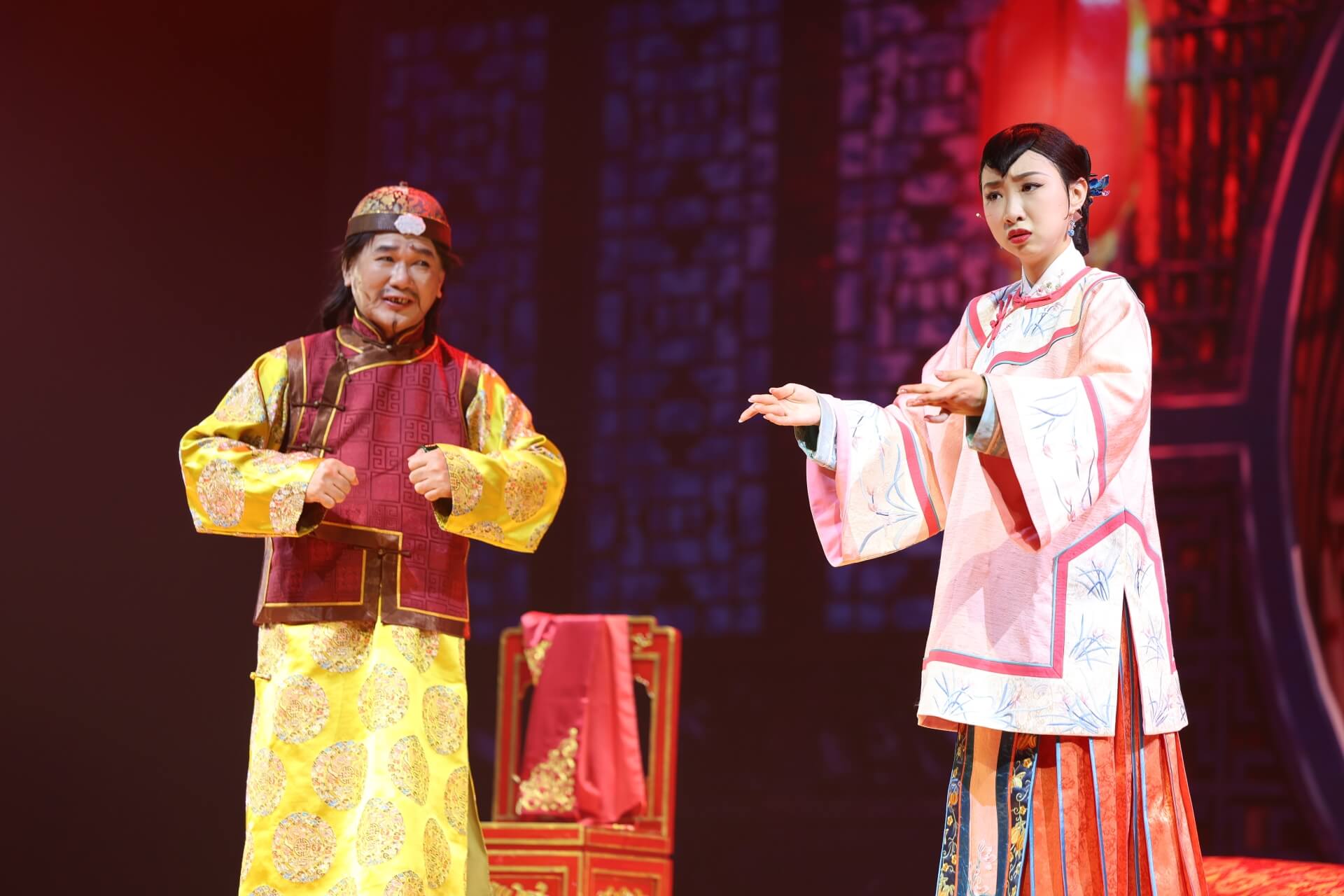
After more than half a century of development, the art of crosstalk has taken root in Singapore. The Sin Feng Xiang Sheng Society, Singapore’s oldest crosstalk group, has played a pivotal role in bringing in and promoting crosstalk, as well as producing local crosstalk. Since 1990, it has organised Xiao de yuehui (A Date with Laughter) to promote the creation of locally themed works. In 1994, it presented Chuandeng zhi yue (Passing the Light), which led to a series of crosstalk shows and the birth of the all-female group crosstalk piece Shuochang daoduan (Idle Talk). In 2012, the society launched the Lao shao le (Fun for the Young and Old) series to nurture performers of all ages. In 2015, it incorporated theatrical elements in Unresolved Issues of the Lion City to broaden its expressive range, and introduced the Queries on History series in 2016 to deepen its outreach in schools.
The Young People’s Performing Arts Ensemble traces its origins to the Singapore Broadcasting Corporation’s Young People’s Performing Arts Ensemble established in 1973, which became independent in 1992. The ensemble launched the Roaring Good Times series in 2008 and has since produced over 30 crosstalk pieces. In 2018, it introduced Xiangsheng xiaochazuo (Crosstalk Tea House), which has been staged monthly since 2019 to actively groom young talent.
In 2019, the SPH Media’s Chinese Media Group produced the local crosstalk show Shicheng gujin xiaotan (Lion City: Past and Present) to commemorate Singapore’s bicentennial. The production toured four communities in Singapore, using unresolved cases and social issues to take audiences through the history of Singapore’s founding.
Groups such as the NUS Crosstalk Club, Kai Xin Yi Tuan, xianyu_crosstalk, the Cainiao Crosstalk Club, and the NanFang Arts Association have also collectively contributed to the diverse development of crosstalk in Singapore.
This is an edited and translated version of 相声在新加坡. Click here to read original piece.
Bai Yan. Bai Yan xiangshengji: wutai shenghuo liushinian [The collection of Bai Yan’s crosstalk works: 60 years of life on stage]. Singapore: Union Book Co Pte Ltd, 1996. | |
Han, Lao Da. Lao Da xiangshengji 3 [The collection of Lao Da’s crosstalk works 3]. Singapore: Singapore Asia Publishers, 2000. | |
Han, Lao Da. Shicheng xuan’an: xiangshengju [The crosstalk Unresolved Issues of the Lion City]. Singapore: Lingzi Media, 2018. | |
Tan, Poh Han. Chen Bohan xiangshengji [The collection of Tan Poh Han’s crosstalk works]. Singapore: Grassroots Book Room, 1986. | |
Tan, Tian. Guanyu xiangsheng [On crosstalk]. Singapore: Feng Hua Publishing House, 1979. | |
Tan, Tian. Tan Tian xiangsheng erji [The collection of Tan Tian’s crosstalk works 2]. Singapore: Southern Arts Society, 1988. | |
Tan, Tian. Tan Tian xiangshengji [The collection of Tan Tian’s crosstalk works]. Singapore: Wenxue shuwu, 1984. | |
Tian, Liu. Xiaoyan kan rensheng: Tian Liu xiangsheng xuanji [Embracing life: selected crosstalk works of Tian Liu]. Singapore: Seng Yew Book Store, 1989. | |
Chee, Fee Min. Chee Fee Min xiangshengji [The collection of Chee Fee Min’s crosstalk works]. Singapore: Foong Shoon Fui Kuan, 1988. |