The linguistic landscape of Singapore’s hawker centres


The “linguistic landscape” of a place may refer to the languages and text visible in its public spaces — such as billboards, street names, and building and shop signs. While reflecting the practical uses of language, they could also shed light on things such as national language policies, identity, and ideology.1 Examining the rich linguistic landscape of the hawker centres in multicultural Singapore provides similarly valuable insights.
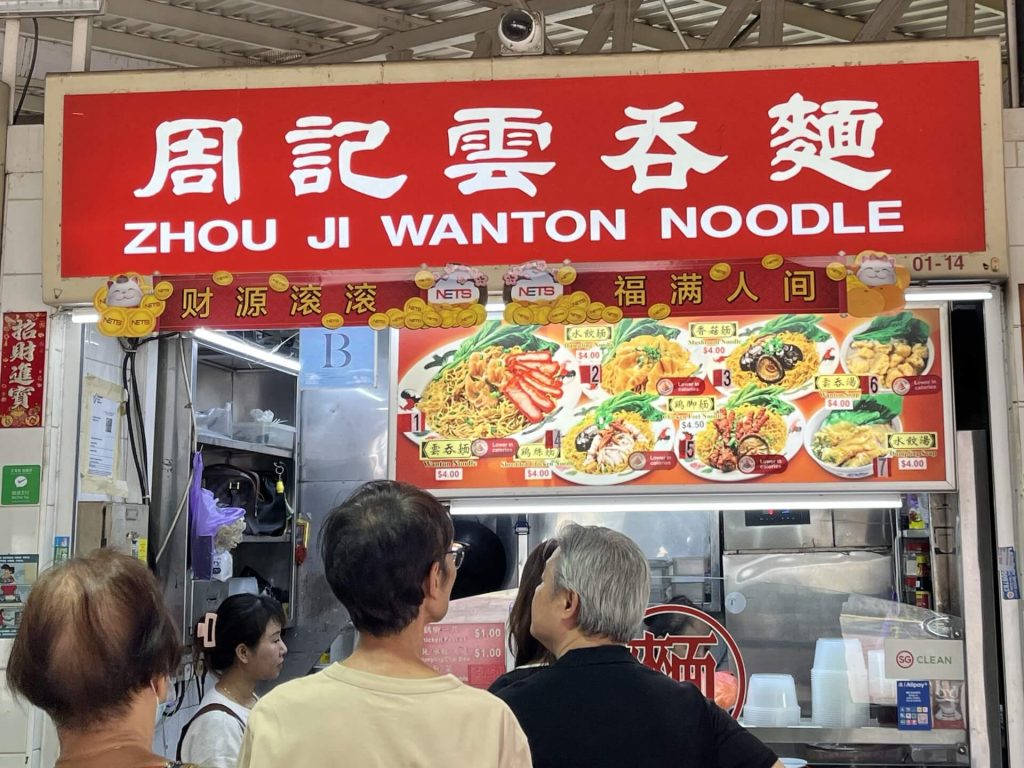
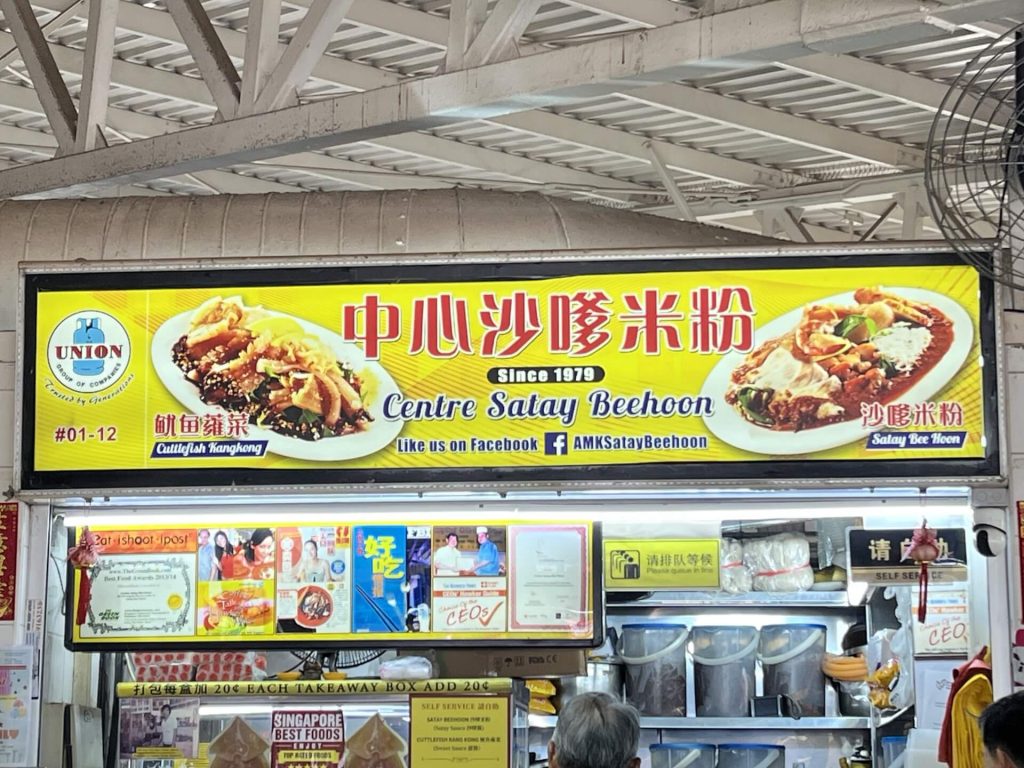
Hawker centres are places where Singaporeans dine and socialise. Today, there are tens of thousands of hawker stalls in Singapore, managed by various different agencies. According to the regulations of Singapore’s Accounting and Corporate Regulatory Authority, all business names must be registered in English. Hawker stallholders who apply to operate food and beverage businesses are engaged in commercial activities and must comply with this rule. Consequently, the official registration documents of local Chinese hawkers only bear their English business names. Chinese names, which are commonly displayed on signboards, are supplementary and used informally for day-to-day business operations. Therefore, hawker stalls or businesses operated by Chinese people typically have two names: an English name, which is registered in accordance with the law, and a Chinese one, which appears on the signboard. As for whether food names on signboards should be listed in English or Chinese, this remains entirely at the discretion of the business owners.
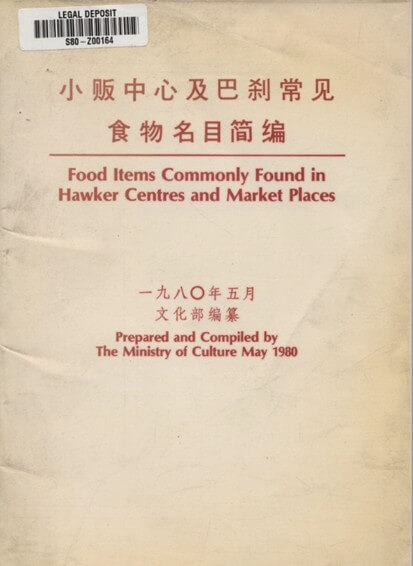
In May 1980, the Ministry of Culture published a booklet Food Items Commonly Found in Hawker Centres and Market Places. Compiled in support of the 1979 Speak Mandarin Campaign, it aimed to address communication difficulties between hawkers and customers arising from different pronunciations of food items in dialects and Mandarin. The 52-page booklet listed 415 common food items, which were divided into 13 main categories including beverages, cooked food, fruit, meat, and vegetables. Each entry included its Chinese name, hanyu pinyin and the corresponding term in English, and Chinese dialects such as Cantonese, Hokkien, and Teochew. If a food item had multiple names, its local colloquial terms were indicated in parentheses. Malay names were also added for food items originating from the Malay community. The booklet reflects the government’s language planning strategies in the early stages of promoting Mandarin and serves as an important document for studying hawker culture and multilingual practices in the early years of nation building.
Multilingual stall signs
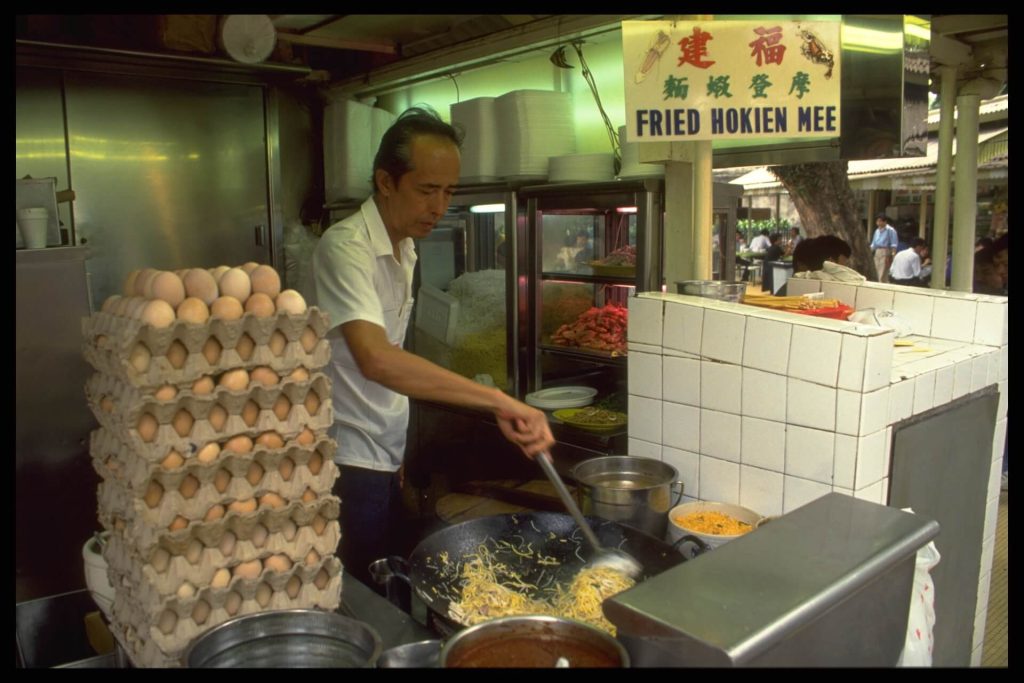
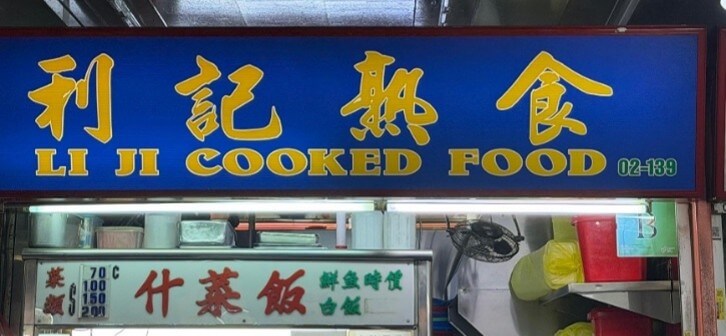
There are no strict regulations governing the naming of hawker stalls or the way that words are presented on their signs. Therefore, Chinese hawker stall signboards are mostly designed by the stall owners based on trade traditions, industry norms, brand history, and cultural considerations. This has led to a diversity of signboards among Chinese-operated stalls.
A notable feature of these signboards is their multilingualism. They often incorporate at least two languages, such as English and Chinese. Malay and other languages may also be used if the stalls sell Malay foods, or foods from other ethnic communities. In addition, the signage presents diverse spoken language forms, featuring not only English and Mandarin, but also dialect characteristics, as well as Malay occasionally.
- 利记熟食 Li Ji Cooked Food
- 金华鱼圆面 Jin Hua Fishball Noodle
- 老巴刹螃蟹面 Lao Ba Sa Crab Mixed Noodle
- 义兴粿汁 Ngee Heng Kuay Chap
- 发记肉骨茶 Huat Kee Bak Kut Teh
- 福来卤面 Hock Lye Lor Mee
- 薄饼 Popiah
- 麻糍 Muah Chee
- 猪肠粉 Chee Cheong Fun
- 荣记鸡饭 Yong Kee Chicken Rice
- 兴兴起骨鸭饭 Heng Heng Boneless Duck Rice
- 利润驰名鸡饭 Lee Loon Cooked Food
- 炒米粉 Fried Bee Hoon
- 炒粿条 Fried Kway Teow
- 六味汤 Lok Mei Soup
- 潮州糜 Teochew Porridge
- 椰浆饭 Nasi Lemak
- 娘惹糕 Nonya Cake
- 罗惹 Rojak
The names of food items also reflect the ancestral hometowns of Chinese immigrants. Culinary culture is often regional-specific, and the rich variety of Singapore Chinese food can be attributed to the fact that the dishes originate from different places. Locals are often able to identify the origins of the dishes from their names alone.
Names and origins of selected local food items
| Chinese food name | Local colloquial name | Origin |
| 叉烧面/叉燒麵 | Char siew mee | Guangdong |
| 叉烧饭/叉燒飯 | Char siew fan | Guangdong |
| 云吞面/雲吞麵 | Wanton mee | Guangdong |
| 鸭饭/鴨飯 | Ark Png | Guangdong/Teochew |
| 虾面/蝦麵 | Hae mee | Minnan (southern Fujian) |
| 卤面/滷麵 | Lor mee | Minnan (southern Fujian) |
| 碗粿 | Wah kueh | Minnan (southern Fujian) |
| 粿汁 | Kway chap | Teochew |
| 蚝煎/蠔煎 | Orh luak | Teochew |
| 炒粿条/炒粿條 | Char kway teow | Teochew |
| 鸡饭/雞飯 | Hainanese chicken rice | Hainan |
| 酿豆腐/釀豆腐 | Yong tau foo | Hakka |
| 肉骨茶 | Bak kut teh | Local (Singapore) |
Coexistence of traditional and simplified Chinese characters
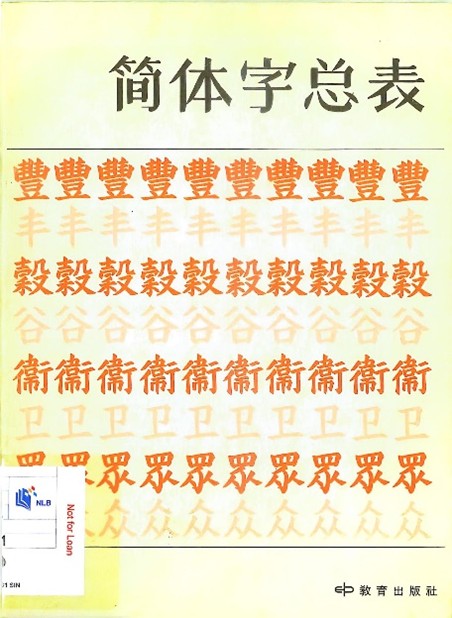
Singapore’s transition from traditional to simplified Chinese characters began in 1969 and was fully implemented by 1976. It started in schools, with the Chinese-language media and government agencies gradually following suit. The public’s adoption of simplified characters lagged behind schools, the media, and the government.
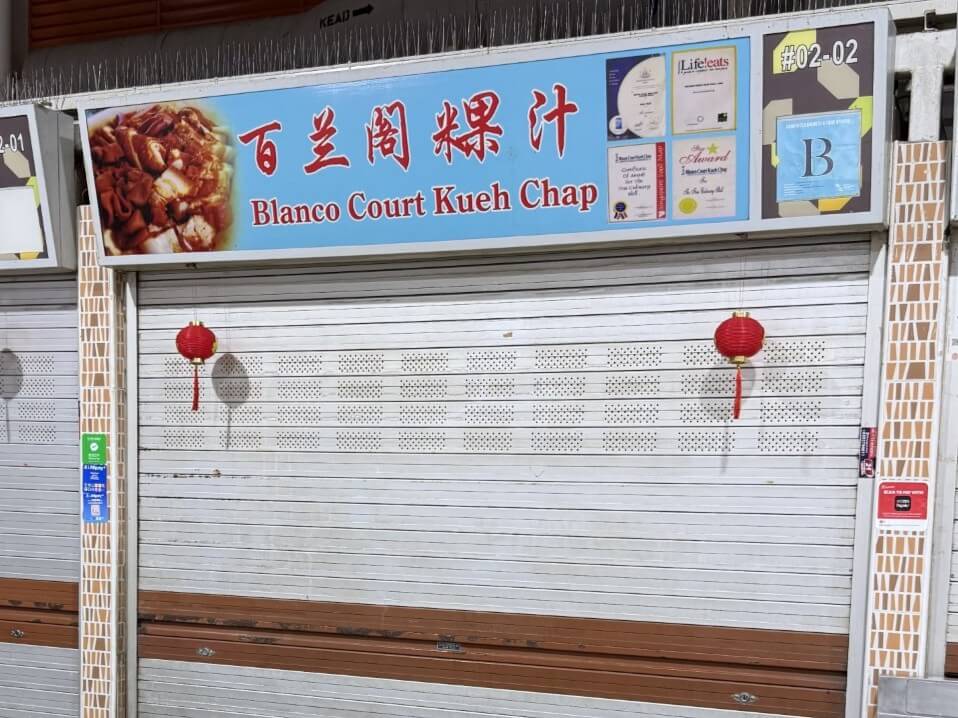
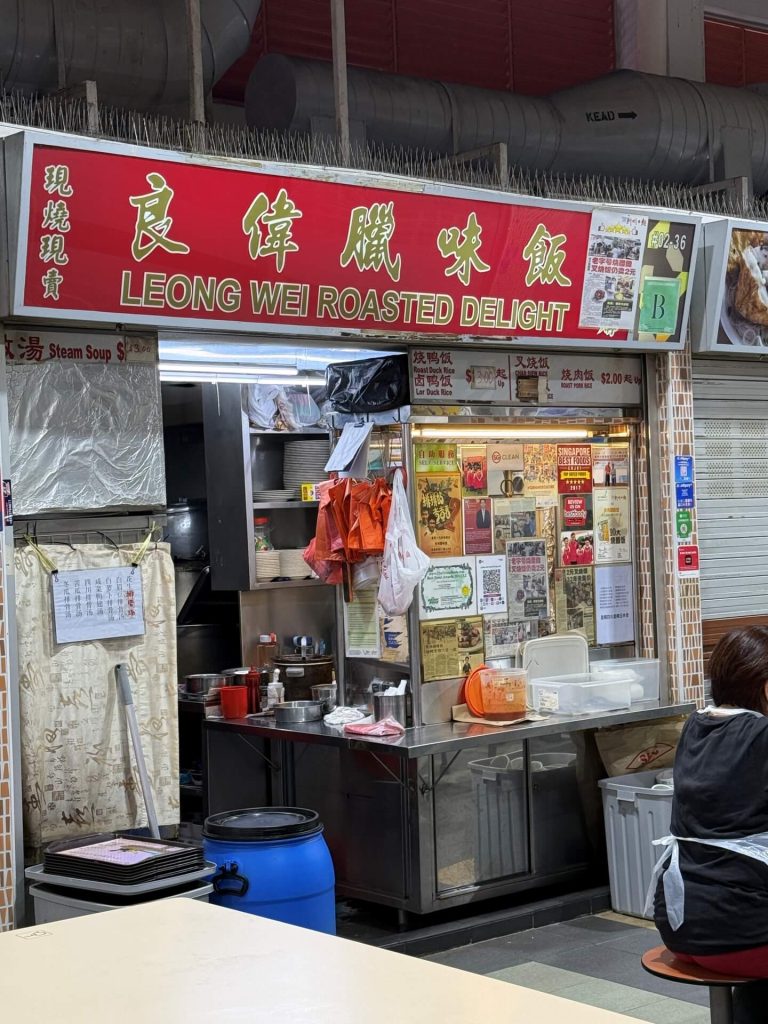
Local business registration authorities do not impose strict restrictions on whether signage must use traditional or simplified characters. As many Chinese have a strong emotional attachment to traditional characters, these older forms can still be seen frequently, even well into the 21st century. According to Chinese culture and tradition, the signboard of a stall or business is regarded as its “front” — a face that plays an important role in identifying and distinguishing the establishment. Many of these businesses are also long-standing brands with a rich history. Consequently, business owners often use traditional characters on their signage as they appear more dignified and authentic, thereby highlighting their brands’ history and cultural depth. Conversely, food names are far less distinctive than business names, so the choice of script (traditional or simplified) has less impact on the overall image of the business, and owners are usually less particular about the form of writing used.
From the colonial era to Singapore’s self-governing period, Chinese signboards of local hawker stalls were almost entirely written in traditional characters and dialect forms. Following Singapore independence in 1965, the government gradually implemented multilingual policies, and hawker centre signage began incorporating both Chinese and English, with traditional and simplified characters coexisting on some signboards.
Common characters, rare characters, and business aspirations
According to a survey, 95% of the Chinese characters on signboards in local hawker centres are among the 2,500 most-used characters.2 This allows customers to recognise and remember the names easily. A small number of characters, however, carry a strong dialect or folkloric flavour. Examples include 侬 (nong), 鼎(ding), 锭 (ding), 镬 (wok in Cantonese), 锝 (de), 锟 (kun), 楗 (jian), 粿 (kueh or kway in Hokkien), 禧 (xi), and 囍 (xi).
According to a survey by the author’s team, commonly used characters on Chinese signage in hawker centres include 记 (ji), 兴发 (xing fa), 成 (cheng), 金 (jin), 顺 (shun), 天 (tian), 新 (xin), 华 (hua), 利 (li), 福 (fu), 香 (xiang), and 美 (mei). Apart from the first character, “记”, which is a traditional hallmark of Chinese businesses, the other commonly used characters are auspicious terms associated with prosperity, success, and good fortune.
- 粿 (kueh or kway) — This character is not listed in China’s Modern Chinese Dictionary or Xinhua Dictionary, but is a common dialect character in Singapore. It mainly refers to a type of rice flour-based food consumed by Chinese in Southeast Asia, and is a general Hokkien term for cakes that have been made from a mix of glutinous and non-glutinous rice flour with fillings and then shaped using moulds. Examples include 甜粿 (sweet cake or tee kueh), 咸甜粿 (savoury sweet cake or kiam tee kueh), and 菜头粿 (radish cake or chye tow kway). According to statistics, there are many food items containing 粿, including 粿条 (flat noodles or kway teow), 面粉粿 (handmade noodle or mee hoon kway), 粿汁 (flat, broad rice sheets in a dark, soy sauce-based broth or kway chap), 笋粿 (dumpling stuffed with bamboo shoots or soon kueh), and 碗粿 (bowl cake or wah kueh). Related expressions include 粿印 (kueh in), the traditionally wooden but now plastic mould used to shape these cakes.
- ⿰米术 (shu) — This character is not found in China’s Modern Chinese Dictionary or Xinhua Dictionary. It is also written as 蜀 (shu) or 黍 (shu). 乌⿰ (wu shu) is a type of black glutinous rice dessert known in Hokkien as orh bee ber, while ⿰米饭 (shu mi fan) refers to glutinous rice, which is known as chu bee png in Hokkien and loh mai fan in Cantonese.
- 潠 (xun) — This character does not appear in China’s Xinhua Dictionary. It refers to a type of mung bean dessert soup and is often known as 豆潠 (tau suan) in Hokkien and Teochew. Hawkers usually use the phonetically similar term 豆爽 (tau suan) for the dessert, as it is more easily recognisable.
Singapore is a multiracial and multilingual society. Hawker centres are not only popular dining spaces for local Chinese, Malay, Indian and other ethnic groups, but also a window into our multicultural practices. Here, the dietary habits, cultural characteristics and languages of the various races intertwine with one another, creating a cultural kaleidoscope and culinary melting pot that is unique to Singapore.
This is an edited and translated version of 新加坡小贩中心的语言文字景观. Click here to read original piece.
| 1 | Shang Guowen, Zhao Shouhui, “Yuyan jingguan yanjiu de shijiao, lilun yu fangfa” [Perspectives, theories and methods in linguistic landscape research], Foreign Language Teaching and Research 2 (2014): 214–223. |
| 2 | Yeow Kwang Yeo, Xinjiapo huaren shushi zhaopai mingcheng de yuyanxue guancha [Linguistic observations of Chinese cooked food stall signage in Singapore], in Xinjiapo huayu yingyong yanjiu xinjinzhan [New research developments on Singapore Mandarin usage], edited by Luo Futeng (Singapore: Global Publishing, 2012), 77. |
Goh, Nguen Wah. Xinjiapo gonggong zhengce fanli: shiwu de juece – xinjiapo zhengfu huayuwen zhengce yanjiu [A paradigm of public policy in Singapore: Pragmatic policymaking — A study of the Singapore government’s Chinese language policies]. Beijing: Contemporary World Publishing House, 2008. | |
Lee, Cher Leng. “Singapore Hawker Centres: A Linguistic Landscape of Identity Diversity and Continuity.” Journal of Asian Pacific Communication 34, no. 1 (2024): 23–55. | |
Ministry of Culture, compiled. Food Items Commonly Found in Hawker Centres and Market Places. Singapore: Ministry of Culture, 1980. | |
Yeo, Yeow Kwang. “Xinjiapo huaren shushi zhaopai mingcheng de yuyanxue guancha” [Linguistic observations of Chinese cooked food stall signage in Singapore]. In Xinjiapo huayu yingyong yanjiu xinjinzhan [New research developments on Singapore Mandarin usage], edited by Luo Futeng, 59–91. Singapore: Global Publishing, 2012. |