A history of Chinese cartoons and comics in Singapore


In 1954, war heroine and teacher, Elizabeth Choy (1910–2006), spoke up against comics at the Singapore Legislative Council. She said, “Something must be done. It is our duty to protect children from the inevitable effects of such detrimental reading material.” 1954 was the same year the United States’ Senate went after comic books in America.1
One would think Choy regarded comics as a bad thing for children. In fact, she was attacking overseas English comics. Chinese cartoons and comics in Singapore, by contrast, tended to reflect socio-political and economic developments, and were viewed less negatively by the public.
The political origins of Chinese cartoons in Singapore (1900s–1940s)
The origins of Chinese cartoons in Singapore are political. In 1907, the first Chinese cartoon in Singapore appeared in Chinese newspaper Chong Shing Yit Pao, in support of Sun Yat-sen’s (1866–1925) efforts to overthrow the Qing dynasty (1644–1912). Influenced by the use of cartoons for revolutionary and propaganda purposes in other anti-Qing dynasty newspapers such as Min Pao (Japan) and China Daily News (Hong Kong) (1900–1913), Chong Shing Yit Pao ran a total of 41 cartoons from 9 September 1907 to 21 March 1908. Some of these cartoons were reprinted from overseas Chinese publications, but others — typically single-panel editorial or political cartoons — were drawn by artists living in Singapore. The British authorities did not take kindly to such satire, and in 1908 they threatened to use the Banishment Ordinance to deport Sun Yat-sen and the editors of Chong Shing Yit Pao for advocating “seditious agitation against China”.2
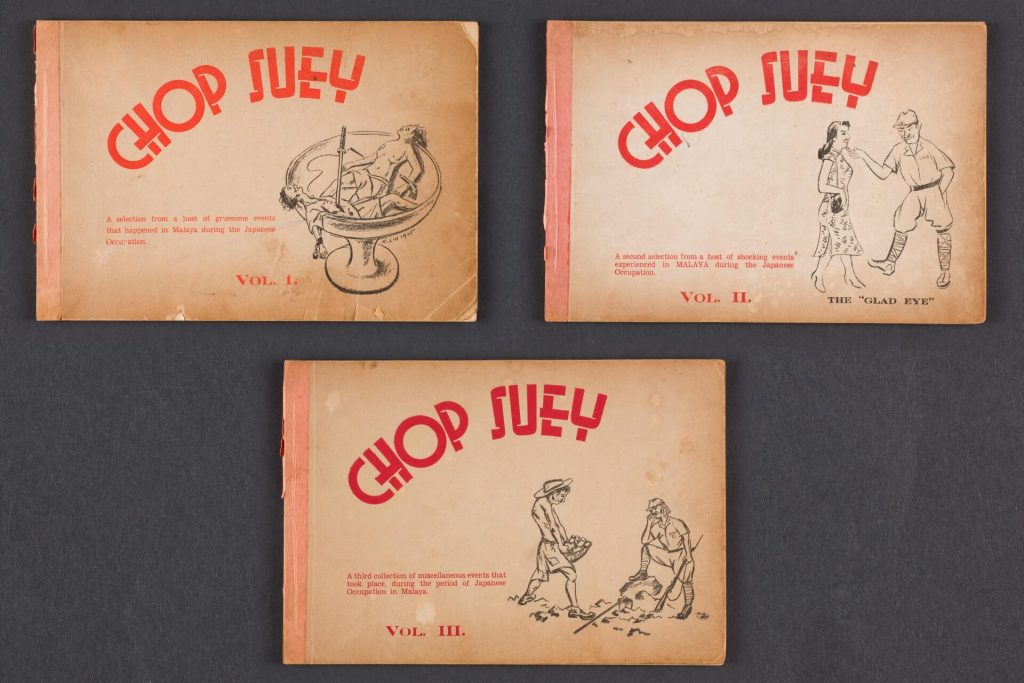
This political template for cartooning in Singapore was set for the next few decades. Chinese newspapers on the island continued to print cartoons about the political situation back in China, advocating for change and reform. When Japan invaded China in 1937, Chinese newspapers and magazines in Singapore focused on attacking the Japanese aggression. Cartoons were part of these anti-Japanese efforts — for this, Chinese cartoonists paid a heavy price when the Japanese invaded Singapore in 1942. Many of them, including anti-Japanese writers and intellectuals, were rounded up and executed. The first cartoon book to appear after the war, Liu Kang’s (1911–2004) Chop Suey (1946), recorded the atrocities of Japanese soldiers who had killed some of Liu’s artist friends like Tchang Ju Chi (1904–1942).3
Post-war developments (1945–1960s)
After the war, cartoons continued to appear in Chinese dailies such as Nanyang Siang Pau and Sin Chew Jit Poh, as well as in magazines. They gave the public an easier way to consume the news by leavening it with humour. They also fuelled debates in Singapore on topics such as independence from the British and the anti-yellow culture campaign.4
While Chinese cartoons remained a staple of Chinese newspapers, there was a lack of dedicated Chinese comic magazines after the war. Nonetheless, comics appeared in popular children’s magazines such as World Children (1950–1978) and Children’s Paradise (1953–1994), providing comic relief from the serious issues of the day. A slight increase in the standard of living after the war also meant that parents were willing to spend a bit more on their children’s education and entertainment, although they remained selective about what they read. Periodicals like World Children and Children’s Paradise were bestsellers and were very popular with parents and children.
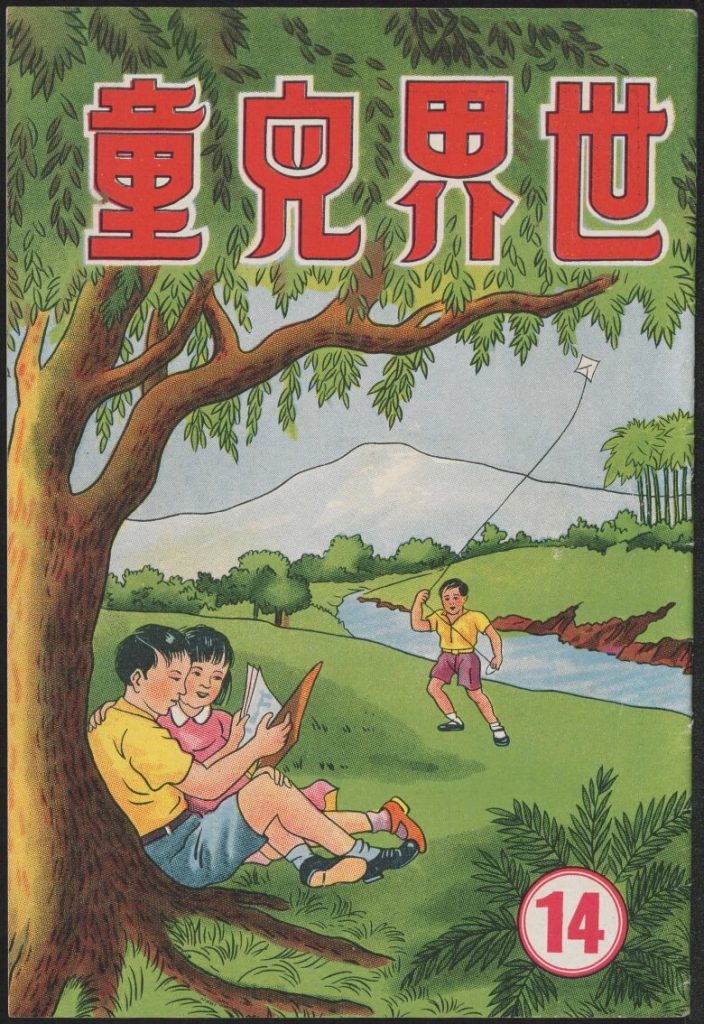
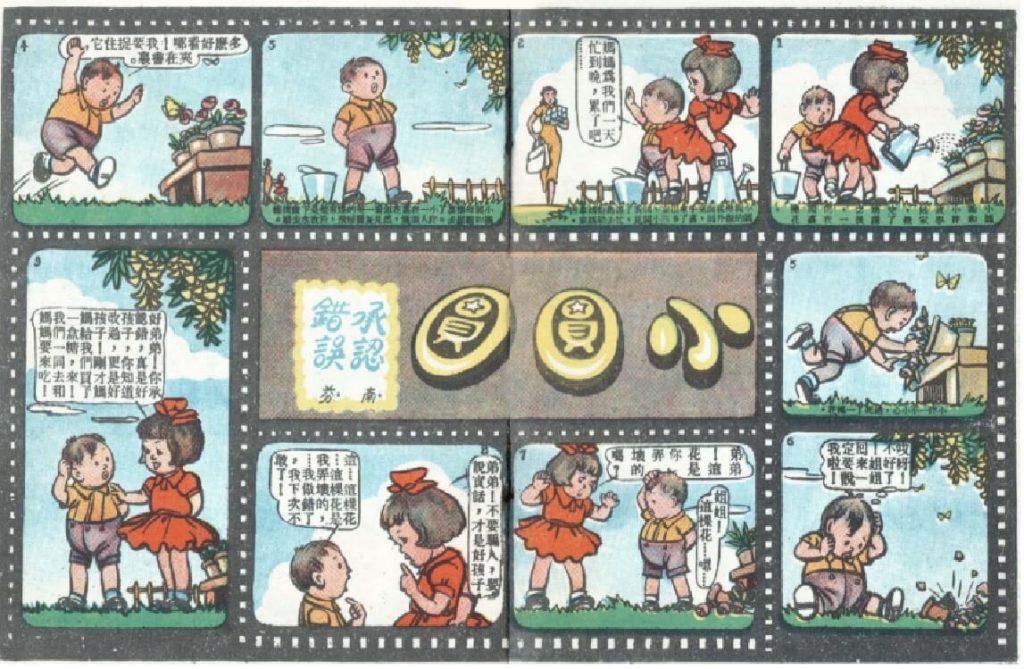
Although these children’s magazines were not strictly political in nature, they were shaped by the political forces of the times. After 1949, World Children (published by World Book Company in Singapore) gradually grew less China-oriented, angling its content towards Southeast Asia and the rest of the world. While Confucian values were still emphasised, the magazine included stories and articles about regional history and geography, global affairs, scientific knowledge, and concepts such as freedom and democracy. In the case of Children’s Paradise from Hong Kong, the link to pro-Western propaganda was even more obvious. Children’s Paradise was published by Union Book Company which was funded by the Asia Foundation. The latter had been established by the US Central Intelligence Agency to fund and support cultural organisations in Hong Kong which promoted pro-Western attitudes. The space of children’s magazines was a cultural and ideological battlefield, and this was reflected in the comics they published.5
Nation-building: Reining in political cartoonists (1965–1980s)
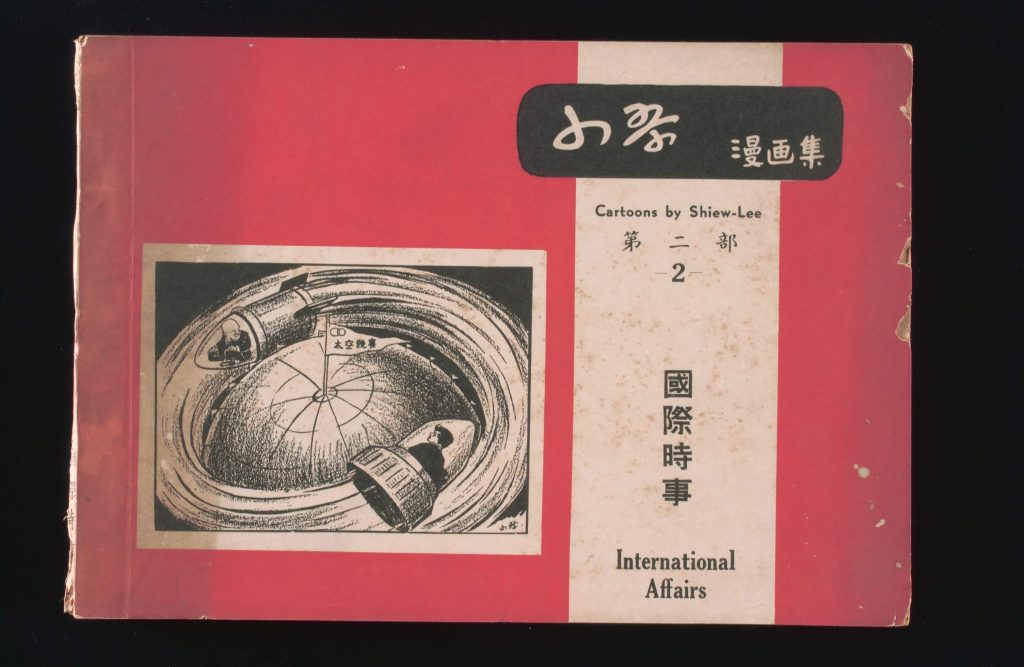
When Singapore gained independence in 1965, the media were expected to play a role in nation-building by helping the state publicise and promote its new policies. Cartoons by artists like Lim Mu Hue (1936–2008) and See Cheen Tee (1928–1996) continued to appear in Nanyang Siang Pau and Sin Chew Jit Poh, occasionally making light-hearted jibes at policies. Nevertheless, satirising politicians was a sensitive matter, and cartoonists were reminded by politicians of how their work should reflect public opinion and policies — but not seek to shape it.6
In May 1971, four senior executives of Nanyang Siang Pau were arrested under the Internal Security Act for using the newspaper to incite racial tensions and promote communism. While no cartoonists were ever arrested, subsequent cartoons in the Chinese press were mostly social observations laced with gentle humour, or focused largely on foreign events, such as works by Koeh Sia Yong in Nanyang Siang Pau.7 From the 1980s to the 2000s, columns in the Chinese newspapers, such as “Comics Fast Food”, in Friday Weekly, also provided young cartoonists with opportunities to express themselves. 8
Cracking down on action comics (1965–1980s)
In the 1970s, local authorities frowned on the influx of action comics from Hong Kong which dealt with themes such as murder, fantasy, robbery, gangsterism, sex, and violence. These comics were popular among young readers. In fact, many primary school kids would willingly go hungry to buy these comics with their daily pocket money.9
In 1972, the police seized thousands of obscene comics during their raids. Most of these Chinese comics from Hong Kong and Taiwan were found selling openly in selected Chinese bookshops in Chinatown, Desker Road and Johore Road. They were shoddily printed in black and white and sold for around 50 cents each.10
In 1976, 7,000 copies of “action-packed” comics for children — reproductions of those published in Hong Kong — were fed to an incinerator in Sembawang. Officers from the Publications Section of the Ministry of Culture seized the comics from a book manufacturer in Tanglin Halt, whose license to print books and magazines was swiftly suspended.11
Boom and bust (1980s–Present)
The 1980s saw the expansion of the Chinese comics market, influenced by the growing popularity of comics from Hong Kong, Taiwan and Japan in Singapore. Young local artists like Wee Tian Beng and Zhang Shengfu were drawing and publishing original comics, often at a financial loss. This period also saw rising readership among girls who were interested in Chinese translations of the shojo manga (girls’ comics). More female comic artists such as Foo Swee Chin, Egg Roll and Xiao Gou — they were regular contributors to the column “Comics Fast Food” — also started their own comics.12
The 1990s were a period when Chinese comics flourished in Singapore, with the huge success of Wee’s adaptation of the Return of the Condor Heroes, published by Asiapac Books. The latter had started out publishing educational comics but saw their best sales in their adaptations of Jin Yong (1924–2018) novels. Whenever a new issue arrived at the newsstands, eager fans would snap them up like hot cakes. Wee Tian Beng went on to form his own comics company, TCZ Studio, publishing comics copyrighted under his own name.
While cartoons are still featured in Lianhe Zaobao, most of their artists do not draw cartoons solely but they do info graphics and other illustrations. The scene faces several challenges today. These include the rising problem of piracy, where books are uploaded online; as well as readers’ shifting interests as they move on to other hobbies such as online gaming. This has had negative consequences for many Chinese artists, comic shops, and publishers. Nonetheless, while the golden age of Chinese comics may be over, Singapore books such as The Samsui Sword 1 (2021) and The Samsui Sword 2 (2024), which have built up a substantial fan base, are some bright spots.
| 1 | “Ban them, says Mrs Choy,” The Straits Times, 4 November 1954. |
| 2 | See Lim Cheng Tju, “Tong Meng Hui, Visual self-representation of the Chinese and the birth of Chinese cartoons in early twentieth century Singapore,” Tangent 6, no. 2 (2007): 180–194. |
| 3 | Recently-found sketches of Chop Suey were displayed for the first time at the Devoted to Serve exhibition (based on Drawn to Satire, a book about the pioneer cartoonists of Singapore) at the Singapore Chinese Cultural Centre in 2024. On the pioneer cartoonists of Singapore, see Lim Cheng Tju, “Singapore’s Pioneer Cartoonists,” BiblioAsia 20, no. 3, October–December 2024. |
| 4 | See Lim Cheng Tju, “The anti-yellow culture campaign in Singapore: 1953–1979,” in The State and The Arts in Singapore: Policies and Institutions, edited by Terence Chong (Singapore: World Scientific, 2019), 31–48. |
| 5 | See Xu Lanjun and Li Lidan, eds, Constructing Nanyang Children: Studies of Chinese Children’s Publications in Post-War Singapore and Malaya (Singapore: World Scientific Global Publishing, 2016). |
| 6 | See Lim Cheng Tju, “Chinese cartoonists in Singapore: Chauvinism, confrontation and compromise (1950–1980),” in Southeast Asian Cartoon Art: History, Trends and Problems, edited by John Lent (North Carolina: McFarland, 2014), 142–177. |
| 7 | Others who drew foreign political or editorial cartoons (and not about local politics) for the Chinese press during this period were Ong Yih and Heng Kim Song. For a brief analysis, see Lim Cheng Tju, “Singapore political cartooning,” Southeast Asian Journal of Social Science 25, no. 1 (1997): 125–150 and Lim Cheng Tju, “Political cartoons in Singapore: Misnomer or redefinition necessary?” Journal of Popular Culture 34, no. 1 (2000): 77–83. |
| 8 | The former Lianhe Zaobao cartoonist Wuyu (real name Goh Ting Cheng, 1958–2025) was one of the founders of “Comics Fast Food”. |
| 9 | “Singapore bans comics from Hong Kong,” The Straits Times, 11 November 1966. |
| 10 | “Police war on pornography,” The New Nation, 26 November 1976. |
| 11 | “Comics burned,” The New Nation, 21 August 1976. |
| 12 | See Lim Cheng Tju, “Stories by female comic artists in Southeast Asia,” in International Perspectives on Shojo and Shojo Manga: The Influence of Girl Culture, edited by Masami Toku (New York; Oxford: Routledge, 2015), 77–86. |
Lim, Cheng Tju. “Sister Art: A Short History of Chinese Cartoons and Woodcuts in Singapore.” International Journal of Comic Art, 3, no. 1 (2001): 59–73. | |
Lim, Cheng Tju and Koh Hong Teng. Drawn to Satire: Sketches of Cartoonists in Singapore. Singapore: Pause Narratives, 2023. | |
World Children-Forever Young: A Tribute to the Early Chinese Children’s Periodical in Southeast Asia. Singapore: Chou Sing Chu Foundation and Popular Holdings Limited, 2014. | |
Xu, Lanjun and Li, Lidan, eds. Jiangou nanyang ertong, zhanhou xinma huayu ertong kanwu ji wenhua yanjiu [Constructing Nanyang Children: A study of Chinese children’s publications in post-war Singapore and Malaya]. Singapore: World Scientific Publishing, 2016. |