Singaporean food that spans dialect groups


Singapore is a melting pot of creeds and cultures whose food is deeply woven into the national fabric.1 This article will focus on the culinary innovations of Chinese immigrants that defy attribution to any particular dialect group. Unlike dishes like Teochew jellied pork trotters or Cantonese roast suckling pig, which retain clear ties to their regional Chinese roots, many of the Singaporean foods explored here — laksa, rojak, bak kut teh, chilli crab, and fried Hokkien prawn mee — have complex and indistinct origins.
Some of these dishes drew inspiration from a mixture of mainland Chinese and non-Chinese Southeast Asian traditions, whereas others were new creations born of Singapore’s multicultural crucible. Together, these uniquely Singaporean dishes feature a blend of techniques and flavours across dialect groups, and have evolved according to local palates and ingredients. This article will trace their tangled histories, while showcasing how they embody Singapore’s dynamic food culture, where culinary boundaries blur and new traditions are forged.
Laksa
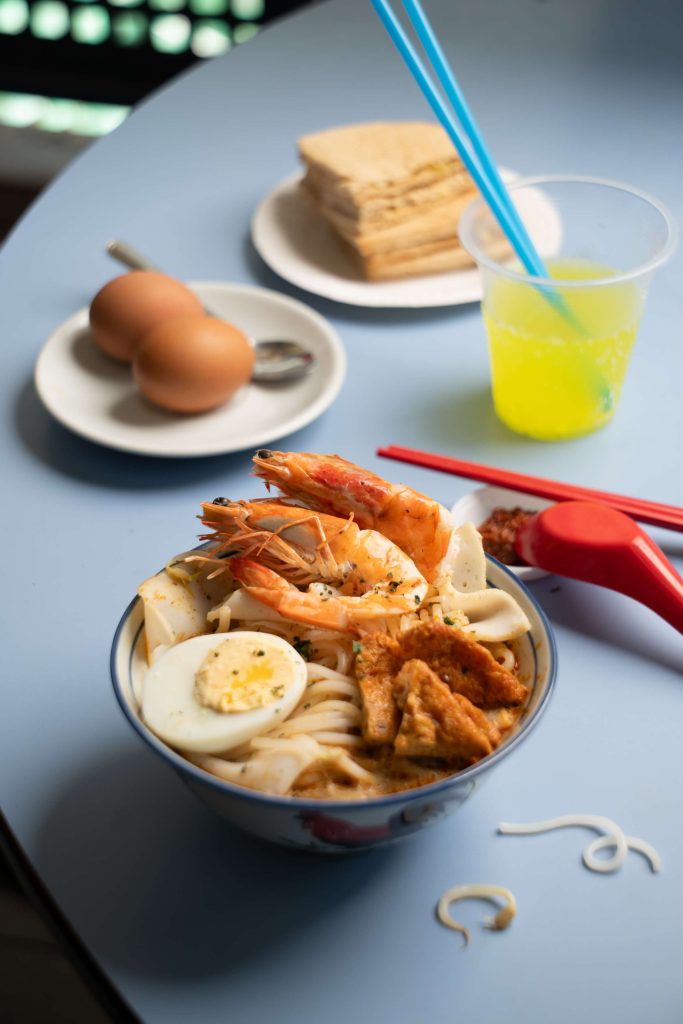
Few dishes are as beloved in Singapore as laksa, a noodle soup whose very name might derive from the Sanskrit laksha (“hundred thousand”), referring to its multitude of ingredients.2 At the heart of a typical bowl of laksa in Singapore is the broth, a heady concoction of curry powder, sambal, shallots, and laksa leaves (Vietnamese coriander). The result is an irresistible balance of richness, sweetness, and spice that lingers long after one’s first mouthful. That said, there is no definitive version of laksa and its origins are tricky to pin down; the earliest laksa variants may have been introduced as early as the 15th century, when a wave of mainland Chinese traders settled down in the Malay Peninsula.3
In Singapore, laksa is the default shorthand for the variant known as curry laksa, whose broth is enriched with coconut milk and, occasionally, dried earthworms.4 Toppings are generous and varied. Cockles or hum are a popular addition, deepening the dish’s natural sweetness. Other accompaniments might include bean sprouts, hard-boiled egg, prawns, fish cake, and even chicken. Another standout topping is tau pok (fried beancurd puff), which soaks up the spicy, savoury broth and releases an explosion of flavour in every bite. Just as there is no definitive version of laksa, there is no one standard noodle used. The most common type is thick rice vermicelli — although it is not unusual to find bowls where these are mixed with yellow noodles, which lend the dish a springy bite.5
A popular subset of curry laksa in Singapore is the Peranakan-inspired Katong laksa, named after the residential neighbourhood where its Hokkien progenitor Ng Juat Swee (nicknamed “Janggut”, Malay for “beard”), lived and plied his trade in the 1940s. But unlike mainstream laksa, Katong laksa does not involve yellow noodles, and its rice noodles are cut into bite-size pieces that can be eaten with just a spoon.6 As an unlicensed hawker, Janggut supposedly started this practice “so that customers could eat quickly in the event that the enforcement officer came along”.7 Janggut later taught his brother Ng Chwee Seng how to make laksa. The duo set up Marine Parade Laksa at 49 East Coast Road in 1963; Chwee Seng and his family continued the business after Janggut died in 1986.8 Since then, more brands have emerged, each claiming to be related to Janggut in some way — and each claiming to have faithfully preserved the original taste of Katong laksa.
Rojak
The Javanese dish known as rujak is traditionally served as part of a prenatal ceremony held during the seventh month of a woman’s pregnancy. Rujak variants have existed for centuries, the most common one being rujak buah (fruit rujak), which consists of tropical fruits like mango or rose apple mixed with palm sugar, tamarind, chillies, and shrimp paste.9
Inspired by Javanese rujak, rojak (Malay for “mixed”) eventually made its way to Singapore, where Malay vendors sold a similar fruit-and-vegetable salad made with simple ingredients like cucumber, kudzu root, and sweet potato, mixed with tamarind juice, sugar, salt, and various kinds of chilli. Over time, they imparted some of their rojak-making tips to their Cantonese, Hokkien, and Teochew peers.10 After World War II, many Chinese hawkers in Singapore began peddling sweet treats. To avoid the stiff competition, some of them switched to selling Chinese-style rojak from pushcarts, wrapped in simpoh air leaves and secured with a toothpick.11
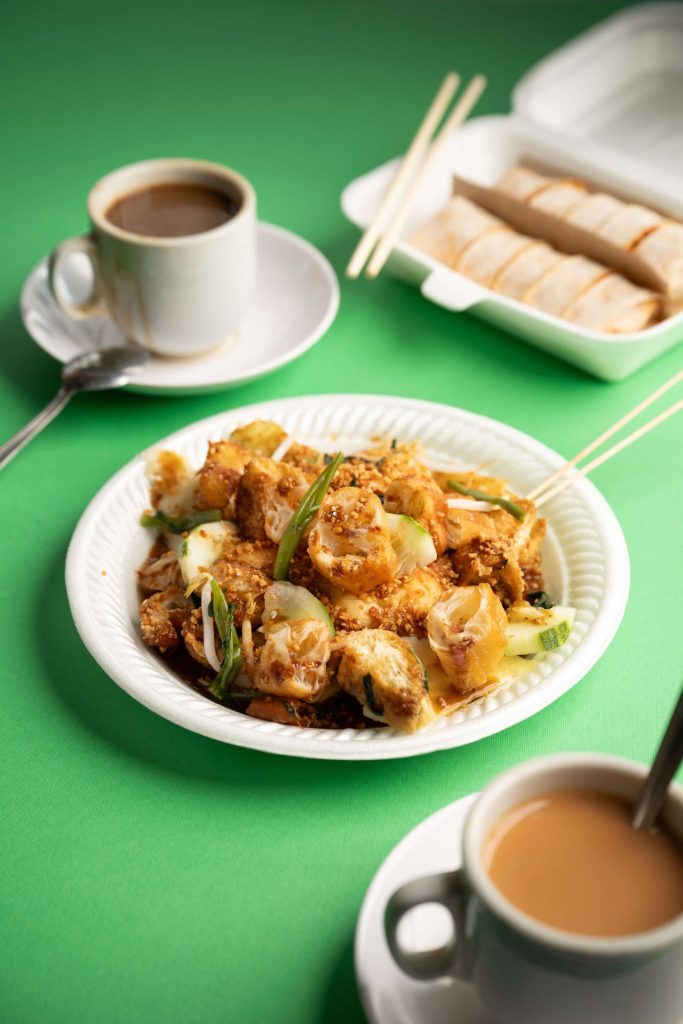
This Chinese rojak that Singaporeans are accustomed to today is much unlike rujak and Malay rojak. It is made with a variety of sweet and tangy ingredients that better suit the local Chinese palate, like bean sprouts, jicama, pineapple, tau pok (fried beancurd puff), you tiao (fried dough fritter), even century egg (a type of Chinese preserved egg) and jellyfish, all topped with dark soya sauce, hae kor (fermented prawn paste), and crushed peanuts.
Other ingredients which were commonly found in Chinese rojak in the mid-20th century — but are now harder to find — include torch ginger flower buds, ambarella, green mango, and water spinach.12 To the uninitiated, its appearance may not be the most appealing: a haphazard heap of chopped items covered in a thick, dark sauce does not exactly scream “appetising” at first glance. Still, the best rojak stalls at hawker centres and coffee shops around the country often draw snaking queues, with each order freshly prepared.
It is worth mentioning that Indian rojak is also popular in Singapore, but developed independently from Chinese rojak. Unlike Chinese rojak, Indian rojak contains ingredients like potato, cuttlefish, and other flour-based items cut into chunks and dipped into a tomato-based gravy.
Bak kut teh
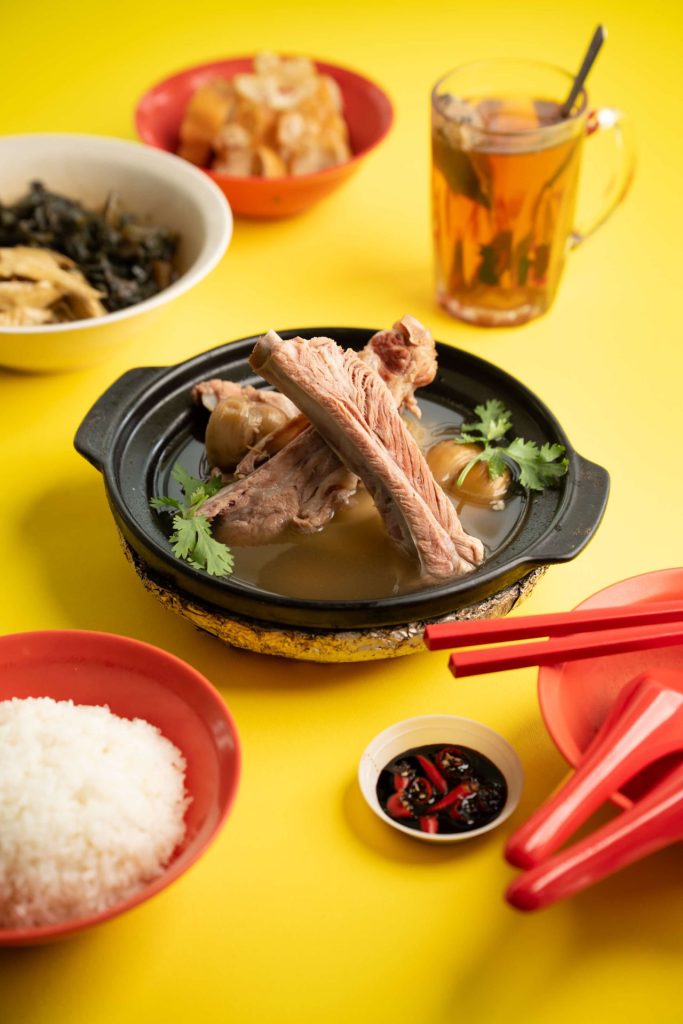
Although its name literally translates as “meat bone tea”, there is no tea in the broth of bak kut teh, a hearty soup made from pork ribs. There are two main styles of bak kut teh in Singapore that are said to trace their roots back to the Teochew and Hokkien communities. Both versions were already available in Singapore by the 1920s, although it is unclear which one came first.13
Teochews, who dominated the local pepper trade, sold broth made from simmering fresh pork ribs with garlic and white pepper to coolies in Clarke Quay and River Valley. Bak kut teh would have been taken for breakfast, since the coolies needed something both hearty and restorative to kickstart their day.14 The Teochew version of bak kut teh is more commonly found in Singapore today, although it only achieved mainstream popularity from the 1960s.15 The Hokkien version leans much more heavily on herbs and spices such as cinnamon, star anise, fennel seeds and coriander, as well as soy sauce. The result is a darker, almost medicinal broth.
Whether dark or light, bak kut teh is typically enjoyed with youtiao (fried dough fritters) that are dunked into the broth. In addition to pork ribs, the broth can also contain pork offal, tails, kidneys, sometimes even liver.16 These can be dipped in dark soya sauce, fresh garlic, and red chilli.
There are several plausible explanations as to why the word teh, or tea, appears in bak kut teh. One theory holds that in the early days, Chinese tea was served together with the soup to balance out its fattiness or heatiness.17 Another possible reason is that in Min Chinese, the term teh need not necessarily mean “tea” — it can also refer to “herbal soup” or “medicinal broth”.18
Chilli crab
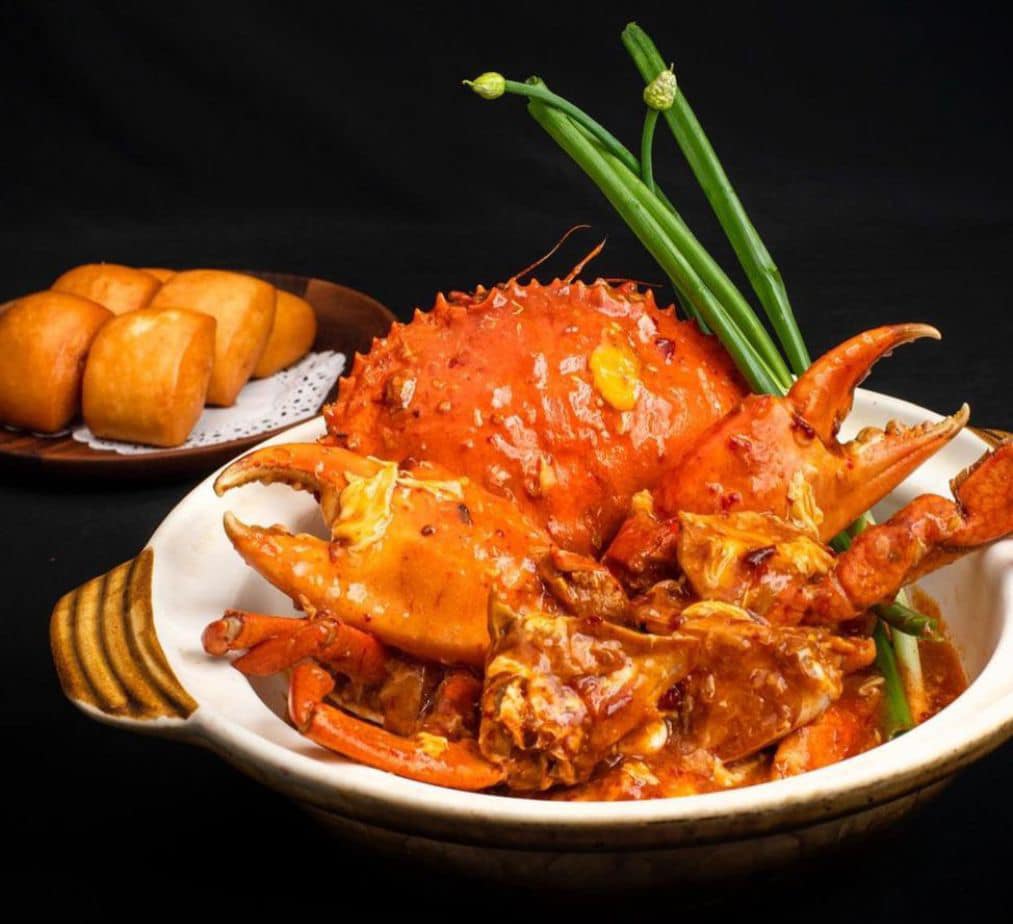
The practice of eating crabs in Singapore probably began with the indigenous seafarers known as the orang laut (Malay for “sea people”).19 But whatever sauce the natives might have enjoyed their crabs with, it was most likely nothing like that which defines chilli crab, which according to the Singapore Tourism Board “is made with mud crab drenched in chilli sauce, with fried bread buns on the side to sop the leftovers”.20
Chilli crab is now widely recognised as one of Singapore’s national dishes, and as of 2020 more than 6,000 giant mud crabs are imported into Singapore each day.21 Yet this was not always the case. The story of Singaporean chilli crab can be traced back to the 1950s,22 when policeman Lim Choon Ngee requested his wife Cher Yam Tian to prepare “something different” for dinner.23 For context: the family lived in a seaside hut near Upper East Coast and Lim often caught flower crabs for Cher to cook.24 But Cher only ever steamed them in the traditional Teochew way and Lim might have “grown tired of the same steamed crab”.25 Upon her husband’s request, Cher stir-fried the crabs with tomato sauce. Lim decided that the new dish was delicious enough to let their neighbours try, whereupon Cher decided to add some chilli to the crab sauce to give it “more kick”.26
Cher began selling her dish to whoever was in the know, though she sometimes used mud crabs instead of flower crabs because of the occasional unavailability of the latter. In 1956, at their neighbours’ urging, Cher and Lim opened a small (and unlicensed) pushcart stall by the banks of the Kallang River.27 At the same time, they began exclusively using mud crabs. In 1962, having saved enough money, the couple opened a proper restaurant along Upper East Coast Road, called Palm Beach Seafood Restaurant. The following year, just as Cher’s dish was really taking off, Cantonese master chef Hooi Kok Wai — one of the “Four Heavenly Kings” of Singaporean Chinese cooking — introduced his own version of chilli crab, substituting the bottled chilli sauce in Cher’s recipe with eggs, sambal (a paste made from dried prawns and roasted and ground chilli peppers), and tomato paste.
Chilli crab’s popularity has not waned, and it is a mainstay at the annual Singapore Food Festival. Several seafood specialists continue to jostle for the chilli crab crown. Some have even faced off against Gordon Ramsay or been featured on film and television. But Cher’s chilli crab is now largely lost to time; Hooi’s reinterpretation effectively set the modern template for what diners today recognise as chilli crab. Even Roland Restaurant (owned by Cher’s son Roland Lim) serves chilli crab like Hooi’s by default, although customers can place advance orders for his mother’s interpretation of the dish.
Fried Hokkien prawn mee
Mention “Hokkien mee” to a Malaysian and he would likely think of a dish made of thick wheat noodles braised in gravy with thick black soya sauce, choy sum, prawns, and lean meat.28 In the early days of Singapore, Hokkien immigrants were known for their “Hokkien fry”, which resembled the dark-coloured Malaysian dish and was traditionally served with a bowl of prawn ball soup. It was also commonly called “Hokkien mee”. However, this dish has almost disappeared from hawker centres today and can only be found in some of Singapore’s oldest Hokkien restaurants and a number of zichar stalls.
On the other hand, the “Hokkien mee” that is unique to Singapore — also known as fried Hokkien prawn mee or fried sotong mee — was reportedly sold as early as the 1880s. It was first popularly referred to as “Rochor mee”, since it was created by a Hokkien immigrant who sold hawker food along Rochor Road. This hawker’s young assistant, also Hokkien, subsequently shared the recipe with his four buddies, who were all Teochew, and they each set up shop in separate districts, including Tanglin, Katong, Balestier Road, and New World.29 Another narrative holds that fried Hokkien prawn mee was the invention of a few seamen from Fujian who worked at local noodle factories in the post-war years and would gather after hours to fry up leftover noodles over charcoal fires.30
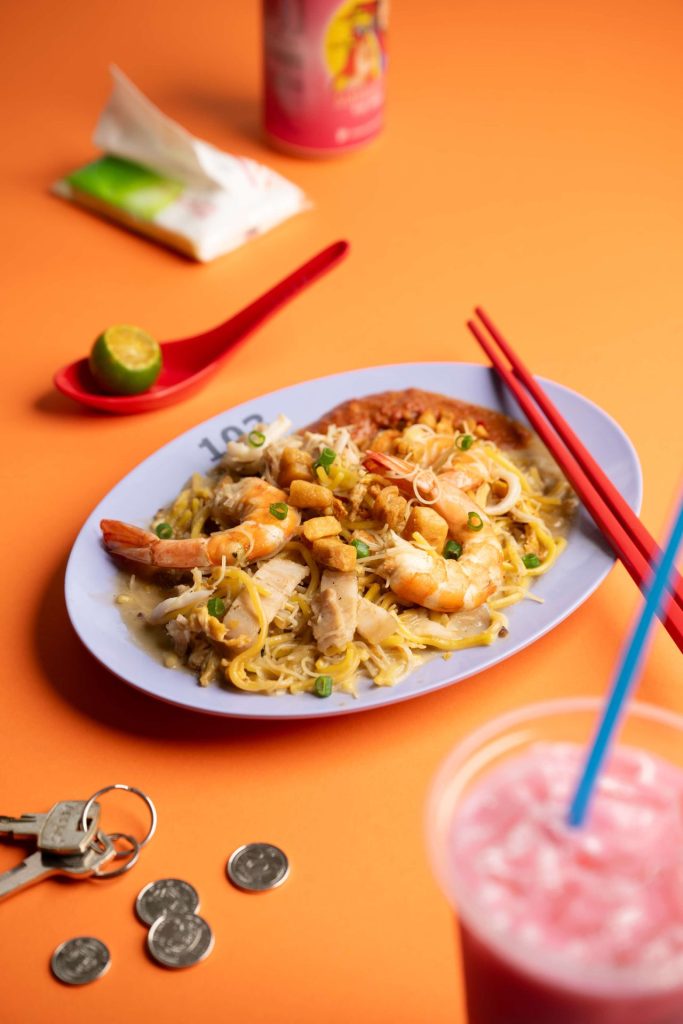
Regardless, it is generally accepted that fried Hokkien prawn mee must consist of rice vermicelli mixed with thick yellow wheat noodles, to be fried in a rich broth with squid, prawns, boiled pork belly, eggs, and chives, topped with fried lard and calamansi. Some hawkers even serve their fried Hokkien prawn mee in opeh (betel nut tree) “leaves” (actually pieces of bark), supposedly to retain heat and enhance the dish’s flavour by absorbing excess oil. What is used to make the broth varies and can include dried anchovies, prawn shells, pork bones, and even pork skin.
In the 1960s, there were no more than a dozen fried Hokkien prawn mee stalls, but their frying styles varied somewhat because their customers preferred slightly different textures and moisture levels.31 Two distinct versions of fried Hokkien prawn mee can be found in Singapore today. The Peranakan-inspired adaptation uses thick laksa-suitable rice vermicelli that is laden with more gravy and paired with sambal belacan.32 There also exists a drier version, where thin rice vermicelli and noodles are left to soak up every drop of broth and are eaten with a few slices of fresh red chilli.33
A tapestry of tastes
As a brief review of food criticisms and histories shows, the question of authenticity looms large over food that purportedly originates from a particular ethnic or dialect group. Certain features are generally expected to be found in such food, like fresh and “light” flavours in Teochew steamed fish, or numbing spice in Sichuan mapo doufu (spicy tofu).
The lines are more blurred, however, when it comes to food pioneered by Chinese immigrants in Southeast Asia. Many of these dishes, from bak kut teh to the misleadingly-named Hokkien mee, cannot be neatly traced back to a single dialect group or, in some cases, to the Chinese mainland at all. Some drew inspiration from regional non-Chinese antecedents, while others emerged as entirely new creations of place and circumstance.
What unites them is their hybridity: the layering of techniques and tastes from different communities, adapted to new environments and palates. Over time, these “third taste” innovations, as Singaporean food critic KF Seetoh puts it,34 became inseparable from our identity. They are Chinese but also not Chinese, and Southeast Asian but also proudly Singaporean — proof that food, like culture itself, is never static and always evolving.
UNESCO’s recognition of Singapore’s hawker culture as “intangible cultural heritage” in 2020 affirms this very dynamism. Each bowl of laksa, each plate of chilli crab, and each packet of fried Hokkien prawn mee carries with it the story of resilience, triumph, and the remaking of tradition in a new land. In the end, the stories behind them are as satisfying as the dishes themselves — complex, layered, and surely worth preserving.
| 1 | Including Chinese, Malay, Indian and Eurasian people, and others. |
| 2 | “Lesha” [Laksa], zaobao.sg, 11 December 2021. |
| 3 | Michael Raffael, “Deconstructing laksa, the fusion dish of Malaysia and Singapore,” National Geographic, 10 February 2019. For more information on laksa variants that cannot be found in Singapore, see for instance Melissa Suraya Ismail, “Types of laksa in (almost) every state In Malaysia,” The Rakyat Post, 10 May 2022. |
| 4 | A certain species (Lumbricus rubellus), used in traditional Chinese medicine, is preferred for its supposed anti-bacterial and flavour-enhancing properties. See Ilsa Chan, “Sim Lim eatery sells laksa cooked with earthworms, boss claims it enhances flavour & freshness,” 8Days, 23 November 2024. |
| 5 | Xinjiapo meishi tianshu [The Singapore Food Bible], Singapore Tourism Board, 20. |
| 6 | Leslie Tay, The End of Char Kway Teow and Other Hawker Mysteries (Singapore: Epigram Books, 2010), 236. |
| 7 | Derrick A Paulo, “Laksa battle in Katong and beyond — but which stall still follows the original recipe?,” CNA, 7 April 2024. |
| 8 | “Janggut’s laksa legacy,” The Straits Times, 7 November 1999. |
| 9 | Evelyn Chen, “Rojak: The evolution of Singapore’s favorite salad,” CNN, 20 August 2020. |
| 10 | Liang Shan, “Ji ge luorelao de gushi” [A few rojak uncle tales], Sin Chew Jit Poh, 29 October 1977. |
| 11 | Liew You Choo, “Huaren chao chu hei luore shidai” [Chinese people frying up an era of black rojak], Lianhe Zaobao, 1 January 2006; “Old Taste Detective Season 3: The old taste of rojak,” Mediacorp, YouTube video, 7 March 2022. |
| 12 | “The old taste of rojak”, Mediacorp, YouTube video, 7 March 2022. |
| 13 | Kua Bak Lim, Minnan wenhua zai xinjiapo lunwenji [Collected essays on Hokkien culture in Singapore] (Singapore: Singapore Amoy Association, 2025), 235. |
| 14 | Leslie Tay, The End of Char Kway Teow and Other Hawker Mysteries (Singapore: Epigram Books, 2010), 32. |
| 15 | “Rougu cha” [Bak kut teh], zaobao.sg, 11 December 2021. |
| 16 | However, this is more commonly seen in Hokkien bak kut teh; Teochew bak kut teh tends to use just spare ribs. Kua Bak Lim, Minnan wenhua zai xinjiapo lunwenji [Essays on Hokkien culture in Singapore] (Singapore: Singapore Amoy Association, 2025), 237. |
| 17 | Xinjiapo meishi tianshu [The Singapore Food Bible], Singapore Tourism Board, 13. |
| 18 | Seng, Faye, “An Huanran tianye biji: cong xiangtu yinshi kuijian Nanyang jiyi” [An Huanran’s field notes: exploring Nanyang heritage through local food], Lianhe Zaobao, 25 August 2025. |
| 19 | Neo Xiaoyun, “Eating Chilli Crab in the Anthropocene: Nature, Culture, and Care,” in Eating Chilli Crab in the Anthropocene: Environmental Perspectives on Life in Singapore, edited by Matthew Schneider-Mayerson (Singapore: Ethos Books, 2020), 20–21. |
| 20 | “Local Highlights: Chilli Crab,” VisitSingapore.com. |
| 21 | Neo Xiaoyun, “Eating Chilli Crab in the Anthropocene: Nature, Culture, and Care,” 19. |
| 22 | The Minangkabau people from West Sumatra have a spicy crab dish called ketam balado that predates (but is also very different from) Cher’s invention. In addition, the Langkawi-based Weng Fung Seafood restaurant may have independently created a different chilli crab dish. Neo Chai Chin and June Lee, “Singapore and Malaysia have claimed these 4 dishes. We get to the bottom of the food fights,” CNA, 24 April 2023. |
| 23 | Nicholas Yong, “Chilli crab: The woman behind Singapore’s beloved dish,” BBC News, 18 February 2023. |
| 24 | “Old Taste Detective Season 2: The old taste of chilli crab”, Mediacorp, YouTube video, 15 March 2021. |
| 25 | “The origin of our signature dish: The chilli crab,” RolandRestaurant.com.sg. |
| 26 | Neo Xiaoyun, “Eating Chilli Crab in the Anthropocene: Nature, Culture, and Care,” 27. |
| 27 | Magdalene Lum, “40 good years dishing up chilli crab,” The Straits Times, 23 June 1996. |
| 28 | Margaret Chan, “Fried and true: Local version of KL Hokkien mee,” The Straits Times, 6 March 1988. “Hokkien mee” in Malaysia may sometimes refer to Penang prawn noodle soup. |
| 29 | Margaret Chan, “Dish that has its roots in Singapore,” The Straits Times, 9 September 1984. |
| 30 | Esther Yiu, “Bang e renqi chao fujian xiamian, tang nong wei zu yin ke lai” [Popular fried Hokkien prawn mee in Punggol draws crowds with its rich, flavourful broth], Lianhe Zaobao, 17 May 2025. |
| 31 | Liew You Choo, “Fujian chaomian bian bian bian” [Fried Hokkien mee keeps evolving], Lianhe Zaobao, 27 March 2005. |
| 32 | Leslie Tay, The End of Char Kway Teow and Other Hawker Mysteries (Singapore: Epigram Books, 2010), 188. The “wetter” style of Hokkien mee bears some superficial resemblance to Penang lam mee (also known as “birthday mee”). |
| 33 | Margaret Chan, “Dish that has its roots in Singapore”; “Old Taste Detective Season 2: The old taste of fried Hokkien mee,” Mediacorp, YouTube video, 8 March 2021. |
| 34 | Lily Kong, Singapore Hawker Centres (Singapore: Focus Publishing, 2023), 133. |
An, Huanran. Xiangtu, yinshi yu jiyi: kua Nanyang tianye biji [Rural living, food, and memories: Trans-Nanyang field notes]. Selangor: Empress Culture Sdn Bhd, 2025. | |
Chua, Lam. Xunwei “Nan” banqiu: shi si wujiang [Exploring southern flavours: Eateries without borders]. Qingdao: Qingdao Publishing House, 2018. | |
Kua, Bak Lim, Minnan wenhua zai xinjiapo lunwenji [Essays on Hokkien culture in Singapore]. Singapore: Singapore Amoy Association, 2025. | |
Kong, Lily. Singapore Hawker Centres. Singapore: Focus Publishing, 2023. | |
Lai, Chee Kien. Early Hawkers in Singapore. Singapore: Focus Publishing, 2020. | |
Leong, Lydia, ed. Singapore Hawker Classics Unveiled: Decoding 25 Favourite Dishes. Singapore: Marshall Cavendish Cuisine, 2015. | |
Liew, You Choo. “Fujian chaomian bian bian bian” [Fried Hokkien mee keeps evolving], Lianhe Zaobao, 27 March 2005. | |
Neo, Xiaoyun, “Eating Chilli Crab in the Anthropocene: Nature, Culture, and Care.” In Eating Chilli Crab in the Anthropocene: Environmental Perspectives on Life in Singapore, edited by Matthew Schneider-Mayerson. Singapore: Ethos Books, 2020. | |
Tan, Chee-Beng, ed. Chinese Food and Foodways in Southeast Asia and Beyond. Singapore: NUS Press, 2011. | |
Tay, Leslie. The End of Char Kway Teow and Other Hawker Mysteries. Singapore: Epigram Books, 2010. | |
Van Esterik, Penny. Food Culture in Southeast Asia. London: Greenwood Press, 2008. | |
Wong, Chiang Yin. How to Eat. Singapore: Focus Publishing, 2021. |