Huangmei opera in Singapore


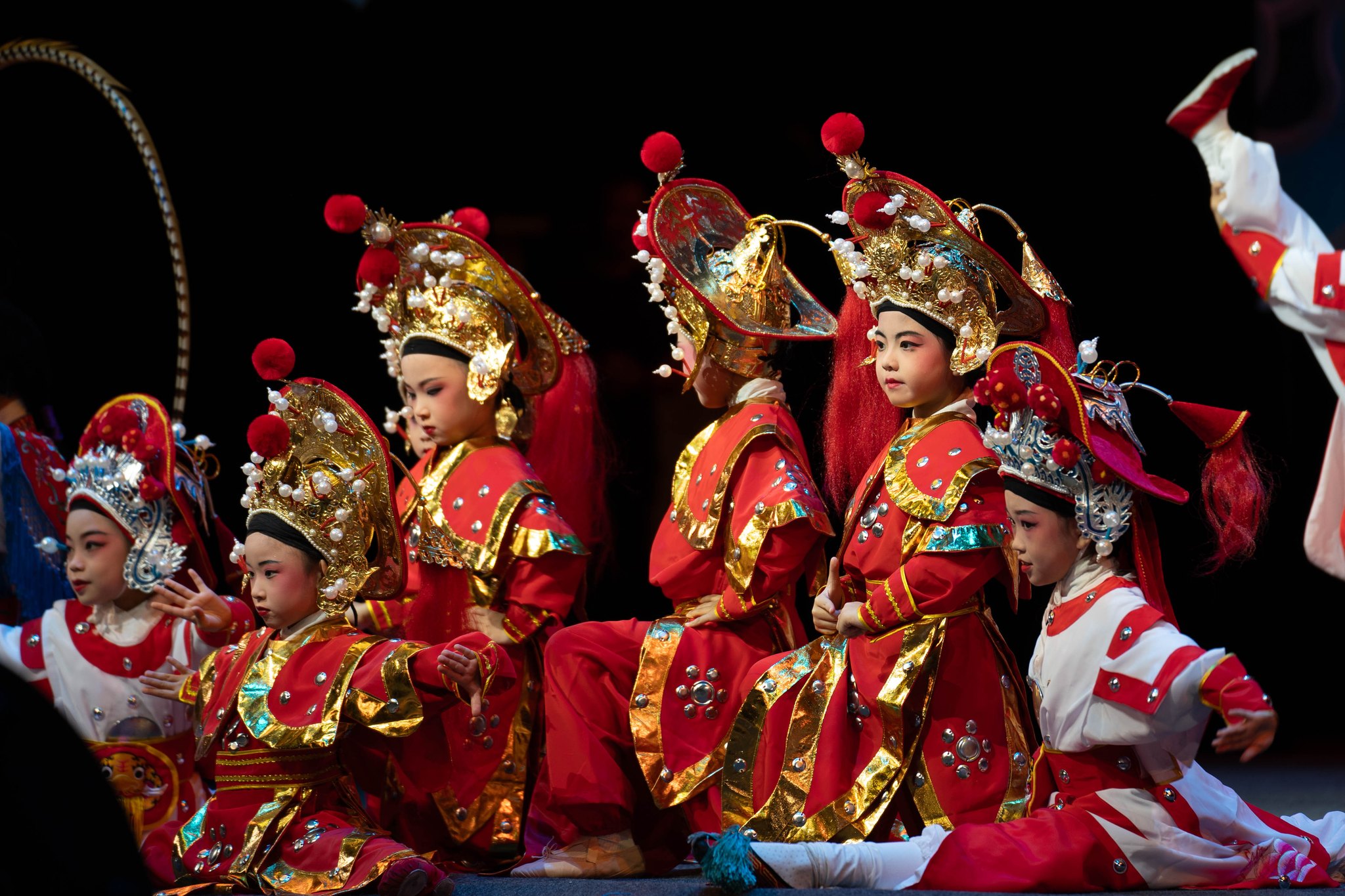
Huangmei opera, originally called “Huangmei tune” or “tea-picking opera”, is one of the youngest genres of traditional Chinese opera. It originated in Huangmei county in Hubei, China, and flourished in the Anqing region of Anhui province. Compared with other forms of Chinese opera, Huangmei opera music is exceptionally popular in China, with simple, flowing melodies that are easy to learn, as well as lively, distinctive, and highly expressive rhythms. It is hailed as one of the five major opera genres in China, along with Peking opera, yue opera, ping opera, and yu opera.
In 1955, the Huangmei opera film Married to a Heavenly Immortal was first screened in Singapore. Its tunes quickly swept across the island, catching on with young people. The genre’s unprecedented popularity marked the beginning of the spread of Huangmei opera in Singapore.
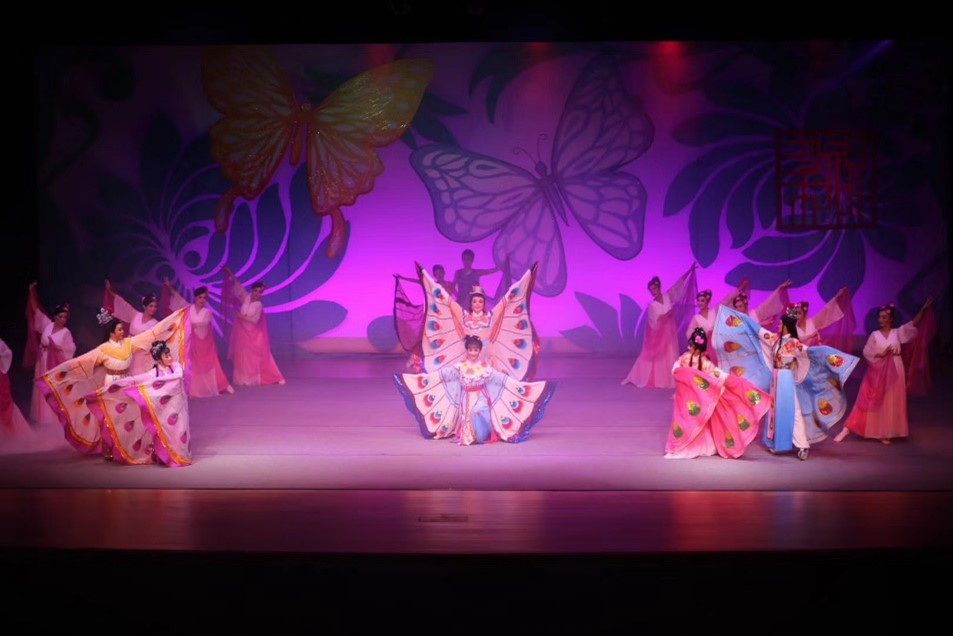
In April 1994, the Anhui Huangmei Opera Theatre was invited by the Singapore Chinese Chamber of Commerce & Industry to participate in the Singapore Chinese Opera Festival, performing plays such as Married to a Heavenly Immortal, Dream of the Red Chamber, Female Prince-Consort, and The Butterfly Lovers. These vivid folk tales drew even more audiences to Huangmei opera.
Popularisation of Huangmei opera
Traditional Chinese opera genres in Singapore mainly include Cantonese opera, Teochew opera, Hokkien opera, Hainanese qiong opera, Peking opera, Shanghai yue opera, and Huangmei opera. With the exception of Huangmei opera, all these genres are supported by dedicated associations or organisations responsible for their promotion and performance. Despite that, Huangmei opera has benefitted from the sustained efforts of various arts organisations which have actively promoted the art form through Chinese opera education in schools and community outreach programmes, securing its place as one of the seven major Chinese opera genres in Singapore.
The main driving forces behind the development of Huangmei opera in Singapore include the Singapore Chinese Opera Institute, the Traditional Arts Centre (Singapore), and Bukit Panjang Government High School. These organisations have promoted knowledge of traditional Chinese opera, nurtured new generations of Huangmei opera audiences and performers, and developed Huangmei opera plays with distinctive local characteristics to foster cross-cultural exchange. Since their establishment, the Singapore Chinese Opera Institute (1995) and the Traditional Arts Centre (2012) have actively engaged in opera arts education through demonstration lectures, performance appreciation sessions, and workshops in over 100 schools. Their professional Huangmei opera courses have also cultivated a pool of talented performers. Additionally, the Youth Opera Showcase hosted by the Singapore Chinese Opera Institute since 2000 and the Singapore Youth Opera Showcase organised annually by the Traditional Arts Centre since 2013, have become key platforms for Huangmei opera performances in Singapore.
Huangmei opera in schools
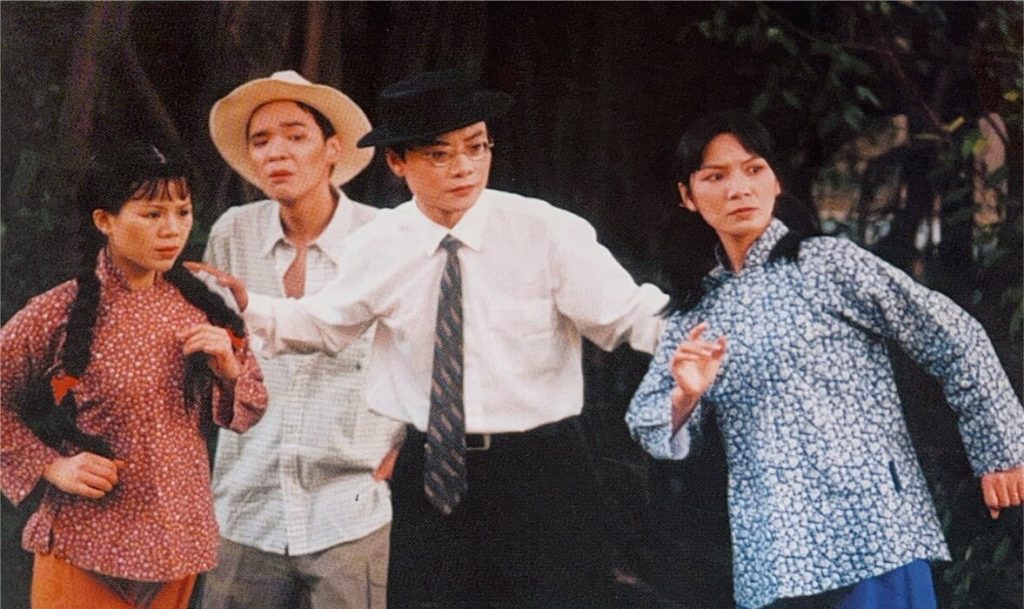
Since 2003, Bukit Panjang Government High School has regularly held Huangmei opera co-curricular activities and performances. Every two years, the school stages large-scale Huangmei opera performances on campus and invites local professional opera instructors to provide on-site guidance. From vocal techniques to body movements, and from directing to set design, each production is jointly produced by teachers and students.
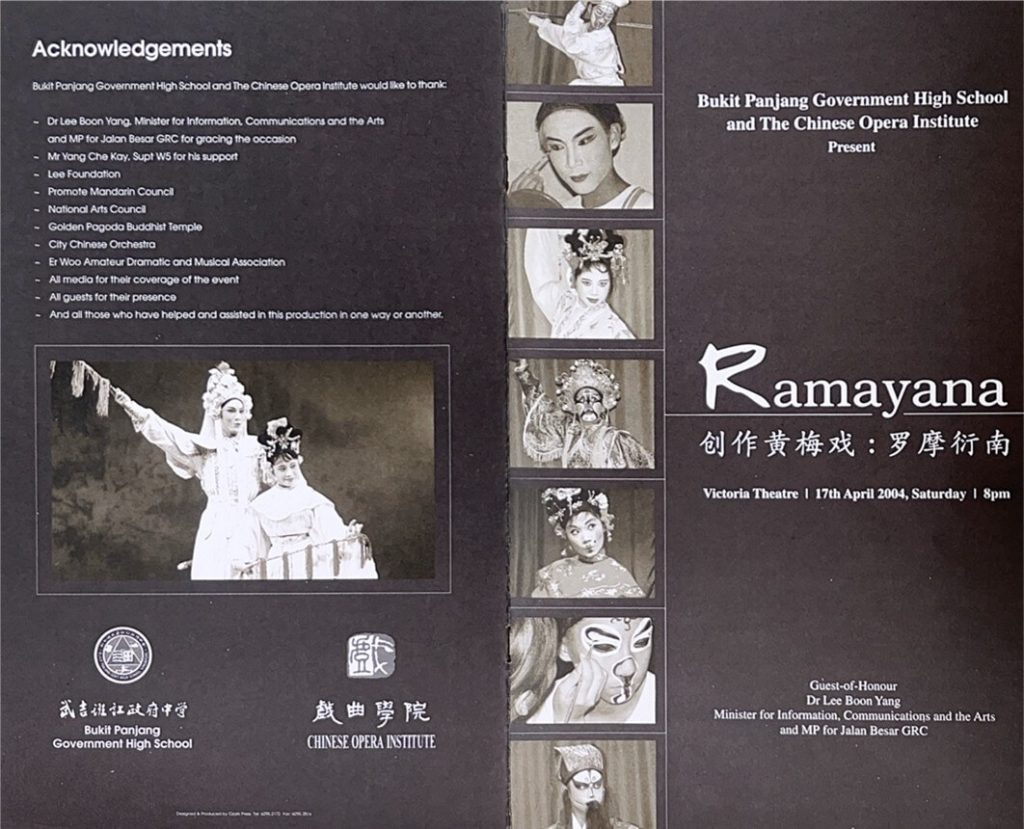
The school also participates in international exchanges related to Huangmei opera. In 1999, it collaborated with the Singapore Chinese Opera Institute to adapt the Indian epic Ramayana into a Huangmei opera, allowing students to engage in cross-cultural exchange. The production was staged overseas as well, including in Thailand and India.
Local innovations
Huangmei opera in Singapore has undergone significant transformation and developed new, distinctive features. Most contemporary productions use Mandarin instead of the traditional Anqing dialect, and tell local stories with Nanyang roots against a multicultural backdrop. In 2006, Zheng He, created by the Singapore Chinese Opera Institute, was jointly staged by Beatty Secondary School, Beatty Primary School, and Chong Boon Secondary School. Centred on the seven voyages of Ming dynasty explorer Zheng He (1371–1433) to the Western Seas, the production incorporated Chinese, Malay, and Indian dances and languages to portray the diverse regions and cultures that Zheng He encountered.
Among Singapore’s many innovative productions, Heroes (2000) is considered the most successful localised adaptation. Based on historical events in Singapore during World War II, the play depicted Singapore’s resistance against the Japanese invasion through 21 Huangmei opera songs. It premiered at the Chinese Culture Festival that year, and was later invited to participate in the Hubei Huangmei Opera Art Festival in China in October.
Another notable local production Ramayana, was adapted from the eponymous Indian epic and narrates the legendary tales of Prince Rama’s apprenticeship and spiritual journey. The opera integrated diverse theatrical elements, including martial arts and chanting, with a vocal style co-developed by the Singapore Chinese Opera Institute and the Hubei Huangmei Drama Theatre in China. It was also staged at Thailand’s National Theatre in 1999 and 2002. A student version was later performed by students from Guangyang Primary School, CHIJ Secondary (Toa Payoh), and others at international arts festivals in Italy and Indonesia. The year 2000 marked a particularly significant milestone, when the Indian Council for Cultural Relations invited the production to perform in India — the birthplace of Ramayana — showcasing Singapore’s Chinese opera on the world stage.
New Huangmei operas
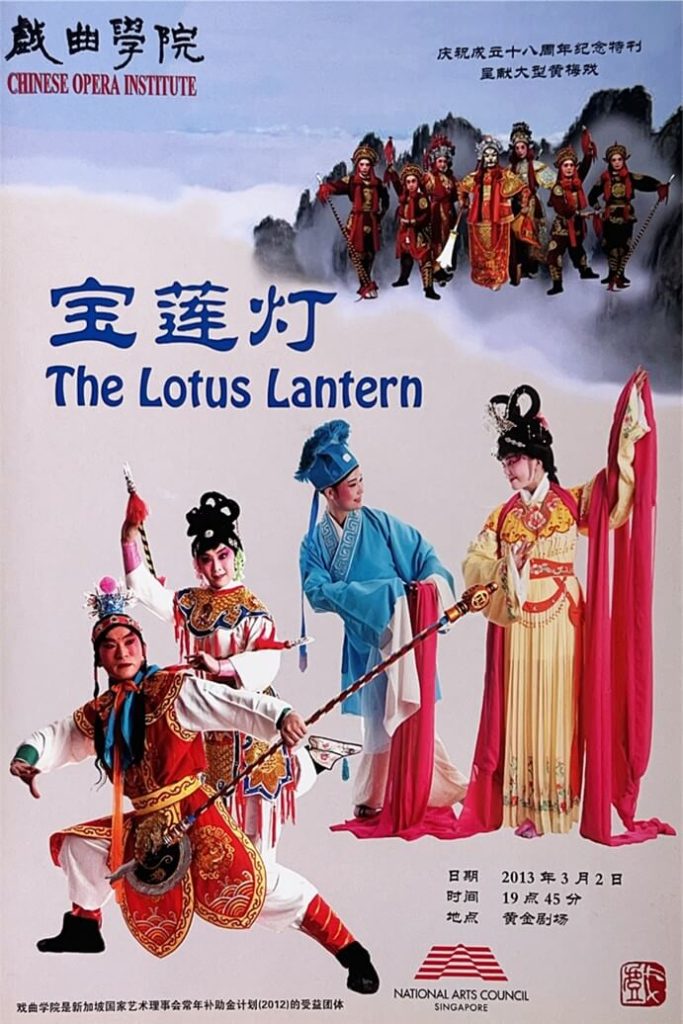
In 2013, the Singapore Chinese Opera Institute presented the innovative Huangmei opera The Lotus Lantern at the Golden Theatre. Breaking with tradition, the production featured modern stage designs and specially invited a professional team to compose new melodies and accompaniment — key efforts at innovating Huangmei opera productions.
In addition, the educational Huangmei opera The Monkey King: Three Battles with the White Bone Demon created by the Traditional Arts Centre with funding from the National Arts Council, was specifically designed for youths in Singapore. Adapted by the centre’s founder Cai Bixia, the opera retained the artistic essence of traditional Huangmei opera while incorporating local elements such as Malay folk songs. With its digestible dialogue and interactive format, the production has become a classic play for introducing Huangmei opera to schools.
Local organisations such as Nam Hwa Opera, Re Xin Opera Association, Star Word Artistry Studio, along with other dedicated individuals, have also played an active role in promoting Huangmei opera in Singapore. Although there is currently no local opera troupe dedicated to Huangmei opera here, these efforts have made remarkable strides in promoting, localising, teaching, and innovating the art form in Singapore.
This is an edited and translated version of 黄梅戏在新加坡. Click here to read original piece.
Bai, Gengsheng. Huangmei xi [Huangmei opera]. Beijing: China Wenlian Press, 2008. | |
Chua, Soo Peng. “Yindu shishi luomo yanna de huawen yanyi” [Chinese adaptation of the Indian epic Ramayana]. Yuan Magazine 161 (2023). | |
Lin, Meiling. “Wuzhong xuesheng yanyi qingchun ban huangmei xi baishe zhuan” [Bukit Panjang Government High School students perform a youth edition of Huangmei opera, Legend of the White Snake]. Lianhe Zaobao, 1 May 2004. | |
Shi, Bailin. Huangmei xi changqiang shangxi [Appreciation and analysis of Huangmei opera vocal techniques]. Shanghai: Shanghai Music Publishing House, 2013. | |
Wang, Yiming. “Kuajie xiju, chongwen jingdian” [Cross-genre theatre: Reimagining a classic]. Lianhe Zaobao, 10 June 2022. |